• Tag Archives commodore
  • Commodore The MicroComputer Magazine, June 1983

    Commodore: The MicroComputer Magazine, June 1983

    In 1983, Commodore published two magazines. Commodore the MicroComputer Magazine was the productivity oriented title and in 1983 it was covering the Commodore 64, VIC-20 and PET line of computers.

    The June 1983 issue includes:

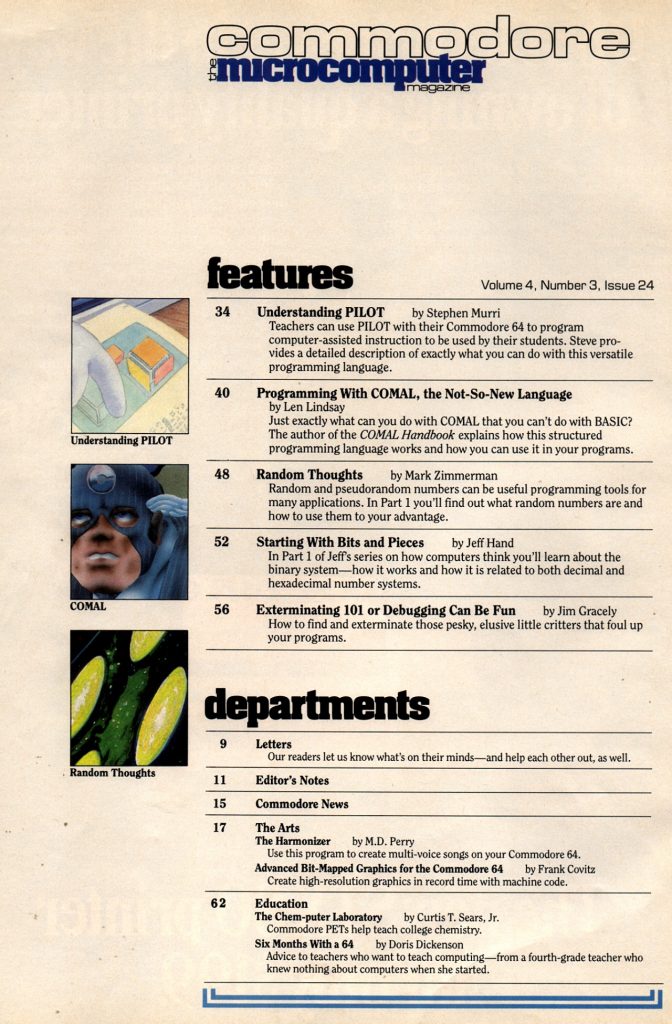
    Features

    • Understanding PILOT – This article gives an overview of PILOT, a programming language that was used for a while in education settings.
    • Programming With COMAL – COMAL was an early structured programming language and pretty old even then but still used. This article gives an overview with an emphasis on how it is better than BASIC.
    • Random Thoughts – Part 1 of a series on random numbers. This series starts off by explaining what random and pseudorandom numbers are and showing how you can generate them in BASIC.
    • Starting With Bits and Pieces – Part 1 of a series on binary. This part shows how the binary number system is related to decimal and hexadecimal including how to convert between them.
    • Exterminating 101 or Debugging Can Be Fun – A guide to debugging in BASIC, including syntax errors, procedural errors, analytical errors and using STOP and PRINT statements for debugging.
    Departments

    • Letters – Letters from readers about finding prime numbers, Word Machine, and more.
    • Editor’s Notes – An editorial on reducing programming frustration. It includes mention of the debugging article in this magazine, user groups and more.
    • Commodore News – Commodore headquarters moves from Wayne to West Chester, Pennsylvania (about 10 miles away); Commodore forms new software division; Commodore starts shipping “B” series business computers – 8 different models are listed, all based on a 6509 processor, some also include an 8088, some offer an optional 8088 and all offer an optional Z80…all also come with 128KB or 256KB of RAM.
    • The Arts
      • The Harmonizer – Type-in program for creating music on the Commodore 64.
      • Advanced Bit-Mapped Graphics for the Commodore 64 – Part 1 of a series. This is a tutorial and sample programs for manipulating graphics on the Commodore 64, including how to manipulate specific pixels, how to clear the screen, how to draw lines, how to link machine language graphics routines from BASIC, and more.
    • Education
      • The Chem-puter Laboratory – Georgia State University is using Commodore PETs to help teach college chemistry classes.
      • Six Months with a 64 – A fourth grade teacher relates here experience with a Commodore 64 in the classroom.
      • Multi-Purpose CBMs Keep Student Interest High – An Illinois high school creates a computer laboratory with Commodore 8032 computers for typing classes, programming classes, and agricultural classes.
      • You and Your Computer Part 5 – Color Me Purple – Using color control keys and the POKE command to program in color on the Commodore 64.
      • Parent Computer Power – Parents help teach computer skills on Commodore 4032s at Michigan elementary school.
      • Microcomputers: Truly Child’s Play – Kinder-Care Learning Centers use Commodore PETs with voice to teach kids computer skills.
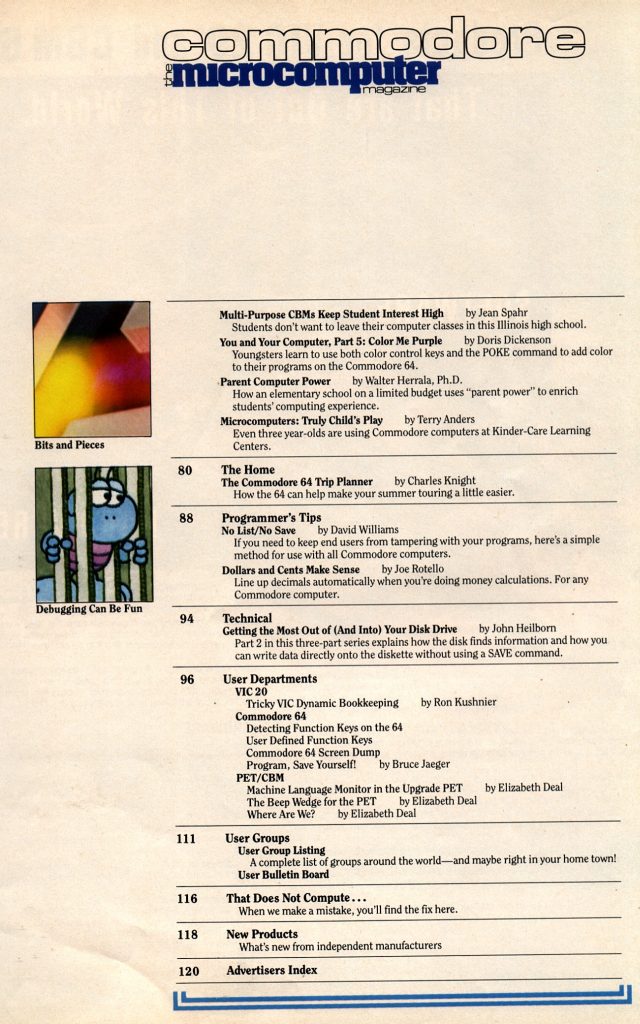
    • The Home: The Commodore 64 Trip Planner – Overview of a freely available program for the Commodore 64 that helps you plan trips by taking in inputs such as fuel stops, food stops, distance, etc.
    • Programmer’s Tips
      • No List/No Save – A method for protecting your software from users. It prevents listing and saving your programs.
      • Dollars and Cents Make Sense – A program for the Commodore 64 that will justify currency output so that the decimal always lines up.
    • Technical: Getting the Most Out of (And Into) Your Disk Drive – Part 2 of a three part series. Formatting disks, finding free space, writing to disk, disk data structure, and more.
    • User Departments
      • VIC 20
        • Tricky VIC Dynamic Bookkeeping – A bookkeeping program for the unexpanded VIC-20.
      • Commodore 64
        • Detecting Function Keys on the 64 – Using function keys in your own programs.
        • User Defined Function Keys – A program that let you make function keys print anything you want.
        • Commodore 64 Screen Dump – A program to dump the current screen to a 1525 printer.
        • Program, Save Yourself! – A type-in utility that makes it easier to save programs you are writing in an easier way.
      • PET/CBM
        • Machine Language Monitor in the Upgrade PET – An overview of the differences in the Machine Language Monitor in upgraded PETs.
        • The Beep Wedge for the PET – A program to make your PET sound like the computers on TV.
        • Where Are We? – Several ways to determine where in memory a program is executing.
    • User Groups – User group listing and a list of a few Bulletin Boards.
    • New Products – Federal Individual Tax Preparation Program (Commodore 64), Mailing List (VIC-20), Numeric Keypad (VIC-20), Math Escape (VIC-20), Sea Word (VIC-20), Birthday Card (VIC-20), Story Time (VIC-20), Utility File (VIC-20), Micron Eye vision system (Commodore 64), Datalog (Commodore 64), BUSSter A64 Digital Input Module, and more.

    …and more!
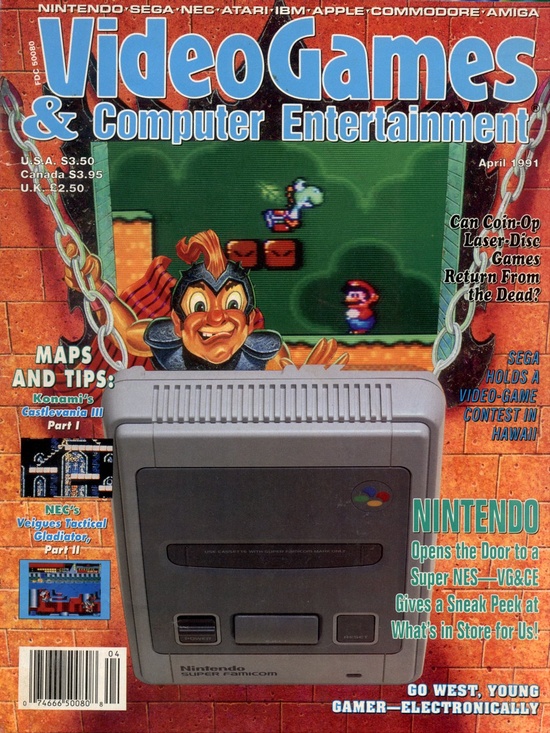

  • VideoGames & Computer Entertainment, April 1991

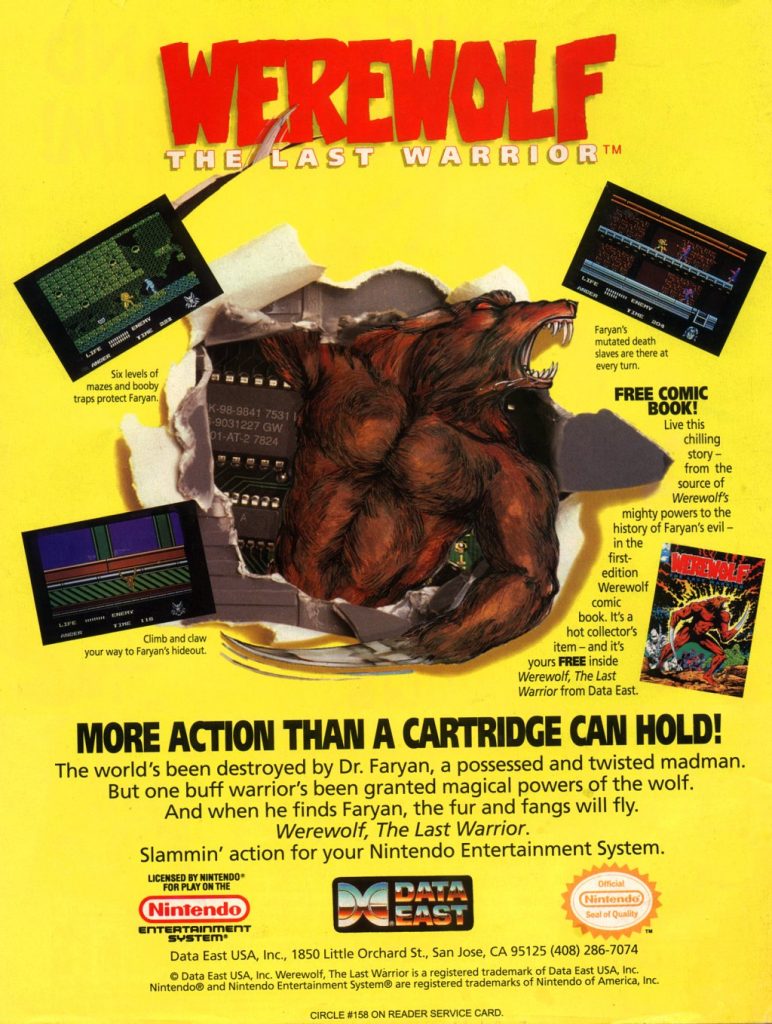
    VideoGames & Computer Entertainment, April 1991

    Retro Gaming / VideoGames & Computer Entertainment, April 1991 - #Nintendo #NES #Sega #SNES #Genesis #NEC #TG16 #Commodore #C64 #Amiga #IBM #Atari - https://www.megalextoria.com/magazines/index.php?twg_album=Video_Game_Magazines%2FVGCE%2Fvgce_91-04_show=vgce_1991-04_001.jpg

    VideoGames & Computer Entertainment was published from 1988 until 1993 before becoming VideoGames and ultimately morphing into Tips & Tricks.

    The April 1991 issue includes the following:

    Features

    • Under the Hood of the Super Famicom, Part 1 – The first part in a series of articles detailing the new Super Famicom. This part discusses the controllers, CPU, graphics capabilities and more.
    • Sega Champs Square Off In (Not-So-) Sunny Hawaii – Coverage of the Sega Genesis World Championship finals. Games involved included Shadow Dancer, Mickey Mouse in the Castle of Illusion, and Joe Montanna Football. The prize was a new Eagle Talon worth $18,000. This just makes me nostalgic for when you could get a new car for $18k…
    • Veigues Tactical Gladiators Strategy Guide, Part II – The second half of a strategy guide for this sci-fi shooter.
    • Games Beyond Tomorrow – An overview of recent sci-fi related gaming releases. Games mentioned include Dash Galaxy in the Alien Asylum (NES), Target Earth (Genesis), Final Zone (Genesis), Day of the Viper (PC, Amiga, Atari ST), The Adventures of Rad Gravity (NES), Atomic Robo Kid (NES), Thexder 2 (Amiga, PC), Hybris (Amiga), Battle Squadron (Amiga), Stellar 7 (PC), Skate Wars (Commodore 64), DeathTrack (PC), Galaxy 5000 (NES), A Boy and His Blob (NES), The Rescue of Princess Blobette (Game Boy), Beyond the Black Hole (PC), Arkanoid (various), Total Recall (NES), Back to the Future Parts II & III (NES), Countdown to Doomsday (Amiga, PC), Countdown to Doomsday (Amiga, PC), MegaTraveller 1 (PC), Full Metal Planet (PC, Amiga), Space 1889 (PC), Circuit’s Edge (Amiga, PC), Star Wars (Commodore 64), BattleTech: The Crescent Hawks’ Inception (PC, Amiga, Apple II, Atari ST, Commodore 64), MechWarrior (PC), Wing Commander (PC), Universe III (Amiga, Atari ST, PC), Star Trek: The Kobayashi Alternative (Apple, Commodore 64, PC), Star Trek: First Contact (Apple II, Commodore 64, PC), The Promethean Prophecy (Apple, Commodore 64, PC), Star Trek V: The Final Frontier (Amiga, PC), Altered Destiny (Amiga, PC), Space Quest III and Space Quest IV (Amiga, PC), Chamber of the Sci-Mutant Priestess (Amiga, PC), Quasar (Amiga), Star Control (PC), Reach for the Stars (Apple II, Apple IIgs, Commodore 64, PC, Macintosh), Stellar Crusade (Amiga, Atari ST, PC), Granada (Genesis), and more.
    • Castlevania III Players Guide, Part I – Part 1 of a detailed strategy guide for Castlevania III for the NES.
    • Winning the West with Games – Games all about exploring and conquering the wild West. Games covered include Galleons of Glory (PC), Gold of the Americas (Amiga, Atari ST, PC), Billy the Kid (Amiga, Atari ST, PC), Gold Rush (PC), The Lost Dutchman Mine (Amiga, Atari ST, PC), Colorado (Genesis), Western Games (Amiga, Atari ST, Commodore 64), Buffalo Bill’s Wild West Show and Rodeo (Amiga, Atari ST, Commodore 64, PC), and more.

    Departments

    • Editor’s Letter – What to expect of reviews in VG&CE.
    • Reader Mail – Comments and questions about Genesis vs. TurboGrafx-16 sales, reviewers, beta testing games, and more.
    • Tip Sheet – How to get past Mission 6 in Double Dragon II, finding Magneto’s lair in X-Men, and defeating the end boss in Blaster Master.
    • News Bits – Commodore introduces the CDTV, Broderbund releases Sport Simulated Boxing and Sport Simulated Tennis, Nintendo announces 1990 sales figures…there were 7.2 million Nintendo Entertainment Systems sold which was increase of 27% over the previous year, Nintendo announces various Super NES and Game Boy peripherals, Taxan spends big on advertising G.I. Joe game, Atari drops price of the Lynx to $99.95, Accolade releases hint book for Elvira, and more.
    • Easter Egg Hunt – Secret tricks and codes for TV Sports Football (TG-16), Mega Man 3 (NES), Buster Douglas Knockout Boxing (Genesis), Thunder Force III (Genesis), Teenage Mutant Ninja Turtles: Fall of the Foot Clan (Game Boy), and Lock ‘n’ Chase (Game Boy).
    • Destination Arcadia – A look at Mad Dog McCree plus VG&CE’s picks for the best arcade games of the years. Games picked include Teenage Mutant Ninja Turtles, Air Inferno, Four Trax, F-15 Strike Eagle, Mercs, Pigskin 621 A.D., and Diner (pinball).
    • Gaming on the Go – A look at some of the latest games for portable systems including Zarlor Mercenary (Atari Lynx), Robo-Squash (Atari Lynx), Rampage (Atari Lynx), and Shanghai (Atari Lynx).
    • Inside Gaming – Focusing on games for adults.
    • Game Doctor – Questions answered about Mega Drive and Genesis compatibility, 3D gaming, choosing a sound card for a PC, game saving via passwords on TurboGrafx-16 games, game expense in Europe, and more.
    • Fandango – A look at recent fanzines including cyberBeat #1 and the December 1990 issue of Arena.

    Reviews

    • Video-Game Reviews
      • Totally Rad – A decent platform game for the NES.
      • The Adventures of Lolo III – A save the princess adventure game for the NES. If you liked the previous two Lolo games then you would probably like this one.
      • Basewars – Playing baseball with robots on the NES.
      • Sword Master – A pretty generic beat-em-up for the NES.
      • Fatal Labyrinth – An ok RPG for the Genesis but without much of a storyline.
      • MegalStorm – A sci-fi themed platform game by Irem for the NES.
      • RoboCop 2 – A pretty good platform game for a licensed game and a lot like the original Robocop arcade. For the NES.
      • Metal Mech – A sci-fi platform game in which you control a mech. For the NES.
      • Powerball – A futuristic sports game for the Genesis.
    • Computer-Game Reviews
      • Stratego – A computerized version of the board game for the PC and Macintosh.
      • Stellar 7 – A remake of the original for the Amiga and PC.
      • Dragon’s Lair II – A conversion of the laser disc arcade game for the Amiga.
      • Imperium – A sci-fi strategy game for the Amiga, Atari ST and PC.
      • The Secret of Monkey Island – The classic adventure game for the Amiga, Atari ST and PC.
      • Command HQ – A strategy war game featuring five scenarios from 1918 to the near future for the PC.
      • BattleTech: The Crescent Hawks’ Revenge – A strategy game set in the BattleTech universe for the Amiga and PC.
      • Buck Rogers: Countdown to Doomsday – Sci-Fi themed RPG that uses the same engine as the Gold Box AD&D games for the Amiga, Commodore 64, and PC.
      • Shadow of the Beast II – Graphically impressive beat-em-up for the Amiga.
    • Computer Game Strategies
      • The Immortal – Staying alive in this isometric adventure game for the Amiga, Apple IIGS and Atari ST.
      • Chamber of the Sci-Mutant Priestess – Strategy guide for this humorous sci-fi action/adventure game for the Amiga and PC.

    …and more!


  • Amiga World, Premiere Issue, 1985

    Amiga World, Premiere Issue, 1985

    Pictured above is the premiere issue of Amiga World. For the first couple of years, the Amiga 1000 was the only Amiga model available. Contents of this issue include:

    Features

    • A First Look at the Amiga – A detailed look at the new Amiga (Amiga 1000) computer from Commodore. Features include a 68000 CPU, custom chips for graphics and sound, 256K of RAM easily expandable to 512K, a built-in 3.5-inch 880K disk drive, and much more.
    • What If… – All about what the Amiga can do that other computers can’t.
    • Amazing Graphics – An overview of Amiga graphics capabilities including the various resolution/available colors combinations, sprites, and more.

    Articles

    • Stimulating Simulations: Electronic Arts Gets Involved with Amiga – A look at the work that Electronic Arts is doing for the Amiga, including titles such as Archon, One-on-One, Seven Cities of Gold, Skyfox, and Starflight. Also, a look at the various people involved, including an interview with Trip Hawkins.
    • Sounds Like – A look at Harmony, a computerized accompaniment program developed using AI and speech recognition techniques.
    • A Peek at the 68000 – The history and capabilities of the CPU chosen to be at the heart of the Amiga, the 68000.
    • The Amiga as a Teaching Tool – Various ways in which the Amiga can be used as an educational device.

    Columns

    • Avision – Praise for the Amiga and the origins of Amiga World.
    • Zeitgeist – More about the genesis of Amiga World and how it was put together.
    • Amiga Solutions – A cynic takes a look at the Amiga and compares it to the Macintosh and IBM PC.

    Departments

    • Digital Canvas – A look at some impressive artwork created with the Amiga.
    • Help Key – Questions answered about the Amiga’s memory capacity, connecting additional disk drives, the keyboard, modem compatibility, Amiga ports, and more.
    • List of Software – A summary of currently available software and software coming soon for the Amiga. As a brand new machine there are only a couple dozen so far.
    • Coming Next Issue – Using the Amiga in a business environment, Telecommunications, Behind the Scenes at Commodore Amiga, What is MIDI?, and more.