
Compute! was one of the most popular multi-format computer magazines of the 1980s. In 1987 it was covering the Apple II, Atari 8-bit, Atari ST, Commodore 64, PC, Amiga, and maybe others. The September 1987 issue includes:
Features
- Computers in the Classroom: Ten Years and Counting – A look back at the history of computers in the classroom and what lies ahead.
- Computer Learning Month: An Enthusiastic Start – October 1987 was to be the first computer learnig month featuring a wide variety of contests, meetings, and other events across the country highlighting computers in education.
- Monte Carlo – A type-in solitaire card game in BASIC for the Commodore 64, IBM PC, Apple II, Amiga, Atari ST, and Atari 8-bit computers.
- I Didn’t Know You Could Do That with a Computer! – A look at what computers can do and the software available to do it that goes beyond typical wordprocessing and spreadsheet tasks. Software is mentioned here for genealogy, career management, designing houses, gaming, health and fitness, and more.
Reviews
- ProWrite for the Amiga – A word processing application with graphics capabilities.
- Tornado Notes – A memory resident note taking program for the IBM PC.
- Warship – A naval combat strategy game from SSI for the Commodore 64, Apple II, and Atari 8-bit.
- PHM Pegasus – A game in which you command a NATO hydrofoil for the Apple II and Commodore 64.
- Create a Calendar – A calendar creation program from Epyx for the Commodore 64, Apple II, and IBM PC.

Columns and Departments
- The Editor’s Notes – Results of a recent survey indicate that the most popular programming languages among programmers are BASIC, Fortran, C, and Pascal.
- Readers’ Feedback – Letters from readers about text color on the PC, printing with a serial printer using SpeedScript on the Commodore 64, creating an adventure game on the Atari 800XL, programming reference books for the Atari ST, and more.
- The Beginner’s Page: Interactive Programming – Creating programs in BASIC that rely on user input.
- The World Inside the Computer: Music, Video, and FOR-NEXT Loops – A look at the classroom of the future.
- Microscope: The Micros Market Gets Serious – The disappearing distinction betweeh “home computers” and “business computers”.
- Telecomputing Today: Just When You Though It Was Safe – The FCC adds surcharges for phone line computer use, Worldport display prototype of 2400bps pocket sized modem, Tymnet increases prices, and more.
- Computers and Society: The Classroom Computer – A Tool For Teachers – Computers as a tool for teachers.
- INSIGHT: Atari – Machine Langauge Graphics – A tutorial for creating graphics using machine language on Atari 8-bit machines.
- ST Outlook: One Last Bug – A look at one of the worst BASIC bugs of all time.
- IBM Personal Computing: Create a Blues Symphony – A look at The Music Feature, a high quality music synthesizer on a full-lenth expansion card for the IBM PC XT, AT, and PS/2 Model 30.
- AmigaView: The Great Amiga Reboot – Commodore releases the new and lower cost Amiga 500.
The Journal
- Smart Alec – A machine language program for the Commodore 64 that simulates human thinking.
- QuickChange: Easy Color Setting for the IBM PC/jr – A program for the PC and PCjr that allows you to easily customize border, background, and forground colors.
- Atari BASIC Search and Destroy – A type-in program for the Atari 8-bit that will allow you to search a BASIC program for any string of characters.
- Audio Recorder for Apple II – A type-in program for the Apple II that will allow you to add digitally recorded sound and music to your own programs.
- Amiga SuperMenus – A type-in program that enhances Amiga BASIC’s MENU command.
- Atari XL/XE Hidden RAM – A way to access the 8K of RAM under BASIC ROMs on Atari XL and XE computers.
- Amiga and 64 Ramdisk Files – Examples for creating RAMdisks on the Amiga and the Commodore 64 with 1764 RAM expansion module.
- Applesoft Line Lister – A short type-in utility that simplifies BASIC program listings on the Apple II.
- 64+ – A type-in utility for the Commodore 64 that adds new commands that make editing and programming easier.

…and more!


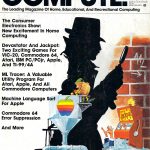 Compute! (August 1984)

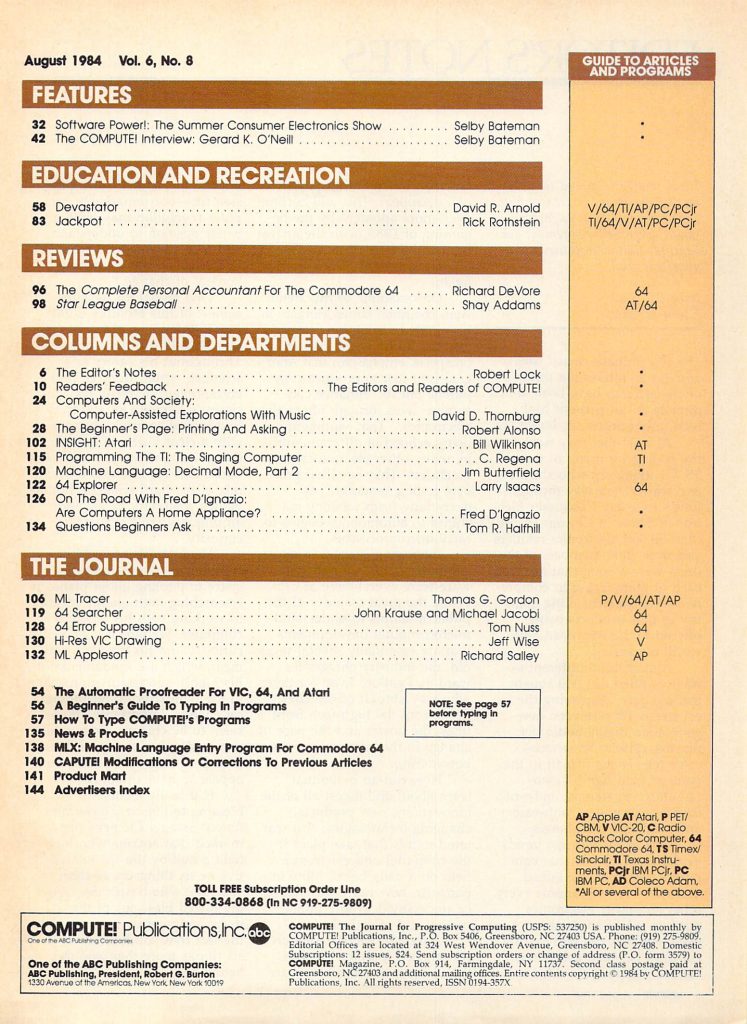
 Compute! (September 1987)
