• Tag Archives Atari 8-bit
  • Compute! (September 1987)

    Compute! was one of the most popular multi-format computer magazines of the 1980s. In 1987 it was covering the Apple II, Atari 8-bit, Atari ST, Commodore 64, PC, Amiga, and maybe others. The September 1987 issue includes:

    Features

    • Computers in the Classroom: Ten Years and Counting – A look back at the history of computers in the classroom and what lies ahead.
    • Computer Learning Month: An Enthusiastic Start – October 1987 was to be the first computer learnig month featuring a wide variety of contests, meetings, and other events across the country highlighting computers in education.
    • Monte Carlo – A type-in solitaire card game in BASIC for the Commodore 64, IBM PC, Apple II, Amiga, Atari ST, and Atari 8-bit computers.
    • I Didn’t Know You Could Do That with a Computer! – A look at what computers can do and the software available to do it that goes beyond typical wordprocessing and spreadsheet tasks. Software is mentioned here for genealogy, career management, designing houses, gaming, health and fitness, and more.

    Reviews

    • ProWrite for the Amiga – A word processing application with graphics capabilities.
    • Tornado Notes – A memory resident note taking program for the IBM PC.
    • Warship – A naval combat strategy game from SSI for the Commodore 64, Apple II, and Atari 8-bit.
    • PHM Pegasus – A game in which you command a NATO hydrofoil for the Apple II and Commodore 64.
    • Create a Calendar – A calendar creation program from Epyx for the Commodore 64, Apple II, and IBM PC.

    Columns and Departments

    • The Editor’s Notes – Results of a recent survey indicate that the most popular programming languages among programmers are BASIC, Fortran, C, and Pascal.
    • Readers’ Feedback – Letters from readers about text color on the PC, printing with a serial printer using SpeedScript on the Commodore 64, creating an adventure game on the Atari 800XL, programming reference books for the Atari ST, and more.
    • The Beginner’s Page: Interactive Programming – Creating programs in BASIC that rely on user input.
    • The World Inside the Computer: Music, Video, and FOR-NEXT Loops – A look at the classroom of the future.
    • Microscope: The Micros Market Gets Serious – The disappearing distinction betweeh “home computers” and “business computers”.
    • Telecomputing Today: Just When You Though It Was Safe – The FCC adds surcharges for phone line computer use, Worldport display prototype of 2400bps pocket sized modem, Tymnet increases prices, and more.
    • Computers and Society: The Classroom Computer – A Tool For Teachers – Computers as a tool for teachers.
    • INSIGHT: Atari – Machine Langauge Graphics – A tutorial for creating graphics using machine language on Atari 8-bit machines.
    • ST Outlook: One Last Bug – A look at one of the worst BASIC bugs of all time.
    • IBM Personal Computing: Create a Blues Symphony – A look at The Music Feature, a high quality music synthesizer on a full-lenth expansion card for the IBM PC XT, AT, and PS/2 Model 30.
    • AmigaView: The Great Amiga Reboot – Commodore releases the new and lower cost Amiga 500.

    The Journal

    • Smart Alec – A machine language program for the Commodore 64 that simulates human thinking.
    • QuickChange: Easy Color Setting for the IBM PC/jr – A program for the PC and PCjr that allows you to easily customize border, background, and forground colors.
    • Atari BASIC Search and Destroy – A type-in program for the Atari 8-bit that will allow you to search a BASIC program for any string of characters.
    • Audio Recorder for Apple II – A type-in program for the Apple II that will allow you to add digitally recorded sound and music to your own programs.
    • Amiga SuperMenus – A type-in program that enhances Amiga BASIC’s MENU command.
    • Atari XL/XE Hidden RAM – A way to access the 8K of RAM under BASIC ROMs on Atari XL and XE computers.
    • Amiga and 64 Ramdisk Files – Examples for creating RAMdisks on the Amiga and the Commodore 64 with 1764 RAM expansion module.
    • Applesoft Line Lister – A short type-in utility that simplifies BASIC program listings on the Apple II.
    • 64+ – A type-in utility for the Commodore 64 that adds new commands that make editing and programming easier.

    …and more!


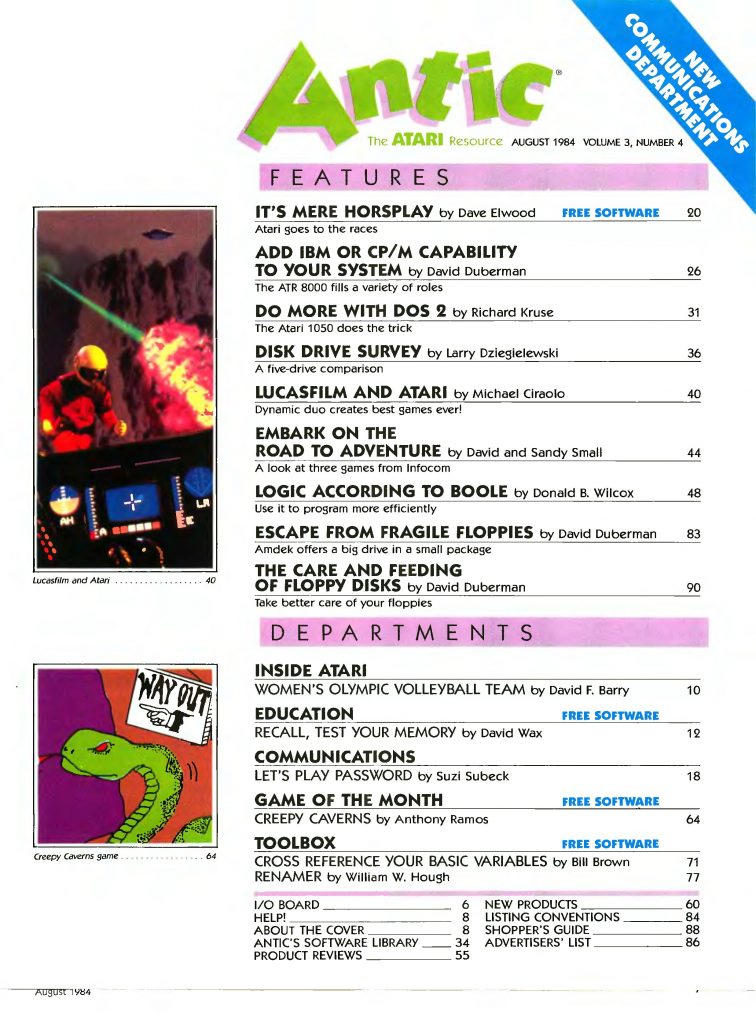
  • Antic (August 1984)

    Antic was one of the two major Atari 8-bit magazines in the U.S. (the other being ANALOG). Antic also had some coverage of the Atari ST though 1984 was before that. The August 1984 issue includes:

    Features

    • It’s Mere Horseplay – A type-in program for handicapping horse races.
    • Add IBM Or CP/M Capability To Your System – A look at the ATR8000, a versatile expansion for Atari 8-bit computers that adds the ability to connect standard disk drives and printers and depending on the variant, can also add CP/M or IBM PC compatability.
    • Do More With DOS 2 – Using DOS 2.0 to increase disk storage with the Atari 1050 disk drive.
    • Disk Drive Survey – A look at some of the disk drives available for the Atari 8-bit, including the TRAK AT-D2, RANA 1000, INDUS GT, Atari 1050, ASTRA 1620, and Atari 810.
    • Lucasfilm And Atari – Early Lucasfilm games came out first on the Atari 8-bit. These include Ballblazer and Rescue on Fractalus which are discussed here.
    • Embark On The Road To Adventure – A look at adventure games including Infocom’s Enchanter, Infidel, and Planetfall.
    • Logic According To Boole – Using Boolean logic in your programs.
    • Escape From Fragile Floppies – A look at the AMDC I and AMDC II, single and dual 3-inch floppy drive systems for the Atari 8-bit.
    • The Care And Feeding Of Floppy Disks – A guide to taking care of your floppy disks.

    Departments

    • Inside Atari – Atari’s sponsorship of the women’s Olympic volleyball team.
    • Education – A type-in memory game that gives you what is basically a computer version of Simon.
    • Communications – A look at password protected BBS’s. In the early days, you didn’t necessarily need a login and password to access a PC. Though obviously, having a unique account has its advantages and would become the norm.
    • Game of the Month – A type-in action/adventure game called Creepy Caverns. It looks a little like Gateway to Apshai.
    • Toolbox – A type-in tool for creating a variable cross-reference list for your programs. It gives you a list of variables and line numbers on which they appear.
    • Product Reviews – Reviews of the Aprom and Six Pack, Panzer-Jagd (Avalon Hill), Exodus: Ultima III (Origin), Safetyline (Maximus), Spare Change (Broderbund), BASIC Building Blocks, 810 Turbo, Dragonriders of Pern (Epyx), and Success With Math (CBS Software).
    • New Products – A brief look at new and upcoming products including Bruce Lee (Datasoft), C-221M and C-2215 disk drives, Pack It/Chain It, Relax (Synapse), Diskette Head Cleaning Kit, and more.

    …and more!


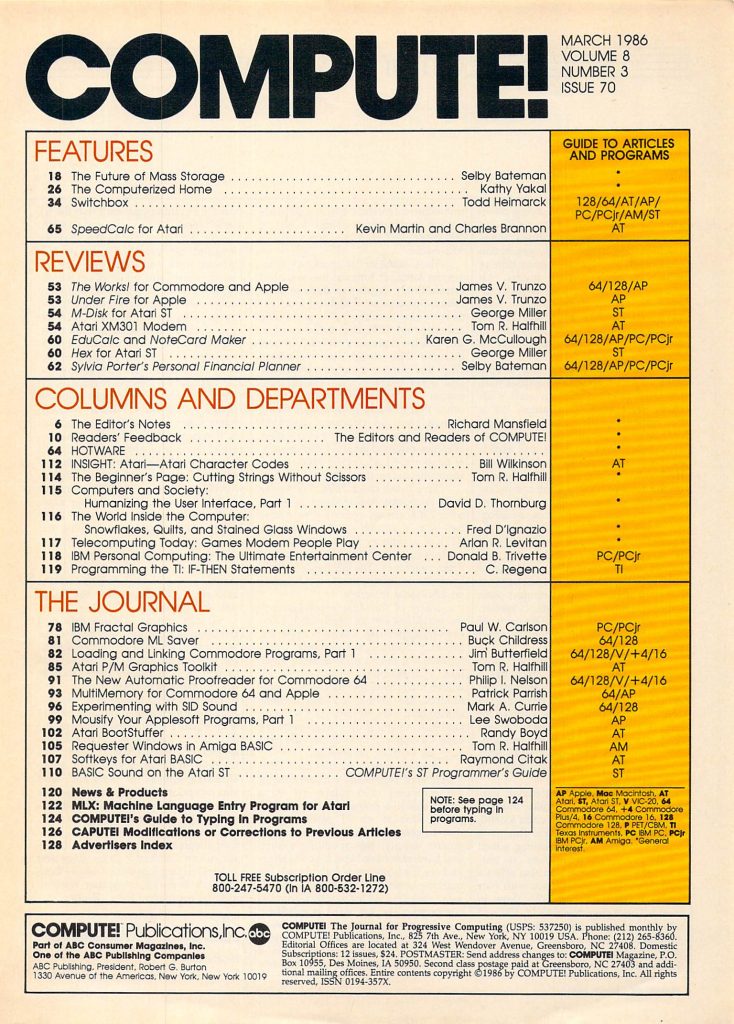
  • Compute! (March 1986)

    Source: Compute! – Issue Number 70 – March 1986

    Compute! was an excellent magazine that covered most popular computers of the time. I was partial to the spin-off Gazette because I had a Commodore 64 but this one was excellent as well. It was a little less technical that Byte but all magazines at the time were technical compared to today. The March 1986 issue includes:

    Features

    • The Future of Mass Storage – The future was bright for mass storage. 3.5″ floppies were replacing 5.25″ floppies, Hard drives were becoming affordable, and optical storage for the average user was on the horizon.
    • The Computerized Home – Computerized home automation was a thing long before Alexa. The X-10 interface was the de-facto standard and X-10 modules were available for pretty much any platform.
    • Switchbox – A type-in puzzle game with versions specifically for the Commodore 128, Commodore 64, Atari 8-bit, Atari ST, PC, and Amiga.
    • SpeedCalc for Atari – A type-in professional quality spreadsheet program for the Atari 8-bit.

    Reviews

    • The Works! – A software package for the Commodore 64 and Apple II that includes 13 programs in the categories of tools, organizers, arts, and learning.
    • Under Fire – A World War II strategy game for the Apple II.
    • M-Disk – Software for creating a RAM Disk on the Atari ST.
    • Atari XM301 Modem – A 300bps direct connect modem for Atari 8-bit computers.
    • EduCalc and NoteCard Maker – A combination of a simplified spreadsheet program and simplified database manager with versions for the Commodore 64, Apple II, and PC (Apple II version reviewed here).
    • Hex – A puzzle/strategy game for the Atari ST.
    • Sylvia Porter’s Personal Financial Planner – This software package includes six programs including Transaction Manager, Budget Manager, Asset/Liability Manager, Balance Sheet, and Financial Planner. The Commodore 64 version is reviewed here with versions also available for the PC and Apple II.

    Columns and Departments

    • The Editor’s Notes – A comparison of the new Amiga and Atari ST.
    • Readers’ Feedback – Letters from readers about code comments, computers for charity, recording music on the Amiga, and more.
    • HOTWARE – The top five selling software titles in three different categories. In the top places were F-15 Strike Eagle (Entertainment), Typing Tutor III (Education), and Print Shop (Home Management).
    • INSIGHT: Atari – A look at Atari character codes. Atari 8-bit computers used a variant of ASCII called ATASCII.
    • The Beginner’s Page: Cutting Strings Without Scissors – How to split strings in BASIC.
    • Computers and Society: Humanizing the User Interface, Part 1 – Exploring ways to make the user interface easier to use and more intuitive.
    • The World Inside the Computer: Snowflakes, Quilts, and Stained Glass Windows – Art on the Amiga.
    • Telecomputing Today Games Modern People Play – A look at online multiplayer gaming. At the time, that typically meant turn based gaming on BBS systems or services like CompuServe.
    • IBM Personal Computing: The Ultimate Entertainment Center – A guide for using your PC or PCjr with a TV.
    • Programming the TI: IF-THEN Statements – Using IF-THEN statements including examples for simulating AN/OR, doing Algebra, and more.
    • News & Products – Valhalla announced for the Commodore 64; MIDI Ensemble for the PC; AtariWriter and AtariWriter Plus word processors for the Atari ST; What’s Our Worth? home inventory package for the Commodore 64; and more.

    The Journal

    • IBM Fractal Graphics – Three type-in programs for creating fractals on the IBM PC and PCjr.
    • Commodore ML Saver – A type-in program for saving machine language programs directly from memory to disk on the Commodore 64.
    • Loading and Linking Commodore Programs, Part 1 – The first in a series of article on loading, chaining, and overlaying programs on Commodore computers.
    • Atari P/M Graphics Toolkit – Atari Player/Missile graphics is the Atari 8-bit version of sprites. This type-in toolkit makes it easier to develop and use P/M graphics on the Atari.
    • MultiMemory for Commodore 64 and Apple – Short type-in programs for the Commodore 64 and Apple II that allow you to segment memory for loading multiple BASIC programs.
    • Experimenting with SID Sound – Some examples for controlling the Commodore 64’s SID sound chip.
    • Mousify Your Applesoft Programs, Part 1 – The first of a two-part guide to using a mouse (or joystick or paddles) with your own programs.
    • Atari BootStuffer – This short type-in program for the Atari 8-bit allows you to create a menu system to load up to 8 different programs with one key press.
    • Requester Windows in Amiga BASIC – A guide to adding requester windows (dialog boxes) to Amiga BASIC programs.
    • Softkeys for Atari BASIC – This type-in program gives you automatic line numbering and various hotkeys when writing your own BASIC programs.
    • BASIC Sound on the Atari ST – A guide to getting started with creating basic sound effects on your Atari ST.

    …and more!