• Tag Archives Dreamcast
  • Official Sega Saturn Magazine (October 1998)

    Source: Official Sega Saturn Magazine – Issue Number 36 – October 1998

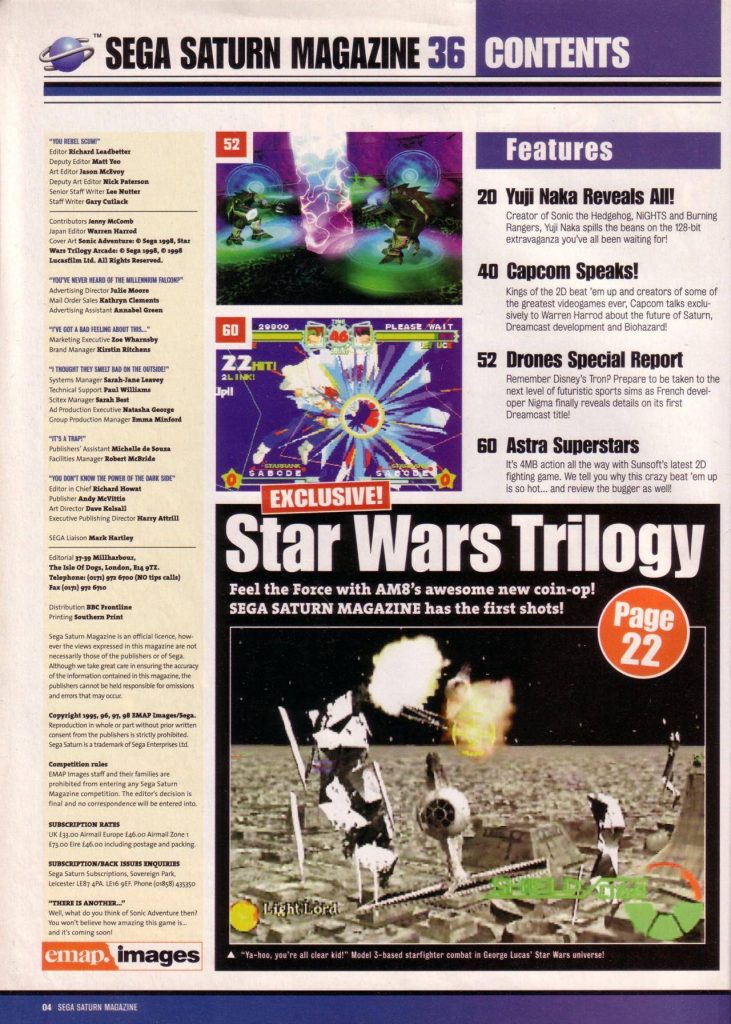
    This was the official Sega Saturn magazine in the U.K. I believe that the October 1998 issue was nearly the last issue and it was already heavily covering the Dreamcast. The writing was on the wall for the Saturn and had been for a while. This issue includes:

    Features

    • Yuji Naka Reveals All! – An interview with Yuji Naka, who was responsible for the four Sonic games on the Genesis, as well as Burning Rangers and NiGHTS. Here he talks mostly about the Dreamcast.
    • Capcom Speaks! – An interview with Mr. Noritaka Funamizu, General Producer of Capcom’s Development Division. Here he talks mostly about future plans for the Dreamcast.
    • Drones Special Report – An interview with Alex Lemedy, Game Designer, Producer and Project Manager for NIGMA Software. Here he talks mostly about their first game for the Dreamcast called Drones.
    • Astra Superstars – A detailed review of Astra Superstars, Sunsoft’s latest 2D fighting game for the Saturn which utilizes the 4MB expansion.
    • Star Wars Trilogy – A detailed look at the upcoming Star Wars arcade game produced by Sega’s AM8 division and based on Model 3 hardware.
    Previews

    • Guardian Force – A 2-D shooter for the Saturn produced by Success.
    • Konami MSX Pack – A collection of classic games for the Saturn that were originally released on the MSX computer, including Road Fighter, Soccer, Antarctic Adventure, Konami Rally, Hyper Sports 2, Yie-Ar Kung-Fu (one of my favorites on the Commodore 64), Yie-Ar Kung-Fu 2, Gradius, Golf, Tennis, Boxing, Billiards, and more.
    • Sega Ages: Disney – Two classic Disney games that were originally released on the Genesis now collected for the Saturn. Castle of Illusion and Quackshot are both included.
    • Arcade Gears – Arcade conversions of both Image Fight and X-Multiply on one disc for the Saturn.

    Reviews

    • Astra Superstars – A 2D fighter for the Saturn from Sunsoft.
    • Deep Fear – A survival horror game for the Saturn by Sega. Described here as being the last major release by Sega for the Saturn.

    Regulars

    • Editorial – A new era for Sega, pondering possibly the last official Sega Saturn review and the future with the Dreamcast.
    • News – Sonic is back for the Dreamcast; screen shots of Dreamcast technical demos; PC version of Sega Rally 2; Neo Geo Pocket introduced; and more.
    • Virtua Writer – Letters from readers about D2, Tomb Raider 2, Virtua Fighter 3, Sega Rally 2, Daytona 2, Saturn games on the Dreamcast, and more.
    • Q+A – Questions answered about playing audio CDs on the Dreamcast, games coming out on the Dreamcast, the 128-bitness of the Dreamcast, import games on the Dreamcast, network connectivity on the Dreamcast, and more.
    • Coin-Operated – A look at The King of Fighter ’98 and Dynamite Cop (including an interview with the creator).
    • Up the Back End – Japanese advertisement of the month…

    Playing Tips

    • Castlevania X, Part Two – Part two of a detailed strategy guide for Castlevania X.
    • Tips Megathon, Part One – Part one of a guide to every tip for every Saturn game ever printed in the magazine.

    …and more!


  • Electronic Gaming Monthly (September 1998)

    Source: Electronic Gaming Monthly – September 1998

    Electronic Gaming Monthly was one of the most successful gaming magazines and one of my favorites. I never subscribed but did buy issues frequently and bought pretty much every issue in a span between 1990 and 1993. By 1998 I was rarely buying an issue. I’m not sure why really but I guess like everybody else, I was starting to get more content online. Contents from the September 1998 issue (the 110th issue!) include:

    Features

    • Metal Gear Solid – Nothing had been seen from the Metal Gear franchise for the better part of a decade. In fact, it couldn’t really be called a franchise at that point. But it was back in a big way on the PlayStation in 3D glory so of course EGM had a story on it.
    • Hurry Up and Die So I Can Play – This is an article on female game designers and sound engineers. Why sound engineers specifically vs. graphic artists or other game designers? I have no idea. Anyway, this article goes into how female game designers and sound engineers feel about current (at the time) female characters in gaming.
    • Pocket Cameron – This is an article about the Game Boy Camera and making your own ‘blockbuster’ (Pocket Cameron, James Cameron, get it? Hahaha…heh.) Though the article goes over how to use the camera it is a bit tongue-in-cheek. After all, it can’t even really record video, just black and white images. Though you can make some simple animations by using a series of photos. As a side note, at the time the Game Boy Camera was in the Guiness Book of World Record as the world’s smallest digital camera.

    Departments

    • Editorial – This editorial is about making gaming a little more grown-up instead of something targeted at adolescent males.
    • Letters – The Letter of the Month talks about how Sony made the PlayStation a success with their marketing despite it being technically inferior to the Nintendo 64. It foreshadows the failure of the Dreamcast with a warning to heed the lessons of the PlayStation vs. the Saturn.
    • Press Start – EGM’s news section. The feature story was about violence in video games and Florida’s latest attempt at censorship (which fortunately failed).
    • Gaming Gossip – A regular column featuring rumors and gossip in the gaming industry. This month the Dreamcast, Game Boy Color games, and Saturn’s Virtua Fighter 3 were the topics.
    • Review Crew – EGM’s regular reviews section. Pocket Fighter, Banjo Kazooie and Shining Force III were the featured games though there were many other reviews.
    • Previews – EGM’s regular previews section. It is similar to the reviews section except it looks at unfinished games with an uncritical eye. For the Nintendo 64, Twisted Edge SnowBoarding, Bomberman Hero, Madden NFL 99 and Wipeout 64 were looked at among others. For the PlayStation Bust-a-Groove, Parasite Eve, Tenchu, Duke Nukem: Time to Kill, and Colony Wars: Vengeance were featured. For the Saturn, Castlevania was the featured preview. There were arcade previews too (big name arcade game were still being made in 1998) including Street Fighter Alpha III, Daytona 2, Soul Calibur and Gauntlet Legends.
    • Jump Start – This is what EGM was calling their strategy section. This month’s featured strategy was on Vigilante 8.
    • Trick of the Trade – EGM’s tips and tricks column featuring X-Men vs. Street Fighter on the PlayStation.
    • Get Some! – This was a column dedicated to new gadgets and media. This month it looked at The Buz video capture device by Iomega, a book of Photomosaics, Space Ghost: The Musical, and Sony’s new TRV64 Hi-8 camcorder.
    • The Final Word – A sort of second editorial to wrap up the magazine. This one is a rant about the deficiencies of modern controllers, focusing on the Dreamcast and Nintendo 64.

  • Legacy of Kain: Soul Reaver

    https://darth-azrael.tumblr.com/post/655841777232887809/oldgamemags-bloodshed-legacy-of-kain-soul


    Legaacy of Kain: Soul Reaver is a 3rd person action/adventure hack and slash game that was released in 1999 for the PC on CD-ROM and for the PlayStation. It was also released the following year for the Sega Dreamcast. Soul Reaver is the sequel to Blood Omen and represents a shift in game play style. In many respects the game play is similar but whereas Soul Reaver is 3D, Blood Omen was in more of a 2D overhead style.

    In many regards, Soul Reaver is similar to other 3D action games of the time. One of the more interesting and unique game play mechanics is the ability to shift from the “real world” to the spectral plane. The spectral plane offered more limited interaction but also allowed you to walk through obstacles. Also, as opposed to being the typical hero, you instead take the role of a disfigured vampire and the plot is quite dark. The game was initially rated Teen but the Dreamcast version and later re-releases upped the rating to Mature.

    Reviews for Soul Reaver were generally very positive. There are a couple of caveats though. First, this game ends up being in large part a puzzle game with many puzzles to solve along the way. Many of these puzzles can be difficult which can lead to frustration. The other issue is the lack of a map. While creating your own maps can be fun in turn based RPGs, the lack of a map in an action adventure game can just be annoying. Also, I prefer the 2D style of the original vs. the 3D style of this one but maybe that’s just because I’m old.

    In addition to the original releases, Soul Reaver was released as a “Greatest Hits” title on the PlayStation. It was also later released in 2009 via a digital download on the PlayStation Network. Otherwise, if you want to give this game a try you’ll have to track down an original or resort to emulation. It is definitely a game worth checking out and all three versions (PC, PS1 and Dreamcast) are decent so you can pick your favorite platform of the three.

    Screen shots above are from the Sega Dreamcast version of the game.