• Tag Archives Atari 65XE
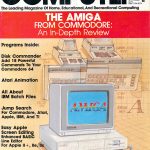
  • Compute! (September 1985)

    Compute! was probably the best magazine for the average computer user in the early to mid 1980s and perhaps beyond. At least if you had an interest in more than one platform. Compute! covered all of the popular home computers of the time and there were a bunch in 1985 including the Commodore 64, Apple II, Atari 8-bit, PC, TI-99/4A, the brand new Amiga and Atari ST, and probably others. The September 1985 issue includes:

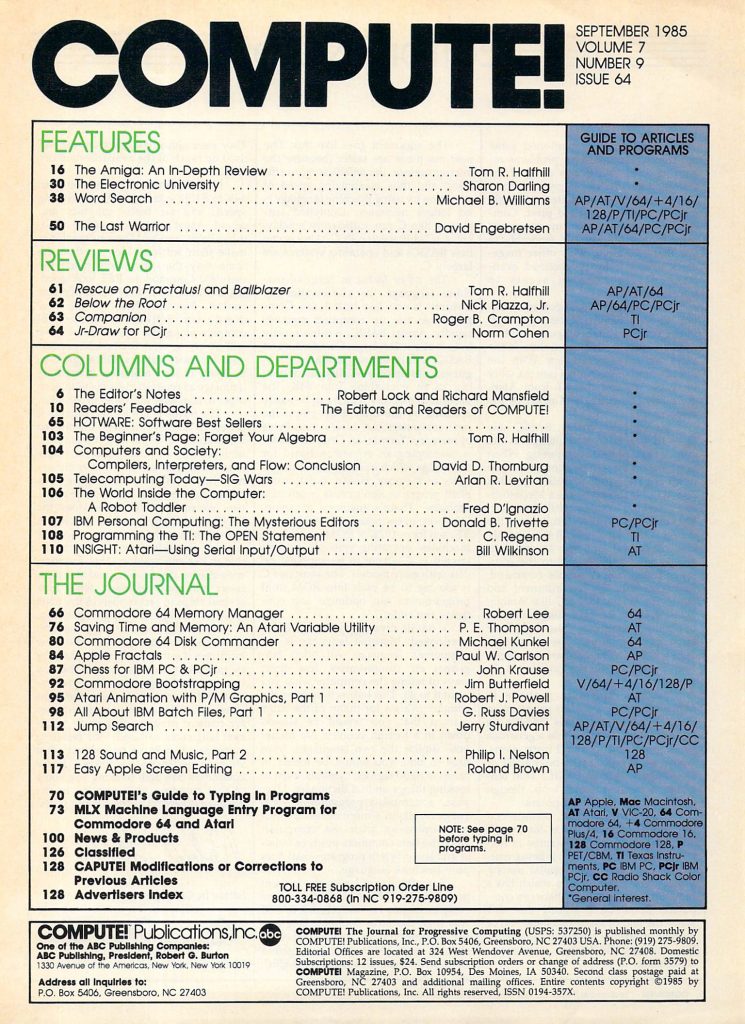
    Features

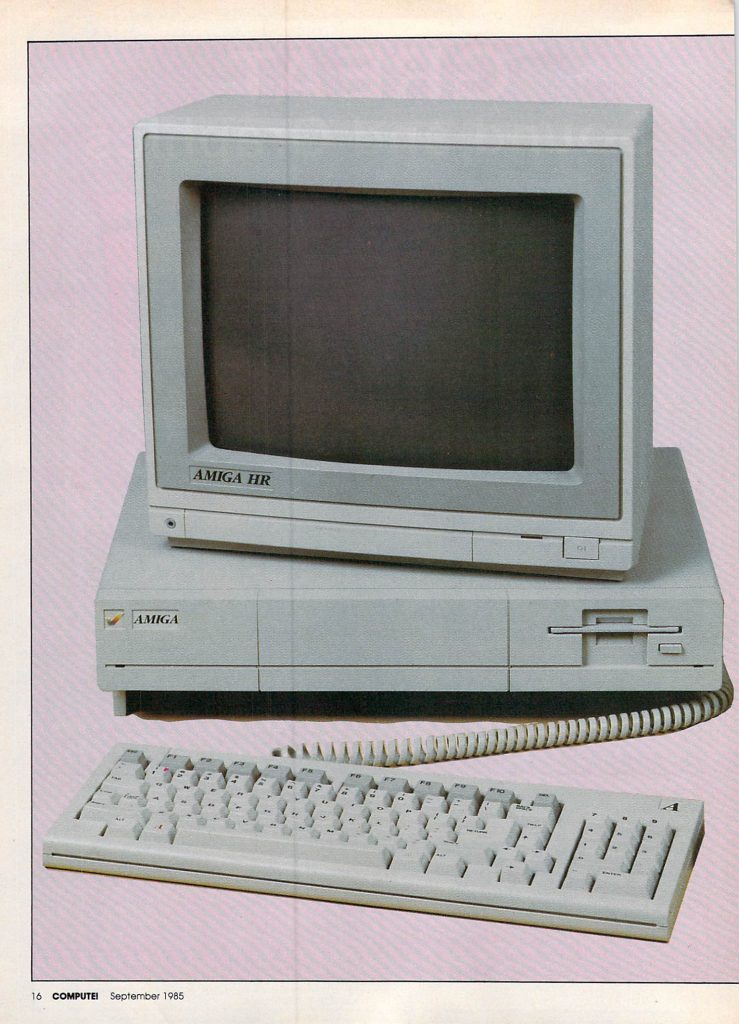
    • The Amiga: An In-Depth Review – A detailed look at the new Amiga (Amiga 1000) from Commodore. It was due to be released in August.
    • The Electronic University – While it took a while for online education to really take off, it is far from new. This article tells the story of one family who is using their Commodore SX-64 to earn online degrees.
    • The Last Warrior – A type-in arcade style action game for hte PC, Commodore 64, Atari 400/800, and Apple II.

    Reviews

    • Rescue on Fractalus! and Ballblazer – Reviews of these two classic Lucasfilm games for Atari 8-bit computers.
    • Below the Root – An adventure game for the Commodore 64 based on the Green Sky Trilogy of books.
    • Companion – A word processing program for the TI-99/4A.
    • Jr-Draw for PCjr – An art program designed for the PCjr that can optionally use a light pen.
    Columns and Departments

    • The Editor’s Notes – A discussion of the Amiga, BASIC, machine language, and the C programming language.
    • Readers’ Feedback – Letters from readers about relational operators, Atari tape to disk transfer, adding beeps to key presses on the Commodore 64, unlocking IBM PC BASIC programs, and more.
    • HOTWARE: Software Best Sellers – Best selling software this month includes Flight Simulator II (Entertainment), Math Blaster! (Education), and Print Shop (Home Management).
    • The Beginner’s Page: Forget Your Algebra – It turns out you don’t need an extensive math background to program a computer.
    • Computers and Society: Compilers, Interpreters, and Flow: Conclusion – How different compilers and interpreters affect program flow and complexity.
    • Telecomputing Today – SIG Wars – Special Interest Group sysops switch between services while those services claim ownership of all messages and uploaded files in a SIG.
    • The World Inside the Computer: A Robot Toddler – A look at the Herojr personal robot.
    • IBM Personal Computing: The Mysterious Editors – A look at the editors that IBM provides with its PCs including BASIC, DEBUG, and EDLIN.
    • Programming the TI: The OPEN Statement – Some examples of using the OPEN statement on the TI-99/4A.
    • INSIGHT: Atari – Using Serial Input/Output – A look at how printing and disk access works via SIO.
    The Journal

    • Commodore 64 Memory Manager – A type-in program for the Commodore 64 that allows you to load multiple BASIC programs into memory at once and switch between them.
    • Saving Time and Memory: An Atari Variable Utility – A set of type-in utilities for the Atari 8-bit that allows you to list, rename, and abbreviate variable names in BASIC programs.
    • Commodore 64 Disk Commander – A type-in utility for the Commodore 64 that makes disk access more convenient.
    • Apple Fractals – A type-in program for generating fractals on the Apple II.
    • Chess for IBM PC & PCjr – A type-in chess program for the PC and PCjr based on an earlier published version for other machines.
    • Commodore Bootstrapping – A tutorial and demo for how to load programs that are divided into multiple parts on the Commodore 64, VIC-20, C16, PET/CBM, and Plus/4.
    • Atari Animation with P/M Graphics, Part 1 – The first part of an animation tutorial for the Atari 8-bit using Atari’s Player/Missile graphics.
    • All About IBM Batch Files, Part 1 – The first part of a tutorial for using DOS batch files.
    • Jump Search – A demonstration of binary search on the Atari 400/800, Apple II, IBM PC, Commodore 64, TI-99/4A, and Color Computer.
    • 128 Sound and Music, Part 2 – This part explores the Commodore 128’s FILTER, SOUND, and PLAY commands.
    • Easy Apple Screen Editing – A type-in screen editor for the Apple II.

    …and more!


  • ANALOG Computing (May 1985)

    Source: Computer & Video Game Magazines – ANALOG Computing – May 1985

    There were a couple of good Atari 8-bit magazines published in the U.S. Overall, I think ANALOG was probably the best. The May 1985 issue includes:

    Features

    • BASIC AUTORUN.SYS File – A type-in BASIC AUTORUN.SYS designed for autobooting BASIC programs.
    • Basic Burger – A type-in game that, from the description, sounds like a clone of Burger Time.
    • Z-Plotter – A type-in program for plotting graphs of formulas that you enter.
    • Boulder Bombers – A type-in game in which you must drop bombs to clear away a landslide that is blocking flood waters from receding.
    • Loan Shark – A type-in payment calculator that allows you to calculate payments based on loan amounts and interest rates.
    • Two-Fifty-Siz – A type-in program that will display 256 colors on screen at once.

    Reviews

    • US Doubler – The US Doubler is a hardware upgrade for the Atari 1050 disk drives that adds the capability to read and write double-density disks. With the included Sparta DOS, it also speeds it up significantly.
    • Tax Command – Tax preparation software for your Atari 8-bit.
    • Panak Strikes! – Reviews of various games including Realm of Impossibility (Electronic Arts), The Scrolls of Abadon (Access Software), Beach-Head (Access Software) – one of my personal favorites but on the Commodore 64, Spy vs. Spy (First Star Software), and The Serpent’s Star (Broderbund).
    • Enhancement to BASIC – An enhancement to BASIC on Atari computers that adds new functions.

    Columns

    • Editorial – An overview of recent changes to the magazine including changes to the format, increase in telecommunications coverage, and more.
    • Reader Comment – Letters from readers about back issues on disk, coverage in the U.K, a modification to Planetary Defense that allows you to use the Atari Touch Tablet, uses of a VCR with Atari 8-bit computers, and more.
    • New Products – A brief look at new products including a new online game service called Games Computer Play, The Atari Computer Workout (book), Castle Cobbler and Subtraction Fair from Mindscape (kids educational software), The Print Shop from Broderbund, Bounty Bob Strikes Back, and more.
    • Griffin’s Lair – A look at recent educational software titles including Tink’s Adventure (Mindscape) and Tuk Goes to Town (Mindscape).
    • Ask Mr. Forth – A demonstration of the differences between FORTH and BASIC via FORTH versions of a couple of previously published BASIC graphics programs.
    • On-Line – An argument against software piracy using unruly kids in a movie theater as an analogy.
    • The End User – How to take the perfect screen shot. At this time, that meant using a film camera and photographing the monitor.

    …and more!


  • ANALOG Computing (July 1986)

    Source: ANALOG Computing – July 1986

    ANALOG computing was probably the best Atari 8-bit computer magazine published in the U.S. (though I suppose some might make an argument for Antic). They dabbled in Atari ST coverage when it came along but for the most part they stuck with 8-bit coverage. The July 1986 issue includes:

    Features

    • The 810 Flip Switch – It was common practice to punch a hole (really a notch) in the side of a floppy disk in order to make it useable as a double-sided disk. The instructions here are to build a switch for the Atari 810 disk drive that accomplishes the same thing without having to clip your disk.
    • RAMcopy! – A type-in program that will automatically copy specified files to a RAMdisk upon startup.
    • An interview with Russell Smith and Wayne Smith – An interview with the people behind the ATR-8000, an Atari 8-bit expansion that adds CP/M capability.
    • The 8-Bit Parallel Interface – Instructions for building a parallel interface for Atari 8-bits.
    • D:CHECK in Action! – A type-in program designed to correctly typing errors in the Action! development system.
    • Cassette LogWriter – A type-in program for printing labels/inserts for Cassettes.
    • Bits & Pieces – Part of a series on Atari hardware. This part focuses on using the joystick ports to control external devices.
    • ST-Log – An insert for the Atari ST. Included are a type-in program for creating function key templates, a program that helps you use fractions instead of decimals in LOGO, reviews o Personal Pascal, Easy Draw and Typing Tutor, a guide to ST software, a column on keyboard and disk I/O in C, and more.
    • Personal Robots – Robots that can be used with Atari computers.
    • Arm your Atari – Using the Armatron robotic arm with an Atari 8-bit computer.
    • Blast! – A type-in sci-fi themed shoot-em-up game.

    Reviews

    • Panak Strikes! – Reviews of various games including Spy vs. Spy Volume II: The Island Caper (First Star Software), The Mask of the Sun (Broderbund), and Ankh (Datamost).
    • Critical Connection – A software/hardware combo designed to allow you to use CP/M devices wth your Atari.
    • RAM Upgrade Kits – Reviews of RAM upgrade kits including the 256K XL RAM Upgrade Kit and the ICD Rambo XL Upgrade Kit (also 256K).

    Columns

    • Editorial – Recent updates to the magazine.
    • Reader Comment – Letters from readers about the Gemini SG-10 printer, Atari ST monitors, sound capabilities of the Atari ST, and more.
    • 8-Bit News – Super BoulderDash released along with a re-release of the original, Microflyte ATC joystick released made especially for Flight Simulator, Star Fleet I released, new Atari 8-bit hardware announced, and more.
    • BASIC Editor – A new type-in program designed to help you accurately type-in BASIC listings from ANALOG.
    • The End User – Financial Cookbook from Electronic Arts for the Atari ST, a real-time clock add-on for the Atari ST, a new Supra hard drive for the Atari ST, CHAT – a new telecommunications software package for the Atari ST, and more.
    • Boot Camp – Graphics programming in machine language.

    …and more!