• Tag Archives Commodore 128
  • Compute! (March 1986)

    Source: Compute! – Issue Number 70 – March 1986

    Compute! was an excellent magazine that covered most popular computers of the time. I was partial to the spin-off Gazette because I had a Commodore 64 but this one was excellent as well. It was a little less technical that Byte but all magazines at the time were technical compared to today. The March 1986 issue includes:

    Features

    • The Future of Mass Storage – The future was bright for mass storage. 3.5″ floppies were replacing 5.25″ floppies, Hard drives were becoming affordable, and optical storage for the average user was on the horizon.
    • The Computerized Home – Computerized home automation was a thing long before Alexa. The X-10 interface was the de-facto standard and X-10 modules were available for pretty much any platform.
    • Switchbox – A type-in puzzle game with versions specifically for the Commodore 128, Commodore 64, Atari 8-bit, Atari ST, PC, and Amiga.
    • SpeedCalc for Atari – A type-in professional quality spreadsheet program for the Atari 8-bit.

    Reviews

    • The Works! – A software package for the Commodore 64 and Apple II that includes 13 programs in the categories of tools, organizers, arts, and learning.
    • Under Fire – A World War II strategy game for the Apple II.
    • M-Disk – Software for creating a RAM Disk on the Atari ST.
    • Atari XM301 Modem – A 300bps direct connect modem for Atari 8-bit computers.
    • EduCalc and NoteCard Maker – A combination of a simplified spreadsheet program and simplified database manager with versions for the Commodore 64, Apple II, and PC (Apple II version reviewed here).
    • Hex – A puzzle/strategy game for the Atari ST.
    • Sylvia Porter’s Personal Financial Planner – This software package includes six programs including Transaction Manager, Budget Manager, Asset/Liability Manager, Balance Sheet, and Financial Planner. The Commodore 64 version is reviewed here with versions also available for the PC and Apple II.
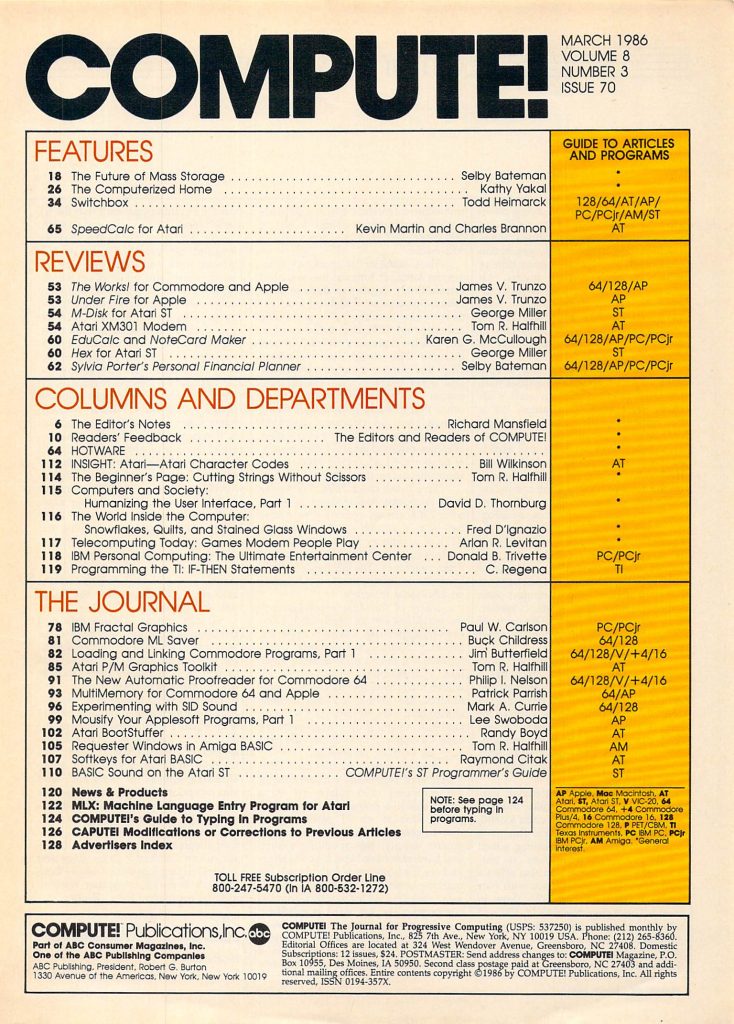
    Columns and Departments

    • The Editor’s Notes – A comparison of the new Amiga and Atari ST.
    • Readers’ Feedback – Letters from readers about code comments, computers for charity, recording music on the Amiga, and more.
    • HOTWARE – The top five selling software titles in three different categories. In the top places were F-15 Strike Eagle (Entertainment), Typing Tutor III (Education), and Print Shop (Home Management).
    • INSIGHT: Atari – A look at Atari character codes. Atari 8-bit computers used a variant of ASCII called ATASCII.
    • The Beginner’s Page: Cutting Strings Without Scissors – How to split strings in BASIC.
    • Computers and Society: Humanizing the User Interface, Part 1 – Exploring ways to make the user interface easier to use and more intuitive.
    • The World Inside the Computer: Snowflakes, Quilts, and Stained Glass Windows – Art on the Amiga.
    • Telecomputing Today Games Modern People Play – A look at online multiplayer gaming. At the time, that typically meant turn based gaming on BBS systems or services like CompuServe.
    • IBM Personal Computing: The Ultimate Entertainment Center – A guide for using your PC or PCjr with a TV.
    • Programming the TI: IF-THEN Statements – Using IF-THEN statements including examples for simulating AN/OR, doing Algebra, and more.
    • News & Products – Valhalla announced for the Commodore 64; MIDI Ensemble for the PC; AtariWriter and AtariWriter Plus word processors for the Atari ST; What’s Our Worth? home inventory package for the Commodore 64; and more.

    The Journal

    • IBM Fractal Graphics – Three type-in programs for creating fractals on the IBM PC and PCjr.
    • Commodore ML Saver – A type-in program for saving machine language programs directly from memory to disk on the Commodore 64.
    • Loading and Linking Commodore Programs, Part 1 – The first in a series of article on loading, chaining, and overlaying programs on Commodore computers.
    • Atari P/M Graphics Toolkit – Atari Player/Missile graphics is the Atari 8-bit version of sprites. This type-in toolkit makes it easier to develop and use P/M graphics on the Atari.
    • MultiMemory for Commodore 64 and Apple – Short type-in programs for the Commodore 64 and Apple II that allow you to segment memory for loading multiple BASIC programs.
    • Experimenting with SID Sound – Some examples for controlling the Commodore 64’s SID sound chip.
    • Mousify Your Applesoft Programs, Part 1 – The first of a two-part guide to using a mouse (or joystick or paddles) with your own programs.
    • Atari BootStuffer – This short type-in program for the Atari 8-bit allows you to create a menu system to load up to 8 different programs with one key press.
    • Requester Windows in Amiga BASIC – A guide to adding requester windows (dialog boxes) to Amiga BASIC programs.
    • Softkeys for Atari BASIC – This type-in program gives you automatic line numbering and various hotkeys when writing your own BASIC programs.
    • BASIC Sound on the Atari ST – A guide to getting started with creating basic sound effects on your Atari ST.
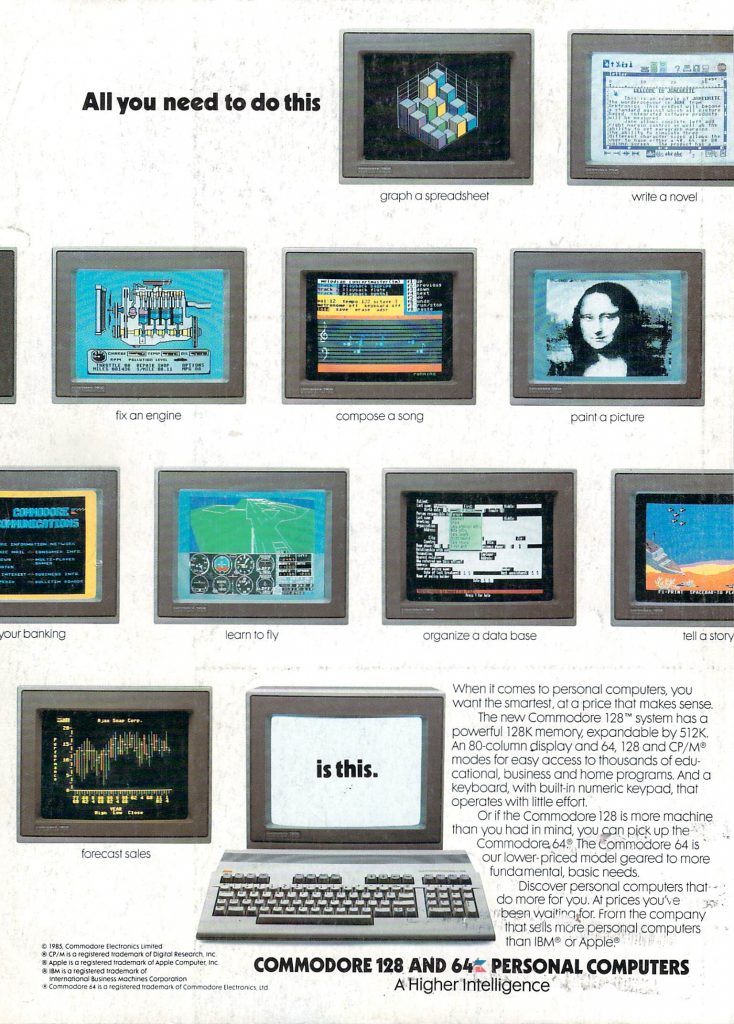
    …and more!

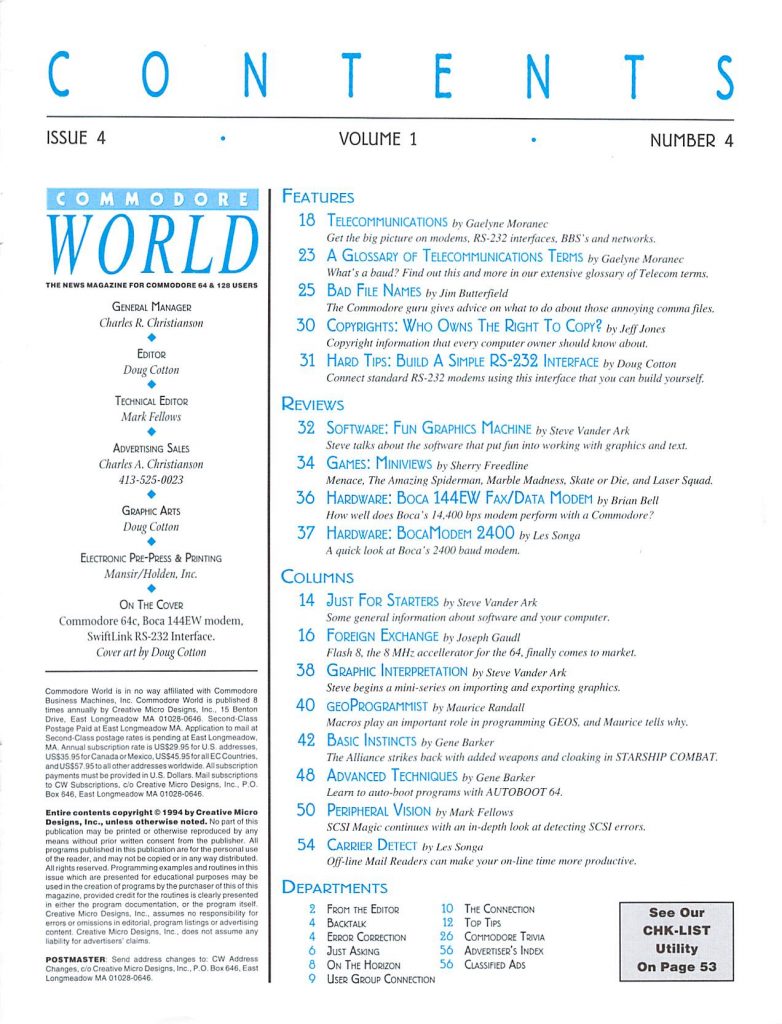
  •  Commodore World – Volume 1, Number 4

    Source: Commodore World – Volume 1, Number 4

    I think that Commodore World was the last professional Commodore 8-bit magazine published in the U.S. It was published bi-monthly in the mid to late 1990s. This issue isn’t dated that I see but I believe it would have been from near the end of 1994. Issue number four of Commodore World includes:

    Features

    • Telecommunications – A guide to getting online with your Commodore 64.
    • A Glossary of Telecommunications Terms – Definitions for terms such as “baud”, “BBS”, and “echo”, as well as modem communications standards and much more.
    • Bad File Names – How to fix various file problems on Commodore 64 disks.
    • Copyrights: Who Owns The Right To Copy? – A discussion of copyright law, especially how it applies to computer software.
    • Hard Tips: Build A Simple RS-232 Interface – A guide to building your own modem interface.

    Reviews

    • Software: Fun Graphics Machine – A review of this high-resolution graphics editor that can be used for desktop publishing and to create everything from video titles to business cards and much more.
    • Games: Miniviews – Brief reviews of Menace (Psygnosis), The Amazing Spider-Man (Paragon), Marble Madness (Electronic Arts), Laser Squad (MicroIllusions), and Skate or Die (Electronic Arts).
    • Hardware: Boca 144EW Fax/Data Modem – A detailed review of this 14.4Kbps modem.
    • Hardware: The Boca 2400 – I review of this 2400bps modem. This was about as fast as you could go on the Commodore 64 with a basic RS-232 interface. You had to get fancier interfaces if you wanted faster speeds.

    Columns

    • Just For Starters – A guide for computer beginners on the types of software available for the Commodore 64 and what they can be used for.
    • Foreign Exchange – A look at the Flash 8, an add-on for the Commodore 64 that provides a 65C816 CPU and up to 8 MHz speeds.
    • Graphic Interpretation – A guide to importing and exporting graphics to and from GEOS.
    • geoProgrammist – Using macros and managing memory in GEOS.
    • BASIC Instincts – The third installment of a five part series on building a large game called Starship Combat.
    • Advanced Techniques – A type-in program that will let you autoboot your own programs.
    • Peripheral Vision – Identifying and handling SCSI errors on CMD’s HD.
    • Carrier Detect – A guide to offline BBS mail reading. I never did much of this with the Commodore 64 but I do remember doing a lot with Bluewave on the PC.

    Departments

    • From The Editor – Planned obsolescence in the computer world.
    • BackTalk – Letters from readers about the first issue of the magazine.
    • Just Asking – Questions answered about the CBM 8032 printer and GEOS, gamepads for the C64, using larger disks under CP/M, and more.
    • On The Horizon – Disposition of Commodore’s assets after bankruptcy still undetermined; Grapevine Group ceases operations; CMD releases GeoCable II which can be used to connect printers to The C64’s parallel port for high speed printing; Commodore RoundTable on GEnie offers gifts to new members; and more.
    • The Connection – News about file compression from Loadstar, dieHard, Fun Graphics Machine, and more.
    • Top Tips – Tips about switch settings for printer interfaces, better video via the Commodore 128 composite video port, and more.

    …and more!


  • The Australian Commodore and Amiga Review (November 1987)

    Source: The Australian Commodore and Amiga Review – November 1987

    This Commodore specific magazine was published in Australia. It covered both the Commodore 8-bit line as well as the Amiga depending on what time frame we are talking about. This issue from November 1987 includes:

    Hardware

    • Action Replay Mk III – The latest iteration of a cartridge designed to back up copy protected software. It worked by taking a snaphot of memory so it didn’t really work with games that required disk access after loading (e.g. to load additional levels).
    • Comodem – A 1200 baud modem designed to plug straight into the user port of the Commodore 64 (i.e. it didn’t require a separate interface).

    Software

    • Blitz 64 Compiler – A BASIC compiler for the Commodore 64.
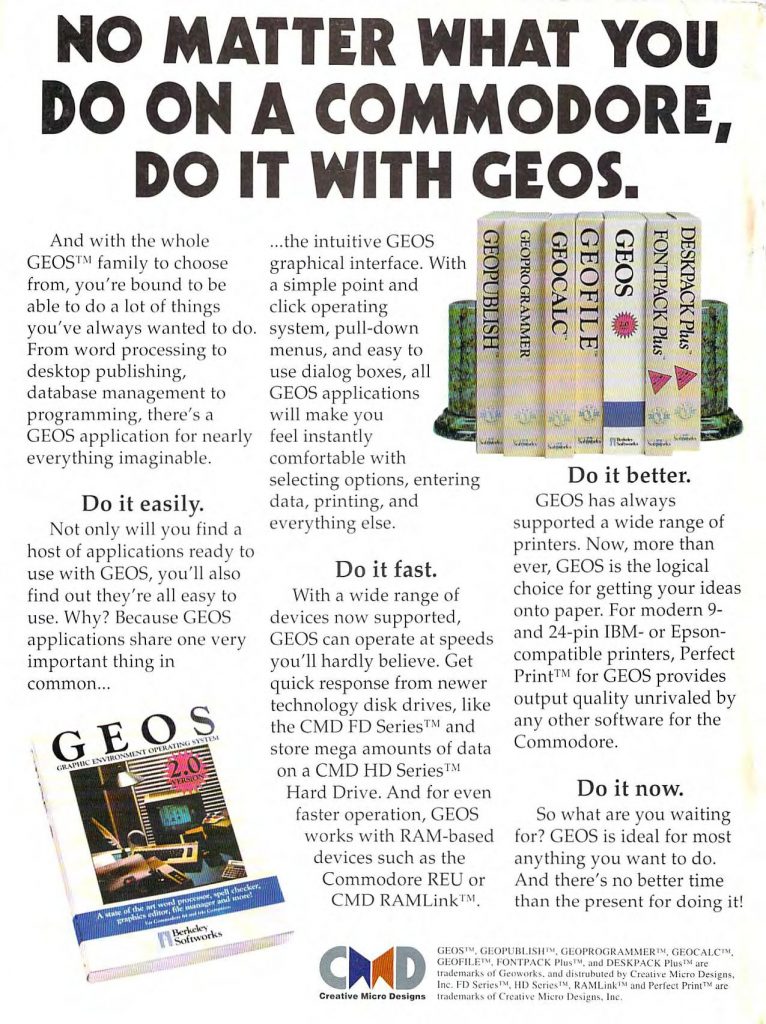
    • Book Review – A review of the “How to Get the Most out of GEOS”, a guide to the GEOS operating system which was a GUI for the Commodore 64.
    • Pirates – Review of this classic MicroProse game for the Commodore 64.
    • Boulderdash II: Rockford’s Revenge – Sequel to the classic arcade style game from First Star Software.
    • Bubble Bobble – An excellent arcade game for the C64 in which you must guide a bubble through a maze of various obstacles.
    • Arena – A sports game from Psygnosis for the Amiga that features a variety of sports like pole vault, high jump, long jump, shot put, 100 meter run, etc.
    • Pi R Squared – An arcade/puzzle style game featuring lots of wheels which I guess is where the name comes from.
    • Pro Golf – Yet another golf game…

    Amiga Review

    • Amiga 2000: Top of the Range – A review of the Amiga 2000. This was perhaps the time when the Amiga was furthest ahead of any other home computer on the market, especially for the price.
    • GIZMOS – A set of desktop tools for the Amiga including a calendar, memopad, rollodex, printing utility, calculators, and more.
    • Hints & Tips – Tips for using Pagesetter, customizing your keyboard settings, using Workbench, and much more.
    • Terrorpods – Review of this sci-fi action/adventure game from Psygnosis.

    Programming

    • Sprites in the Border – A technique for getting sprites to display in the border areas on the Commodore 64 with coding examples.
    • C128 function keys for your C64 – A type-in program that allows you to use the Commodore 128 function keys when in C64 mode.
    • Little Invoicer – A type-in program for the Commodore 64 designed to generate simple invoices.
    • Machine Code Tutorial Pt III – The third part in a tutorial on machine language programming. This part implements some examples of instructions discussed in previous parts.

    Regular Appearances

    • Editorial – An overview of what is in this issue and a look ahead to what is to come.
    • Ram Rumblings – News and a look at new products including Midi Master (a package that turns the C64 into a music synthesizer), new titles from Activision including Supersprint, Guadalcanal, Xis, and Wonderboy; Gunship from MicroProse; Avtec Mega Modem, and more.
    • Letters – Letters from readers regarding adventure game help, reset switches, and more.
    • Adventurer’s Realm – Various adventure game news (including info on Beyond Zork), tips, questions and other adventure game discussion. Some games included this month are Dragonworld, ZZZzzz, Holy Grail, Nine Princes of Amber, Knights Orc, and more.
    • Arcade Action – A look at new and upcoming games including Centurions, Deathwish III, T.A.N.K., Space Port, Typhoon, and Garrison.
    • High Scores – High scores submitted by readers for over 50 different games.

    …and more!