• Tag Archives atari
  • VideoGames & Computer Entertainment (February 1993)

    Source: VideoGames & Computer Entertainment – February 1993

    VideoGames & Computer Entertainment was my favorite magazine in the years that it was published (late 1980s to early 1990s). It was really sort of the successor to the original Electronic Games magazine, at least until Electronic Games was actually rebooted. The February 1993 issue includes:

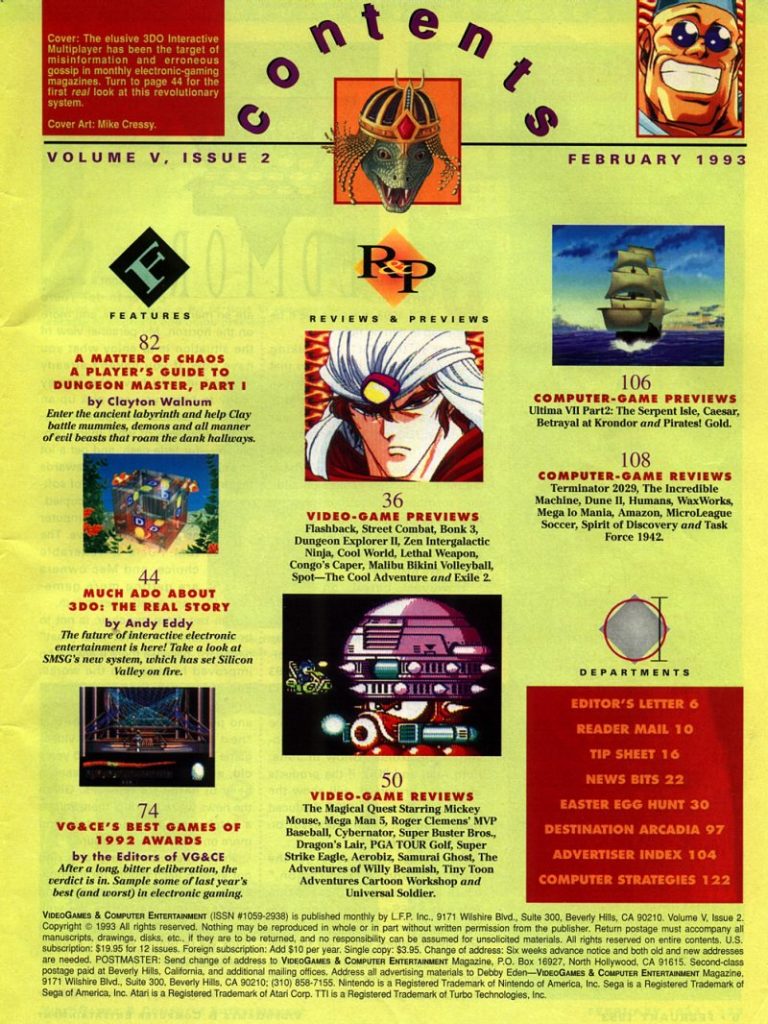
    Features

    • A Matter of Chaos: Player’s Guide to Dungeon Master, Part I – VG&CE had some pretty great game guides. However, you had to be disciplined about looking at them because they could ruin the game for you. This one covers the first part of Dungeon Master for the Super NES.
    • Much Ado About 3DO: The Real Story – It’s a shame the 3DO didn’t have more success. This article is a first look at the machine with some technical details and a look at its capabilities.
    • VG&CE’s Best Games of 1992 Awards – Sonic the Hedgehog 2 won VG&CE’s Video Game of the Year award with other awards going to Street Fighter II (SNES), Warsong (Genesis), F22 (Genesis), The Legend of Zelda: A Link to the Past (SNES), Loom (TG16), Dungeons & Dragons: Warriors of the Eternal Sun (Genesis), Mick & Mack as the Global Gladiators (Genesis), Contra III – The Alien Wars (SNES), Ultima Underworld: The Stygian Abyss (computer game of the year), Hardball III, Wolfenstein 3D, Comanche: Maximum Overkill, V for Victory, Star Control II, The Secret of Monkey Island, Wizardry: Crusaders of the Dark Savant, Dune, LINKS 386 Pro, plus numerous honorable mentions and other lists (such as worst games of 1992).
    Previews & Reviews

    • Video-Game Previews – Brief previews of Flashback (Genesis), Bonk 3 (TurboGrafx-16), Street Combat (Super NES), Dungeon Explorer II (TurboGrafx-16), Zen Intergalactic Ninja (NES and Game Boy), Lethal Weapon (NES and Game Boy), Cool World (Super NES and Game Boy), Congo’s Caper (Super NES), Malibu Bikini Volleyball (Atari Lynx), Spot – The Cool Adventure (Game Boy), and Exile 2 (TurboGrafx-16).
    • Video-Game Reviews – Reviews of The Magical Quest Starring Mickey Mouse (Super NES) – Capcom made some great Disney licensed games and this was one of them, Mega Man 5 (NES) – and there would still be one more Mega Man game on the NES, Roger Clemens’ MVP Baseball (Genesis), Cybernator (Super NES), Buster Bros. (TurboGrafx-16 CD), Dragon’s Lair (Super NES) – a platform game not really like the arcade version, PGA Tour Golf II (Genesis), Super Strike Eagle (Super NES), Aerobiz (Super NES), Samurai Ghost (TurboGrafx-16), The Adventures of Willy Beamish (Sega CD), Tiny Toon Adventures Cartoon Workshop (NES), and Universal Soldier (Super NES) – another bad licensed game.
    • Computer-Game Previews – Short previews of Ultima VII Part 2: The Serpent Isle, Caesar – I think I actually have this one somewhere though I’ve never played it, Betrayal at Krondor – my roommate in college spent many hours on this game, and Pirates! Gold.
    • Computer-Game Reviews – Reviews of The Terminator 2029 – only a few years away now, The Incredible Machine, Dune II – the first RTS I ever really saw, The Humans, WaxWorks, Mega lo Mania, Amazon: Guardians of Eden, MicroLeague Action Sports Soccer, Discovery, and Task Force 1942.

    Departments

    • Editor’s Letter – A look at what’s ahead in 1993 including the 3DO, Atari Jaguar, the PlayStation (which at the time was essentially an SNES console with CD-ROM), and more.
    • Reader Mail – Letters from readers about RPGs, Nintendo’s 32-bit CD-ROM system, portable systems, and more.
    • Tip Sheet – Hints and tips for Night Trap (Sega CD), The Guardian Legend (NES), and Cosmic Fantasy 2 (TurboGrafx-CD).
    • News Bits – Radio Shack debuts a new interactive CD player called the Memorex MD-2500 VIS, Nintendo cleared of antitrust charges, classic games re-released for the NES (Zelda, Zelda II, Punch-out, Metroid) for $29.99 each, Sunsoft licenses The Pirates of Dark Water, Atari drops price of Lynx to $79.99, and more.
    • Easter Egg hunt – Secrets revealed for Batman Returns (Atari Lynx), Super Mario Kart (Super NES), Dead Moon (TurboGrafx-16), Faceball 2000 (Game Boy), Cobra Command (Sega CD), Toki (Atari Lynx), Alisia Dragoon (Genesis), Magic Sword (Super NES), Wacky Races (NES), and Crystal Mines II (Atari Lynx).
    • Destination Arcadia – A guide to the secrets of Mortal Kombat.
    • Computer Strategies – A strategy guide for The Ancient Art of War in the Skies.

    …and more!


  • Compute! (March 1981)

    Source: Compute! – Issue Number 10 – March 1981

    Compute! was a popular multi-format magazine that covered various computers throughout its long life which started in 1979 and lasted until the 1990s. Throughout its early life, it strictly covered computers based on the 6502 processor. The March 1981 issue includes:

    Table of Contents

    • The Editor’s Notes – The editor opines on software piracy vs. the right to back-up software that you buy.
    • A 6502 Version of the Winter Consumer Electronics Show: January ’81 – News related to 6502 based computers at the Winter CES. The biggest product introduced that year was the Commodore VIC-20.
    • The Beginner’s Page – Some beginner information about BASIC, operating systems, ROM, RAM and storage media.
    • Computers and Society – A look at communications between user and computer via programming languages. LOGO and PILOT are emphasized while BASIC and PASCAL are also mentioned.
    • Taking the Plunge – Machine Language Programming for Beginners – An introductory guide to machine language on the PET though it is applicable to other machines of the time as well. The differences between BASIC, machine language and assembly code are discussed.
    • Computer Communications Experiments – An article on building an RS-232C interface which can be used for modems and other things.
    • Basics of Light Pen Operation – In the early days of computing, light pens were a fairly common user interface option. This article describes in technical detail how they work.
    • Getting the Most from your Pet Cassette Deck – The kinds of cassettes you should use, how to shorten they time it takes to search for programs, and more.
    • The Mysterious and Unpredictable RND – Part 3 – Part 3 of a multi-part series on random number generation in BASIC on the PET. This part demonstrates a dice rolling program using multiple dice.
    • A CAI Program Called Linear Equation – A type-in program for Computer Aided Instruction of Linear Equations.
    • Hex Conversion Using the 6502’s Decimal Mode – A machine language method for converting to and from hexadecimal numbers.

    The Apple Gazette

    • Clearing the Apple II Low-Resolution Graphics Screen – Several BASIC methods for clearing the screen.
    • Fun with Apple and PASCAL – A type-in PASCAL arcade style shooter game for the Apple II (basically shoot at the falling shapes).
    • Flipping your Disk – A guide to making your single side disks double-sided. Essentially, this could be accomplished just by clipping a notch in the side of the disk that didn’t already have one. This worked for a variety of 8-bit computers. Drives were generally single sided so you still had to flip the disk over to read and write data to the second side.

    The Atari Gazette

    • Designing Your Own Atari Character Sets – Creating custom character sets on the Atari 8-bit.
    • Atari Basic: A Line Renumbering Utility – A type-in utility for renumbering the lines of a BASIC program. This was important sometimes because you could run out of line numbers. Every line of code in basic started with a line number. If you needed to add code in between two lines then there would have to be available numbers to do so. If you were unwise enough to make every line number consecutive, that could be problematic. It was common practice to number lines by 10s (first line is 10 second is 20, etc.). However, you never know when you might need more extra line numbers in between.
    • Atari Memory Dump and Dissassembler – A type-in program that will both dump the contents of memory locations to disk or disassemble lines of code.
    • Formatted Output for Atari BASIC – An article with two subroutines for helping you to produce nicely formatted output from BASIC.
    • Random Color Switching while Idle – A method to prevent Atari’s built-in color switching screen saver from kicking in. Pressing a key resets the time for this but when playing a games, you may not be pressing any keys.

    The OSI Gazette

    • A Small Operating System: OS65D the Kernel – The final part in a series on the OS65D operating system.
    • A Six-Gun Shootout Game for the OSI C1P – A type-in BASIC game that sounds a bit like Outlaw on the Atari 2600.

    The PET Gazette

    • Learning About Garbage Collection – Garbage collection (memory reclamation) was necessary on PET machines with certain ROM revision in order to reclaim memory used by strings. Here are a couple of short routines to do that.
    • PET Machine Language Graphics – A machine language graphics subroutine for the PET that provides a variety of graphics functions.
    • Disk File Recovery Program – A type-in program for the PET that can recover accidentally deleted files.
    • PET Exec Hello – A type-in program for automatically executing commands when booting from disk.
    • A Flexible Input Subroutine – A type-in subroutine in BASIC that can handle various types of input.
    • Universal Tape Append for PET/CBM – A type in program that allows for one program to be appended to another on cassette.

    The SBC Gazette

    • Experimenting with the 6551 ACIA – Information for interfacing, operating and controlling a 6441 ACIA with a 6502. The 6551 is used primarily for communications.
    • A Vocal Hex Dump for the KIM-1 – A program designed to work with a speech synthesizer to speak the data in a given memory location.
    • Expanding KIM Style 6502 Single Board Computers – Part 3 of 3 – The final part in a series on expanding the KIM (and KIM-style) single board computers. Basically a series on how to use the bus expansion connector of these machines.
    • Cassette I/O with AIM-65 BASIC – How to make your BASIC program read and write to/from cassette on the AIM 65.

    New Products

    • New Products – Commodore releases disaster relief software used during the fire at the MGM Grand Hotel on November 22, 1980, Personal Software Inc. releases MicroChess and Checker King for the Atari 400/800, Cimarron Corp. announces Legal Time Accounting (accounts receivable and matter tracking for the legal profession) for the Commodore 8032, Microcomputer Software Inc. releases The Landlord apartment management software for the Apple II, Microware releases Scientific Plotter graph producing software for the Apple II, Axlon announces 32K RAM expansion for the Atari 400/800, and much more.

    …and more!


  • Compute! (May 1985)

    Source: Compute! – Issue Number 60 – May 1985

    Compute! was a popular magazine in the 1980s and very early 1990s that covered all of the home computers popular at the time. In 1985 that included the IBM PC (and compatibles), Commodore 64, VIC-20, Atari 8-bit, TI-99/4A, Apple II, and Macintosh. The May 1985 issue includes:

    Features

    • GEM: A New Look for IBM and Atari – GEM was an operating system interface. Basically it was a GUI shell over DOS. It was available for both PCs and the Atari ST. However, while it was the main interface on the Atari ST, it had a fairly small market share on the PC.
    • Home Financial Calculator – A type in home budget program for the Commodore 64, VIC-20, Atari 8-bit, and Apple II.
    • Space Dodger – A type in action game for the TI-99/4A, Commodore 64, VIC-20, Atari 8-bit, and Apple II.
    • SpeedScript 3.0 – Compute! published a high quality type-in word processor for a variety of computers. Version 3.0 for Atari 8-bit computers.

    Reviews

    • Relax Stress Reduction System – Relax, is a software product that uses biofeedback and computer generated graphics to help you reduce stress. It was available for the Commodore 64, PC, Apple II, and Atari 8-bit.
    • Sidekick for PC and PCjr – Sidekick provided a series of tools, including a calculator, notepad, calendar with diary, and ASCII table, that could be accessed via a keystroke even while running other software in DOS.
    • Gateway to Apshai – This was an action/adventure game that was available for the Commodore 64, Atari 8-bit, and Coleco Adam. I had a lot of fun with this one on the Commodore 64.
    • Championship Lode Runner – Lode Runner is a non-scrolling platform game that is blast to play. Championship Lode Runner is essentially just additional levels but they tended to be harder. It’s reviewed here for the Commodore 64 and Apple II.
    • MacVision for Apple Macintosh – A hardware/software package for the Macintosh that lets you digitize images from a video camera.

    Columns and Departments

    • The Editor’s Notes – How there tends to be resistance to new technologies. The focus here is the typewriter vs. word processor.
    • Readers’ Feedback – Readers write in to discuss baud, reading the PC keyboard from BASIC, Commodore 64s in the classroom, chaining programs on the Commodore 64, help with Deadline by Infocom, analog vs. digital joysticks, and more.
    • The Beginner’s Page – Using loops in BASIC.
    • Telecomputing Today – A tutorial on uploading and downloading files. Trivial today but not quite as much so in 1985.
    • Computers and Society: Visual Computing, Part 2 – The second part in a series on graphical operating environments.
    • INSIGHT: Atari – Bugs in various Atari BASIC versions and solutions for working around them.
    • The World Inside the Computer: Redefining Computer Literacy – The future of home computers as digital utility centers.
    • Programming the TI: Japanese Characters – A type-in program for reprogramming the keyboard to print Japanese characters on the TI-99/4A.
    • IBM Personal Computing: Titling Your Vacation – Programs for the IBM PC that can be used to create titles that can then be photographed to be used in slide shows, etc.

    The Journal

    • ScriptSave: Automatic Disk Saves for Commodore 64 Speedscript 3.0 – A type-in utility that works with Speedscript 3.0 on the Commodore 64 to automatically save your work every 10 minutes.
    • Dynamic Function Keys for VIC & 64 – A type-in program that assigns useful functions for programmers to the function keys on the VIC-20 and Commodore 64.
    • IBM Disk Rx – A type-in program for DOS machines designed for file recovery of accidentally deleted files.
    • Apple IIc RAM Disk Mover, Part I – A type-in utility to quickly move the contents of a floppy disk to a RAM disk.
    • 64 Tape to Disk Transfer – A type-in utility that makes it easy to transfer programs from tape to disk on the Commodore 64.
    • News & Products – Broderbund announces The Music Shop for the Commodore 64, The Original Boston Computer Diet available for the PC and coming soon for the Apple II and Commodore 64, Mindwheel text adventure released for the PC, Apple II, and Commodore 64, new dot matrix printers from Star Micronics, and more.

    …and more!