• Tag Archives DOS
  • PC World (February 1991)

    Source: PC World – February 1991

    By the early 1990s, PCs were being rapidly adopted though it would still be a few more years until the Internet came into widespread use. When AOL started providing web access in 1995 is probably a good metric for that. PC World was certainly one of the most popular PC magazines at the time and in 1991, 486 based PCs were around but 386 (and lower) were still much more common. The February 1991 issue of PC World includes:

    Cover Stories

    • Excel 3.0: The Push-Button Spreadsheet – A preview of the latest version of Excel. Some new features of Excel 3.0 include a new tool bar, hierarchical worksheets, drawing tools, and more.
    • Laptops in Living Color – A preview of a few upcoming laptops with color screens including the Sharp Colorstar featuring a 20-MHz 386 CPU, 100MB hard drive, and 256 color VGA screen for between $10,000 and $15,000 and the Toshiba T3200SXC featuring 20-MHz 386SX CPU, 120MB hard drive, and 256 color VGA screen for $9000. Those color screens weren’t cheap then.
    • Value Alert! 20-MHz 386SX Systems – Reviews of the latest batch of 20-MHz 386 based computers including the ALR Powerflex 20CSX ($3600), AST Premium II 386/20 ($3528), Compaq Deskpro 386x/20 ($4279), Dell 320LX ($3659), NCR PC386sx20 ($3547), and NEC PowerMate SX/20 ($3635). Typical specs included 4-5MB of RAM, 100-120MB hard drive and VGA graphics.
    • Personal Laser Printers: Looking Better All The Time – Reviews of the latest laser printers including the Brother HL-4 ($1381), HP LaserJet IIP ($1493), IBM LaserPrinter E ($1500), Okidata OL400 LED Page Printer ($994), Panasonic KX-P4420 Laser Printer ($1334), and Tandy LP 950 ($2199).

    Special Report

    • Windows – A special supplement on windowing environments and applications.
    • The Windows-Mac Connection – A look at GE’s experience getting Macintoshes and Windows based PCs working together.
    • Reviews – Reviews of The DeskTop Set 3.0, Spinnaker Plus 2.0, Ashlar Vellum for MS-DOS With Windows 3.0, PerForm Pro Designer and Filler, Distinct Back-Up 2.0, Command Port 7.0, and Windows Workstation Release 3.

    News

    • Top of the News – 16-ppm laser printers hit the market, CD-ROM and erasable optical technologies arrive, IBM introduces the luggable PS/2 Model P75 featuring a 33-MHz 486 CPU and 8MB of RAM for $16000, and more.
    • Industry Outlook – IBM and Tandy back new multimedia standards with better audio and CD-ROM drives coming to PCs soon, cheaper laser printers on the way, 9600bps modems gaining ground, Macintosh introduces low cost LC model to tempt PC users, and more.
    • Product Outlook – A look at new and upcoming products including the AST Premiu Exec 386SX/20 and 286/12 notebook models, Howtek Personal Color Printer, Control Point Backup, Crosstalk Communicator 1.0, Zeos 286 Notebook, Tandy 2810 HD, Toshiba T2000SX, and lots more.

    Previews

    • PageMaker Tries Harder – A preview of PageMaker 4.0 desktop pubishing software.
    • ccMail Meets Windows – A preview of cc:Mail for Windows 1.0 e-mail package.

    Features

    • Taming the Telephone – What contact management software can do for you.
    • Buyers’ Guide: Management Software – A guide to numerous contact management tools including Act 2.0, Contact Professional 2.4, The Desktop Set 3.0, Performer 2.01, Tracker 4.0, and many others.
    • The WordPerfect Office – Communications and file-sharing functions for users of WordPerfect products.

    How To

    • The Help Screen – Questions answered about duplicating fields in Paradox 3.0, end of the month macros for spreadsheets, and more.
    • Network Q&A – Questions answered about fault tolerance, including disk mirroring and duplicating.
    • Windows Walk-Through – The basics of using Windows.
    • Words Into Print – Automatic footnoting with WordPerfect.
    • Spreadsheets (A…Z) – Graphing spreadsheet data with Lotus 1-2-3 version 2.x.
    • Data Basics – Adding titles and column headings to database reports.
    • The Art of Persuasion – Choosing the best typefaces for business documents.
    • The Information Edge – Tips for getting the best value out of GEnie’s off-hour services.

    Departments

    • Richard Landry – The new Windows craze.
    • Letters – Letters from readers about accounting software, installing Windows 3.0, tech support, shareware, and more.
    • Consumer Watch – Advice for getting an old PC fixed.
    • Taking It Home – Tips for backing up and insuring your home/office computer.

    …and more!

  • Byte (September 1984)

    Source: Byte – September 1984

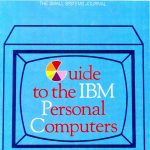
    This issue of Byte was a special issue emphasizing IBM. The IBM PC had been released a few years earlier and even in 1984, it wasn’t a given that the PC and DOS were going to take over the world. CP/M was still around with CP/M 86 having been introduced as well and even “compatible” PCs were not always that compatible yet. I think Byte did one of these IBM special issues (which also covered IBM’s larger systems as well) for a few years at least. The September 1984 issue of Byte includes:

    Introduction

    • IBM and its PCs – How IBM stepped into a void in a crowded market to provide the ability to address a lot of memory (for the time), an 80 column display, an open system architectures, and a good keyboard/word processing combo…a combination of features lacking in other systems. I find it interesting that this editorial calls the IBM PC the third major standard behind CP/M and the Apple II. Not sure how the Apple II gets that label as there were other machines nearly or in some cases more popular. The Apple II line (including the IIgs) sold 5-6 million machines, the TRS-80 line sold 2.5 million, Atari sold 4-5 million Atari 8-bit computers and the Commodore 64 sold 17-20 million Commodore 64s and I don’t think that number includes the compatible Commodore 128 that sold around 4 million. Granted, all of these systems were still in production when this issue was published so these numbers had not yet been reached.
    • IBM Personal Computers at a Glance – While there were a number of upgrades available, a basic IBM PC in 1984 included an Intel 8088 4.77MHz CPU, 256K RAM (max 640K), 360K 5.25-inch floppy drive, and five expansion slots for $1995. The IBM PC XT was very similar but included a 10 MB hard drive and eight expansion slots and cost $4395. The PCjr was IBMs attempt at a purely “home computer” and included only 64K (max 128K) and a terrible chicklet keyboard but included a built-in color adapter and cartridge slots (but no standard expansion slots). Finally, there was the IBM Portable PC which basically had the same specs as the IBM PC in a luggable form factor and built-in 9-inch amber monitor. Then there were specialized configurations designed for use with IBMs mainframes and other specialized machines.
    • Forecast: Market Dominance – IBM shipped 600,000 IBM PCs and XTs in 1983 and all signs were pointing to dominance by IBM in the personal computer market. It would take almost another decade before the IBM PC standard was essentially the only standard. Ironically, in another 10 years IBM would be exiting the personal computer business.

    Stalwarts

    • A Tale of Two Operating Systems – A comparison of Microsoft’s PC-DOS (which was at version 2.0 at this point) and IBM’s XT/370 OS.
    • The Future of UNIX on the IBM PC – A look at UNIX on the IBM PC (which was already available at the time).
    • Five Window Managers for the IBM PC – Before Microsoft Windows came to dominate, there were numerous other window managers that ran on top of DOS. This article includes a preview of five of them including DesQ, WindowMaster, VisiOn, Concurrent DOS, and of course Windows itself.
    • Two Logos for the IBM PC – A comparison of two implementations of Logo including one by Digital Research (DR Logo) and one by IBM (IBM Personal Computer Logo).
    • The Logical Record Keeper: PROLOG on the IBM PC – A look at a PROLOG implementation for the IBM PC based on DEC-10 PROLOG.
    • An Introduction to PC Assembly Language – A beginner’s guide to assembly language on the 8088. The only assembly language programming I ever did was on a 68000 in college. I understand that the 68000 is much nicer to program for in assembly than 8086/8088 CPUs and their derivatives.
    • Technical and Business Graphics on the IBM PC – Business graphics meant things like charts, graphs and presentation software. While most things are PowerPoint today, such “business graphics” were done with a combination of spreadsheet software, graphing software, and presentation software. Some of the software looked at here includes SuperCalc3, Lotus 1-2-3, GrafTalk, Business Graphics System, DR Graph and ChartMaster.
    • Word Processing Revisited – Reviews of the latest versions of WordStar, Word, pfs:Write, MultiMate, and FinalWord.
    • Six Database-Management Systems for the IBM PC – A comparison of six popular DBMSs for the PC including Condor 3 2.11, dBASE II 2.4A, R:base 4000 1.10, KnowledgeMan 1.06, C.I.P 1A, and pfs:file/pfs:report.
    • Evaluating 8087 Performance on the IBM PC – The 8087 is the optional math co-processor that works with the IBM PC and IBM PC XT (as well as some clones). This article evaluates its performance and even compares some functions on a Cray super computer (which was “only” 180 times faster in some cases).

    Extra Power for Special Needs

    • The IBM XT/370 Personal Computer – The XT/370 was a special version of the IBM PC XT that could operate as an XT personal computer, an interactive full screen terminal to a mainframe, or in a mode that can actually run System/370 programs.
    • Number Crunching on IBM’s New S9000 – The S9000 was based on the Motorola 68000 CPU and could use large amounts of RAM (2 MB or more). It was designed for scientific uses and this article evaluates its performance for use in nuclear magnetic resonance spectrometry.
    • The Mainframe Connection: IBM’s 3270 PC – The 3270 PC was a special version of the PC that included the high speed terminal interface for mainframes and could simultaneously run DOS programs.
    • Modems: The Next Generation – A comparison of some of the latest modems including the Prentice X100 POPCOM ($475), Hayes Smartmodem 1200B ($599), Bizcomp PC-Intellimodem ($499), Novation ACCESS 1-2-3 ($595), Cermetek INFO-MATE 212PC ($480), and Microcom ERA2 ($499). All support 1200bps.
    • Moving Data Between PCs and Mainframes – Today, moving data around is trivial. In the olden days, moving data between mainframes and personal computers could be more of a pain.
    • Testing for IBM PC Compatibility – There were many PC “compatible” machines by 1984. However, in the early days, compatibility could vary. Some machines were more compatible than others. This article presents two programs that can test for compatibility issues.
    • What’s New – CallText 5000 text-to-speech converter and telephone interface, Micro-Design hard drives (5 to 22 MB), RAM+6 multifunction card with real-time clock, Multi-Tech MultiModem, AST MPII 64K memory expansion and clock/calendar, Spellbinder, PortaAPL, Metafile 8.0, and much more.

    …and more!


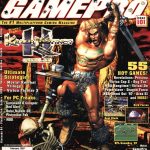
  • GamePro (February 1997)

    Source: GamePro – February 1997

    Along with Electronic Gaming Monthly, GamePro was one of the most popular gaming magazines for a long time. In 1997 is was primarily covering the Nintendo 64, PlayStation, and Sega Saturn and was also still covering the Super NES, Sega Genesis and Neo Geo. It also had a little PC and arcade coverage. The February 1997 issue includes:

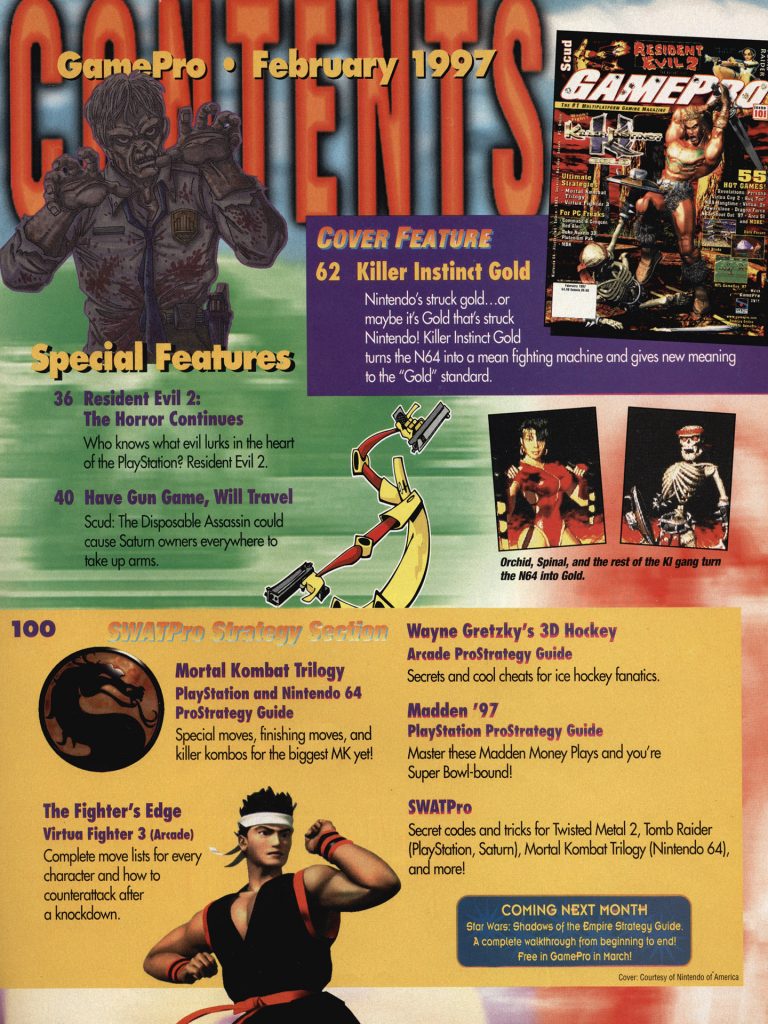
    Cover Story

    • Killer Instinct Gold – A preview of ths $80 cart for the Nintendo 64 and is basically a combination of Killer Instinct and Killer Instinct 2.

    Special Features

    • Resident Evil 2: The Horror Continues – The first sequel to the immensely popular survival horror game on the PlayStation.
    • Have Gun Game, Will Travel – A somewhat humorous light gun game that combines both first person and side-scrolling sections. It can be played with one or two players.

    SWATPro Strategy Section

    • Mortal Kombat Trilogy – A strategy guide for Mortal Kombat Trilogy on the PlayStation and Nintendo 64. As the name suggests, this game is really a combination of the first three Mortal Kombat games.
    • The Fighter’s Edge: Virtua Fighter 3 – A complete move list for all characters and how to counterattack in Virtual Fighter 3 in the arcade.
    • Wayne Gretzky’s 3D Hockey – A strategy guide for this arcade hockey game featuring various secrets and cheats.
    • Madden ’97 – A strategy guide for this early Madden game on the PlayStation.
    • SWATPro – Codes and various tips for Twisted Metal 2 (PlayStation), Tomb Raider (PlayStation, Saturn), Mortal Kombat Trilogy (Nintendo 64), and lots of other games.

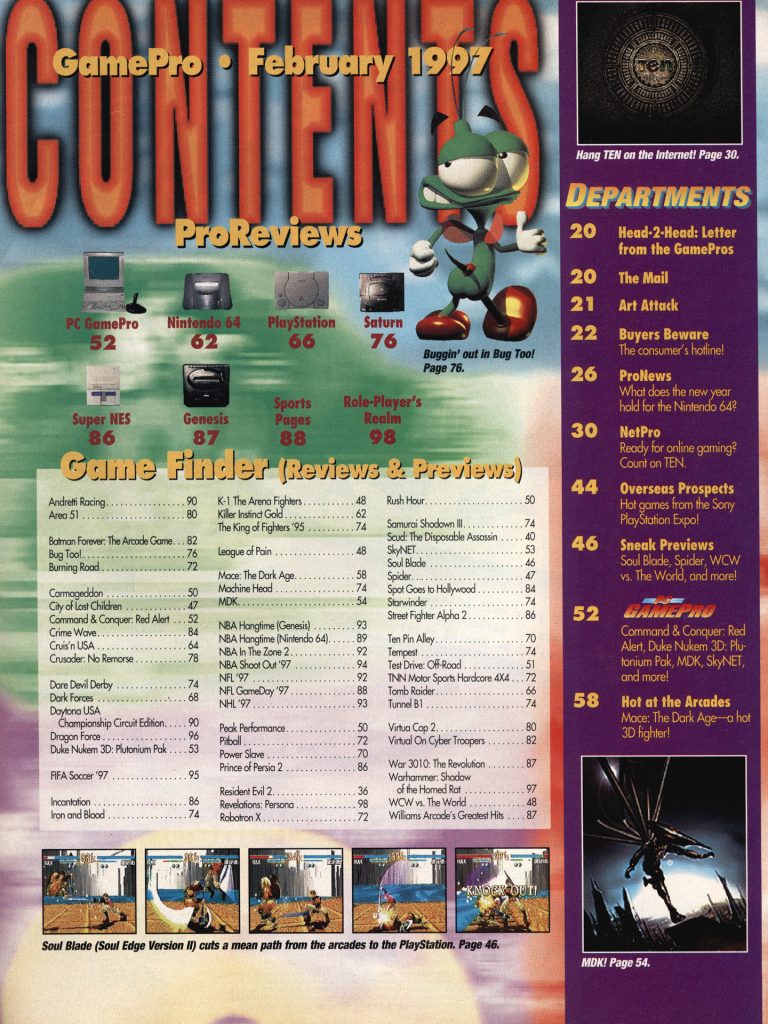
    ProReviews

    • PC GamePro – Reviews of Command & Conquer: Red Alert, Duke Nukem 3D Plutonium PAK, SkyNET, and MDK.
    • Nintendo 64 – Reviews of Killer Instinct Gold, and Cruis’n USA.
    • PlayStation – Reviews of Tomb Raider, Dark Forces, Ten Pin Alley, Power Slave, PitBall, Burning Road, Robotron X, Hardcore 4×4, The King of Fighters ’95, Dare Devil Derby, Starwinder, Iron and Blood, Samurai Showdown III, Tempest, Machine Head, and Tunnel B1.
    • Saturn – Reviews of Bug Too!, Crusader, Virtua Cop 2, Area 51, Virtual On Cyber Troopers, Batman Forever: The Arcade Game, Spot Goes to Hollywood, and Crime Wave.
    • Super NES – Reviews of Street Fighter Alpha 2, Prince of Persia 2, Incantation, and War 3010: The Revolution.
    • Genesis – A reviews of Williams Arcade’s Greatest Hits.
    • Sports Pages – Reviews of NFL GameDay ’97 (PlayStation), NBA Hang Time (Nintendo 64), Andretti Racing (Saturn), Daytona USA Championship Circuit Edition (Saturn), NBA In The Zone 2 (PlayStation), NFL ’97 (Saturn), NHL ’97 (Saturn), NBA Hangtime (Genesis), NBA Shoot Out ’97 (PlayStation), FIFA Soccer ’97 (Nintendo 64),
    • Role-Player’s Realm – Reviews of Dragon Force (PlayStation), Warhammer: Shadow of the Horned Rat (PlayStation), and Persona (PlayStation).

    Departments

    • Head-2-Head: Letter from the GamePros – Discussion about 3DO’s upcoming new M2 system.
    • The Mail – Letters from readers about 3DO, secret codes for Twisted Metal 2, Tecmo’s Deception, and more.
    • Art Attack – Reader submitted artwork.
    • Buyers Beware – Modifying your PlayStation to play Japanese games, Nintendo 64 controller problems, Xband support, and more.
    • ProNews – N64 and PSX game releases delayed, including Shadows of the Empire, Curis’n USA, Tetrisphere, Turok, Mission Impossible, and others; Virtual Boy discontinued; and more.
    • NetPro – How to play online games via TEN.
    • Overseas Prospects – A look at Sony PlayStation Expo ’96 in Chiba, Japan. Some new games shown include Final Fantasy VII, Puzzle Fighter, Rockman (Mega Man) 8, Ace Combat 2, Soul Edge, and more.
    • Sneak Previews – Previews of upcoming games including Spider (PlayStation), City of Lost Children (PlayStation), WCW vs. The World (PlayStation), League of Pain (PlayStation), Carmageddon (PlayStation, DOS), Rush Hour (PlayStation), Peak Performance (PlayStation), and Test Drive: Off-Road (PlayStation DOS, Windows 95).
    • Hot at the Arcades – A look at Mace: The Dark Age, a 3D fighting game from Atari Games.

    …and more!