Source: Compute! – Issue Number 12 – May 1981
Compute! was one of the earliest and longest running multi-format computer magazines published in the U.S. In the early days, it covered the Atari 400/800, Apple II and Commodore PET as well as various kit computers. The May 1981 issue includes:
- The Editor’s Notes – A look at some of the things seen at the West Coast Computer Faire, including the Votrax Type-‘N-Talk text to speech synthesizer, the Commodore Super-PET, A 256K memory expansion from Axlon for the Atari 800, and more.
- The Readers’ Feedback – Praise for the magazine, small business programs for the Atari, improving magazine distribution, and more.
- Computers and Society – Addressing computer phobia.
- Computer Aided Instruction, Boon or Bust? – Analyzing the effects of computers in the classroom. Still a novel idea at the time.
- They Mysterious and Unpredictable RND – The last part in a series on random numbers. This part presents solutions for finding maximum and minimum numbers in a sample of random numbers, simulating dice rolls and a number of other exercises.
- Land of the Lost – A Program For a Cassette Filing System – A type-in menu-driven program to create labels for cassettes (the dominant home computer storage medium of the time).
- Using The 6522 to Drive a Printer – How to construct an interface for a parallel printer and create a machine language program to drive it using a Comprint 912P printer and OSI computer.
- Using the Aim 64 as a Remote Terminal for an Apple – Using a 6551 ACIA (Asynchronous Communications Interface Adapter) and RS-232C interface, NOVATION CAT modem, and AIM 65 single board computer to create a terminal for an Apple II.
- EPIDEMIC – A Simulation of an Epidemic – A type-in BASIC program for the PET that simulates the spread of an epidemic based on your inputs.
- A Floating Point Multiplication Routine – A type-in machine language program that converts two signed numbers to floating-point binary numbers and performs multiplication with 9 digit accuracy.
- Naming Compounds – A type-in program for the PET designed for high school chemistry students that can test students on naming compounds and creating formulas from the names.

The Apple Gazette
- Using Named GOSUB and GOTO Statements in Applesoft BASIC – A simple way to create named subroutines vs. just using line numbers.
- Commas, Colons, and Quote Marks Too – Writing BASIC programs that can accept commas, colons and quotation marks as part of their input.
- Generating Lower Case Text on the Apple II Plus Using the Paymar Chip – By default the Apple II Plus could only display uppercase letters. However, it could be modified with a PAYMAR (LC-1) so that lower case letters could be used. The type-in program can then convert strings in your BASIC programs to lowercase.
The Atari Gazette
- A Cure for Atari BASIC or, Make Your Atari a Bit Wiser – An assembly language program that adds the ability to do bitwise operations in Atari BASIC.
- Copy Your Atari Screen to Your Printer – A short BASIC program that will dump the contents of the screen to a printer.
- Hardware Information at Last! – Three new Atari technical manuals, including Atari 400/800 Technical User Notes, Atari 400/800 Operating System, and Atari 400/800 Disk Operating System.
- Using Strings for Graphics Storage – A method for using BASIC strings to create graphics on the Atari.
- Atari Machine I/O – Three machine language routines for processing input.
- Disk Directory Printer – A couple of BASIC programs for creating directory listings of your disks.
- Condensing Data Statements on the Atari – Using characters instead of numbers in DATA statements used as input for machine language programs to save space (one character equates to one to three digits).
- Real-Time Clock on the Atari – A BASIC program that can set, configure, and use the real-time clock included in Atari computers.
- Review: Stud Poker – A simple poker game designed to run on Atari computers with 16K.
The OSI Gazette
- Through the Fill-The-Buffer Routine with Gun and Camera – Some technical info on how the “Fill-the-Buffer” routine (FTB) of OS BASIC works.
- FOOTU: FOO Revisited – Converting FOO (a racing game for the OSI) to run on OSI systems with BASIC-in-ROM.
The PET Gazette
- A Fast Visible Memory Dump – A program for creating a graphical memory dump to a printer.
- Machine Language: Getting to the Machine Language Program – Methods for combining BASIC programs with machine language routines.
- A Thirteen Line BASIC Delete – A short BASIC program that allows you to delete any group of lines form an existing program.
- Calculated Bar-graph Routines on the Pet – How to calculate the length of bars in a bar graph so that they can be properly printed.
- The Revised Pet/CBM Personal Computer Guide – A look at the changes in the newest revision of the Osborne/McGraw-Hill Pet/CBM Personal Computer Guide.
- Un-Compactor – A BASIC program that reverses the process of the Compactor program published in a previous issue. It would “compact” programs by doing thing like combining multiple programming lines onto one line and separating them by colons, etc.
- Using the Hardware Interrupt Vector on the Pet – Making the PET execute your machine language program every 60th of a second using the hardware interrupt vector while BASIC programs run normally.
- Pet as an IEEE-488 Logic Analyzer – Using another PET and a IEEE interface cable to see what is going on on the GPIB.
- Running 40 Column Programs on a CBM 8032 – A way to make 80-Column PETs work like 40-Column PETs.
The SBC Gazette
- Nuts and Volts – Information about building your own microcontrollers.
- A Kim-1 Music File in Microsoft Basic: Part 1
- New Products – Atari sponsors contest for new software; the BYTEWRITER-1 dot matrix printer from Microtek; Hayes releases the Smartmodem, a 300 baud modem that set the standard for years to come for $279; and more.
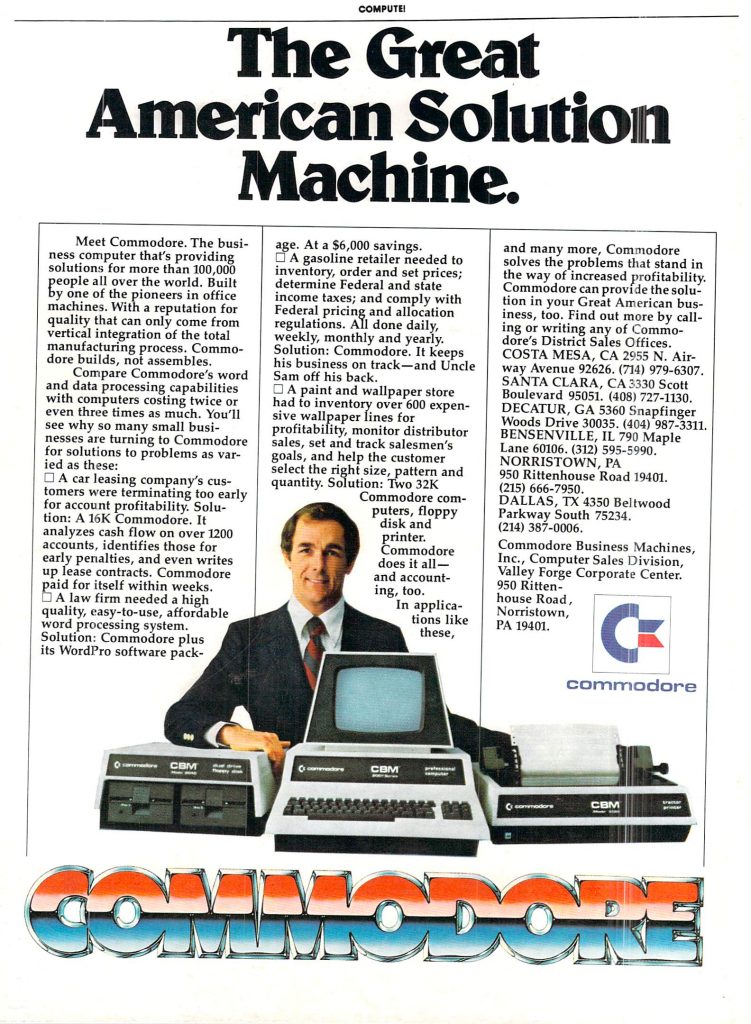
…and more!