• Category Archives Amiga
  • Google emulates 1980s-era Amiga computer in Chrome

    The Amiga 500 lives again — in Google’s browser.

    Google developer Christian Stefansen on Thursday resurrected a version of the venerable computer system from the 1980s in the form of a Web app that runs in Chrome. Forty-year-olds who want to relive their childhoods or younger people who want to see just how hard their elders had it can visit the Amiga 500 emulator for Chrome online, boot the machine, and play some games.

    Chrome emulates the old operating system by a Chrome-specific version of the Open Source Universal Amiga Emulator. Stefansen brought its 400,000 lines of code, written in the C programming language originally, to the Portable Native Client (PNaCl) foundation built into Chrome.

    The Native Client technology runs software written to run on a particular processor at close to the speeds that native software runs. The approach gives software more direct access to a computer’s hardware , but it also adds security restrictions to prevent people from downloading malware from the Web that would take advantage of that power.

    Native Client started with x86 chips, but Google has been expanding it with the PNaCl version. PNaCl is processor-independent, letting programmers run native code for the ARM chips in mobile devices — and the old Motorola 68000 family that was at the heart of the Amiga 500.

    Full article: http://news.cnet.com … -computer-in-chrome/


  • Amiga World Tech Journal, December 1991

    Amiga World Tech Journal, December 1991

    Amiga World Tech Journal was a very technically oriented spinoff of Amiga World. Only seven issues were published in 1991 and 1992. The December 1991 issue includes:

    Articles

    • 68030 to 68040 Differences – Explore Motorola’s speed demon
    • Clean Up Your Programs – Debugging with Enforcer and Mungwall
    • Efficient Assembly Programming – Combine low-level banging with system calls
    • Custom Interfaces with ARexx – Add a GUI to Lharc
    • “Pure” Tricks with SAS/C – Safe resident code
    • Inside MIDI – What it means – beyond Musical Instrument Digital Interface
    • Designing a Device Driver – Don’t embed commands, collect them in a driver
    • Spawning Tasks – Create synchronous and asynchronous processes in C
    • Programming 2.0’s NewMenus – More help from gadtools library
    • Programming Serial.Device – Find more control below SER:
    • Hard Disks: How Fast Are They Really? – Translating the spec-sheet to real performance

    Reviews

    • Amiga UI Style Guide – The definitive word on look and feel

    Columns

    • Message Port – Who are you?
    • Digging Deep in the OS – An introduction to tags
    • Graphics Handler – 2.0 changes to graphics.library
    • TNT – Products and news worth noting
    • Letters – The floor is yours…

    On Disk

    • Loads of Libraries
    • Custom Printer Drivers
    • Plus source code and executables for articles

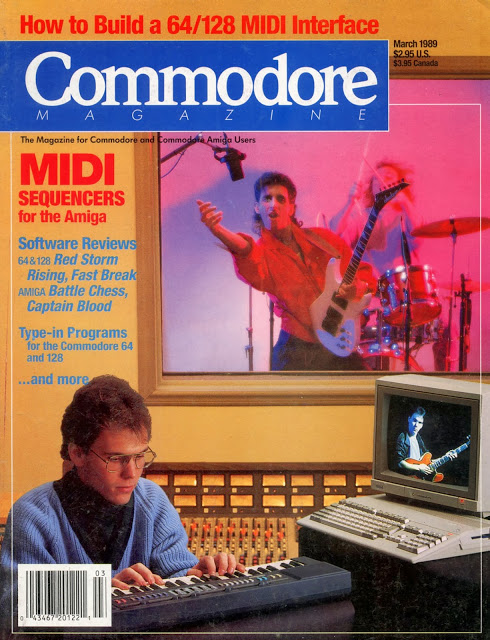
  • Commodore Magazine (March 1989)

    Commodore Magazine, March 1989

    Commodore published a number of official publications over the years with Commodore Magazine being the final one. It covered the Commodore 64, Commodore 128 and Amiga. They did a pretty good job covering all three systems as opposed to reducing Commodore 8-bit coverage in favor of the Amiga. However, at the end of 1989 they ceased publication with some of the Commodore 64 columns being absorbed by RUN magazine.

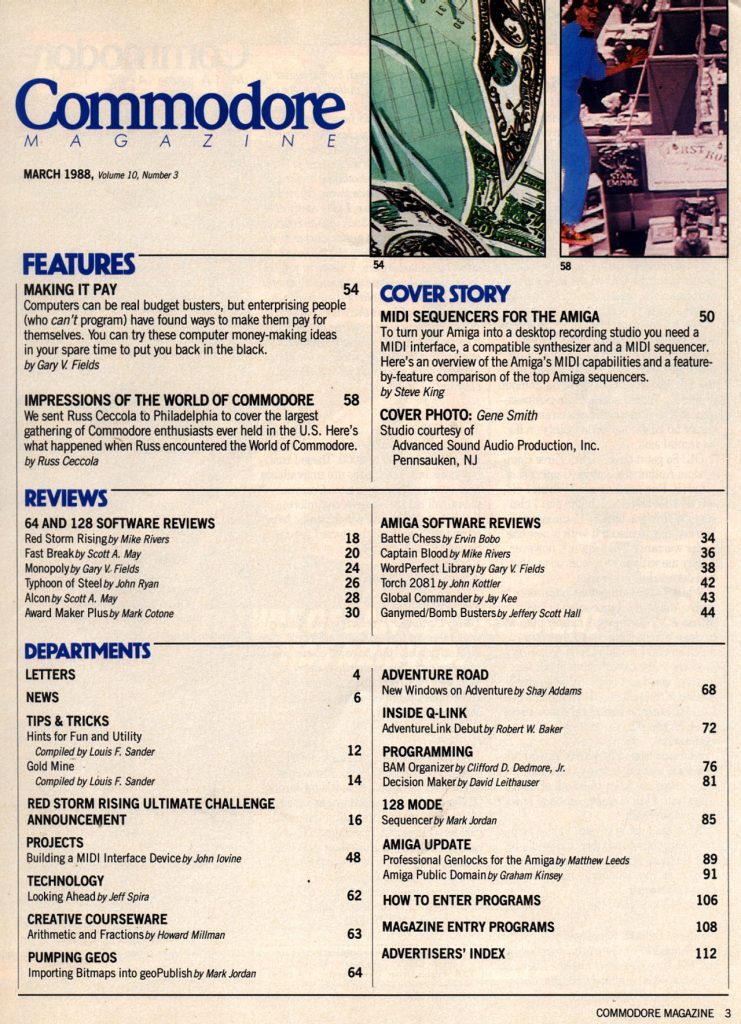
    The March 1989 issue of Commodore Magazine includes:

    Features

    • Making It Pay – This article covers various ways you can make money with your computer. Some examples include writing custom software for businesses, training people how to use common business applications such as word processing and database management programs, keeping track of other people’s stock portfolio’s, typing papers for college students, resumes, etc., preparing tax returns, and more.
    • Impressions of The World of Commodore – A look at the first World of Commodore show in the U.S. (previous shows had all been in Canada). It was held in the Philadelphia Civic Center on the last weekend in November, 1988. There were nearly 70 exhibitors selling Commodore related hardware and software.
    • Cover Story: MIDI Sequencers for the Amiga – While the Atari ST became the preferred machine for MIDI related stuff, the Amiga was quite capable as well. This article gives an overview of some of the MIDI sequencers available at the time, including KCS, Texture, MIDI Magic, Dynamic Studio and Soundscape.

    Reviews

    • 64 and 128 Software Reviews
      • Red Storm Rising – Participate in World War III from the comfort of your Los Angeles Class nuclear submarine. Based on the Tom Clancy book of the same name.
      • Fast Break – A pretty good basketball game from Accolade.
      • Monopoly – A computerized version of the classic board game.
      • Typhoon of Steel – A detailed World War II strategy/war game from SSI.
      • Alcon – A nice arcade conversion from Taito of this vertical shooter.
      • Award Maker Plus – A program for designing and printing award certificates.
    • Amiga Software Reviews
      • Battle Chess – Perhaps the first chess game that was fun to play even if you didn’t like chess.
      • Captain Blood – A sci-fi graphics adventure game from Mindscape in which you get sucked into the universe you created.
      • WordPerfect Library – A collection of five utilities designed to make you more productive, including a calculator, calendar, file manager, notebook and program editor.
      • Torch 2081 – An action strategy game in which you must build a barrier with your Star Defense Glider to protect the planet from fireballs. It plays a bit like Qix.
      • Global Commander – A difficult strategy game in which you play the role of something akin to the head of the U.N. as you try to keep the world from going to war.
      • Ganymed/Bomb Busters – Ganymed is an arcade game with a Star Wars theme that looks like a much more advanced version of Empire Strikes Back on the 2600. In Bomb Busters you must collect all the bombs in each level before they explode while avoiding various whimsical enemies.
    Commodore Magazine
    March 1989, Volume 10, Number 3
    Page 003 (Contents)

    Departments

      • Letters – Letters from readers about mouse cleaning and where to buy Amiga related hardware in Saudi Arabia.
      • News – Commodore announces the Amiga 2000HD and Amiga 2500; the second U.S. World of Commodore show is announced for May 19-21, 1989 at the Los Angeles Convention Center; Commodore and Moniterm Corp. release a high-res monochrome monitor for the Amiga called the Viking 1; Accolade releases Grand Prix Circuit for the Commodore 64 (I spent many hours playing this game); Paragon announces Spider-Man and Captain America in Dr. Doom’s Revenge; Titus Software releases Galactic Conqueror for the Amiga, Electronic Arts releases MacArthur’s War, a Koran War strategy game for the C64; Arcadia releases Double Dragon for the C64; Commodore releases the PC40-II, a 80286 based PC compatible computer; and much more.
      • Projects – Detailed instructions for building a MIDI Interface Device for the Commodore 64 and 128.
      • Technology – A look ahead to the future of malware (a word not yet in use at the time) and the difference between Viruses, Worms and Trojan Horses.
      • Creative Courseware – A look at some educational software for the Commodore 64, including Piece of Cake Math (for ages 7-13) and Fraction Factory (for ages 8-14).
      • Pumping GEOS – A guide to importing images into geoPublish plus other tips and tricks for creating and printing newsletters with geoPublish.
      • Adventure Road – A look at two role-playing/adventure games: Times of Lore, a fantasy role-playing game and Neuromancer, based on William Gibson’s cyberpunk classic.
      • Inside Q-Link – The online service for Commodore 64 owners debuts a new service called Adventure-Link for creating and playing adventure games.
      • Programming
        • BAM Organizer – A type-in disk utility program that lets you easily perform various disk management tasks such as deleting files, renaming files, and locking/unlocking files among other things.
        • Decision Maker – A type-in program designed to help you make decisions between, for example, two different products.
      • 128 Mode – A type-in educational game for the Commodore 128 that helps you learn “sequences” such as the order of presidents, etc.
      • Amiga Update
        • Professional Genlocks – Genlocks are devices designed to perform a variety of functions related to using the Amiga with TV video, including converting RGB to composite video, locking the timing of Amiga generated video to an external video signal and overlaying Amiga generated graphics on top of an input video signal. A summary of several professional Genlock devices are given here, including: SuperGen by Digital Creations, Magni 4004 by Magni Systems, and GEN/ONE by Communications Specialties Inc.
        • Amiga Public Domain – A look at some recent Amiga public domain software including AZComm, a terminal program; Friends, a tool for adding a mouse trail; PcPatch, a tool for copying MS-DOS files on your Amiga; Conman version s1.3, a tool for making the command line interface easier to use; ShoANIM version 5.3, a video player; NotBoingAgain, a demo; and several others.
    Commodore Magazine
    March 1989, Volume 10, Number 3
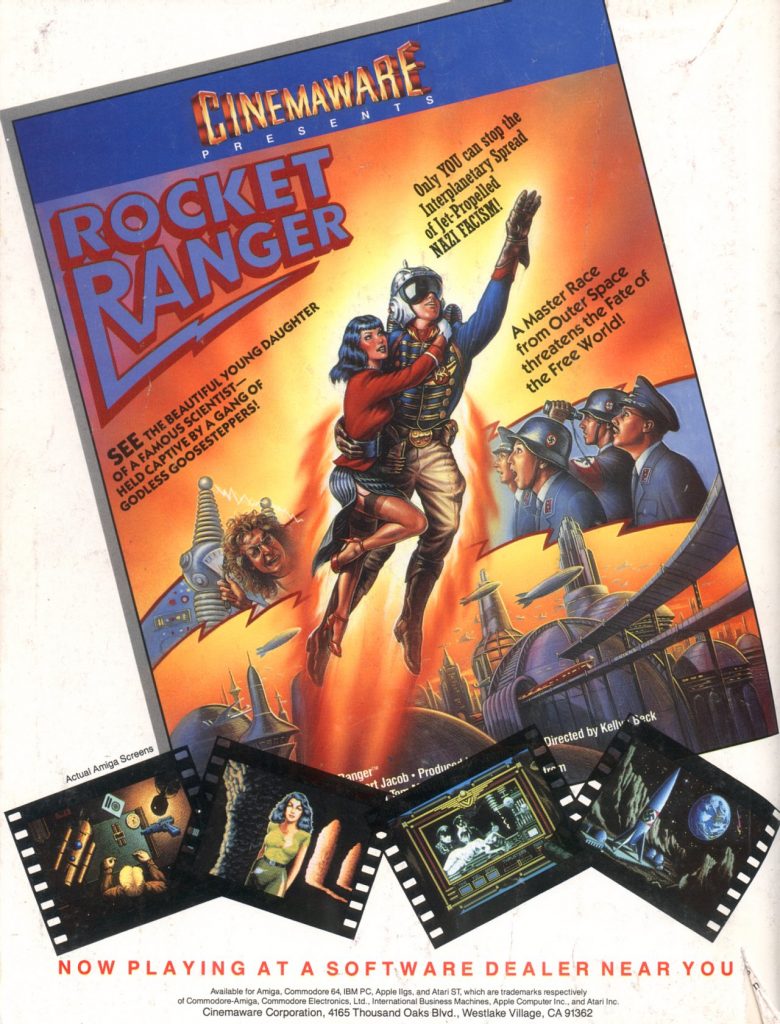
    Page 114 (Advertisement)
    Cinemaware
    Rocket Ranger (Amiga, Commodore 64, IBM PC, Apple IIgs, Atari ST)

    …and more!