• Tag Archives retrogaming
  • The One (January 1993)

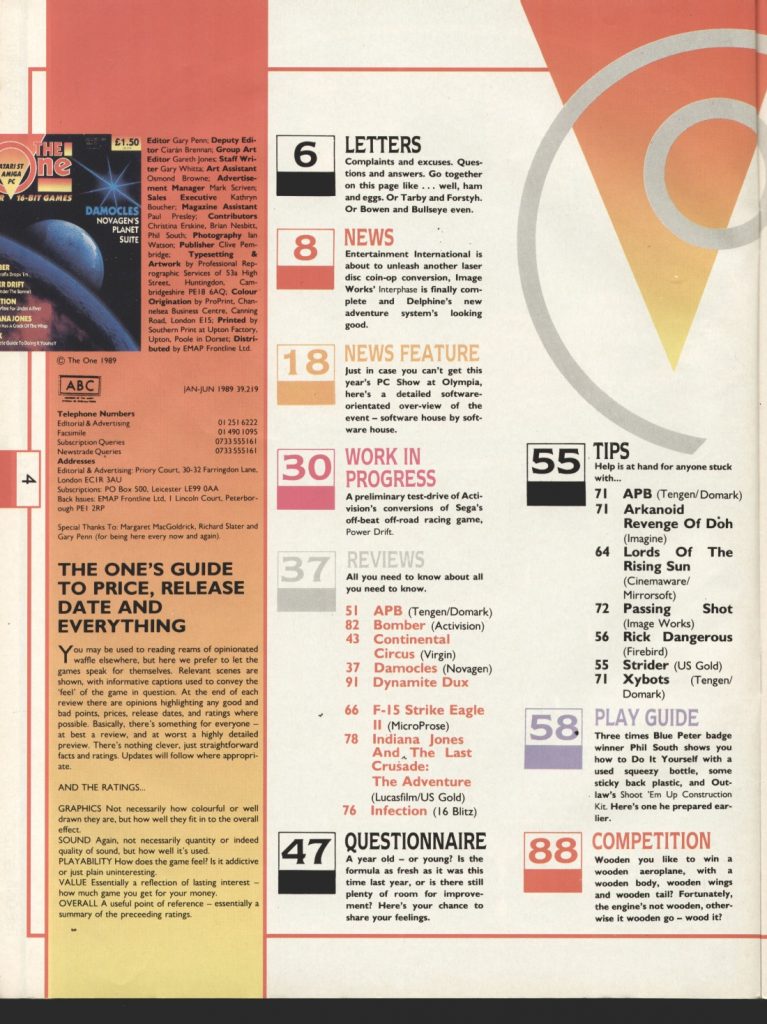
    Over the course of its life, The One mostly covered games on 16-bit computers. The platforms differed over the years but by early 1993, The One was called The One Amiga and exclusively covered that platform. The January 1993 issue includes:

    • Boot Sector – Contents of the cover disks this month include one complete game (Psycho Santa) and three demos (Doctor Who, Gunship 2000, and Archer MacLean’s Pool).
    • News – Two new games coming from Digital Image Design for the Amiga 1200 including Odyssey and TFX Inferno; new platform game from Miracle Games called Miracle Bat; new Amiga joystick (Argostick) from Cheetah; new version of Zool for the Amiga 1200; and more.
    • Letters – Letters from readers about competitions, piracy, Superfrog, 16-bit consoles vs. the Amiga, and more.
    • The Dirty (Half) Dozen – An interview with Amiga software developers Martin Kenwright, Andrew Baybrook, Eric Matthews, Archer Maclean, Jon Hare, and Mev Dinc.

    • Fantastic Voyages – Two new CD-ROM based games coming from Psygnosis including Microcosm and Dracula.
    • Work In Progress – A look at two more upcoming games still in progress including SuperHero and Dune 2.
    • That Was The Year That Was… – The One annual game awards. Some of the winners include Another World (best graphics), Wizkid (best sound, most original), Legends of Valour (best technical achievement), Sensible Software (best programming team), Team 17 and Renegade (best software house), and Sensible Soccer (game of the year).
    • Preview 1993 – Previews of games upcoming in 1993 including Jurassic Park, Batman Returns, Syndicate, Lobo, Apocalypse, Splash Jordan, Alien Breed 2, Body Blows, and Sensible Soccer 2.
    • Reviews – Reviews of Indiana Jones IV, Gobliins 2, TV Sports Boxing, Waxworks, Ugh!, Street Fighter 2, Leeds United Champions!, Cool World, KGB, Alien 3, Robosport, Cytron, Tearaway Thomas, and Krusty’s Super Funhouse.

    • Cheapos – A look at recent budget releases/re-releases including Alien Breed ’92 – Special Edition, Future Wars, Flimbo’s Quest, Prince of Persia, Bignose The Caveman, The Grandslam Collection, Combat Classics, Super Fighter, The Dream Team, and Super All-Stars.
    • Tips – Tips, tricks, and strategies for Assassin, Wing Commander, The Legend of Kyrandia, Putty, Dizzy, The Manager, Eye of the Beholder 2, Pinball Fantasies, Test Drive 2, The Humans, Pitfighter, Rodland, Parasol Stars, and Troddlers.
    • PD Zone – A look at some of the latest public domain releases including Baldy, Pacman Deluxe, Atoms, Hellzone, Top of the League, and Leap!
    • The Diary of a Game – Part six of a continuing diary of the making of Uridium 2.
    • Previews – Previews of upcoming games including B-17 Flying Fortress, Combat Air Patrol, Arabian Nights, Darkseed, and Fatal Strokes.
    • Recommended – A list and brief review of highly rated games that might make good Christmas gifts. Games on the list include The Addams Family, Black Crypt, The Aquatic Games, Ashes of Empire, Beast 3, Civilization, Dune, Eye of the Beholder 2, Indiana Jones 4, The Legend of Kyrandia, Lure of the Temptress, Monkey Island 2, Pinball Dreams, Ultima VI, Wing Commander, and many others.

    …and more!

  • Palamedes (NES)

    Palamedes is a relatively obscure puzzle game for the Nintendo Entertainment System that was released in 1990. It’s probably far more obscure than it really should have been as it was originally an arcade game by Taito and it is a fairly solid game for those that like the puzzle genre. It’s not terribly flashy and I think it just got lost in the shuffle in what was probably the most prolific time for the NES and probably puzzle games as well as Tetris had been released the year before.

    The basic concept of Palamedes is pretty straightforward: players must match dice faces to clear a stack of descending dice before they reach the bottom of the screen. The visuals are pretty simple and there are no fancy licensed characters which perhaps contributed to it being overlooked by many (but then the same can be said of Tetris), however the gameplay is what is important and that is pretty solid here. In Palamedes, you control a small character at the bottom of the screen. At the top, a wall of dice slowly descends. Your character holds a die that can be rotated to show any face from 1 to 6. By pressing the button, you can throw your die upward to eliminate a die in the descending wall by hitting it with a matching number.

    What makes the game a little more interesting is that players can perform combos by eliminating multiple dice in a row or in patterns, such as sequences (e.g., 1-2-3) or matching sets (e.g., three of the same number), which result in bonus points and can push the wall back, giving you more time to react. Essentially, you are trying to clear rows just as in Tetris but doing so in a different way. Another plus is the two-player split-screen mode. Like some similar puzzle games, as you clear rows on your side, they are added to your opponent’s side.

    There are two keys to success in this game. The first is being able to quickly rotate the die your are throwing to the value you want. The second is being able to not only quickly identify simple matches, but patterns that can eliminate more dice from the top of the screen in one throw. The early levels are pretty easy but as the speed ramps up, it gets very challenging as you would expect. It can be said for many games, but playing another person is probably the most fun and gives the most replay value.

    While generally viewed positively, even reviewers seemed to largely miss this game. Contributing to the game’s relative obscurity is probably the lack of anything resembling fancy graphics. The dice are easy to see and identify but very simple. Your avatar at the bottome of the screen is likewise fairly simple. I suppose the graphics are fairly colorful but other than that, there’s not much to say about them. Of course, Tetris was likewise very simple graphically but it first gained fame on the Game Boy where simpler graphics were more expected. One thing they definitly could have improved on is the music. It’s relatively simple, repetitive, and definitely not as catchy as Tetris (though your taste may vary). I doubt the box art helped sell the game either. However, neither the simple graphics or repetitive music (or box art) detract from what is pretty solid gameplay.

    If you are a fan of puzzle games then this is definitely one you should check out and one you might have missed back in the day. The screen shots above are from the NES version but it was also released for the MSX, FM Towns, and Game Boy. If you want to play the NES version, this game can be had fairly cheaply especially if you don’t care about it being complete in the box. You can, of course, always emulate but then you probably might as well play the arcade version.

    The ad above is from the March 1991 issue of Game Player’s.