• Category Archives Apple ][
  • Apple ][
  • Avalon Hill’s Under Fire! (Commodore 64)

    https://darth-azrael.tumblr.com/post/189715749036/retrocgads-usa-1988


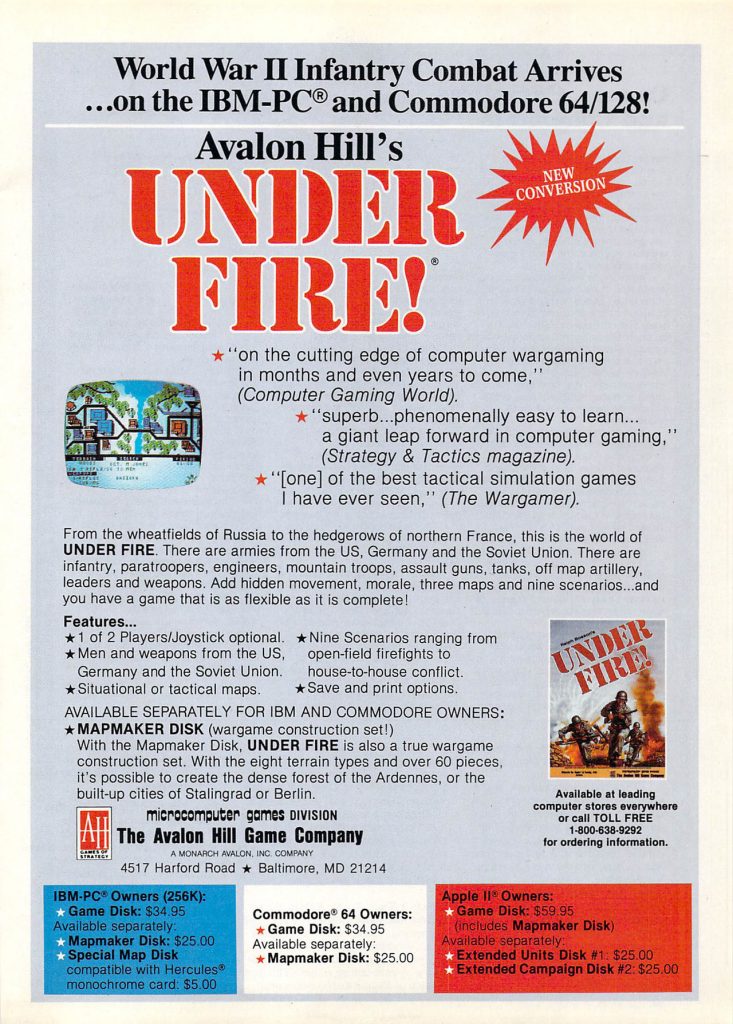
    Avalon Hill’s Under Fire! was the war game to have when it was released, at least if you were a war game aficionado. It was a tactical World War II land combat simulator. The graphics were pretty basic but it was the game play that mattered. Based on the ads, it looks like the Apple II version was released first, followed later by ports for DOS and the Commodore 64. The ad above is from 1988 and is advertising the DOS and Commodore 64 versions as a “new conversion”. While not advertised as such, Under Fire was very much like a computer version of Avalon Hill’s board game, Squad Leader.
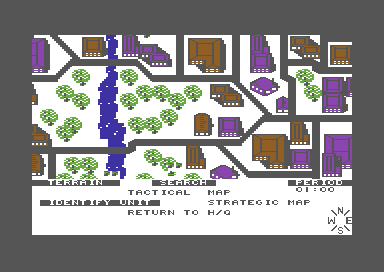
    While the graphics weren’t terrific on any system, they were better on the Apple II and Commodore 64 than the DOS version but that was a trade off for slightly slower game play. The main screen was a simple map divided into squares. The scale of the game or how much space each square represented was user selectable. Units were represented by simple symbols…soldier, tank and halftrack. Under Fire can be played with one or two players. In either case, each “player” enters their orders and then the results play out simultaneously. Depending on the scenario, games can last from 10 minutes to many hours.
    There were two “Extended Capabilities Disk” expansions that added various improvements, units, maps, and scenarios. These were both released only for the Apple II and I believe they were both released before the DOS and Commodore 64 ports. I am unsure whether these additions and improvements were incorporated into those versions or not.
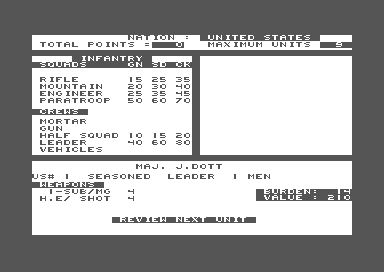
    Tactical turn based games like Under Fire used to be a lot more common than they are now. This is a case where many of the best games in this category are very old games. Under Fire is still worth playing if you like this style of gaming. There aren’t any new versions or ports of this game so you’ll have to track down an original disk or use emulation. I would go with the Commodore 64 version but pick your favorite platform as it doesn’t make a huge difference.

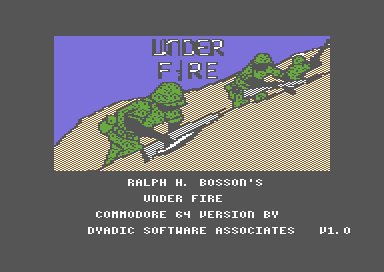
    Screen shots above are from the Commodore 64 version of the game.


  • The Best Of Hardcore Computing (1984)

    Source: The Best Of Hardcore Computing

    Hardcore Computing started life primarily as a magazine that provided information on circumventing disk based copy protection (mostly for the Apple II) though it did contain some other, mostly technical, content. This “Best Of” issue from 1984 includes all such information published by the magazine up until that point in organized, condensed, updated and corrected form. Contents include:

    • Getting into DOS with DISKEDIT
    • An inside look at disk formats using DISKVIEW
    • Deprotecting disks with SUPER IOB
    • A quick and easy way to UNLOCK HYPERSPACE WARS
    • Taking a peek at BOOT CODE TRACING
    • List of Publisher abbreviations and INTRODUCTION TO ‘PARMS’
    • The Compleat Guide to LOCKSMITH PARAMETERS
    • Step-by-step guide to making backups using NIBBLEs AWAY II PARAMETERS
    • Technical notes and making backups using BACK-IT-UP II+ PARAMETERS
    • How to make backups using COPY II PLUS PARAMETERS
    • Curing those Auto-Start ROM blues HARDWARE SOLUTIONS
    • A MENU HELLO PROGRAM
    • USING BOTH SIDES OF YOUR DISKETTES
    • Advanced Playing Techniques, or how to get INSIDE CASTLE WOLFENSTEIN
    • Learn to use and understand Strings wtih TEXT INVADERS
    • Getting into Hi-res with ZYPHYR WARS
    • CHECKSOFT/CHECKBIN

    …and more!


  • Hardcore Computist (August 1988)


    Source: Hardcore Computist – Issue Number 58 – August 1988


    Hardcore Computist was a technically oriented magazine that mostly covered the Apple II. It was controversial for its emphasis on circumventing the disk-based copy protection of the time. The August 1988 issue includes:

    • Editorial
    • Bugs
    • Most Wanted Softkeys

    Features

    • Mixing ProDOS with Thexder – Here’s how to put Thexder on a disk with ProDOS.
    • Infocom Decoder Revisited – Here’s how to add semi-automatic decoding to the Infocom Decoder. No more tedious hand decoding.
    • Cracking on the IIe – Another look at using the auxiliary memory on the IIe to remove copy protection.
    • Might & Magic Revisited – More information on what’s where and how to get a little more. Also included, a complete item list with the various equipping/use effects and bonuses.
    • Might & Magic Character Editor – Some much needed help for the adventurer in a neat and easy to use format.
    • An indepth guide to Ultima IV – A fairly comprehensive look at the excellent adventure.
    • Computing for 1-3 year olds
    • – How to use your computer to teach your child in the formative years.

    • The Product Monitor
    • – Games, Bugs and fixes, and some juicy rumors and propaganda.

    Notes

    • A better way to print Starter Kit DOCs
    • Curing Fatal System Error #0911
    • Realtime Situation Control using CDAs
    • Chuck Yeager’s Advanced Fight Trainer
  • Softkeys
    • A.I.
    • BoulderDash
    • BoulderDash Construction Set
    • DeathSword
    • Design Your Own Home: Architecture
    • Design Your Own Home: Interior
    • Design Your Own Home: Landscape
    • Facemaker
    • Gauntlet
    • Kings Quest II
    • Mastery Arithmetic
    • Microzine #26
    • Muppet Slate v1.0
    • PFS: Graph
    • Rad Warrior
    • Rings of Ziflin
    • Seaspeller
    • Smart Eyes
    • Spell It!
    • Wings of Fury

    APT’s

    • Castle Wolfenstein
    • Marble Madness IIgs
    • Might & Magic
    • Ultima IV
    • Ultima V

    Playing Tips

    • Coveted Mirror
    • Deathlord
    • Might & Magic
    • Oo-Topos
    • Ultima IV

    IBM Notes

    • Help Wanted!

    …and more!