• Tag Archives Tandy
  • Buzzard Bait (Color Computer)

    color-computer-magazine-issue-08-009

    Source: Color Computer Magazine – Issue Number 8 – October 1983

    Despite nearly matching the longevity of the Commodore 64, Tandy’s Color Computer line never really had the third party software support that the Commodore 64 and other 8-bit computers of the time had. The fact that Radio Shack did not really court third party development combined with the fact that the hardware was only sold at Radio Shack probably had something to do with that.

    Buzzard Bait is one example of the games you would typically find for this system. As you can see, it is a blatant rip-off (er…clone) of the arcade game Joust. It actually isn’t terrible (except for the sound which was a limitation of the CoCo series). There were lots of clones of more popular arcade games on the Coco but the quality varied wildly. Some were decent like Buzzard Bait and some were terrible.

    Buzzard Bait was released by a company called Tom Mix Software in 1983. Like much of the software for the CoCo, you could only find it easily via mail order but the company did have a BBS that you could order through so that’s pretty cool. It was available on both disk and cassette and given the fact that it wasn’t marketed through major retail establishments, original copies are probably pretty rare. I didn’t see one on eBay at a glance and that’s usually a pretty good indication. This is one you will probably need emulation to try. However, for a better conversions of Joust, you are better off checking out the official conversions for the Atari 8-bit, Atari 7800 and Atari ST.


  • TRS-80 Model III

    It seems like every computer maker was using some celebrity to sell there machines in the early 1980s. Commodore had the right idea with William Shatner for the VIC-20. Who better to sell a computer than a sci-fi star? Radio Shack did well also with the famed Sci-Fi and science writer Isaac Asimov. Of course, then there was Texas Instruments with Bill Cosby for the TI-99/4A…

    I’m not sure that “You Won’t Find a Broader Line of Microcomputers Than Radio Shack’s TRS-80” is the absolute best endorsement they could have come up with but what they were getting at is that there were a number of TRS-80 models that excelled for different purposes. Most computer makers had basically one model or sometimes two. Apple only really had the Apple II at this point, Commodore the VIC-20 and PET, Texas Instruments the TI-99/4A, etc. Tandy/Radio Shack at this point (circa 1980 or so) had the Model II and Model III (unrelated really), the color computer and a couple of portable models. Interetingly they seem to be advertising the Color Computer as a games machine and in the very early 1980s it was still a selling point to have off-the-shelf software available as opposed to having to write your own. Though the Model III is not mentioned by name in this ad, it is the one that Isaac Asimov is using in the picture.

    In this second ad with Asimov, he is featuring the TRS-80 Model III and in particular it’s ability as a word processing system. It seem that SuperSCRIPSIT must have been the best thing since sliced bread.

    The TRS-80 Model III was probably the most common TRS-80 model at this particular time because of its relative popularity in the education market. Illogically, the Model III was the successor to the original TRS-80 while the Model II was a completely different machine (good thing they didn’t use Leonard Nimoy for this ad). The Model III was completely redesigned into an all-in-one design and had a number of enhancements while maintaining compatibility (at least 80% anyway) with the Model I.
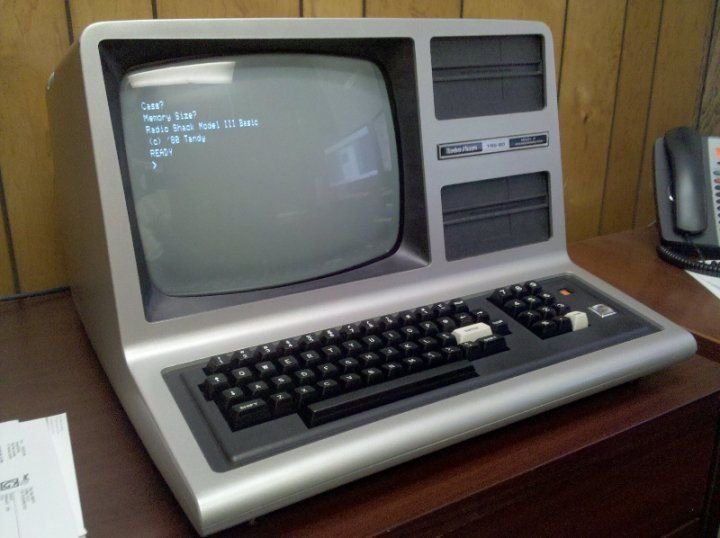
    The Model III was released in July 1980. In addition to being an all-in-one unit, it had a better keyboard, could now do lowercase letters and had a faster processor (a 2.03 MHz Z-80 vs. the 1.77 MHz version in the original) and faster and more reliable disk and cassette interfaces. The lowest end version still only had 4KB of memory but it was expandable up to 48KB. Two floppy drives could be added to the case (typically single-sided, double-density) though a power supply upgrade and system memory of at least 32KB was necessary to do so. TR-DOS 1.3 was the default OS but other 3rd party DOS versions were also available, the most common being LDOS.

    My computer programming class when I was a freshman in high school used TRS-80 Model IIIs and 4s. This was in 1989-90 when they were already long out of date (though the Model 4D was still being sold at this time).

    “Hidden in the trash” was a reference to the ancient TRS-80 line of computers made by Tandy and Radio Shack in the ‘70s and ’80s. Computer users of that era had given the TRS-80 the derogatory nickname of “Trash 80.”

    -Ernest Cline, Ready Player One

    http://darth-azrael.tumblr.com/post/163489632349/anoraksalmanac-hidden-in-the-trash-was-a


  • TRS-80 Model I

    Tandy Radio Shack – 80 Home computer

    TRS-80

    http://darth-azrael.tumblr.com/post/163450055879/retrobear-tandy-radio-shack-80-home-computer

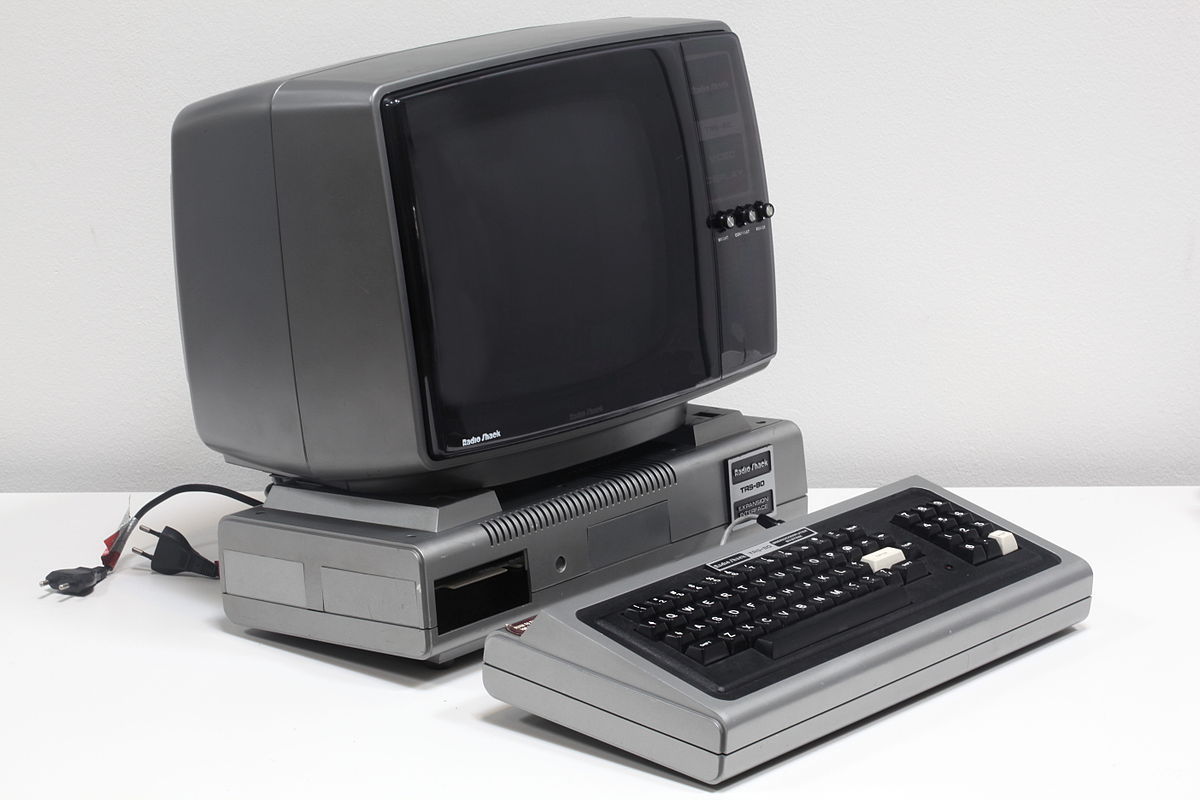
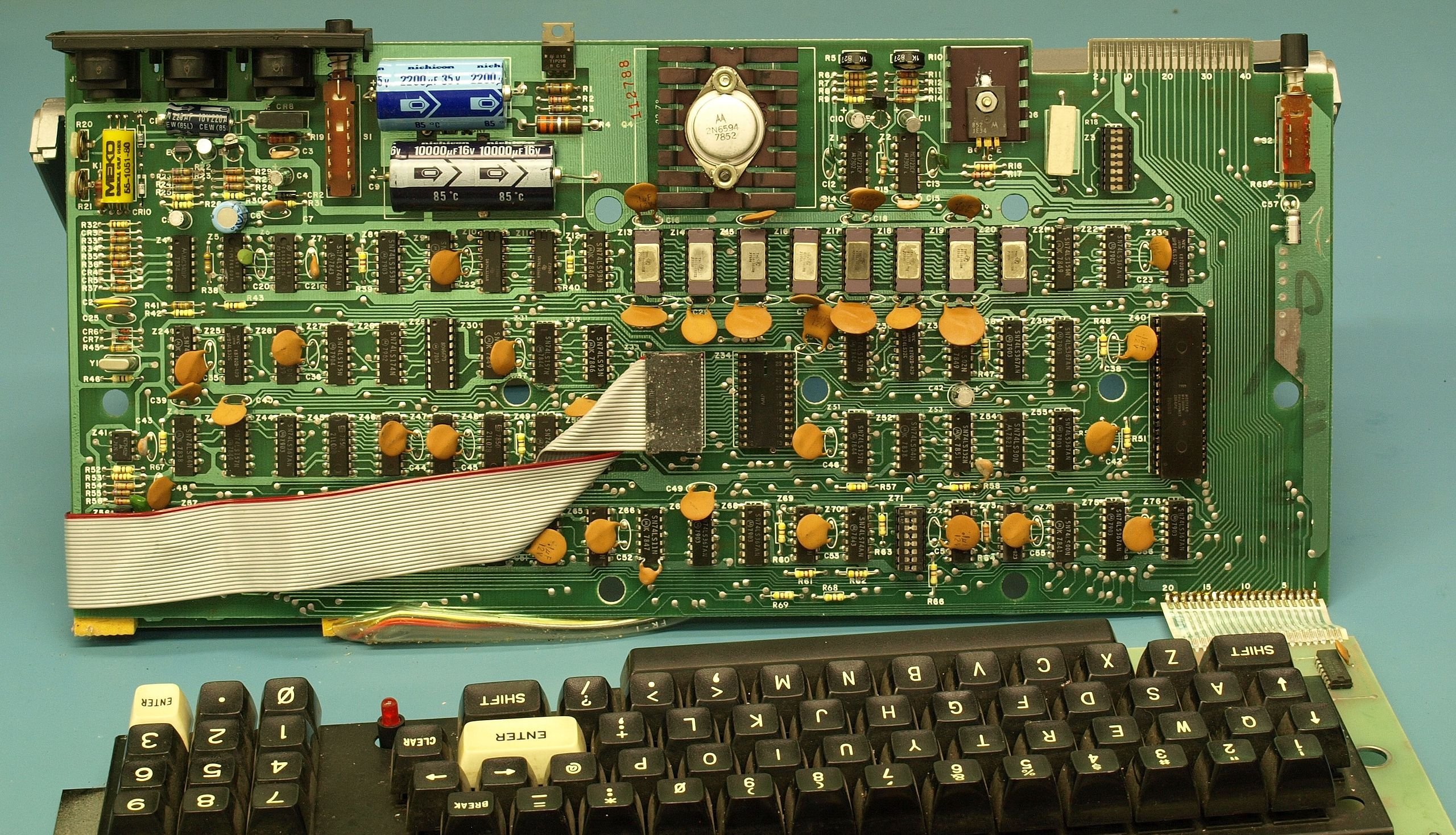
    The TRS-80 Model I (originally just called the TRS-80) was Radio Shack’s first computer. Introduced in 1977, it was one of the earliest home computers. It competed with the Commodore PET and Apple II as well as the Atari 400/800 all of which were introduced around the same time frame. The TRS-80 was based on the Zilog Z80 CPU and originally shipped with just 4K of RAM though it was expandable to 48K. Most other home computers at that time were based on the 6502 processor.

    The TRS-80 enjoyed a brief period of domination as it was the best selling computer, outselling Commodore and Apple, through 1981. It also had the largest selection of software during that time period. In 1980 it was selling at a rate triple that of Apple who was in second place. After 1981, the TRS-80’s dominance faded as cheaper and graphically more sophisticated computers like the VIC-20 arrived and Apple started gaining a greater foothold. The TRS-80 had a disadvantage in that it did not support color graphics or much in the way of graphics at all beyond basic text. Oddly, at a time when most computers had 40-column displays or perhaps 80-column displays with an upgrade, the TRS-80 had a 64-column display. In addition to TR-DOS, the TRS-80 could also run CP/M but only with modifications.

    A cassette tape drive was included with the TRS-80 to save an load programs. However, it was slow and unreliable. It was difficult to adjust the volume settings correctly for saving and it was often a process of trial and error. In order to add any other hardware, including a disk drive, real-time clock, serial port or even a printer, an Expansion Interface box had to be purchased along with the appropriate expansion card. The Expansion Interface (E/I) box is the box the monitor is sitting on in the picture above. The Expansion Interface box included a floppy disk controller. A single density, 85Kb floppy drive became available about six months after the TRS-80 was introduced. This was also initially unreliable, largely due to buggy TRS-80 ROM code but could be compensated for. More capable third party drives eventually became available as did a hard drive but it was extremely expensive at nearly $2500 for 5MB. A second 5MB drive could be added to the hard drive chassis for an additional $2000. The hard drive chassis could hold up to four drives for a whopping 20 MB at a bargain price of $8500.

    Despite Radio Shack’s mostly low quality software, there were a large number of third party titles available that were much better. For a long time, Radio Shack refused to sell any software it did not develop and this probably contributed the the TRS-80’s fall from domination over the years. Despite note having much in the way of graphical capabilities, there were a number of games (including Zork!) available in addition to productivity and other types of software.

    The TRS-80 was succeeded in 1980 by the Model III (the Model II was a completely different non-compatible business oriented machine) and in 1984 by the Model 4. There was also a luggable version (4P) and finally in 1985 the 4D was introduced. This was the last TRS-80 computer and was available all the way through 1991.