• Tag Archives retrocomputing
  • Info (September 1989)

    Info was a magazine for Commodore computer owners. The unique thing about it was that it was also produced using Commodore computers, the Commodore 64 in the early days and later on the Amiga. By 1989, focus had definitely shifted to the Amiga but it was still covering the Commodore 64. The September 1989 issue includes:

    Features

    • Video Boot Camp – A guide to using the Amiga as a video workstation. Includes discussions of Deluxe Paint, external video adapters, genlock devices, digitizers, and more.
    • Video Hardware Roundup – A look at tons of video hardware for the Amiga including video encoders (C-View, ENC-1, A520 Video Adaptor, etc.), Genlocks (Minigen, Progen, Amigen, Supergen, Scanlock, etc.), video digitizers (Perfect Vision, Framegrabber, Live!, Digiview Gold 3.0, etc.), and more.
    • Interview: Gail Wellington – An interview with Commodore’s General Manager of Software & Product Support.
    • Building a Super Amiga – The Amiga, through software and add-on hardware, could be configured to run IBM PC or Macintosh software as well as Amiga software. There was also a version of Unix created for it. This article goes through customizing an Amiga to be able to do all of this and more. The configuration presented here includes an Amiga 2000 with a 100 MB SCSI hard card, a 68030 upgrade card with 8MB of RAM (total 9MB system ram), Commodore’s A2286 Bridgeboard, and more.

    Departments

    • INFOtorial – News on a couple of Amiga related publications ceasing operations including Commodore Magazine and Robo City News.
    • Reader Mail – Mail from readers including one letter from Electronics Boutique about their decision to no longer sell hardware though they mention still selling software for the Amiga, Commodore 64, Apple II, Macintosh and PC compatibles.
    • News & Views – King James Bible now available on disk for the Amiga; Commodore has a new president; Commodore sponsors Library of Congress exhibit; rumors of Hewlett Packard buying Commodore; and more.
    • New Products – A look at recent releases including a new package from Broderbund called The Family Software Library (includes Bank Street Writer, Type!, and Where in Europe is Carmen Sandiego?), the Lattice Communications Library for the Amiga, The Accountant for the Amiga, Argus AniMagic animation software for the Amiga, and more.
    • Magazine Index – A look at what’s been in recent Commodore related magazines including Amiga World, Amazing Computing, The Amiga Sentry, Amiga User International, Byte, Commodore Magazine, Compute!’s Gazette, Computer Shopper, Run, Amiga Transactor, Transactor, AmigaTimes, Amnows, Jumpdisk and Amiga Resource.
    • Games for Amiga – Reviews of new games for the Amiga including Dragon’s Lair II (preview), Archipelagos, Deja Vu II: Lost In Las Vegas, Fright Night, Jack Nicklaus, Gunship, Arthur, Time and Magik, Kingdoms of England, The Last Inca, Fast Break, Vegas Gambler, Indiana Jones & The Temple of Doom, Titan, Battle Squadron (preview), Robot Reader: The Three Bears, Dinosaurs are Forever, and Uncle D’s Con Sound Tration.
    • Games for C64 – Reviews of new games for the Commodore 64 including Risk, Menace, Qix, Total Eclipse, Destroyer Escort, Axe of Rage, Baal, Hostage, Wizardry III: Legacy of Llylgamyn, Project Firestart, Keith Van Eron’s Pro Soccer, and Navy Seal.
    • Public Domain – A look at recent public domain software including three GEOS Utilities (Blue Pencil 1.0, Switcher 1.3, and Printmate), Tic Tock Toe (Tic Tac Toe game with time limits), Flip-Flop (a board game reminiscent of checkers), Authenticalc II (calculator), and much more.

    Reviews

    • Hometown, U.S.A. – Software for the Commodore 64 for creating paper toys.
    • 3D Options – Software for the Amiga that converts IFF bitmapped images into structured drawings.
    • Anti-Virus – Prevents bootblock and worm infections on the Amiga.
    • V.I.P. – Virus Infection Protection protects the Amiga from viruses by keeping a copy of the bootblock.
    • Toshiba 321SLC – A high-end $899 24-pin color dot-matrix printer.
    • Viking I – A 19-inch high-resolution (up to 1008×800) monochrome monitor for the Amiga.
    • A-Max – A Macintosh emulator for the Amiga.

    ETC.

    • Show Reports – Reports from Amiga Festival in San Francisco, World of Commodore Los Angeles, CES Chicago, and Amiga Devcon.
    • BRYCE – A regular comic strip featured in Info.

    …and more!


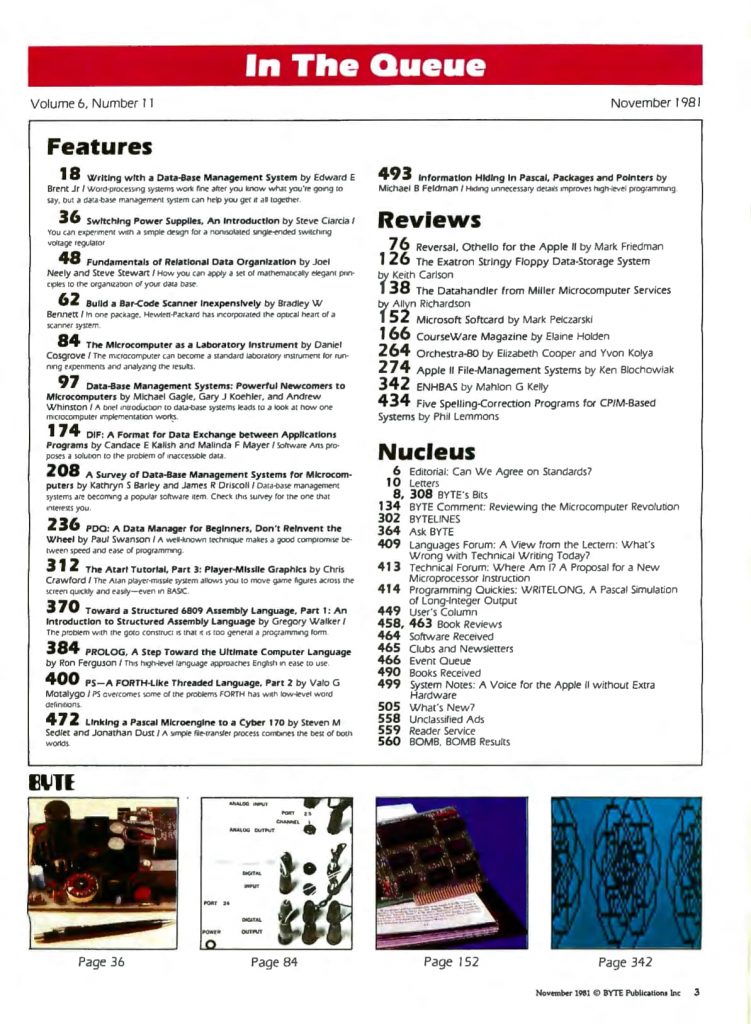
  • Byte (November 1981)

    Byte tended to be the most technical of mainstream computer magazines though it became less so over time. It was not PC specific (after all, it was being published long before IBM’s PC was released). 1981 was the same year the PC first appeared. If you owned a “home computer” it was likely made by Apple, Commodore, Atari, or Tandy. Personal computers on the business side were most often CP/M based. The November 1981 issue of Byte includes:

    Features

    • Writing with a Database-Management System – How a database can help in the early stages of a writing project.
    • Switching Power Supplies, An Introduction – An introduction to building more efficient power supplies that use switching regulators.
    • Fundamentals of Relational Data Organization – A tutorial on relational databases with some examples.
    • Build a Bar-Code Scanner Inexpensively – A guide to building a bar-code scanner. While typing in program listings was common at the time, it was thought that eventually people would be able to scan barcodes vs. hand entering code. While there were some examples of this, the idea never really took off.
    • The Microcomputer as a Laboratory Instrument – Reasons to use a computer as a lab tool and some of its uses including data acquisition, data analysis, and more. The use case presented here is studying the biophysics of plant growth.
    • Data-Base Management Systems: Powerful Newcomers to Microcomputers – Database Management Systems on microcomputers were a relatively new thing at the time. The first big killer apps for microcomputers were the spreadsheet at word processing. This was another.
    • DIF: A Format for Data Exchange between Applications – This was a data exchange standard by Software Arts. I’m not sure if this particular standard ever went anywhere but other companies (like Microsoft) would come up with their own ways of doing this.
    • A Survey of Data-Base Management Systems for Microcomputers – An overview of database management software available for microcomputers. Some of the software looked at here includes The Informer, Data Handler, Cromenco Data Base Management Systems, Micro Manager, MDBS, Selector IV, and more.
    • PDQ: A Data Manager for Beginners, Don’t Reinvent the Wheel – A simple data manager for floppy based systems.
    • The Atari Tutorial, Part 3: Player-Missile Graphics – The third part in a tutorial series on the Atari 400/800. This part covers Player-Missile Graphics which is basically the Atari 8-bit’s version of sprites.
    • Toward a Structured 6809 Assembly Language, Part 1: An Introduction to Structured Assembly Language – Taking a page from structured high level languages like C and Pascal, this article discusses a methodology for doing structured programming in assembly using the 6809. This is the first part in a series.
    • PROLOG, A Step Toward the Ultimate Computer Language – PROLOG is presented here as a language that takes us one step closer to programming in plain English (or whatever spoken language).
    • PS – A FORTH-Like Threaded Language, Part 2 – The second part of the definition of a language called PS which is similar to FORTH.
    • Linking a Pascal Microengine to a Cyber 170 – A guide to sharing resources between a microcomputer (Western Digital Pascal Microengine) and a mainframe (Data Corp Cyber 170).
    • Information Hiding in Pascal, Packages and Pointers – Insulating Pascal programs from low level programming details.

    Reviews

    • Reversal, Othello for the Apple II – Review of this Othello game for the Apple II.
    • The Exatron Stringy Floppy Data-Storage System – So called stringy floppy drives were really high speed tape drives that used specialized digital cassettes. It gets a pretty good review here as tested tith a TRS-80 but they never really caught on.
    • The Datahandler from Miller Microcomputer Services – A database system for the TRS-80.
    • Microsoft Softcard – A hardware/software package for the Apple II that includes CP/M 2.2 and Microsoft’s BASIC-80 version 5.0.
    • CourseWare Magazine – An educational magazine that included a cassette with educational software.
    • Orchestra-80 – A hardware and software add-on for the TRS-80 that allows you to produce music.
    • Apple II File-Management Systems – A look at various database systems for the Apple II.
    • ENHBAS – An enhancement for Microsoft BASIC on the TRS-80.
    • Five Spelling-Correction Programs for CP/M-Based Systems – A look at CP/M based spell-checkers including The Word, Spellguard, Wordsearch, Microspell, and Microproof.

    Nucleus

    • Editorial: Can We Agree on Standards? – The short answer, not really. But this goes over some successful standards including the S-100 bus, BASIC (sort of), and others.
    • Letters – Letters from readers about MusicSystem from Mountain Computer, Ada, and more.
    • BYTE Comment: Reviewing the Microcomputer Revolution – A look back at the last five years of the so-called microcomputer revolution.
    • BYTELINES – IEEE adopts S-100 bus standard; Japanese have little success in U.S. computer market; floppy drive makers to begin making half-height 5.25″ drives; CPU makers to add floating point operations to 16-bit CPUs; and more.
    • Ask BYTE – Questions answered about analog to digital conversion, the TRS-80 Disk-80 project for the TRS-80, interfacing with the TRS-80 Model III, and more.
    • Languages Forum: A View from the Lectern: What’s Wrong with Technical Writing Today? – From the point of view of the college classroom.
    • Programming Quickies: WRITELONG, A Pascal Simulation of Long-Integer Output – A Pascal routine that produces long-integer output.
    • System Notes: A Voice for the Apple II without Extra Hardware – Recording voices digitally on the Apple II.
    • What’s New? – The Bytewriter computer driven typewriter; the Silentype Thermal Printer; an 8088 coprocessor for the Apple II, a light pen for the TRS-80 Model II, the Model 1080 VersaModem (300bps), and much more.

    …and lots more!


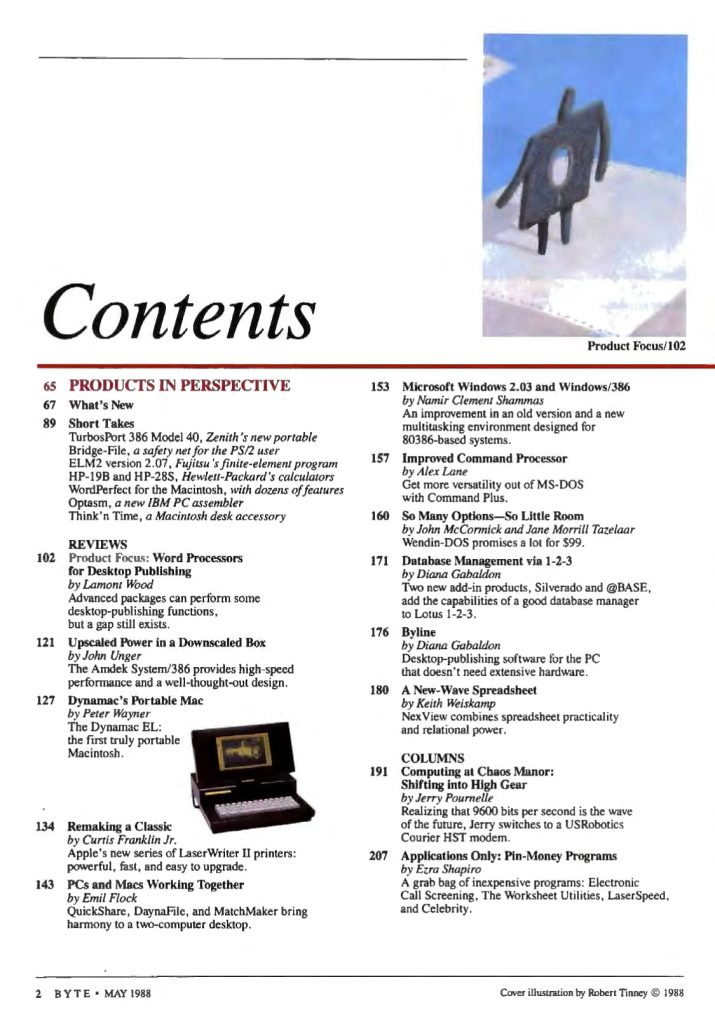
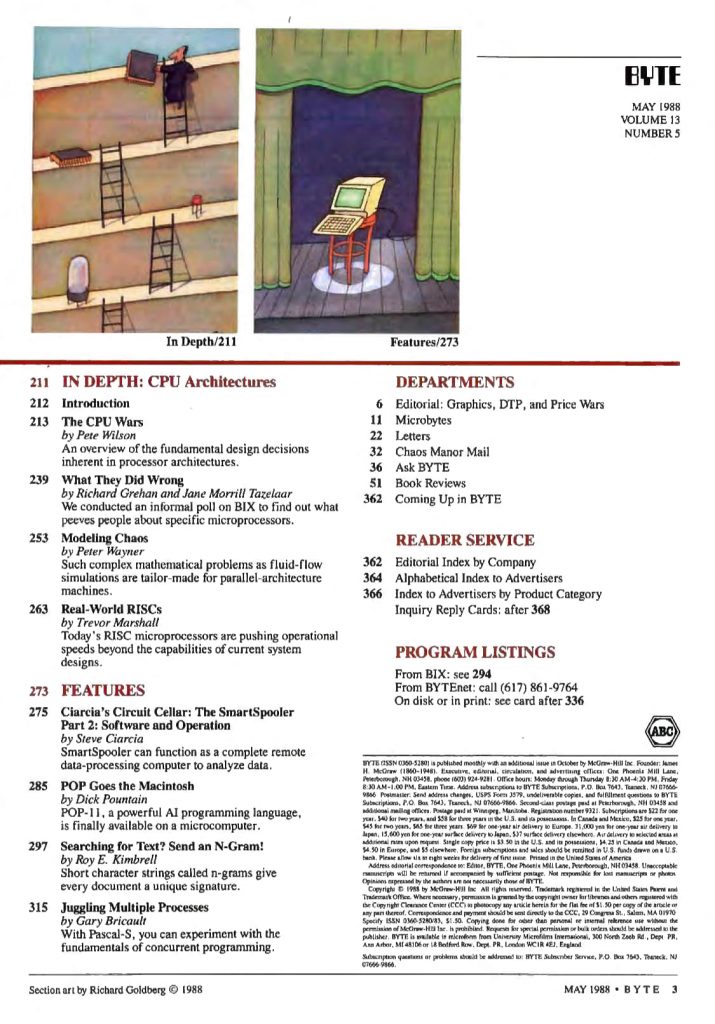
  • Byte (May 1988)

    Byte tended to be the most technical of mainstream computer magazines though it became less so over time. It was not PC specific (after all, it was being published long before IBM’s PC was released) but by the late 1980s, the majority of its coverage was oriented towards the PC. The May 1988 issue includes:

    Products in Perspective

    • What’s New – A brief look at new products including the Datacomputer 3.0, faster 386 systems from ALR, A 286 system from Golden Arche, a 1.44MB floppy drive kit from Toshiba, the DEC DF212 and DF242 modems, RamQuest II RAM expansion board for PS/2s, Ethernet for the Mac II, the Bondwell-8 Turbo laptop with 1MB RAM, and more.
    • Short Takes – A hands-on look at new products including the TurboPort 386 Model 40 laptop from Zenith (includes 386 processor at 12 MHz, 2 MB RAM, 40 MB hard drive, and a fluorescently backlit supertwist liquid crystal display for $7599), external 3.5″ and 5.25″ disk drives for the PS/2 from Sysgen, WordPerfect for the Mac, and more.

    Reviews

    • Word Processors for Desktop Publishing – An overview of word processors with desktop publishing features. Products looked at here include DisplayWrite 4, MASS-11, Microsoft Word, MultiMate Advantage II, OfficeWriter, Senna Word IV, SmartWord, WordPerfect, Wordstar 2000 Plus, and XyWrite III Plus.
    • Upscaled Power in a Downscaled Box – A look at Amdek’s System/386 PC. It includes a 16-MHz 80386 CPU, 1 MB of RAM, a 1.2MB 5.25″ floppy drive, 40 MB hard drive, and more for $5949.
    • Dynamac’s Portable Mac – A Dynamac EL laptop was basically a repackaged Mac Plus in laptop format. As reviewed here it would set you back well over $8k.
    • Remaking a Classic – A look at a new series of LaserWriter IIs including the IISC, IINT, and IINTX.
    • PCs and Macs Working Together – A look at three products for sharing files between a PC and a Mac including QuickShare, DaynaFile, and MatchMaker.
    • Microsoft Windows 2.03 and Windows/386 – A look at what was then the latest versions of Windows. Windows didn’t really catch on until 3.0/3.1.
    • Improved Command Processor – A look at Command Plus 2.01, an improved command processor for DOS.
    • So Many Options – So Little Room – An inexpensive multitasking, multiuser, windowing, MS-DOS compatible operating system called Wendin-DOS.
    • Database Management via 1-2-3 – a look at two add-on products for Lotus 1-2-3 (Silverado and @BASE) that add more database management features.
    • Byline – A lightweight desktop publishing package from Ashton-Tate.
    • A New-Wave Spreadsheet – A new spreadsheet program called NexView.

    Columns

    • Computing at Chaos Manor: Shifting into High Gear – Installing a US Robotics Courier HST modem plus hands-on with other products including Business Class (Activision), Cyber Studio (Antic Publishing), DeskLink and LapLink Mac (Traveling Software), MathCAD (MathSoft), Physics (Broderbund), Geometery (Broderbund), TK! Solver Plus (Universal Technical Systems), and more.
    • Applications Only: Pin-Money Programs – A look at useful inexpensive software including Electronic Call Screening, LaserSpeed, The Worksheet Utilities, and Celerity.

    In Depth: CPU Architectures

    • The CPU Wars – A look at different CPU architectures and the design philosophies behind them. CPUs such as the 8086, 68000, 6502, SPARC, and others are discussed.
    • What They Did Wrong – A look at the shortcomings of various CPUs including the 6502, 8080, Z80, 8086, and others.
    • Modeling Chaos – A look at a parallel CPU architectures.
    • Real-World RISCs – A look at the AMD Am29000 and how this CPU speeds up memory access.

    Features

    • Ciarcia’s Circuit Cellar: The SmartSpooler Part 2: Software and Operation – The second part in a series on building a remote data-processing computer.
    • POP Goes the Macintosh – A look at POP-11, a powerful AI programming language now available for the Mac.
    • Searching for Text? Send an N-Gram! – A method of fingerprinting a document to make it easier to find.
    • Juggling Multiple Processes – Concurrent programming with Pascal-S.

    Departments

    • Editorial: Graphics, DTP, and Price Wars – A look at increasing competition in the Desktop Publishing industry.
    • Microbytes – Engineers put print head on a chip; Intel introduces a new C Compiler for embedded applications; the rise of Ada; an ISDN demo; and more.
    • Letters – Letters from readers about Lisp, the Heath HV-2000 speech card, speech software, MathCAD, AI, WORM drives, and more.
    • Ask BYTE – Questions answered about the IBM Proprinter XL, call forwarding, Turbo Pascal, exceeding 64K in FORTRAN, and more.
    • Book Reviews – Chaos: Making a New Science by James Gleick, Programming Secrets for the Macintosh by Scott Kramer, Programming The Intel 80386 by Bud E. Smith, Computers In Battle: Will They Work? by David Bellin and Gary Chapman, and Programmer’s Guide to PC & PS/2 Video Systems by Richard Wilson.

    …and more!