

A summary for those that haven’t been keeping up with this series:
I found a number of 5.25″ disks at a thrift store a number of years ago (sometime in the late 1990s to the best of my recollection). I finally got around to acquiring a 5.25″ disk drive and extracting the contents a several years back. Since then, I have been occasionally posting the content here.
Based on the contents, most or all of these disks were apparently once owned by someone named Connie who used to run the “Close Encounters” Special Interest Group (SIG) on Delphi in the mid 1980s.
The following description of this SIG was found in a document on one of the disks: “This SIG, known as ‘Close Encounters’, is a forum for the discussion of relationships that develop via computer services like the Source, CompuServe, and Delphi. Our primary emphasis is on the sexual aspects of those relationships.”
This service was text based and was accessed via a modem and whatever terminal program you had available for your computer to dial in with. Many of these disks have forum messages, e-mails and chat session logs. All of this is pre-internet stuff and I am not aware of any archives in existence today that contain what was on Delphi in the 1980s.
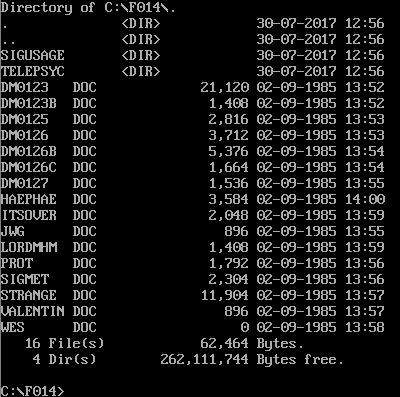
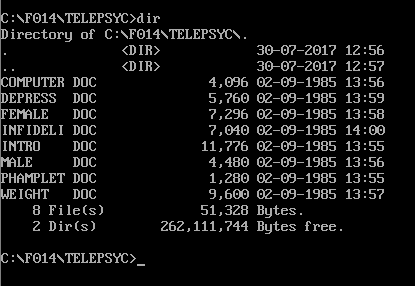
This post includes the contents of COMPUTER.DOC. This file is dated September 2nd, 1985 and is in a subdirectory called TELEPSYC. This is an article on types of computer addiction (“ego syntonic” and “ego dystonic”). No name or other credit is listed in the file. I tried doing a web search on a few strings from this article but couldn’t find anything so I’m not sure who wrote it. Based on the name of the subdirectory and the mention near the end of the file itself, I believe this article came from a special interest group or some other kind of feature on Delphi called “TelePsych”.
=-=
COMPUTER.DOC
=-=
—
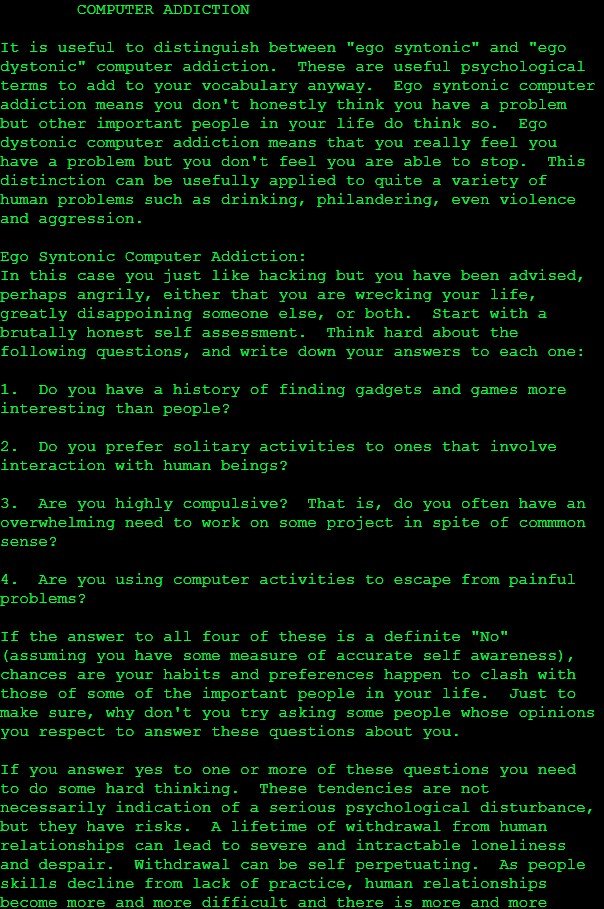
        COMPUTER ADDICTION

It is useful to distinguish between "ego syntonic" and "ego
dystonic" computer addiction.  These are useful psychological
terms to add to your vocabulary anyway.  Ego syntonic computer
addiction means you don't honestly think you have a problem
but other important people in your life do think so.  Ego
dystonic computer addiction means that you really feel you
have a problem but you don't feel you are able to stop.  This
distinction can be usefully applied to quite a variety of
human problems such as drinking, philandering, even violence
and aggression.

Ego Syntonic Computer Addiction:
In this case you just like hacking but you have been advised,
perhaps angrily, either that you are wrecking your life,
greatly disappoining someone else, or both.  Start with a
brutally honest self assessment.  Think hard about the
following questions, and write down your answers to each one:

1.  Do you have a history of finding gadgets and games more
interesting than people?

2.  Do you prefer solitary activities to ones that involve
interaction with human beings?

3.  Are you highly compulsive?  That is, do you often have an
overwhelming need to work on some project in spite of commmon
sense?

4.  Are you using computer activities to escape from painful
problems?

If the answer to all four of these is a definite "No"
(assuming you have some measure of accurate self awareness),
chances are your habits and preferences happen to clash with
those of some of the important people in your life.  Just to
make sure, why don't you try asking some people whose opinions
you respect to answer these questions about you.

If you answer yes to one or more of these questions you need
to do some hard thinking.  These tendencies are not
necessarily indication of a serious psychological disturbance,
but they have risks.  A lifetime of withdrawal from human
relationships can lead to severe and intractable loneliness
and despair.  Withdrawal can be self perpetuating.  As people
skills decline from lack of practice, human relationships
become more and more difficult and there is more and more
impetus to keep withdrawing.  If you have some of these
tendencies but you do not feel you really have a severe
problem you must set some goals regarding how much time and
energy you want to make available to the important people in
your life as well as to your non-computer responsibilities.
It might help if you asked someone to help you monitor this
committment and remind you if you deviate from it.  If you
feel you have these tendencies to a more severe degree you
should seek professional consultation.

Ego Dystonic Computer Addiction:
You know you hack too much, but you feel you can't stop.  This
is probably similar to a gambling addiction.  Hacking is a
process of prolonged concentration and frequent frustration
that rewards at unpredictable intervals, promising but never
quite delivering great satisfactions (just like gambling).
This can be an insidious but powerful set of circumstances.
It gets even more compelling if you are depressed or escaping
from painful problems.  There are no simple answers, but try
these out:

1.  Take a computer vacation. Unplug the equipment and take it
to a friend's house for two weeks.

2.  Schedule a couple of computer-free days every week.

3.  Keep a journal of your feelings and private thoughts.
When you "get the urge" to hack, you may really be avoiding
dealing with them.  Try facing them directly as possible by
writing them down.  It probably won't be as painful as you
expected.

4.  Expand your repertoire of pleasurable activities.  Make a
list of non computer activities that might give you pleasure
and commit yourself to spending time on these instead of
hacking.

In either case, don't hesitate to seek help either from a
mental health professional in your community or from TelePsych
if you feel you are losing the battle.  Self help has its
limitations.  The price of delaying could get pretty high.

