• Tag Archives Amstrad
  • Amstrad Computer User (April 1986)

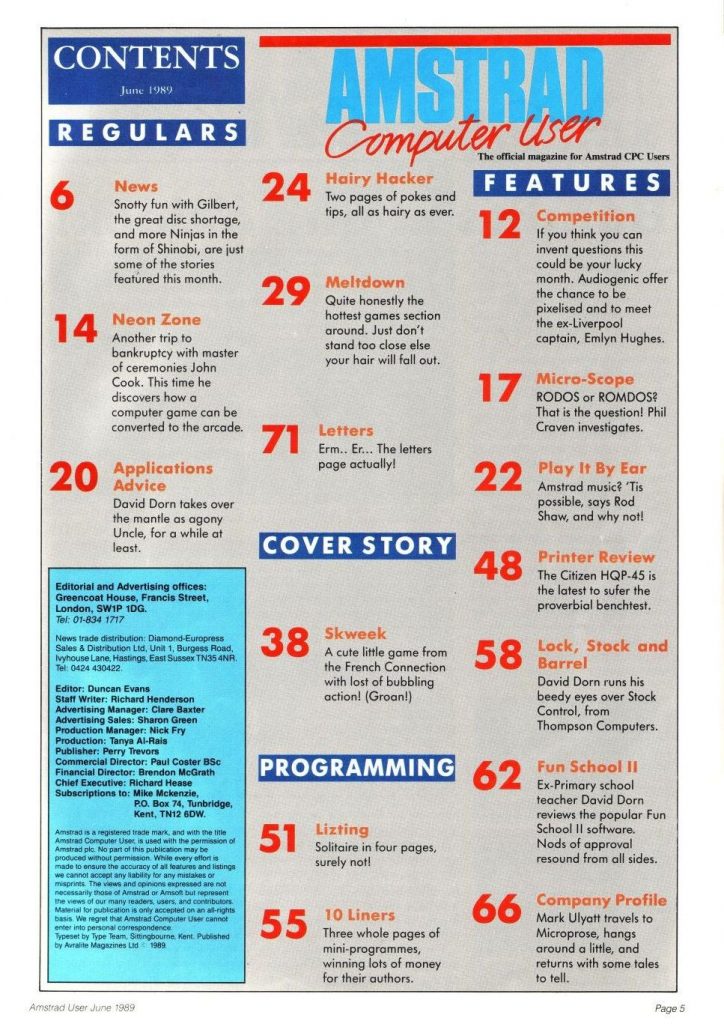
    The Amstrad CPC line of computers were not ones I had ever even heard of back when they were current in the mid 1980s to early 1990s. They were popular in the U.K. but virtually unknown in the U.S. and never commercially available here as far as I know. Amstrad Computer User was one of the magazines that covered these machines in the U.K. The April 1986 issue includes:

    Regulars

    • News – Profits up for Amstrad; new game, Meltdown, for the CPC 6128; a new port of Empire from Firebird for the CPC; rumors of a PCW 8512 model of the CPC; new ports of Activision games Rescue on Fractalus and Eidolon for the CPC; and more.
    • Letters – Letters from readers about the availability of the magazine in Australia, DR Draw on the PCW 8256, the music in The Neverending Story, and more.
    • Gallup Chart – A list of the top 20 games on the CPS. At the top of the list is They Sold a Million. Coming in second is Yie Ar Kung Fu (one of my favorites on the Commodore 64).
    • Least Significant Bit – Commentary on disc based games, Amstrad profits, and more.

    Features

    • Animator – A type-in program for creating animation.
    • Goin’ Loco – A guide to using string variables in BASIC.
    • Adventure Column – A look at Lord of the Rings on the Amstrad CPC.
    • Windows – The last article in a series on creating pull-down menus on the Amstrad.
    • 6-8-4-5 Who do we appreciate? – A guide to manipulating graphics on the CPC.
    • Screen Flipping – A demonstration of creating animation on the CPC 664 and 6128 via ‘screen flipping’.
    • Awards – The results of the first Amstrad User Rewards where users pick winners in a variety of categories.

    Reviews

    • Epson FX85 – A review of the latest dot matrix printer from Epson.
    • In the Pictures – An overview of the latest drawing programs available on the Amstrad including Rembrandt, Grafpad 2 Art, and AMX Art.
    • Romboard Rivals – Reviews of the Honeysoft Rom Board and the Britannia ROM Board. These were devices in which you could plug ROM chips into with programs. This was sort of an alternate approach to cartridges except that ROMs would generally be left in and the programs on them could be selected any time.
    • Game Reviews – Reviews of the latest games available for the Amstrad CPC incluing Tau Ceti (Game of the Month), Skyfox (I played the Commodore 64 version of this one some), Three Weeks in Paradise, Sweevos World, Sir Fred, Spindizzy, Zorro, Le 5eme Axe, TLL, Theatre Europe, and Cluedo.

    Amstrad Business Computing

    • Editorial – Reflecting on the first year of te PCW 8256, the latest iteration of the Amstrad CPC.
    • Living with Joyce</b – Hands on with LocoScript, the word processor included with the PCw 8256.
    • Who are you? – The results of a user survey in a previous issue.
    • Getting inside your PCW 8256 – A guide to creating a custom character set on the PCW 8256.

    …and more!


  • Amstrad Computer User (January 1990)

    Source:

    While the Amstrad CPC was virtually unheard of in the U.S., it was a popular computer in the U.K. from the mid 1980s into the early 1990s. While there were several variants, they were all based on a 4 MHz Z80 processor and most commonly had 64KB to 12KB of RAM and a built-in cassette or 3-inch disk drive. Amstrad Computer User was one of the magazines dedicated to these machines. The January 1990 issue includes:

    Regulars

    • Letters – Letters from readers about splitting the screen into two modes, fractal landscapes, typing in programs, building a robot, and more.
    • News – Sexism in software; Darius+; the new Delta 2000 joystick; Page Publisher, a new desktop publishing package released; Verran AC Datalink; and more.
    • Competition – Win several Ghostbusters themed items by answering a few simple questions about the movies.
    • Combat Zone – A look at upcoming arcade games including Exterminator (Gotlieb), Teenage Mutant Ninja Turtles (Konami), Special Criminal Investigations (Taito), Mechanized Attack (SNK), and Line of Fire (Sega).
    • 10 Liners – Short type-in programs to create a TV static effect, a robot race, a disk management program, and a morse code converter.
    • Microscope – Capturing and printing out images with the CPC.
    • Gameplan – Reviews of games including Ghouls ‘N’ Ghosts, Dynamite Dux, After the War, Sporting Triangles, Star Wars Trilogy, Mutant Fortress, and Spaceghost.
    • Hints and Tips – Tips, tricks, and cheats for License to Kill, APB, Shinobi, Bards Tale, Archon, Skate or Die, Arctic Fox, Total Eclipse, Dizzy II, and much more.
    • Auntie John – A technique for reducing a 16K image to only 8K.
    • Comms – An introduction to the world of the BBS.

    Features

    • Sprites Alive – A review of a software package that allows you to generate your own sprites.
    • Ledger – A review to an update of General Ledger 6128, a computerized book-keeping program for the Amstrad CPC from SD Microsystems.
    • Fractals – The final part of a three part series on fractals. This part relates to generating landscapes.

    …and more!

  • Amstrad Computer User (January 1992)

    Source: Amstrad Computer User – January 1992

    The Amstrad CPC line of computers was Z80 base and could run AMDOS or CP/M. It was popular in the U.K. and some other parts of Europe. Amstrad Computer User is a magazine that was published in the U.K. dedicated to these machines. 1992 was near end of life for these computers as well as this magazine. The January 1992 issue includes:

    Regulars

    • News – New formula one racing game with Nigel Mansell’s name on it; new Foot Pedal controller; results of a computer fair survey; and more.
    • Letters – Letters from readers about troubleshooting CPC 6128 problems, creating a loading screen, Amstrad related books, CPC production questions, the FD-1 disk drive, and more.
    • 10-Liners – Short type-in programs for making the CPC play Auld Lang Syne, testing your piano skills, converting between hex, decimal and binary, displaying a clock on your screen, and more.
    • PD Scene – A look at some of the latest devolpments in public domain software for the CPC including the fact that some titles now cost money. Also, a look at various libraries of public domain software.
    • Adventure – A look at some of the latest adventure related products available for the CPC including some books on the subject as well as a review for Crispin Crunchy, tips and hints for Scrolls of Wisdom, request for help from readers, and more.
    • Bomb Alley – Reviews of some of the latest games including Space Crusade, Final Fight, Movie Premiere (includes four games: Teenage Mutant Hero Turtles, Back to the Future 2, Days of Thunder, and Gremlins 2), Super Sega (a compilation including Shinobi, Crackdown, Golden Axe, E-SWAT, and Super Monaco GP), G-Loc, and Capcom Collection (includes US Squadron, LED Storm, Strider and Strider II). Also, reviews of budget games (usuall re-releases) including Batman, Turrican, Heroes of the Lance, and X-Out.
    • Hairy Hacker – Hacks for various games including Fast Food, Shinobi, R-Type, Combat School, and Elite. These POKEs and short program provide things line infinite lives, infinite credist indestructibility, etc.
    • Easydraw – Additional modules for a continuing series that provides a type-in art program. This month modules for erasing and creating shapes are included.
    • Listing – A type-in Pac-Man clone called, creatively, Paclone.
    • Applications – Advice on transferring data from the CPC to a PC, printer problems, using OCP Art Studio, and more.
    • Comms – A how-to guide for electronic mail on the CPC.

    Features

    • Stick up – Part 2 of a joystick round-up. This part includes a look at the Sureshot Supreme, the Terminator, the Cruiser, the Zipstick Super Pro, the Sureshot Command Module, and the Sureshot Standard.
    • Moving Parts – A guide to using BASIC on the CPC to create animation.
    • Kitting Out – A do-it-yourself guide for building your own joystick.

    …and more!