• Tag Archives Amstrad CPC
  • Amstrad Computer User (April 1985)

    Source: Amstrad Computer User – April 1985

    The Amstrad CPC was a line of 8-bit personal computers based on the Z80A CPU that was popular in the U.K. and other parts of Europe. For the most part, nobody in North America has ever heard of it so looking through a magazine dedicated to it has a bit of an alternate reality feel. Like the Commodore 64, The CPC line in large part was though of as a games machine. However, it could also run CP/M software so there were tons of business related apps as well. Having said that, CP/M was already well on its way out in 1984 when this line was first introduced. The Commodore 128 introduced in 1984 also had CP/M capabilities but it was really little used. The CPC 464 was the first and most popular model. It included 64KB of RAM and a built-in cassette deck. Amstrad Computer User was a magazine originally dedicated to this machine and the April 1985 issue includes:

    Regulars

    • News – A detailed look at the L.E.T. microcomputer show (a trade only event not open to the public). Some new products shown include Ghostbusters, Master of the Lamps, The Music Studio, Defend or Die, Lords of Midnight, The Rocky Horror Show, The Hobbit and more. Many of these were not available in CPC form yet but conversions were in work.
    • Letters – Various comments from readers on the magazine itself, the use of GOTO statements, Grand Prix Driver, alternative Amstrad computer names, Lords of Time, and much more.
    • Software Reviews – Reviews of Sorcery (game of the month), Mutant Monty, Cubit, Splat, Laswerwarp, Star Commando, Codename Mat, Sultan’s Maze, Xanagrams, Crazy Golf, and Blagger.

    Features

    • Book Reviews – Reviews of BASIC Programming On The Amstrad by Wynfor James and The Working Amstrad my David Lawrence and Simon Lane.
    • Printer Reviews – Reviews of four different printers including the Amstrad DMP-1 dot matrix printer, Brother M-1009 dot matrix printer, Kaga/Taxan KP810 Epson compatible dot matrix printer, and the Dyneer DW16 daisy wheel printer.
    • The Joy of Sticks – Reviews of several joysticks for the Amstrad CPC including the Amstrad JY-2, Wico Red Ball, Wico – The Boxx, Wico Three Way Deluxe, Quickshot I, Quickshot II, Kempston Junior Pro, and Kempston Competition Pro 5000.
    • Screen Squashing – A programming technique for getting more characters on a line in the lower res graphics mode 0.
    • Intro to Music – Part two of an introductory series on creating music with the Amstrad CPC.
    • Forth – Part two of an introductory series on the Forth programming language. This part covers the Forth stack and reverse polish notation.
    • Machine code Programming – A type-in machine language utility for creating simple sprites.
    • Hardware Project – A project for creating a batter backed-up real-time clock that plugs into the user port.
    • Writing Adventures – A high level how-to guide for creating a text based adventure game, including some sample code.

    Programs

    • Missile Attack – A type-in CPC version of Missile Command.
    • The Monsters Final Hour – A type-in text based adventure game featuring Frankenstein (or his monster anyway).

    Competition

    • The Ins and Outs of the Amstrad – A competition in which you must identify the screen shots on the cover for a chance to win a copy of this book. 30 copies are up for grabs.

    …and more!


  • Amstrad Action (December 1985)

    Source: Amstrad Action – Issue Number 3 – December 1985

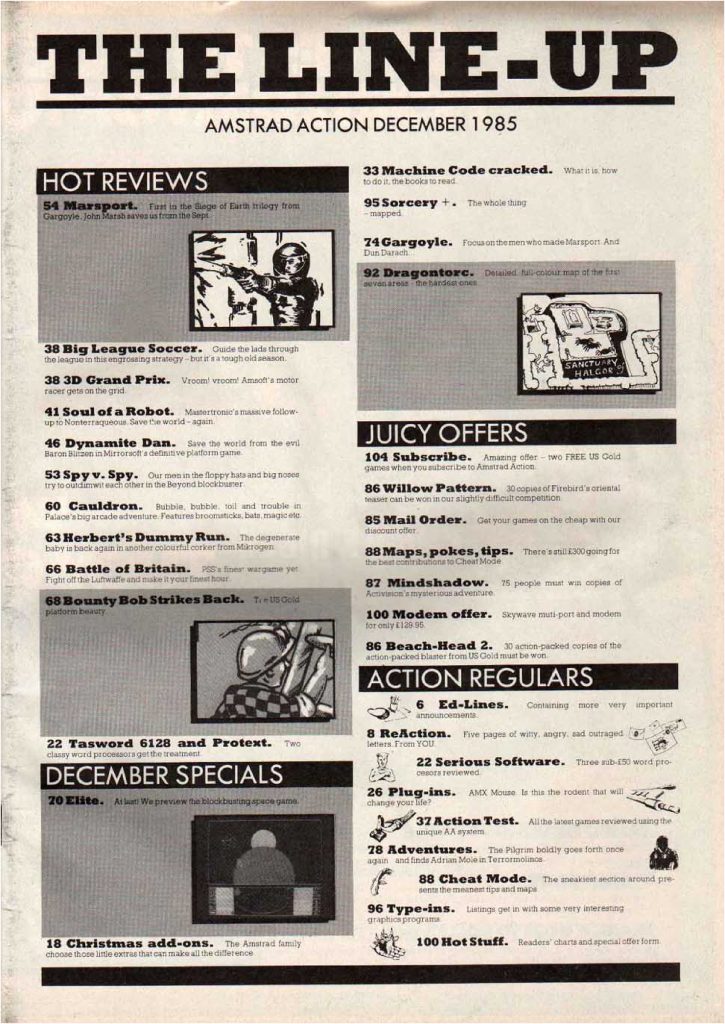
    The Amstrad CPC was a popular 8-bit computer in the U.K. and other parts of Europe. Amstrad Action was a magazine dedicated to that platform that emphasized gaming (though it had some other content). The December 1985 issue includes:

    Hot Reviews

    • Marsport – An interesting looking split screen adventure game with a sci-fi setting.
    • Big League Soccer – Football (Soccer) management programs seeemd to all the rage in the U.K. I don’t think they were that popular in North America though.
    • 3D Grand Prix – Looks to be something between Pole Position and Grand Prix Circuit.
    • Soul of a Robot – 256 rooms to puzzle your way out of in this action/puzzle game.
    • Dynamite Dan – A highly rated action game that reminds be a bit of Spelunker. I never played this one but I loved Spelunker on the Commodore 64.
    • Spy v. Spy – An excellent game based on the comic strip of the same name.
    • Cauldron – A combination of genres that include Defender like sequences and platform game like sequences.
    • Herbert’s Dummy Run – Part of a series of action games. This one features challenging game play and various mini-games.
    • Battle of Britain – A combination of action and strategy in this World War II themed game.
    • Bounty Bob Strikes Back – The sequel to Miner 2049er (which was never released on the Amstrad).
    • Tassword 6128 and Protext – Two word processors reviewed.

    December Specials

    • Elite – A preview of the classic space flight game that was available on numerous systems.
    • Christmas add-ons – Some suggestions for additions to your Amstrad computer setup for Christmas. Joysticks, RAM expansions, light pens, disk drives and more are featured.
    • Machine Code cracked – An introduction to machine code on the Amstrad.
    • Sorcery + – A multi-page spread featuring the entire map for the game Sorcery +.
    • Gargoyle – An interview with members of Gargoyle, the company behind the games Marsport and Dun Darach.
    • Dragontorc – A complete map for this game.

    Juicy Offers

    • Subscribe – Get your choice of two U.S. Gold games when you subscribe to Amstrad Action.
    • Willow Pattern – Answer three questions for your chance to win this game.
    • Mail Order – Order any of the game reviewed in this issue at a discount.
    • Maps, pokes, tips – Get rewarded for submitting your own tips and cheat.
    • Mindshadow – Answer three questions for your chance to win this Activision game.
    • Modem Offer – A 1200 baud modem and software for only 130 pounds.
    • Beach-Head 2 – Match the drawing to the island they are from for your chance to win a copy of Beach-Head 2.

    Action Regulars

    • Ed-Lines – An introduction to this issue, a call for cartoonists and previous competition winners.
    • ReAction – Letters from readers on topics such as praise for the magazine, finding the magazine, the Amstrad Computer Show, the demise of the Amstrad CPC664 and more.
    • Serious Software – A look at non-gaming software, this month featuring three word processors including Tasword 6128, Protext, and Brunword.
    • Plug-Ins – A mouse for the Amstrad and an art program to use it with.
    • Action Test – Reviews of the latest games including Argo Navis, 3D Boxing, Caesar’s Travels, Don’t Panic, Formula One Simulator, Hi Rise, Satellite Warrior, Willow Pattern, World Cup Soccer and World Series Baseball.
    • Adventures – A look at adventure games including The Secret Diary of Adrian Mole, Tomb of Kuslak, and Souls of Darkon.
    • Cheat Mode – Tips and cheats for various game including Raid (Raid Over Moscow must not have been politically correct in the U.K. because that’s what this game appears to be), Roland in Time, Hunchback, Dun Darach, and more.
    • Type-ins – A new feature this month, type-in programs in this month’s issue include several short programs to generate graphical patterns.
    • Hot Stuff – Forms to vote for your favorite gaming and non-gaming software.

    …and more!


  • Amstrad Computer User (January 1987)

    Source: Amstrad Computer User – January 1987

    Amstrad made a number of different computers over the years, including PC compatibles. However, their original Z80 based CPC 464 with built-in cassette drive was probably the most popular, at least in Europe. It was not something a North American audience would have likely have even heard of. Amstrad Computer User covers this and other compatible successors as well as the PC clones. The January 1987 issue includes:

    Regulars

    • News – MicroProse announces Silent Service and AcroJet for the CPC, Advanced Memory Systems develops Max – a Gem like front end for CPC computers, and more.
    • Letters – Letters from readers on various topics, including a question about the various Amstrad computers and compatibility, using a CPC 6128 for business purposes, and more.
    • Gallup Chart – A list of the top 20 games for the CPC. Some games on the list familiar to me include Trivial Pursuit, Ghosts & Goblins, Tempest, and Druid.
    • Least Significant Bit – Odd news and rumor including a rat stolen at a software release party, a computer monitor that flew first class, and computers melting.

    Reviews

    • Mini Office II – An all in one office suite for the Amstrad CPC featuring a word processor, database, spreadsheet, presentation, terminal, and label printing programs.
    • Model Universe – A 3D modeling package for the Amstrad.
    • Games for the PC – An overview of popular PC games at the time that would work on the Amstrad PC1512. Titles mentioned include Seven Cities of Gold, Championship Golf, F-15 Strike Eagle, Pinball Construction Set, Boulder Dash, Boulder Dash 2, and Hacker.
    • StarGlider – There were quite a few of these wire frame space flight simulators around in the 1980s. Elite and Echelon are two others that come to mind. Most of them are pretty good, including this one.
    • Jailbreak – A lesser known arcade conversion and the first by Konami for the Amstrad.
    • Game scene – Reviews of the following games for the Amstrad CPC:
      • Hardball – Classic baseball action from Accolade. I had this one for my Commodore 64.
      • Druid – A gauntlet like game that I loved. Again, I had it on my Commodore 64.
      • They Stole A Million – A game that allows you to become a criminal mastermind.
      • Glider Rider – An interesting plot but it plays as a somewhat confusing maze game.
      • Light Force – A vertical shooter with excellent graphics and game play.
      • Werner – Mach Hin! – An odd German game that plays out like a comic strip.

    Competitions

    • Win a Jailbreak – Possible win a Jailbreak arcade machine by answering four trivia questions correctly.
    • Citizen printer – Identify the 10 differences between two pictures to possibly win a Citizen LSP10 dot matrix printer (and two ribbons).

    Programming

    • Making Mallard fly – Some BASIC programming tips and tricks for Mallard BASIC on the Amstrad PCW.
    • Assembly point – Addition and subtraction using machine language.
    • Hidden MS-DOS files – All about file attributes in MS-DOS and how to hide files.
    • Crawler – This type-in game for the CPC appears to be a Centipede clone.
    • Split screens – A type-in program that allows you to create a split screen with unique content, colors and resolutions.

    Features

    • Protext people – An article about Arnor, a software company working exclusively on the CPC.
    • Frost Byte mapped – A complete map of the game Frost Byte for the CPC.
    • Hairy Hackers Haunt – Some hacks for games and other programs including Commando, The Apprentice, Hacker, LocoScript, and Defend or Die.
    • Psst – wanna cheap call? – Apparently, PSS was a service you could call to connect to remote BBS systems instead of having to call long distance. The advantage of course was lower costs.
    • Behind Biggles – The story of the making of a game based on a movie with a time traveler.
    • Seek and ye shall find – An article on adventure games. Inheritance: Panic in Las Vegas by Infogrames, The Snow Queen, and After Shock are featured.

    …and more!