• Tag Archives statism
  • Crossing the Welfare State With the Carbon Tax

    Crossing the Welfare State With the Carbon Tax

    I don’t have strong views on global warming. Or climate change, or whatever it’s being called today.

    But I’ve generally been skeptical about government action for the simple reason that the people making the most noise are statists who would use any excuse to increase the size and power of government.
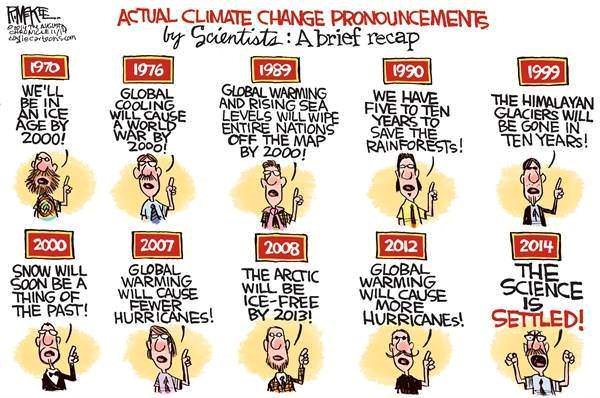
    To be blunt, I simply don’t trust them. In Washington, they’re called watermelons – green on the outside (identifying as environmentalists) but red on the inside (pushing a statist agenda).

    But there are some sensible people who think some sort of government involvement is necessary and appropriate.

    The Carbon Tax

    George Schultz and James Baker, two former Secretaries of State, argue for a new carbon tax in a Wall Street Journal column as part of an agenda that also makes changes to regulation and government spending.

    …there is mounting evidence of problems with the atmosphere that are growing too compelling to ignore. …The responsible and conservative response should be to take out an insurance policy. Doing so need not rely on heavy-handed, growth-inhibiting government regulations. Instead, a climate solution should be based on a sound economic analysis that embodies the conservative principles of free markets and limited government. We suggest…creating a gradually increasing carbon tax…, returning the tax proceeds to the American people in the form of dividends. And…rolling back government regulations once such a system is in place.”

    A multi-author column in the New York Times, including Professors Greg Mankiw and Martin Feldstein from Harvard, also puts for the argument for this plan.

    On-again-off-again regulation is a poor way to protect the environment. And by creating needless uncertainty for businesses that are planning long-term capital investments, it is also a poor way to promote robust economic growth. By contrast, an ideal climate policy would reduce carbon emissions, limit regulatory intrusion, promote economic growth, help working-class Americans and prove durable when the political winds change. …Our plan is…the federal government would impose a gradually increasing tax on carbon dioxide emissions. It might begin at $40 per ton and increase steadily. This tax would send a powerful signal to businesses and consumers to reduce their carbon footprints. …the proceeds would be returned to the American people on an equal basis via quarterly dividend checks. With a carbon tax of $40 per ton, a family of four would receive about $2,000 in the first year. As the tax rate rose over time to further reduce emissions, so would the dividend payments. …regulations made unnecessary by the carbon tax would be eliminated, including an outright repeal of the Clean Power Plan.”

    They perceive this plan as being very popular.

    Environmentalists should like the long-overdue commitment to carbon pricing. Growth advocates should embrace the reduced regulation and increased policy certainty, which would encourage long-term investments, especially in clean technologies. Libertarians should applaud a plan premised on getting the incentives right and government out of the way.”

    Not So Fast

    I hate to be the skunk at the party, but I’m a libertarian and I’m not applauding. I explain some of my concerns about the general concept in this interview.

    In the plus column, there would be a tax cut and a regulatory rollback. In the minus column, there would be a new tax. So two good ideas and one bad idea, right? Sounds like a good deal in theory, even if you can’t trust politicians in the real world.

    However, the plan that’s being promoted by Schultz, Baker, Feldstein, Mankiw, etc, doesn’t have two good ideas and one bad idea. They have the good regulatory reduction and the bad carbon tax, but instead of using the revenue to finance a good tax cut such as eliminating the capital gains tax or getting rid of the corporate income tax, they want to create universal handouts.

    They want us to believe that this money, starting at $2,000 for a family of four, would be akin to some sort of tax rebate.

    That’s utter nonsense, if not outright prevarication. This is a new redistribution program. Sort of like the “basic income” scheme being promoted by some folks.

    And it creates a very worrisome dynamic since people will have an incentive to support ever-higher carbon taxes in order to get ever-larger checks from the government. Heck, the plan being pushed explicitly envisions such an outcome.

    I’ve made the economic argument against carbon taxes and the cronyism argument against carbon taxes. Now that we have a real-world proposal, we have the practical argument against carbon taxes.

    Reprinted from International Liberty.

    This article was originally published on FEE.org. Read the original article.


  • Got a License for that YouTube Channel? 

    Got a License for that YouTube Channel?

    Justin Chandler was shocked and confused when he was given a citation for operating a business out of his home without first obtaining a license.

    Unlike many people who run home-based businesses, Chandler doesn’t actually sell anything. In fact, he doesn’t even provide a service. He does, however, run a successful YouTube channel, which, according to officials in Cobb County, Georgia, means Chandler qualifies as a small business owner.


    Internet Famous

    Known to his subscribers as “KOSDFF,” Chandler has become a well-known personality in the world of online gaming. In only a few short years, he has gained hundreds of thousands of social media followers and almost a million YouTube subscribers.  

    Capitalizing on his channel’s popularity, Chandler was able to monetize his views and earn enough money to quit his day job and focus on creating video content full-time.

    While many would applaud his drive and entrepreneurial spirit, the county has instead chosen to reprimand Chandler and his roommates for earning a living without first seeking the government’s permission.   

    Recently, Chandler and five of his fellow vloggers decided to move in together in order to spend even more time working on their projects, with the ultimate goal of earning more money. Choosing a home in Cobb County, Georgia, the roommates had no idea they were violating any local statutes.

    A Pesky Neighbor

    Unfortunately, multiple roommates meant multiple cars parked in the driveway and on the street, which bothered several neighbors. Instead of doing the neighborly thing, and expressing their concerns to Chandler and his roommates directly, the residents took their complaint straight to their local homeowners association, who in turn went straight to county officials.

    Originally, the complaint was based on local zoning laws which classified Chandler’s home as a “single family dwelling.” Since Chandler and his colleagues are not related, this gave the country cause to dig deeper into the situation.

    Upon discovering that Chandler and his roommates were all professional YouTube personalities, the county sent the vloggers a citation threatening to fine the housemates $136 per day and evict them if they refused to comply with their demands.

    When Dana Johnson, director of Cobb County’s Community Development Agency was asked about the situation, she stated, “If he is producing content and receiving revenue from the content produced at his home, then he is running a business and must file for a business license.” She continued, “Just because he makes an occupation in a manner that is new and innovative does not relieve him of his obligation to pay business taxes, just as all other businesses are required to do.”

    Everybody’s Tube

    Every day, millions of Americans upload videos to YouTube and it is safe to speculate that a majority of these individuals do not have business licenses. For vloggers who have been able to monetize their channels, there is also no absolute certainty that they will reach the same levels of success as Chandler. In many cases, monetization means earning somewhere around $1 per 25 views.

    If Cobb County believes that any amount of revenue constitutes a need to obtain a business license, as their own representative stated, then those bringing in only mediocre funds may also be forced to obtain licenses that may cost more than the revenue they are generating.  

    Enforcing this law locally in Cobb County, Georgia might seem insignificant, but setting this precedent could very well impact the entire vlogging community.

    If there is one thing all governments love, it’s finding a way to profit from the success of entrepreneurs. If Cobb County can penalize Chandler and his roommates, it is only a matter of time before other local municipalities begin cracking down on their vloggers as well.  

    Chandler expressed his thoughts on the matter saying, “This extremely unique and rare scenario poses the question: [Does] filming and uploading YouTube videos from your home constitute the home as a business? Does it matter how many views I have or how much income I make from it? Because to be honest, I do the same thing millions of other Americans do.”


    Brittany Hunter

    Brittany Hunter is an associate editor at FEE.

    This article was originally published on FEE.org. Read the original article.


  • You Try to Provide Shelter for the Homeless and You Get Fined $12,000

    You Try to Provide Shelter for the Homeless and You Get Fined $12,000

    A local Maryland church has been fined $12,000 for providing shelter to homeless individuals living in the community. Over the last several years there has been a crackdown on privately funded charitable efforts, with local governments using food and safety concerns-along with zoning codes to penalize those who are trying to help those less fortunate.

    Having the church provide this option has been a lifesaver for many. Just last month, 4,000 pounds of leftover barbecue from the World Series of BBQ in Kansas City, Missouri was destroyed before it was able to be served at a local homeless shelter. Local health officials claimed that they could not account for the safety of the food, even though the chefs who prepared the meat were world renowned in their craft. As a result, 3,000 homeless people went without a meal.

    In 2014, an elderly man in his 90s was jailed numerous times for feeding the homeless after a city ordinance was passed, forbidding citizens from doing so. While these are just a few examples, both instances demonstrate a pattern of local governments shutting down individuals who were willing to dedicate their time and funds to helping those in need.

    The events currently unfolding at the Patapsco United Methodist Church in Maryland follow this same trend of punishing those seeking to do charity work on a private and voluntary scale. For some time now, a handful of homeless community members have been using the church for shelter during the late night hours. Since Maryland winters can be rough, having the church provide this option has been a lifesaver for many who would have otherwise slept out on the street.

    Chase Away Sleeping People?

    Reverend Katie Grover lamented, “I can’t control who sleeps here at night unless I’m here all day and all night. Homelessness, poverty, it’s chronic. At this point in time, the best we can do as a church is just be a place of refuge and not be chasing people who are just trying to sleep.”

    For the most part, the church has been able to provide shelter to these homeless individuals without strong opposition from the surrounding community. However, Chester Bartko, whose property line lies just behind the church, has insisted that the church put an end to providing shelter to those with nowhere else to go.

    Bartko, who has repeatedly alerted local officials to the church’s actions, believes that the homeless should be seeking assistance elsewhere. “The county and state has facilities for homeless people. They shouldn’t be here living like this,” Bartko told local reporters. Bartko has also asserted that one of his apple trees, which rests on the other side of the church’s fence has been ruined by these homeless visitors, but these reports have not yet been confirmed.

    Must Have a Permit! 

    Since the church does not have the proper permit which would allow these homeless visitors to reside there overnight, the city is demanding that the church pay a $12,000 fine by December the 18th.

    In times of economic uncertainty, communities should empower churches and other private organizations to give as much as they are willing to give. By creating criminals out of do-gooders, and then sending those in need back to into the state’s arms, we are not doing anything to strengthen our communities.

    Reverend Grover is beside herself now that she is unable to continue what she believes to be God’s work. “This is the business that we conduct carrying for the least, the last and the lost, and the best we can do right now is let them take refuge,” she said. “I had one woman say this is the only place she felt safe to lay her head down to sleep at night because she has no place else to go. It’s an issue with no real good solution, but we as a church believe that Christ has called us to serve the least, the last, and the lost.”

    This piece was published by Generation Opportunity


    Brittany Hunter

    Brittany Hunter is a Staff Contributor at Generation Opportunity.

    This article was originally published on FEE.org. Read the original article.
