• Tag Archives government
  • There’s No “Lost” Economic Growth During Government Shutdowns

    According to Congressional Budget Office (CBO) data, the federal government spent $3.9 trillion in 2017. In Argentina, total federal spending in 2017 was $161 billion.

    The above statistical disparity rates mention in consideration of all the hand-wringing related to the partial federal government shutdown in the U.S. Supposedly, an elongated one would slam the brakes on the U.S. economic expansion. No less than J.P. Morgan CEO Jamie Dimon observed this week that a prolonged shuttering of one quarter of the federal government could “reduce growth to zero.”

    Dimon would be wise to relax. So would others convinced that government spending is a substantial driver of U.S. economic vitality. Nothing could be further from the truth.

    Implicit in what’s wholly false is that Argentina’s economy is a fraction of the U.S.’s simply because its politicians are quite a bit more parsimonious than are the members of Congress. Such a view isn’t serious, but it’s a reminder of just how much statistics can obscure reality.

    Simply put, Argentina’s federal spending is a fraction of U.S. federal spending precisely because its economic output is a fraction of what takes place stateside. Just the same, federal spending in the U.S. dwarfs that of other countries precisely because the U.S. economy is quite a bit larger than other countries’ economies.

    Governments only have money to spend insofar as the private sector in countries produces wealth for them to spend. Congress was able to spend $4.1 trillion (according to CBO data) in 2018 because American output is many multiples of $4.1 trillion.

    Governments can’t stimulate economic growth with spending; rather, their spending is only possible because of economic growth. Applied to the partial shutdown of the federal government, what limits government spending logically cannot limit economic growth. Figure that if there were a permanent cessation of a quarter of federal activity, the result would be trillions worth of extra resources for private actors to put to work.

    Readers might think about the above for a moment. When our federal government spends, it means that Nancy Pelosi, Mitch McConnell, and Donald Trump are playing a substantial role in the allocation of trillions worth of wealth first created in the private sector. On the other hand, when fewer dollars flow to Washington, it happily means that people like Jeff Bezos, Peter Thiel, and Travis Kalanick have more in the way of resources to experiment with. Yet defenders of the big government status quo persist.

    In a client report written last week, Regions Bank chief economist Richard Moody lamented that the partial shutdown would disrupt the “flow of economic data” at a “most inopportune time given increased uncertainty about over the course of the U.S. economy.” Moody unwittingly makes the case for a more permanent shutdown.

    Lest he forgets, arguably the most scrutinized of all economic statistics produced by the federal government is the one that measures the rate of unemployment in the U.S. Yet too often unsaid here is how totally unnecessary the report is. The Bureau of Labor Statistics (BLS) employs 2,500 people at a cost of $640 million annually to produce its monthly unemployment report. Each month, meanwhile, the private company ADP releases a report two days ahead of the BLS’s that nearly mimics the BLS’s, all at no expense to the taxpayer. There is a market demand for reliable employment data, and the market is providing it. What works for unemployment can logically work for any other statistic that economists claim to be necessary for them to do their jobs. If it’s necessary, private actors can do it without burdening every American with the cost.

    The point of all this is that true believers in limited government would be wise to not let this partial government shutdown go to waste. Instead, proponents of a shrunken federal footprint should seriously address whether or not many people in a country populated by over 300 million have actually noticed a difference in their lives in the past few weeks.

    Indeed, arguably the most vivid lesson of the shutdown is being overlooked. Eight-hundred thousand furloughed federal employees, and what, exactly, is the noticeable harm? The media trumpet the federal employees’ missed paychecks and niche difficulties faced by the citizenry (economists and financial types lacking economic data, for instance), but what goes unreported is that for 95 percent of the population, life goes on essentially unaffected in any material way. What better evidence that our government spending is mostly waste and make-work?

    So while alarmists will continue to promote false notions about the “lost” economic growth that will result from the political class wasting fewer dollars, reality will continue to intrude on what’s not serious as most get on with their lives properly indifferent to what at least temporarily limits the activities of one quarter of our federal behemoth.

    Which brings up a challenge that is also an opportunity. What hasn’t affected voters after three weeks will similarly not affect them after three years. If Republicans really want to prove how unnecessary our $4 trillion federal government is, they should keep it shut down through 2021. The economy will boom in the interim thanks to a shrunken federal burden, and a long-term point will have been made about the good of shrinking Leviathan to all of our betterment.

    This article was reprinted from RealClearMarkets. 

    Source: There’s No “Lost” Economic Growth During Government Shutdowns – Foundation for Economic Education


  • The Sectors Driving America’s Cost of Living Spike All Have One Thing in Common: They’re Heavily Regulated by Government

    In a recent extract of her book Squeezed, Guardian columnist Alissa Quart documented in detail the insecurities faced by many ordinary American families. Student loan debt, housing costs, and health care bills can be crippling even for those on decent enough incomes. For the struggling poor with job insecurities, the situation can be worse still.

    Even with the US labor market tightening, concern about working- and middle-class living standards has left politicians reaching for radical solutions. In the past year, mainstream politicians have advocated federal job guarantees, universal basic income, huge minimum wage hikes, attempts to boost union power and membership, expanding tax credits, co-determination laws, universal single-payer health care, and much else besides.

    A better first step is surely to ask why certain things are expensive in the first place.

    Putting aside the legion risks of such policies, these proposals have one major thing in common: they could be described as “income-based approaches” to trying to raise living standards. They all assume that markets, left to their own devices, cannot provide adequate living standards, necessitating interventions to raise households’ disposable incomes (through affecting income via pay or transfers directly, or reducing household payments for certain goods or services).

    For sure, some policies in this mold can help to alleviate financial hardship. But Quart highlighting out-of-control costs of different goods or services surely suggests a better first step is surely to ask why certain things are expensive in the first place, before reaching for compensatory interventions or transfers.

    In a recent research paper for the Cato Institute, I did precisely that for basic goods and services which poor households spend disproportionately on. And I found that nine types of intervention alone in housing, food, child-care, transport, clothing, and sectors governed by occupational licensing combine to raise the cost of typical poor households directly by anywhere between $830 and $3,500 per year. All these “income-based approach” things we do, in other words, are compensating households for cost-inflating government policies elsewhere.

    The average household in the bottom income quintile puts 25.2 percent of total spending per year towards direct housing costs, for example. Yet land use planning and zoning laws imposed at local levels of government, particularly in desirable metropolitan areas, impose a significant regulatory tax. This costs households anywhere up to around $2,000 per year, depending on location. This not only has direct financial consequences but makes it more difficult for poor households to move to good job opportunities.

    The best evidence suggests too that state-level child-care regulation, including staff-child ratios and qualification requirements for center staff, raises prices by $500 per year or more across the country, not to mention making it more difficult for low-income parents to return to work.

    In fact, in area after area, one sees misguided interventions raise the costs of everyday items. Ethanol mandates and protectionist sugar and milk programs raise the cost of everyday groceries. Regulations relating to fuel efficiency and car dealerships raise the cost of cars and hence driving. Tariffs on clothing and footwear are extraordinarily regressive because the poor spend disproportionately on these goods, and lower-quality variants of products tend to attract the highest tariffs. It’s well established too that occupational licensing raises wages in sectors and the price of associated services.

    Any analysis of this type has to stop somewhere. Mine focused on basic goods and poorer families, but one could make similar arguments for other sectors, not least health care and utilities, and some of the analysis applies even more forcefully for those further up the income scale.

    A recent Cato book, Overcharged: Why Americans Pay So Much For Healthcare, documents in lucid detail how the whole US healthcare system encourages high costs for services, for example. It’s not my area of expertise, but no doubt similar logic applies to the university sector, too.

    With the federal budget deficit already large, and most of the ideas floating around all coming with risky unintended consequences, now seems an opportune time for a cost-of-living agenda which examines and undoes these cost-inflating interventions at all levels of government.

    Some goods and services will always be expensive, and there may be a role for government to supplement the incomes of the unfortunate. But we should at least, from a regulatory perspective, aim for a “first do no harm” approach which does not raise living costs for families unnecessarily.

    Rather than treating the symptoms of the financial struggles outlined in Squeezed and talked about every day, let’s do what we can to address the underlying causes.

    Source: https://fee.org/articles/government-is-behind-the-cost-of-living-spike-in-the-us/


  • 3 Facepalm Moments in Regulation

    As a policy wonk, I mostly care about the overall impact of government on prosperity. So when I think about the effect of red tape, I’m drawn to big-pictures assessments of the regulatory burden.

    Here are a few relevant numbers that get my juices flowing.

    • Americans spend 8.8 billion hours every year filling out government forms.
    • The economy-wide cost of regulation reached $1.75 trillion in 2010.
    • For every bureaucrat at a regulatory agency, 100 jobs are lost in the economy’s productive sector.
    • A World Bank study determined that moving from heavy regulation to light regulation “can increase a country’s average annual GDP per capita growth by 2.3 percentage points.”
    • Regulatory increases since 1980 have reduced economic output by $4 trillion.
    • The European Central Bank estimated that product market and employment regulation has led to costly “misallocation of labour and capital in eight macro-sectors,” and also found that reform could boost national income by more than six percent.

    But one thing I’ve learned over the years is that I’m not normal.

    Most people don’t get excited about these macro-type calculations.

    Instead, they’re far more likely to get agitated by regulations that make their daily lives a hassle. Such as:

    I certainly can sympathize. It’s galling that the clowns in Washington have made our existence less pleasant.

    Most people also are quite responsive to anecdotes about red tape. Simply stated, big-picture numbers are like a skeleton, while real-world examples put meat on the bones.

    Today, let’s look at some absurd examples of the regulatory state in action.

    We’ll start with bone-headed pizza regulation, as explained by the Wall Street Journal.

    FDA released guidance for posting calorie disclosures at restaurants with more than 20 locations, and the ostensible point is to help folks choose healthier foods. The regulations…are an outgrowth of the 2010 Affordable Care Act… The reason some restaurants have spent years fighting these rules is not because executives lay awake at night plotting how to make Americans obese. It’s because the rules are loco. …Take pizza companies, which have to display per slice ranges or the number for the entire pie. Calories vary based on what you order—the barbarians who put pineapple on pizza are consuming fewer calories than someone who chooses pepperoni and extra cheese. But the number of pepperonis on a pizza depends on the pie’s size and whether someone also adds onions and sausage. ..The rules are so vague that companies could face a crush of lawsuits, which will be abetted by this “nonbinding” FDA guidance.

    By the way, you won’t be surprised to learn that academic researchers have found these types of rules have no effect on consumer choices.

    A systematic review and meta-analysis determined the effect of restaurant menu labeling on calories and nutrients…were collected in 2015, analyzed in 2016, and used to evaluate the effect of nutrition labeling on calories and nutrients ordered or consumed. Before and after menu labeling outcomes were used to determine weighted mean differences in calories, saturated fat, total fat, carbohydrate, and sodium ordered/consumed… Menu labeling resulted in no significant change in reported calories ordered/consumed… Menu labeling away-from-home did not result in change in quantity or quality, specifically for carbohydrates, total fat, saturated fat, or sodium, of calories consumed among U.S. adults.

    Shocking, just shocking. Next thing you know, someone will tell us that Obamacare didn’t lower premiums for health insurance!

    For our second example, we have a surreal story out of California.

    A farmer faces trial in federal court this summer and a $2.8 million fine for failing to get a permit to plow his field and plant wheat in Tehama County. A lawyer for Duarte Nursery said the case is important because it could set a precedent requiring other farmers to obtain costly, time-consuming permits just to plow their fields. “The case is the first time that we’re aware of that says you need to get a (U.S. Army Corps of Engineers) permit to plow to grow crops,” said Anthony Francois, an attorney for the Pacific Legal Foundation. “We’re not going to produce much food under those kinds of regulations,” he said. …The Army did not claim Duarte violated the Endangered Species Act by destroying fairy shrimp or their habitat, Francois said. …Farmers plowing their fields are specifically exempt from the Clean Water Act rules forbidding discharging material into U.S. waters, Francois said.

    Wow, sort of reminds me of the guy who was hassled by the feds for building a pond on his own property. Or the family persecuted for building a house on their own property.

    Last but not least, our third example contains some jaw-dropping tidbits about red tape in a New York Times story.

    Indian Ladder Farms, a fifth-generation family operation near Albany, …sells homemade apple pies, fresh cider and warm doughnuts. …This fall, amid the rush of commerce—the apple harvest season accounts for about half of Indian Ladder’s annual revenue—federal investigators showed up. They wanted to check the farm’s compliance… Suddenly, the small office staff turned its focus away from making money to placating a government regulator. …The investigators hand delivered a notice and said they would be back the following week, when they asked to have 22 types of records available. The request included vehicle registrations, insurance documents and time sheets—reams of paper in all. …the Ten Eyck family, which owns the farm, along with the staff devoted about 40 hours to serving the investigators, who visited three times before closing the books. …This is life on the farm—and at businesses of all sorts. With thick rule books laying out food safety procedures, compliance costs in the tens of thousands of dollars and ever-changing standards from the government…, local produce growers are a textbook example of what many business owners describe as regulatory fatigue. …The New York Times identified at least 17 federal regulations with about 5,000 restrictions and rules that were relevant to orchards. …Mr. Ten Eyck…fluently speaks the language of government compliance, rattling off acronyms that consume his time and resources, including E.P.A. (Environmental Protection Agency), OSHA (Occupational Safety and Health Administration), U.S.D.A. (United States Department of Agriculture) and state and local offices, too, like A.C.D.O.H. (Albany County Department of Health).

    And here’s an infographic that accompanied the article.

    Wow. No wonder a depressingly large share of the population prefers to simply get a job as a bureaucrat.

    Needless to say, this is not a system that encourages and enables entrepreneurship.

    Which is why deregulation is a good idea (and Trump deserves credit for making a bit of progress in this area). We need some sensible cost-benefit analysis so that bureaucracies are focused on public health rather than mindless rules.

    And it also would be a good idea in many cases to rely more on mutually reinforcing forms of private regulation.

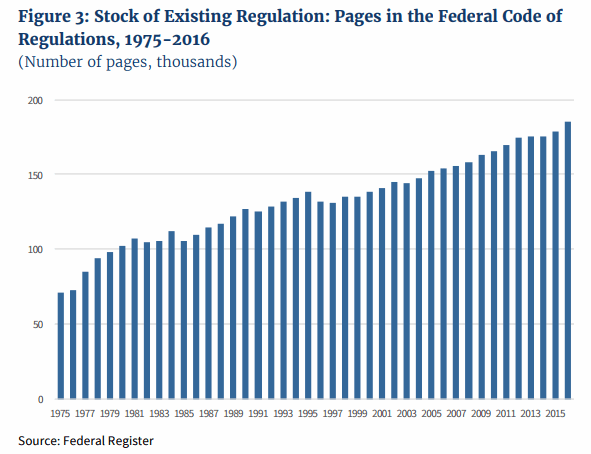
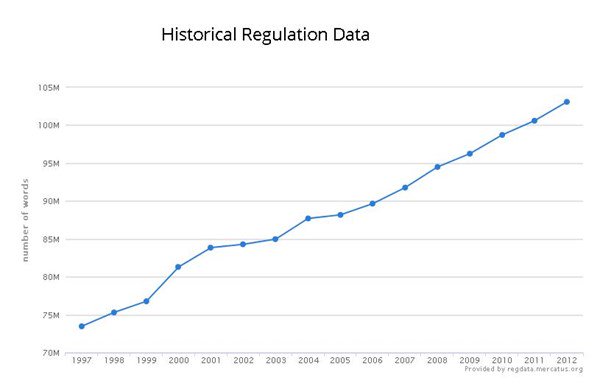
    Since I’m a self-confessed wonk, I’ll close by sharing this measure of the ever-growing burden of red tape. I realize it’s not as attention-grabbing as anecdotes and horror stories, but it is very relevant if we care about long-run growth and competitiveness.

    P.S. On the topic of regulation, I admit that this example of left-wing humor about laissez-faire dystopia is very clever and amusing.

    P.P.S. I’ve used an apple orchard as an example when explaining why a tax bias against saving and investment makes no sense. I’ll now have to mention that the beleaguered orchard owner also has to deal with 5,000 regulatory restrictions.

    Reprinted from International Liberty.


    Daniel J. Mitchell

    Daniel J. Mitchell is a Washington-based economist who specializes in fiscal policy, particularly tax reform, international tax competition, and the economic burden of government spending. He also serves on the editorial board of the Cayman Financial Review.

    This article was originally published on FEE.org. Read the original article.