And they shouldn’t feel (or more importantly, vote) this way. U.S. presidential elections were never supposed to devolve into contests between just two people, even though that’s what happens in a winner-take-all system such as ours. The Constitution does not mention political parties at all, and the Framers were worried that the rise of powerful factions would undermine liberty. As John Adams wrote in a
letter in 1780: “There is nothing which I dread so much as a division of the republic into two great parties, each arranged under its leader, and concerting measures in opposition to each other. This, in my humble apprehension, is to be dreaded as the greatest political evil under our Constitution.”
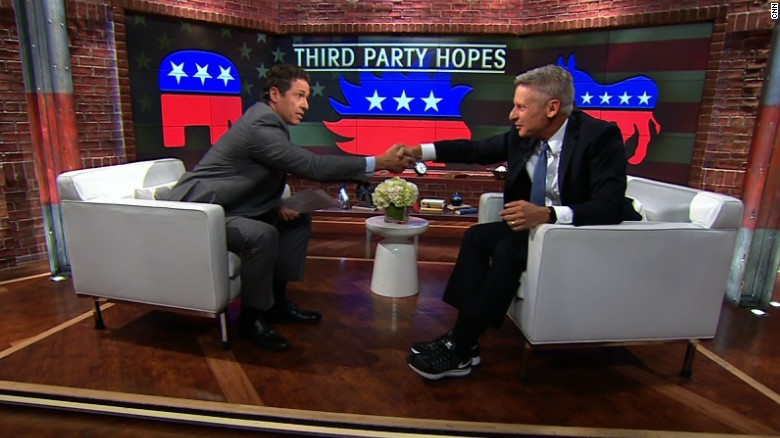
And even in 2016, voters still have choices beyond Clinton or Trump. A viable third party has put forth a compelling alternative in the form of libertarian Gary Johnson. For the second presidential election in a row, the Libertarian Party has chosen Johnson, a softspoken entrepreneur and former governor of New Mexico, as its candidate. His running mate is the impressive former governor of Massachusetts, William Weld. And just in the last few days, David French — a constitutional lawyer, National Review writer and Iraq war veteran —
has emerged as a potential independent candidate.
Both served as moderate Republicans who generally opposed runaway government spending while advocating social tolerance. Weld cut spending and privatized state services, earning
high marks from the Cato Institute, a libertarian think tank. Johnson pushed for school choice reforms and low taxes. Both supported drug decriminalization and same-sex marriage. As such, both embody
the libertarian philosophy that government should leave people alone, an approach that is
broadly popular with the American public.
Many voters are quick to dismiss third-party candidates, but Johnson and Weld are different. Between them, they have 16 years of successful executive experience as governors, working effectively with legislators, opposition and the business community alike. Contrast this with the presumptive Republican and Democratic nominees: Donald Trump is a
thin-skinned reality TV star with an authoritarian streak, and Hillary Clinton is a former secretary of state whose signature contribution to foreign policy — the 2011 military intervention in Libya — was
an unmitigated disaster. It’s no wonder Americans are reacting unfavorably to the idea of deciding whether Donald Trump’s complete lack of experience, decorum and honesty are more disqualifying than Hillary Clinton’s sleaziness and corruption.
And yet they will continue to struggle, because Americans are being bombarded by talking heads and political operatives depicting this race as a clash between just two choices: Democrat or Republican, left or right, A or B. People who even entertain other options are castigated for throwing away their votes. The GOP, in particular, is fond of telling people that a vote for the Libertarian Party is a vote for Clinton (and it tried a similar tactic in 2012 with President Obama).
In reality, nothing could be further from the truth: A vote for Johnson isn’t a vote for anyone other than Johnson. Indeed, the Founders never intended to set up a system that continuously produced just two choices, and modern Americans recognize that it’s almost always better to have more choices than fewer. Consumers want the option to shop around for everything from cable companies to health care providers to ice cream flavors. Additional choices provide people with more autonomy and agency to make the decision that fits them, rather than feel morally obligated to engage in a “less-bad” calculus.
Source: Don’t fall for “lesser of two evils” argument (Opinion) – CNN.com