• Tag Archives 1970s
  • Byte (October 1979)

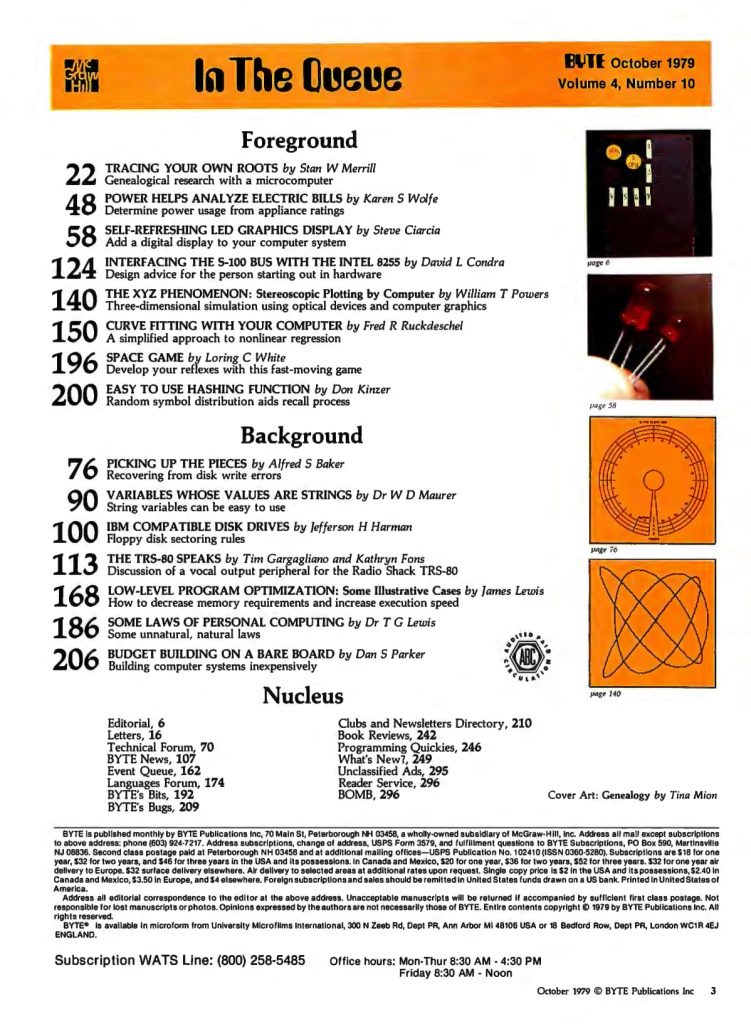
    I’m not sure if Byte was the first computer magazine but I think of it as the original computer magazine. It was around before home computers were even a thing. Nevertheless, Byte was covering “small systems” or microcomputers used by businesses and hobbyists starting in 1975. The October 1979 issue includes:

    Foreground

    • Tracing Your Own Roots – A type-in program to aid you in your genealogical research.
    • Power Helps Analyze Electric Bills – A type-in BASIC program to help you analyze your power bill.
    • Self-Refreshing LED Graphics Displays – A guide to building LED displays of various sizes including a 4×4 LED matrix.
    • Interfacing The S-100 Bus With The Intel 8255 – The Intel 8255 is a programmable peripheral interface chip that could be used, for example, to interface to a printer.
    • The XYZ Phenomenon: Stereoscopic Plotting by Computer – A way to print 3D images.
    • Curve Fitting With Your Computer – Curve fitting multiple variable data tables.
    • Space Game – A BASIC type-in Space War type game that will run on 8080 based machines like the MIPS Altair.
    • Easy To Use Hashing Function – A tutorial on hashing and an assembly hashing function.
    Background

    • Picking Up The Pieces – A guide to recovering from floppy disk errors.
    • Variables Whose Values Are Strings – A couple of methods for storing strings.
    • IBM Compatible Disk Drives – The IBM PC was still in the future. IBM compatible in this case refers to the IBM 33FD 8-inch floppy drive which was originally create for the IBM 3740 Data Entry System.
    • The TRS-80 Speaks – A guide to using BASIC to control the Speech Synthesizer Module for the TRS-80.
    • Low Level Program Optimization – How to reduce the space required and execution time of your programs.
    • Some Laws of Personal Computing – Defining the personal computer experience.
    • Budget Building On A Bare Board – Building a budget machine in 1979 meant starting with a bare circuit board and adding all the parts yourself.

    Nucleus

    • Editorial – Designing a board for a 6809 processor.
    • Letters – Letters from readers about light based communication, mapping phone companies, converting hexadecimal to ASCII, and more.
    • Technical Forum – Implementing a finite state machine.
    • BYTE News – A look at the future of the S-100 bus and competition from Apple, Radio Shack, Commodore, etc.; a new image sensor using a photo diode array; a new online service called The Source, automobile makers researching computer controlled cards; and more.
    • Book Reviews – Reviews of Practical Microcomputer Programming: The Intel 8080, Practical Microcomputer Programming: The M6800, and Practical Microcomputer Programming: The Z80.
    • Programming Quickies – An assembly program for handling ASCII strings.
    • What’s New – An alphanumeric calculator from Sharp, an encryption device for the TRS-80, an 8085 card, CAT acoustically coupled modem, Apple II Disassembler, Super BASIC for 6800 computers, and much more.
    …and more!


  • Byte (March 1977)

    Source: Byte – March 1977

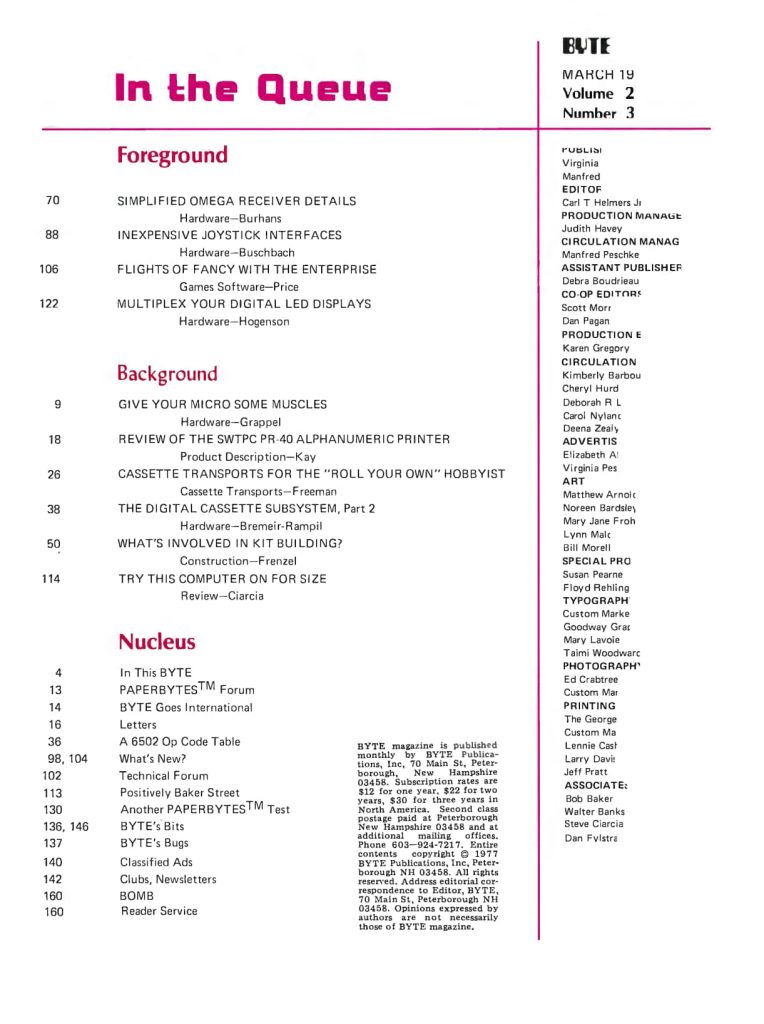
    Byte magazine (subtitled The Small Systems Journal) was a VERY early computer magazine with publication starting in 1975. This issue is from 1977. This is well before the IBM PC was introduced and there wasn’t much in the way of what would come to be known as home or personal computers around. However, the Commodore PET, TRS-80 (Model I), and Apple II were all released year igniting what might be considered the first home computer war. Most other machines were either kit based (you build it yourself, often including soldering) or more business oriented (CP/M based machines). The main CPUs in use were the Intel 8080, Zilog Z80, and MOS 6502. This would remain true for several more years. The March 1977 issue of Byte includes:

    Foreground

    • Simplified Omega Receiver Details – Byte tended to be pretty technical. The earlier the issue, the more technical it tended to be. This article just goes into building something called an Omega receiver. I guess if you didn’t know what that was, you didn’t need to build one. According to Wikipedia, “An Omega receiver is a device that picks up very low frequency radio signals transmitted by Omega stations to determine a position. It was used in conjunction with the Omega navigation system, which was operational from around 1971 until it was shut down in 1997. Omega receivers helped ships and aircraft establish their locations by receiving signals in the 10 to 14 kHz range from a network of eight fixed terrestrial radio beacons.” Sort of an early GPS system…
    • Inexpensive Joystick Interfaces – Earlier computers wouldn’t have joystick interfaces and there wasn’t really a standard interface. Here’s a guide for building your own.
    • Flights of Fancy with The Enterprise – A type-in BASIC action game based on Star Trek in which you must hunt down and destroy the Klingon battle cruisers. It requires approximately 22K of RAM which was a pretty hefty chunk in those days.
    • Multiplex Your Digital LED Displays – By this time, Digital LED displays had gone from an expensive luxury to something the hobbyist could perhaps afford. This guide to multiplexing them is useful, for example, for those wishing to replace the binary lights on some computer control panels or as another form of output.

    Background

    • Give Your Micro Some Muscles – Using a computer to control external devices.
    • Review of the SWTPC PR-40 Alphanumeric Printer – An early dot matrix printer that looks more like a telegraph machine. It is a 5 by 7 dot matrix printer capable of printing the 64 upper case ASCII character set with 40 characters per line at a speed of 75 lines per minute. It comes in kit form, meaning you have to assemble it yourself, for $250.
    • Cassette Transports for the “Roll Your Own” Hobbyist – At this time, data storage for computer hobbyists was almost entirely done via cassette. Basically using the same cassettes and tape recorder devices you would use for audio. This article describes building your own cassette device starting with choosing a better transport mechanism than what you would typically find in cheap consumer devices.
    • The Digital Cassette Subsystem, Part 2 – The second part in a series on the technical details of using cassettes for computer storage.
    • What’s Involved in Kit Building? – What it takes to build your own computer from a kit. It was a little more difficult that bulding (really putting together) a computer today. You may have to do your own soldering, wire wrapping, etc.
    • Try This Computer On For Size – A review of the Digital Group 8080A microcomputer. This is a computer that came in kit form that required extensive soldering and assembly including even CRT assembly.

    Nucleus

    • PAPERBYTES Forum – Excerpts of various letters discussing machine readable printed software. Conceptually, this idea is similar to reading a barcode which was starting to become commonplace, for example, in supermarkets at this time. However, the idea here was to input entire programs via some kind of printed code.
    • BYTE Goes International – Byte announces new Australian edition of the magazine.
    • Letters – Letters from readers regarding arithmetic on the 8080, the ELIZA program, word processing on the Altair, cooling the CPU in an Altair 8800, bank switching with the RCA COSMAC 1802, and more.
    • A 6502 Op Code Table – A reference chart that includes all the op codes for the MOS 6502 CPU. Useful for debugging hex dumps.
    • What’s New? – Phi Deck Tape Mass Storage for the Altair Bus (a tape drive for the Altair with up to 1 MB of storage), Computer Power & Light offers 8080A based computer system for $1863 completely assembled, new version of SC/MP processor from National Semiconductor, and more.
    • Techincal Forum – Comments on a proposed Universal Bus that was described in a previous issue of Byte.
    • Another PAPERBYTES Test – A contest in which you must scan the given page (similar to a really long barcode) and interpret the data which is a series of words. Decode the data and describe how you did it to win.
    • BYTE’s Bits – Steven Jobs reports what he claims is the first shipment of a personal computer system using new 16 K dynamic memory chips. The first systems (the Apple I) was delivered to retailers (in kit form) starting on December 17th, 1976.

    …and more!


  • Vintage Photos – Leo Oestreicher Collection (365-368)