
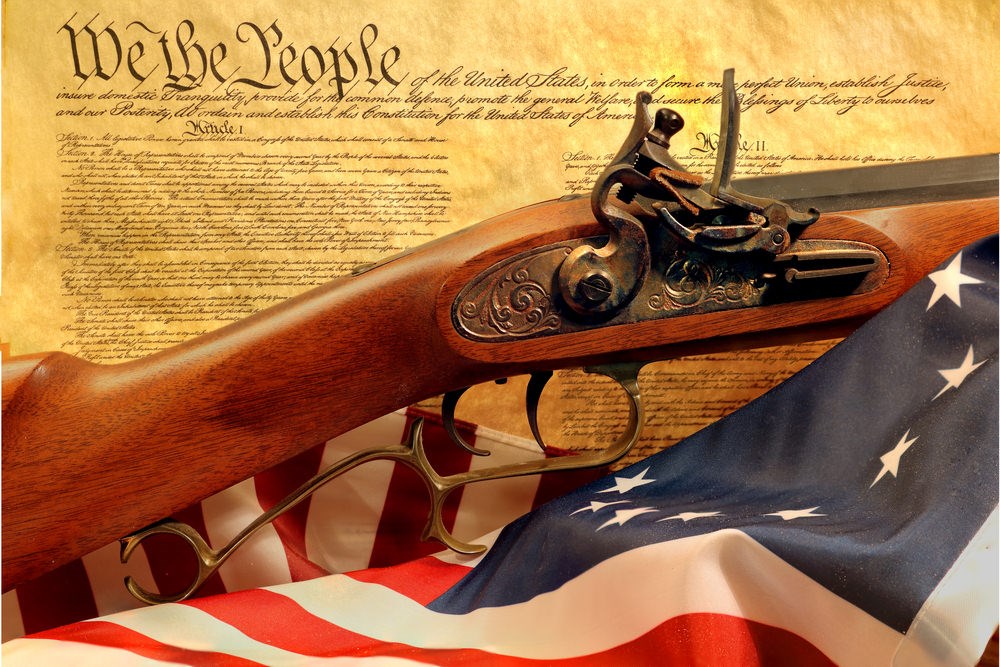
Firearms Technology and the Original Meaning of the Second Amendment
Gun-control advocates often argue that gun-control laws must be more restrictive than the original meaning of the Second Amendment would allow, because modern firearms are so different from the firearms of the late 18th century. This argument is based on ignorance of the history of firearms. It is true that in 1791 the most common firearms were handguns or long guns that had to be reloaded after every shot. But it is not true that repeating arms, which can fire multiple times without reloading, were unimagined in 1791. To the contrary, repeating arms long predate the 1606 founding of the first English colony in America. As of 1791, repeating arms were available but expensive.
This article explains why the price of repeating arms declined so steeply. Then it describes some of the repeating arms that were already in use when the Second Amendment was ratified, including the 22-shot rifle that was later carried on the Lewis and Clark expedition.
James Madison and Firearm Innovation
One of the men to credit for why repeating arms became much less expensive during the 19th century is James Madison, author of the Second Amendment. During Madison’s presidency (1809-17), Secretary of War James Monroe (who would succeed Madison as president), successfully promoted legislation to foster the development of firearms technology. In particular, the federal armories at Springfield, Mass., and Harpers Ferry, Va., were ordered to invent the means of producing firearms with interchangeable parts.
To function reliably, repeating firearms must have internal components that fit together very precisely — much more precisely than is necessary for single-shot firearms. Before President Madison and Secretary Monroe started the manufacturing revolution, firearms were built one at a time by craftsmen. Making a repeating arm required much more time and expertise than making a single-shot firearm. How to make repeating arms was well-known, but making them at a labor cost the average person could afford was impossible.
Thanks to the technology innovation labs created at Springfield and Harpers Ferry, inventors found ways to manufacture firearms components at a higher rate, and with more consistency for each part. Instead of every part being made by hand, parts were manufactured with machine tools (tools that make other tools). For example, the wooden stocks for rifles could be repetitively manufactured with such precision that any stock from a factory would fit any rifle from the factory, with no need for craftsmen to shave or adjust the stock.
In New England, the Springfield Armory worked with emerging machinists for other consumer products; the exchange of information in this technology network led directly to the Connecticut River Valley becoming a center of American consumer firearms manufacture, and to rapid improvements in the manufacture of many other consumer durables. The story is told in: Ross Thomson, Structures of Change in the Mechanical Age: Technological Innovation in the United States 1790-1865 (2009); Alexander Rose, American Rifle: A Biography (2008); David R. Meyer, Networked Machinists: High-Technology Industries in Antebellum America (2006); David A. Hounshell, From the American System to Mass Production, 1800-1932 (1985); Merritt Roe Smith, Harpers Ferry Armory and the New Technology: The Challenge of Change (1977); Felicia Johnson Deyrup, Arms Makers of the Connecticut Valley: A Regional Study of the Economic Development of the Small Arms Industry, 1798-1870 (1948). By the 1830s, manufacturing uniformity was sufficiently advanced that repeating arms were becoming widely affordable, and no longer just for the wealthy.
Centuries of Repeating Arms
What kind of repeating arms were available before 1815, when the Madison-Monroe mass production innovation program began? The state of the art was the Girandoni air rifle, invented around 1779 for Austrian army sharpshooters. Lewis and Clark would carry a Girandoni on their famous expedition, during the Jefferson administration. The Girandoni could shoot 21 or 22 bullets in .46 or .49 caliber without reloading. Ballistically equal to a firearm, a single shot from the Girandoni could penetrate a one-inch wood plank, or take an elk. (For more on the Girandoni, see my article “The History of Firearms Magazines and Magazine Prohibitions,” 88 Albany L. Rev. 849, 852-53 (2015).)
The first repeaters had been invented about three centuries before. The earliest-known model is a German breech-loading matchlock arquebus from around 1490-1530 with a 10-shot revolving cylinder. M.L. Brown, Firearms in Colonial America: The Impact on History and Technology, 1492-1792, 50 (1980). Henry VIII had a long gun that used a revolving cylinder (a “revolver”) for multiple shots. W.W. Greener, The Gun and Its Development, 81-82 (9th ed. 1910). A 16-round wheel lock dates from about 1580. Kopel, at 852.
Production of repeaters continued in the seventeenth century. Brown, at 105-6 (four-barreled wheel-lock pistol could fire 15 shots in a few seconds); John Nigel George, English Guns and Rifles, 55-58 (1947) (English breech-loading lever-action repeater, and a revolver, made no later than the British Civil War, and perhaps earlier, by an English gun maker).
The first repeaters to be built in large quantities appear to be the 1646 Danish flintlocks that used a pair of tubular magazines, and could fire 30 shots without reloading. Like a modern lever-action rifle, the next shot was made ready by a simple two-step motion of the trigger guard. These guns were produced for the Danish and Dutch armies. Brown, at 106-7.
In Colonial America, repeating arms were available for people who could afford them, or who were skilled enough to make their own. For example, in September 1722, John Pim of Boston entertained some Indians by demonstrating a firearm he had made. Although “loaded but once,” it “was discharged eleven times following, with bullets in the space of two minutes each which went through a double door at fifty yards’ distance.” Samuel Niles, A Summary Historical Narrative of the Wars in New England, Massachusetts Historical Society Collections, 4th ser., vol. 5, 347 (1837). Pim’s gun may have been a type of the repeating flintlock that became “popular in England from the third quarter of the 17th century,” and was manufactured in Massachusetts starting in the early eighteenth. Harold L. Peterson, Arms and Armor in Colonial America 1526-1783, 215-17 (Dover reprint 2000) (Smithsonian Institution 1956). Another repeating flintlock, invented by Philadelphia’s Joseph Belton, could fire eight shots in three seconds. Idem, 217. Pim also owned a .52 caliber six-shot flintlock revolver, similar to the revolvers that had been made in England since the turn of the century. Brown, 255. A variety of multi-shot pistols from the late eighteenth century have been preserved, holding two to four rounds. Charles Winthrop Sawyer, Firearms in American History: 1600 to 1800, 194-98, 215-16 (1910).
Devastation at Short Range
The repeaters described above were not the most common arms. It would take two decades for the program begun by President Madison to result in repeating arms beginning to become affordable to the middle class. So in the seventeenth and eighteenth centuries, a person who could not afford an expensive repeater, but who wanted to be able to fire more than one bullet without reloading, would often buy a blunderbuss. The blunderbuss was the size of a very large handgun. Its muzzle flared outward slightly, like a bell. This made it easier to load while bouncing in a stagecoach, or on a swaying ship. The blunderbuss could fire either one large projectile, or several at once. Most often it was loaded with about 20 large pellets, and so it was devastating at short range. The name seems an adaptation of the Dutch “donder-buse” or “thunder gun.”
Excellent for self-defense at close quarters, the blunderbuss was of little use for anything else, having an effective range of about 20 yards. Militarily, it was used by sailors to repel boarders. Stagecoach guards and travelers carried blunderbusses, and it was also a common arm for home defense. For more on the blunderbuss, see Brown and George, above.
High-Capacity Printing Presses
No one would dispute that modern arms are much improved from 1791 in terms of reliability, accuracy, range and affordability. But the gap from the 22-shot Girandoni (powerful enough to take an elk) to a modern firearm is pretty small compared with the changes in technology of “the press.” Compared to the one-sheet-at-a-time printing presses of 1791, the steam and rotary presses invented in the 19th century made printing vastly faster — a speed improvement that dwarfs the speed improvement in firearms in the last 500 years. When the First Amendment was written, a skilled printer could produce 250 sheets in two hours. Today, a modern newspaper printing press can produce 70,000 copies of a newspaper (consisting of dozens of sheets) in an hour. Now, with digital publishing, a newspaper article can be read globally within minutes after it is written.
This means that irresponsible media can cause far more harm today than they could in 1791. For example, in 2005, Newsweek magazine published a false story claiming that American personnel at Guantanamo Bay had desecrated Korans belonging to prisoners there. Eventually, Newsweek retracted the story. But the phony story had already spread worldwide, setting off riots in six countries, in which over 30 people were killed. Had Newsweek been using 18th-century printing presses, the false story would have mostly been read by several thousand people in the New York City area, where Newsweek is based. It would been months — if ever — before the Newsweek issue with the false story was read by anyone in Pakistan or Afghanistan.
We do not limit any constitutional right to the technology that existed in 1791. In District of Columbia v. Heller, the court observed:
Some have made the argument, bordering on the frivolous, that only those arms in existence in the 18th century are protected by the Second Amendment. We do not interpret constitutional rights that way. Just as the First Amendment protects modern forms of communications, e.g., Reno v. American Civil Liberties Union, 521 U. S. 844, 849 (1997), and the Fourth Amendment applies to modern forms of search, e.g., Kyllo v. United States, 533 U. S. 27, 35-36 (2001), the Second Amendment extends, prima facie, to all instruments that constitute bearable arms, even those that were not in existence at the time of the founding.
This is an accurate statement of constitutional law, but it understates how truly frivolous the argument against modern firearms is. The people who ratified the Bill of Rights certainly did not anticipate the invention centuries later of the Internet or of thermal imaging sensors. The American people of 1791 did not have to anticipate the invention of repeating arms, because such arms had been in existence for centuries.
Republished from the Washington Post.
David B. Kopel
This article was originally published on FEE.org. Read the original article.
