• Tag Archives Byte
  • Byte (July 1976)

    1976 was before the personal computer revolution really got going. That would happen the following year with the release of systems like the Commodore PET, Apple 2, Atari 400/800, and TRS-80. However, Byte was already covering computers for hobbyists and other small systems users. The July 1976 issue includes:

    Foreground

    • Coincident Current Ferrite Core Memories – An introduction to core memory and some info about using it in your own projects.
    • Explore an 8080 With Educator-8080 – A type in program for 8080 based machines meant to demonstrate the functions of a computer.
    • The “Ignorance is Bliss” TV Drive Circuit – A guide to building a TV interface that will turn your TV into a terminal.
    • Why Wait? Build a Fast Cassette Interface – The cassette was the first common mass storage device for small computers. This article describes how to build an interface that operates at 110 baud.

    Background

    • Assembling a Sphere – A guide to building the “SYS2/KIT – Intelligent”, a kit computer based on the Motorola 6800 processor.
    • Machine Language Programing For the “8008” – Chapter 1 – This chapter from the above named book covers the 8008 instruction set.
    • Put The “Do Everything” Chip in Your Next Design – A guide to to using the TMS-5501 chip in your own designs. This chip provides an asynchronous communications interface, parallel data IO buffer, interrupt control logic, and five programmable interval timers.
    • Surplus Electronics In Tokyo and Manila – A summary of this author’s experiences searching for surplus electronic components in Tokyo, Japan in October 1975 an Manilla, Philippines in November 1975.
    • Make Your Own Printed Circuit – Some techniques for creating your own printed circuit boards.
    • A Plot Is Incomplete Without Characters – Basic concepts of character generation along with techniques for saving memory space.

    Nucleus

    • The Trend Toward Hassle Free Products – Up to this point, if you wanted a personal computer, you generally had to build, if not design your own. However, that was all starting to change.
    • What’s New? – Tiny BASIC for 6800 based computers, a 100×100 resolution video camera kit, and more.
    • What Happened at Tranton – The first Trenton Computer Festival.
    • Letter – Letters from readers about software marketing, software delivery methods, the Star Trek game, Space War, and more.
    • Ask Byte – A question about systems that could store 5,000 patient records.

    …and more!


  • Byte (February 1978)

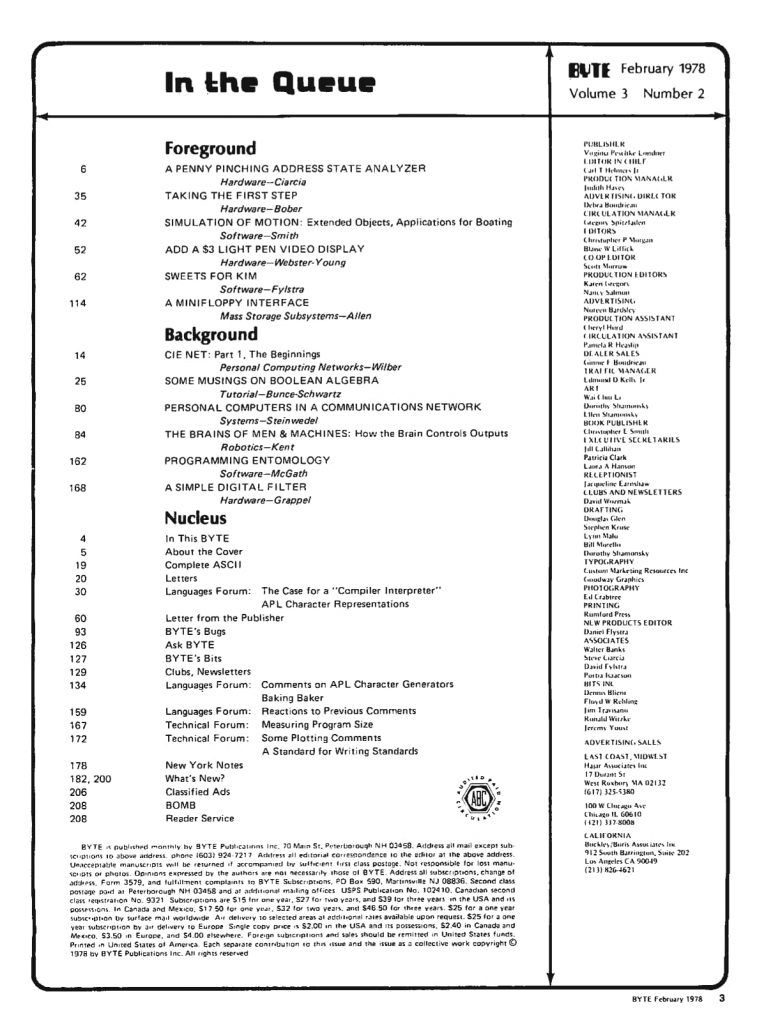
    Byte was one of the earliest and most technical computer magazines available. In 1978, things were really starting to take off in the ‘small computer’ arena. The closest thing to a standard were the S100 bus based 8008 or Z80 machines running CP/M. However, the Commodore PET, TRS-80, and Apple II had all recently been introduced. The February 1978 issue of Byte includes:

    Foreground

    • A Penny Pinching Address State Analyzer – A design for building an inexpensive address state analyzer that displays dynamic fluctuations of a computer’s memory bus.
    • Taking The First Step – An introduction to stepper motors.
    • Simulation Of Motion – Part four of a series on motion simulation. This part discusses applications for boating and other objects in water.
    • Add a $3 Light Pen Video Display – A guide to constructing your own very inexpensive light pen.
    • Sweets For KIM – A type-in lightweight text editor for the KIM.
    • A Minifloppy Interface – A guide to building an interface for a minifloppy disk drive. “Minifloppy” in this case I believe refers to 5.25″ disks. 8-inch disks were more that standard at the time but the smaller floppy drives and disks were cheaper.

    Background

    • CIE Net: Part 1, The Beginnings – The first in a series on the design of a telecommunications network for small systems.
    • Some Musings On Boolean Algebra – Unifying digital electronics, set theory, and propositional calculus using Boolean algebra.
    • Personal Computers in a Distributed Network – A speculative article on a possible method for linking computers wirelessly.
    • The Brains of Men & Machines – The second article in a series. The part looks at motor control of humans vs. machines.
    • Programming Entomology – A guide to protecting yourself from programming bugs.
    • A Simple Digital Filter – Using a computer to do the job of an analog filter.

    Nucleus

    • Complete ASCII – A complete ASCII table with binary, octal, decimal, and hexadecimal equivalents.
    • Languages Forum: The Case for a “Compiler Interpreter” APL Character Representations</> – The considerations of compilers vs. interpreters were a little different when mass storage was at a premium.
    • Ask BYTE – A question and answer about TTL integrated circuit devices driving LED displays.
    • BYTE’s Bits – COMP-CON 78 celebrates three years of the personal computer industry.
    • Languages Forum: Comments on APL Character Generators – A method for displaying ASCII and non-ASCII characters in APL.
    • Technical Forum: Measuring Program Size – Measuring program size depends on the computer and how it stores data.
    • Technical Forum: Some Plotting Comments – Approaches to building a plotter.
    • New York Notes – A report from the first annual Personal Computer Expo.
    • What’s New? – The Delta 4300E video display terminal, the ECMA-34 cassette recorder for computers, a credit card magnetic stripe reader, and more.

    …and more!


  • Byte (July 1981)

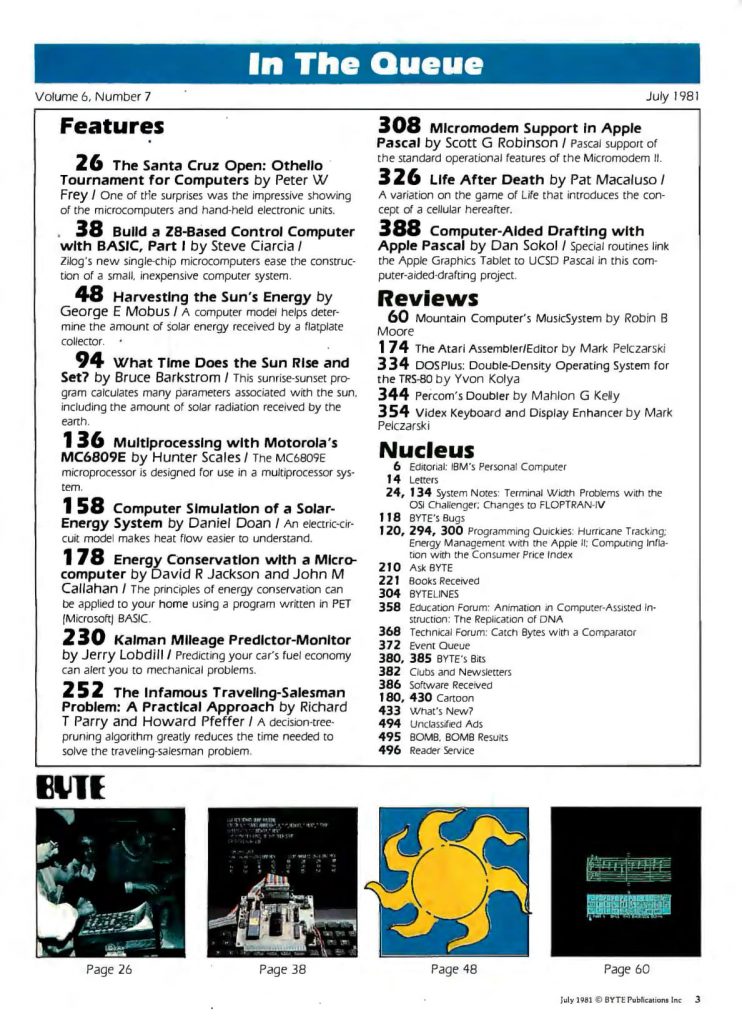
    Byte was perhaps the most successful early computer magazine. In its early days, it covered what would have been considered small business computers, hobbyist systems, and the first home computers. This issue from July 1981 is from shortly before the original IBM PC was introduced and includes:

    Features

    • The Santa Cruz Open: Othello Tournament for Computers – Twenty teams compete to create the best Othello program.
    • Build a Z8-Based Computer with BASIC, Part I – The first in a two part series on building a small computer based on the Zilog Z8 CPU and could be used for microcontroller applications.
    • Harvesting the Sun’s Energy – A type-in program to calculate the proper placement and positioning of solar panels used for heating.

    • What Time Does the Sun Rise and Set? – A type-in program that will give you sunrise and sunset times for a given latitude, longitude, and date.
    • Multiprocessing with Motorola’s MC6809E – The 6809 was a pretty advanced processor for its time. This was also the processor that the TRS-80 Color Computer used. The ‘E’ version had a few changes that made it possible to build multiprocessor systems with them. This article describes those changes and creating a multiprocessor system with it.
    • Computer Simulation of a Solar Energy System – Using a computer to simulate a solar-energy system using the heat transfer equation.
    • Energy Conservation with a Microcomputer – A program to calculate requirements for space conditioning and to help you save energy.
    • Kalman Mileage Predictor-Monitor – Using Kalman filtering techniques to estimate fuel mileage.
    • The Infamous Traveling-Salesman Problem: A Practical Approach – A guide to solving the traveling-salesman problem with your computer.
    • Micromodem Support in Apple Pascal – Accessing the Hayes Micromodem II on an Apple II Plus with Apple Pascal.
    • Computer-Aided Drafting with Apple Pascal – Using an Apple II, Apple Pascal, a Sup’r’terminal board, a Graphics Tablet, and custom software to create a computer-aided drafting system.

    Reviews

    • Mountain Computer’s MusicSystem – A synthesizer board and software for creating music for the Apple II for $545.
    • The Atari Assembler/Editor – A detailed look at Atari Assembler/Editor on cartridge from Atari for the Atari 400/800.
    • DOS Plus: Double-Density Operating System for the TRS-80 – A version of DOS for the TRS-80 Mdel I that supports both double and single density disks and is superior in other ways to the version of DOS supplied with Percom’s Doubler.
    • Percom’s Doubler – A hardware add-on and associated software to nearly double the storage space on floppy disks and increase their speed for a TRS-80 Model I.
    • Videx Keyboard and Display Enhancer – This adapter adds lower-case text capability to the Apple II, particularly useful for word processing.

    Nucleus

    • Editorial: IBM’s Personal Computer – A description and commentary on IBM’s upcoming personal computer, or at least what was known at the time.
    • Letters – Letters from readers about bugs in BASIC interpreters, structured programming, self replicating programs, and more.
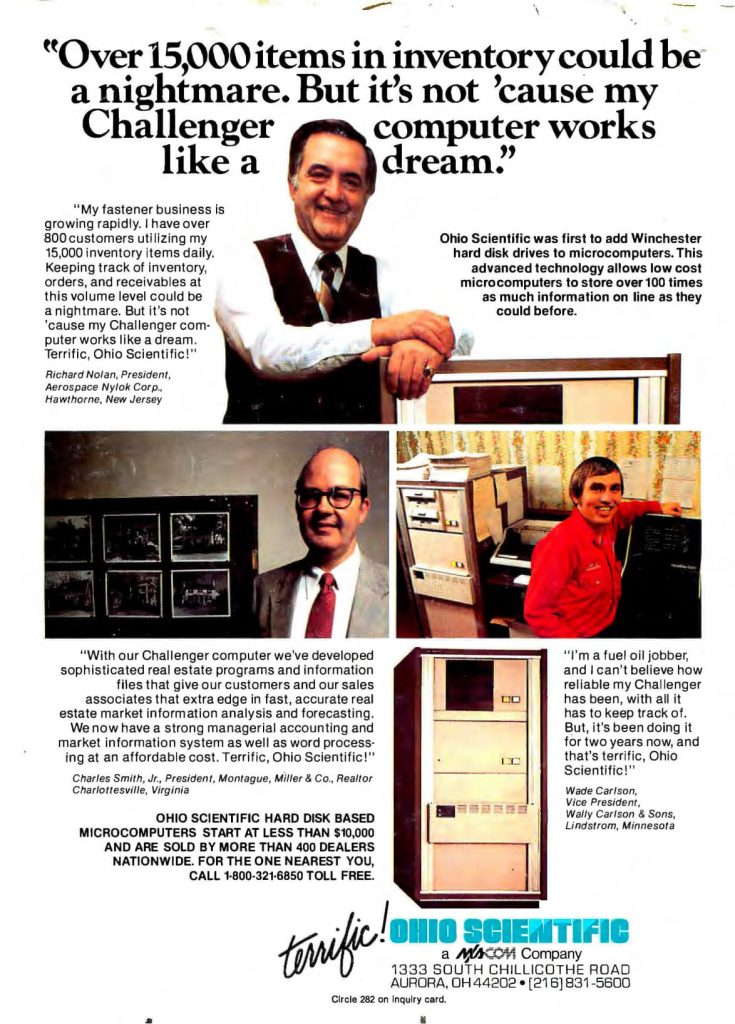
    • System Notes – Solving a problem with the OSI Challenger when the terminal width is less than 24 characters.
    • Programing Quickies – A hurricane tracking program, an energy measurement device and software for the Apple II, and an inflation calculator.
    • Ask BYTE – Questions answered about generating titles for VHS tapes on a TRS-80 Model I, EPROM programming, I/O expansion on the TRS-80 Model I, and more.
    • BYTELINES – NSF approves establishment of CSNET; using Videodisk players for databases and computer aided instruction; founders of MOS start Sirius Systems Technology; Rockwell International abandons bubble memory market; maximum number of transistors on a single IC predicted (wrongly); National Semiconductor develops ECC memory; and more.
    • Education Forum: Animation in Computer-Assisted instruction: The Replication of DNA – This article presents an example of computer aided instruction using a TRS-80 and DNA as the subject matter.
    • Technical Forum: Catch Bytes with a Comparator – A guide to building a logic probe for debugging purposes.
    • What’s New – A look at new items including a serial interface that allows up to eight RS-232C devices to be attached to your computer, a new 150-cps paper tape reader from Addmaster, the MTL portable cassette system, the Model 84G dot matrix graphics printer, the Series III Speech Module from Telesensory Systems Inc., an 8-inch floppy drive for North Star computers, the Mediamax ETP adapter for connecting IBM Model 50, 60, and 75 electronic typewriters to computers to use as a printer, the Epax buffered serial interface for Epson MX-80 printers, a 64KB version of the SuperBrain, Jinsam 8.0 database system for Commodore 8000 computers and 4.0 for Commodore 4000 computers, the XASM6809 Cross Assembler, FPL financial planning software for CP/M, Smartill terminal program for the TRS-80 Model III, and much more.

    …and more!