• Tag Archives TI-99/4A
  • Compute! (August 1984)

    Compute! was one of the more popular home computer magazines of its time. It wasn’t as technical as something like Byte and it concentrated on the machines most potential users would be buying for their home. The August 1984 issue includes:

    Features

    • Software Power!: The Summer Consumer Electronics Show – While some new computers and other hardware were introduced at the Summer CES, there was also a lot of new software. Some machines made debuts privately like the Amiga Lorraine prototype, a new advanced 8-bit computer from Atari, and MSX based computers due to hit the U.S. Commodore also introduced the Plus/4 and C-16 (both of which went nowhere). Coleco was also pushing the Adam which was introduced 6 months earlier. There were also tons of games and other software for the Commodore 64, Atari, and Apple II among others.
    • The COMPUTE! Interview: Gerald K. O’Neill – The head of a company called Geostar Corporation which was a computer-based satellite positioning and communications company.

    Education and Recreation

    • Devastator – A type-in game in which you must destroy an alien invasion force before it destroys Earth. Originally written for the VIC-20 with versions included for the Commodore 64, Color Computer, TI-99/4A, Apple II, and PC.
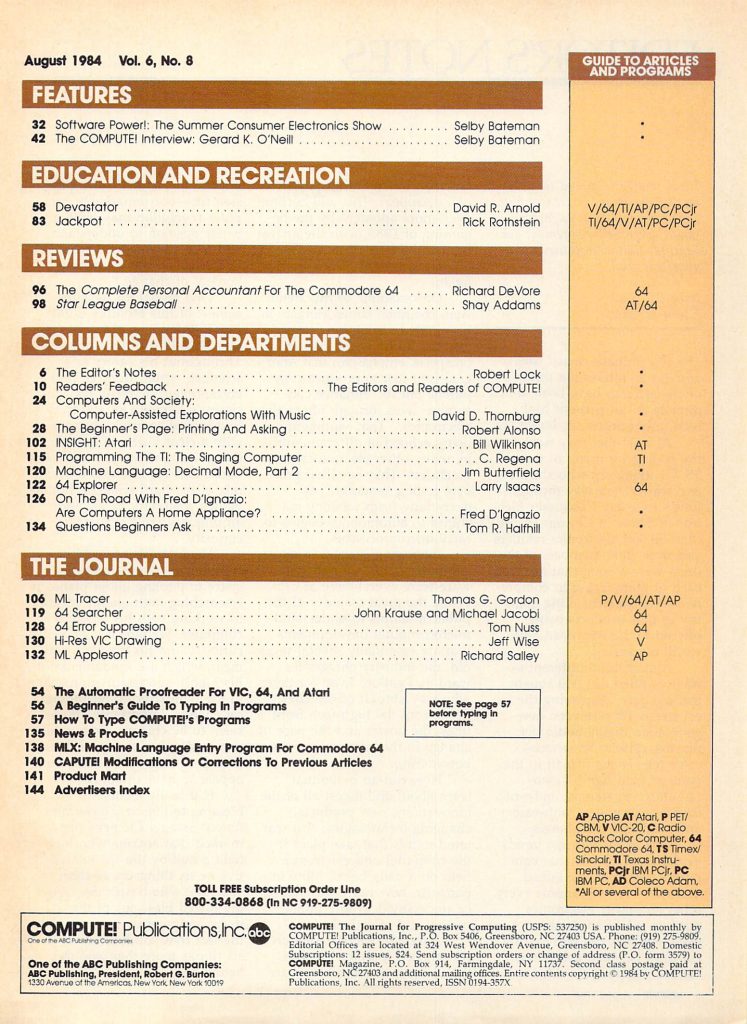
    • Jackpot – A type-in slot machine simulator for the Ti-99/4A, Commodore 64, VIC-20, Atari, and PC.

    Reviews

    • The Complete Personal Accountant For The Commodore 64 – A sophisticated accounting package for the Commodore 64 that includes ten separate programs.
    • Star League Baseball – An excellent baseball sim for its time for the Commodore 64.

    Columns and Departments

    • The Editor’s Notes – An editorial on the Summer Consumer Electronics Show.
    • Readers’ Feedback – Readers write in about Commodore 64 memory, Pascal for the Apple II, Atari checksum errors, using the stack, slowing screen output on the Commodore 64, and more.
    • Computers and Society: Computer-Assisted Explorations With Music – Teaching people to compose music with computers. This article concentrates on a software product called Musicland for the Apple II.
    • The Beginner’s Page: Printing And Asking – Printing special control codes (e.g. cursor movement) in BASIC by using CHR$ and ASCII values.
    • INSIGHT: Atari – Using the Atari 1050 disk drive enhanced density mode.
    • Programming The TI: The Singing Computer – Using the TI Speech Synthesizer to make the TI-99/4A sing.
    • Machine Language: Decimal Mode, Part 2 – Some of the bugs and pitfalls with using decimal mode in machine language on the Commodore 64 and VIC-20.
    • 64 Explorer – Printing characters to a bitmapped display by drawing it.
    • On The Road With Fred D’Ignazio: Are Computers A Home Appliance? – I don’t think computers have really ever been an “appliance”. More like a personal device similar to a mobile phone.
    • Questions Beginners Ask – Questions answered about plugging all computer peripherals into the same wall socket via a power strip and transporting a computer by plane.

    The Journal

    • ML Tracer – A type-in program for the Atari, Apple II, and Commodore computers that allows you to step through machine language programs.
    • 64 Searcher – A type-in program that allows you to search through you BASIC program for the string of your choice.
    • 64 Error Suppression – Avoiding error messages and system freezes when an error occurs on the Commodore 64.
    • Hi-Res VIC Drawing – A guide to drawing hi-res images on the VIC-20.
    • ML Applesort – A type-in machine language program for the Apple II that will sort an array of any length.
    • News & Products – The Drum-Key music interface board for the Apple II, an RS-232 modem adapter for Atari, Graphics Master for the Commodore 64, the Networker communications package for the Apple II, the Creative Electronics lighte pen for the Commodore 64 and VIC-20, and more.
    …and more!

  • Compute! (September 1985)

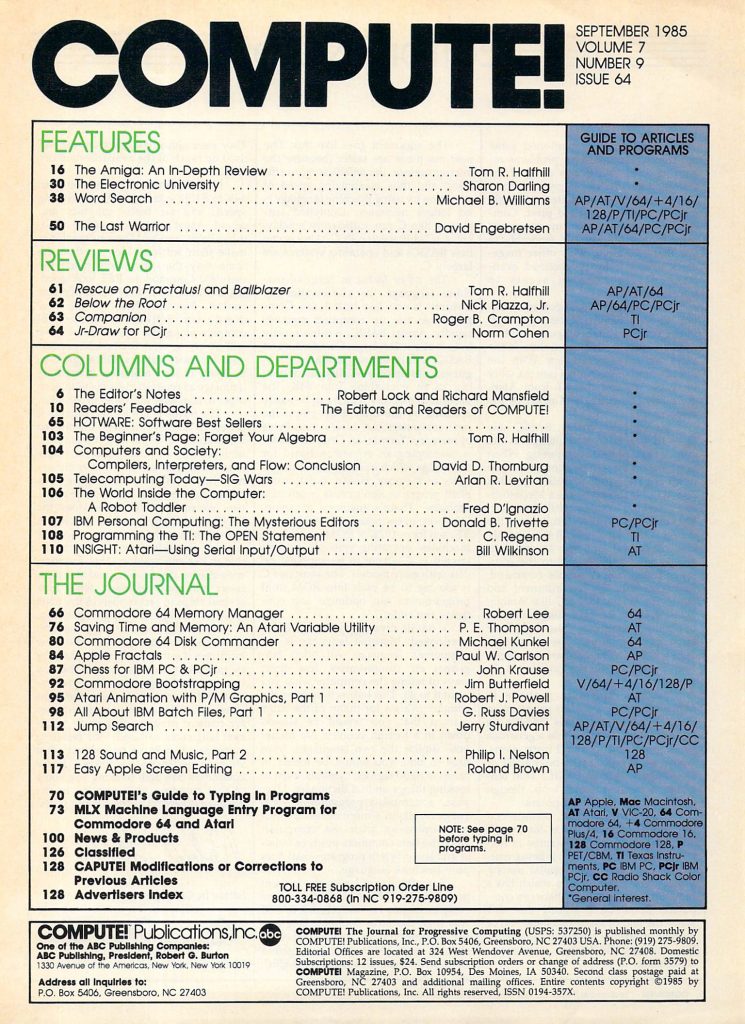
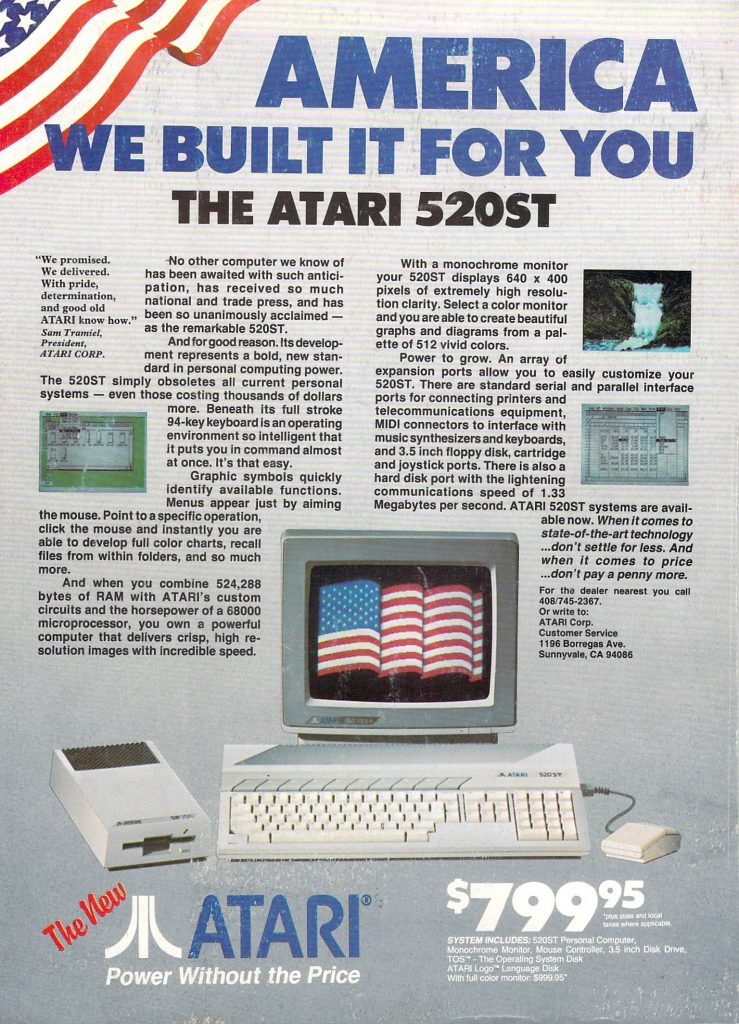
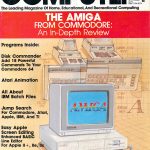
    Compute! was probably the best magazine for the average computer user in the early to mid 1980s and perhaps beyond. At least if you had an interest in more than one platform. Compute! covered all of the popular home computers of the time and there were a bunch in 1985 including the Commodore 64, Apple II, Atari 8-bit, PC, TI-99/4A, the brand new Amiga and Atari ST, and probably others. The September 1985 issue includes:

    Features

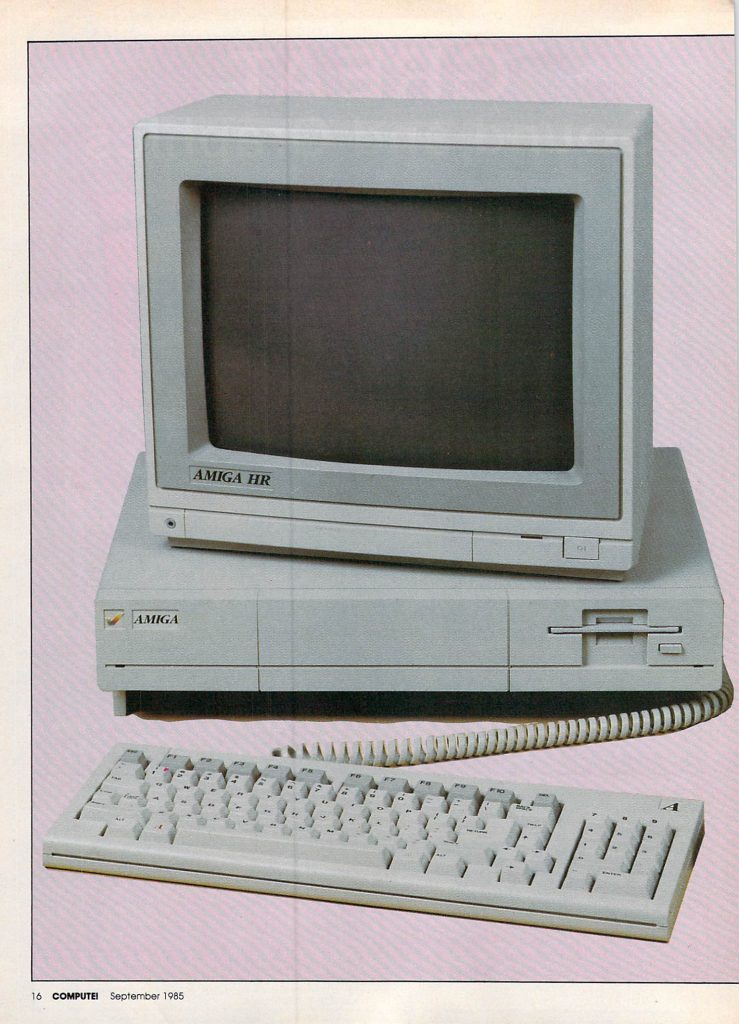
    • The Amiga: An In-Depth Review – A detailed look at the new Amiga (Amiga 1000) from Commodore. It was due to be released in August.
    • The Electronic University – While it took a while for online education to really take off, it is far from new. This article tells the story of one family who is using their Commodore SX-64 to earn online degrees.
    • The Last Warrior – A type-in arcade style action game for hte PC, Commodore 64, Atari 400/800, and Apple II.

    Reviews

    • Rescue on Fractalus! and Ballblazer – Reviews of these two classic Lucasfilm games for Atari 8-bit computers.
    • Below the Root – An adventure game for the Commodore 64 based on the Green Sky Trilogy of books.
    • Companion – A word processing program for the TI-99/4A.
    • Jr-Draw for PCjr – An art program designed for the PCjr that can optionally use a light pen.

    Columns and Departments

    • The Editor’s Notes – A discussion of the Amiga, BASIC, machine language, and the C programming language.
    • Readers’ Feedback – Letters from readers about relational operators, Atari tape to disk transfer, adding beeps to key presses on the Commodore 64, unlocking IBM PC BASIC programs, and more.
    • HOTWARE: Software Best Sellers – Best selling software this month includes Flight Simulator II (Entertainment), Math Blaster! (Education), and Print Shop (Home Management).
    • The Beginner’s Page: Forget Your Algebra – It turns out you don’t need an extensive math background to program a computer.
    • Computers and Society: Compilers, Interpreters, and Flow: Conclusion – How different compilers and interpreters affect program flow and complexity.
    • Telecomputing Today – SIG Wars – Special Interest Group sysops switch between services while those services claim ownership of all messages and uploaded files in a SIG.
    • The World Inside the Computer: A Robot Toddler – A look at the Herojr personal robot.
    • IBM Personal Computing: The Mysterious Editors – A look at the editors that IBM provides with its PCs including BASIC, DEBUG, and EDLIN.
    • Programming the TI: The OPEN Statement – Some examples of using the OPEN statement on the TI-99/4A.
    • INSIGHT: Atari – Using Serial Input/Output – A look at how printing and disk access works via SIO.

    The Journal

    • Commodore 64 Memory Manager – A type-in program for the Commodore 64 that allows you to load multiple BASIC programs into memory at once and switch between them.
    • Saving Time and Memory: An Atari Variable Utility – A set of type-in utilities for the Atari 8-bit that allows you to list, rename, and abbreviate variable names in BASIC programs.
    • Commodore 64 Disk Commander – A type-in utility for the Commodore 64 that makes disk access more convenient.
    • Apple Fractals – A type-in program for generating fractals on the Apple II.
    • Chess for IBM PC & PCjr – A type-in chess program for the PC and PCjr based on an earlier published version for other machines.
    • Commodore Bootstrapping – A tutorial and demo for how to load programs that are divided into multiple parts on the Commodore 64, VIC-20, C16, PET/CBM, and Plus/4.
    • Atari Animation with P/M Graphics, Part 1 – The first part of an animation tutorial for the Atari 8-bit using Atari’s Player/Missile graphics.
    • All About IBM Batch Files, Part 1 – The first part of a tutorial for using DOS batch files.
    • Jump Search – A demonstration of binary search on the Atari 400/800, Apple II, IBM PC, Commodore 64, TI-99/4A, and Color Computer.
    • 128 Sound and Music, Part 2 – This part explores the Commodore 128’s FILTER, SOUND, and PLAY commands.
    • Easy Apple Screen Editing – A type-in screen editor for the Apple II.


    …and more!


  • Compute! (March 1986)

    Source: Compute! – Issue Number 70 – March 1986

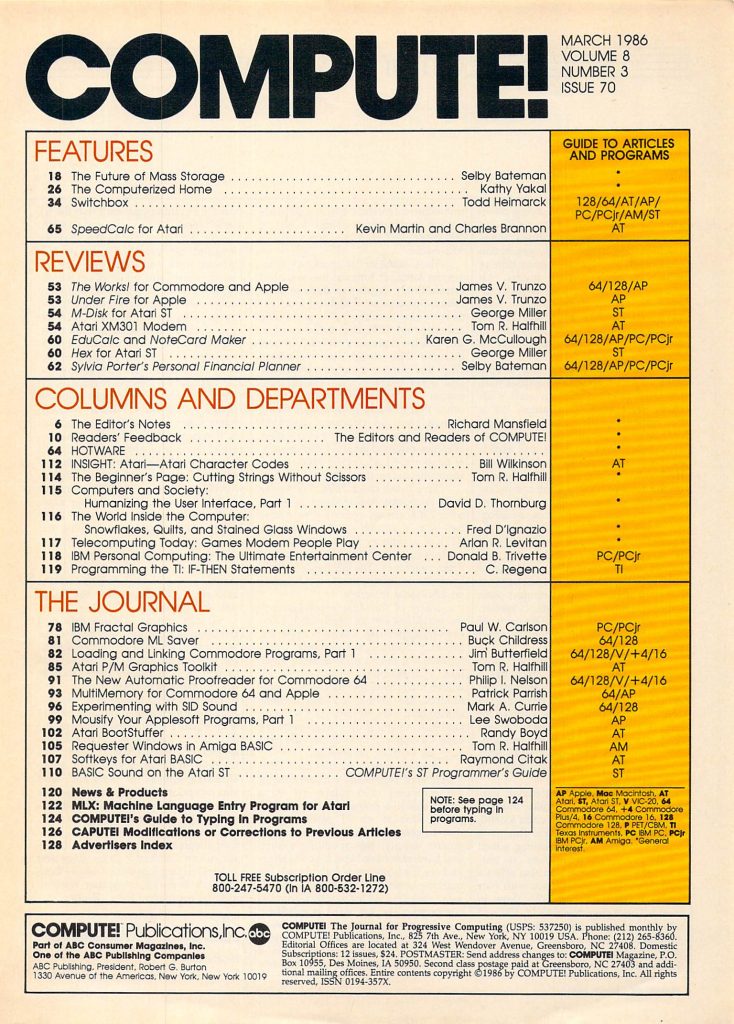
    Compute! was an excellent magazine that covered most popular computers of the time. I was partial to the spin-off Gazette because I had a Commodore 64 but this one was excellent as well. It was a little less technical that Byte but all magazines at the time were technical compared to today. The March 1986 issue includes:

    Features

    • The Future of Mass Storage – The future was bright for mass storage. 3.5″ floppies were replacing 5.25″ floppies, Hard drives were becoming affordable, and optical storage for the average user was on the horizon.
    • The Computerized Home – Computerized home automation was a thing long before Alexa. The X-10 interface was the de-facto standard and X-10 modules were available for pretty much any platform.
    • Switchbox – A type-in puzzle game with versions specifically for the Commodore 128, Commodore 64, Atari 8-bit, Atari ST, PC, and Amiga.
    • SpeedCalc for Atari – A type-in professional quality spreadsheet program for the Atari 8-bit.

    Reviews

    • The Works! – A software package for the Commodore 64 and Apple II that includes 13 programs in the categories of tools, organizers, arts, and learning.
    • Under Fire – A World War II strategy game for the Apple II.
    • M-Disk – Software for creating a RAM Disk on the Atari ST.
    • Atari XM301 Modem – A 300bps direct connect modem for Atari 8-bit computers.
    • EduCalc and NoteCard Maker – A combination of a simplified spreadsheet program and simplified database manager with versions for the Commodore 64, Apple II, and PC (Apple II version reviewed here).
    • Hex – A puzzle/strategy game for the Atari ST.
    • Sylvia Porter’s Personal Financial Planner – This software package includes six programs including Transaction Manager, Budget Manager, Asset/Liability Manager, Balance Sheet, and Financial Planner. The Commodore 64 version is reviewed here with versions also available for the PC and Apple II.

    Columns and Departments

    • The Editor’s Notes – A comparison of the new Amiga and Atari ST.
    • Readers’ Feedback – Letters from readers about code comments, computers for charity, recording music on the Amiga, and more.
    • HOTWARE – The top five selling software titles in three different categories. In the top places were F-15 Strike Eagle (Entertainment), Typing Tutor III (Education), and Print Shop (Home Management).
    • INSIGHT: Atari – A look at Atari character codes. Atari 8-bit computers used a variant of ASCII called ATASCII.
    • The Beginner’s Page: Cutting Strings Without Scissors – How to split strings in BASIC.
    • Computers and Society: Humanizing the User Interface, Part 1 – Exploring ways to make the user interface easier to use and more intuitive.
    • The World Inside the Computer: Snowflakes, Quilts, and Stained Glass Windows – Art on the Amiga.
    • Telecomputing Today Games Modern People Play – A look at online multiplayer gaming. At the time, that typically meant turn based gaming on BBS systems or services like CompuServe.
    • IBM Personal Computing: The Ultimate Entertainment Center – A guide for using your PC or PCjr with a TV.
    • Programming the TI: IF-THEN Statements – Using IF-THEN statements including examples for simulating AN/OR, doing Algebra, and more.
    • News & Products – Valhalla announced for the Commodore 64; MIDI Ensemble for the PC; AtariWriter and AtariWriter Plus word processors for the Atari ST; What’s Our Worth? home inventory package for the Commodore 64; and more.

    The Journal

    • IBM Fractal Graphics – Three type-in programs for creating fractals on the IBM PC and PCjr.
    • Commodore ML Saver – A type-in program for saving machine language programs directly from memory to disk on the Commodore 64.
    • Loading and Linking Commodore Programs, Part 1 – The first in a series of article on loading, chaining, and overlaying programs on Commodore computers.
    • Atari P/M Graphics Toolkit – Atari Player/Missile graphics is the Atari 8-bit version of sprites. This type-in toolkit makes it easier to develop and use P/M graphics on the Atari.
    • MultiMemory for Commodore 64 and Apple – Short type-in programs for the Commodore 64 and Apple II that allow you to segment memory for loading multiple BASIC programs.
    • Experimenting with SID Sound – Some examples for controlling the Commodore 64’s SID sound chip.
    • Mousify Your Applesoft Programs, Part 1 – The first of a two-part guide to using a mouse (or joystick or paddles) with your own programs.
    • Atari BootStuffer – This short type-in program for the Atari 8-bit allows you to create a menu system to load up to 8 different programs with one key press.
    • Requester Windows in Amiga BASIC – A guide to adding requester windows (dialog boxes) to Amiga BASIC programs.
    • Softkeys for Atari BASIC – This type-in program gives you automatic line numbering and various hotkeys when writing your own BASIC programs.
    • BASIC Sound on the Atari ST – A guide to getting started with creating basic sound effects on your Atari ST.

    …and more!