• Tag Archives Byte
  • Byte (October 1980)

    Byte was a bit more technical than most mainstream computer magazines of the time. It really was more for hobbyists than just users. In 1980, the IBM PC still had not bee introduced yet. The closest thing to a standard were machines with an 8080/Z80 CPU, S-100 bus and CP/M but there were tons of proprietary systems. Home users would mostly have been using an Atari, Apple, Commodore, or Radio Shack machine. The October 1980 issue of Byte includes:

    Foreground<

    • An 8088 Processor For The S-100 Bus, Part 2 – The second part of a design for an 8088 based S-100 processor board.
    • Sorting With Binary Trees – A description of the binary tree sorting algorithm.
    • FLOPTRAN-IV: A Tiny Compiler – This is basically a floating point translator for Commodore PET BASIC
    • Symbolic Math Using BASIC – A simple BASIC program that expands polynomials.
    • The 6502 Gets Microprogrammable Instructions – A simple hardware design to add 64 user defined instructions to the 6502 CPU.
    • Vector Graphics For Raster Displays – An efficient method for plotting vectors on a raster display.

    Background

    • Make Liquid-Crystal Displays Work For You – A technical description of LCDs and how to interface with and control them.
    • An Information-Retrieval System – Designing a more user friendly information retrieval system.
    • Add Macro Expansion To Your Microcomputer, Part 1 – The first part of this series on macro assemblers details the process of defining and using macro instructions.
    • Machine Problem Solving – Part 2 of this series focuses on solving cryptarithemetic problems.
    • The Forth Standards Team – A look at FORTH standards, past and present.

    Nucleus

    • Editorial – The results of a reader survey that provides info on the types of people that read Byte.
    • Letters – Letters from readers about software piracy, transferring files from a mainframe to a CP/M machine, TRS-80 performance, and more.
    • Product Review – A review of the Synertek Systems KTM-2 Terminal-on-Board. This was basically a keyboard and terminal hardware that, with a display, made a complete terminal.
    • Desk Top Wonders – Darth Vader’s Force Battle, a game for the TI-59 calculator.
    • Education Forum – A Multiple-Machine Loader for Classroom Computers – This is an interface for loading programs on multiple computers from a single source. This great reduces the coast of classroom systems since a separate disk drive would not be needed for each machine.
    • Product Description – A look at the TRS-80 Model III (I used these in high school though they were already outdated then) and the TRS-80 Pocket Computer.
    • Technical Forum – Adding upper-and-lowercase capability to the TRS-80.
    • BYTELINES – IEEE floating point standard released; Motorola created computer controlled house; toy robots getting smarter; Nevada approves computer based slot machines; Intel working on 32-bit computer; IBM introduces Displaywriter word processing system; Commodore introduces $199 computer (The VIC-20); and more.
    • Book Reviews – Reviews of Microprocessors and Digital Systems, Z80 Microprocessor Programming and Interfacing, and more.
    • Programming Quickies – Exchanging the contents of two memory locations and a Towers of Hanoi implementation in BASIC09.
    • Ask Byte – Questions answered about the high price of terminals, TRS-80 keyboards, TRS-80 memory upgrades, expanding the TRS-80, using a computer at a radio station, and more.
    • What’s New? – A brief look at new products including the TC-8 high-speed cassette for the TRS-80, Microplot 44 thermal printer, The System 10 from GNAT, dot matrix printer from TEI, the Wavetek Model 3010 Signal Generator, and more.

    …and more!


  • Byte (September 1987)

    Byte was a bit more technical than most mainstream computer magazines of the time. It really was more for hobbyists than just users. The September 1987 issue includes:

    Features

    • A Programmer’s Introduction to OS/2 – A guide to writing applications in OS/2. OS/2 was a more advanced OS than DOS but it never really caught on in a mainstream way. I remember really wanting OS/2 when version 2.1 was out. It’s promise of running DOS and Win 3.1 apps simultaneously (in addition to OS/2 apps of course) really appealed to me. Unfortunately, it didn’t work right with the video card in my 486/DX2-66. It was a frustrating experience.
    • The New Generation: A Closer Look – Benchmarking the 80386 and the 68020.
    • Ciarcia’s Circuit Cellar: Build the Circuit Cellar AT Computer, Part 1: AT Basics – Designing a 286 based PC on a card.
    • Programming Project: Crafting Reusable Software in Modula-2 – Building reusable program libraries with careful design in Modula-2.
    • Programming Insight: Teaching Old Screens New Tricks – Creating fancy screen displays in your own programs on the IBM PC. Keep in mind we are talking about text based displays for the most part.
    • Constructing an Associative Memory – Creating a simple nonlinear neural network that runs on your PC.
    • Karmarkar’s Algorithm – A description of a method for solving large linear programming problems.

    Theme: Printer Technologies

    • Color Printing – A look at the color printing technologies of the time. For the most part, they are basically the same as what we have today though really only ink jet and laser have survived in mainstream use.
    • Vector-to-Raster Algorithms – Methods for converting what is on the screen to the printer.
    • Page Printers – They are really talking about laser printers here. The problem at the time was that they were very expensive (and still are relatively speaking though not nearly so much so) and they weren’t high enough resolution to desktop publishing (300 dpi at the time).
    • Print Quality – A look at the various factors that influence print quality and how to objectively measure it.
    • Engineering Close-Ups: Taming the Hot Heads – With increased print speeds comes increased print head temperatures. A look at how this problem is being resolved.
    • Matrix-Line Printing – An alternative to serial character printing that uses an 8-inch wide bank of print hammers that has to move only 1/3 of an inch to print an entire line.
    • Color Thermal-Transfer Printing – The challenges of getting good quality color thermal-transfer printing.
    • Designing a High-Speed Page Printer Controller – The printer controller was often the bottleneck when it came to print speed for laser printers. A look at how to design faster interfaces.
    • Strip-Buffer vs. Full-Page Bit-Map Imaging – Page printers basically use full page bitmap images. However, as resolution goes up, so does memory usage. Strip-buffer technology was a more memory friendly alternative.

    Reviews

    • The Kaypro 386 – Kaypro’s entry into the 386 market. This machine incudes at 16 MHz 386 CPU, 51k RAM on board with an optional 2-megabyte expansion board that can be expanded to 16 megabytes, a 1.2 MB 5.25″ floppy drive, hard drive options ranging from 40 megabytes to 330 megabytes, and more. A model with no hard drive and 512K RAM would set you back $4495.
    • Mail-Order Performance – A look at two 286 based PCs including the Proteus Technology’s Proteus 286GT and PC Design’s GV-286.
    • The NEC Multispeed – A look at this NEC laptop that includes the NEC V30 CPU that can operate at 4.77 and 9.54 MHz, 640K RAM, and a 720K 3.5″ disk drive for $2195.
    • The Micro Clipper Graphics Subsystem – A high-end graphics card for CAD systems for $3295.
    • PC-MOS/386 – A DOS compatible multitasking and multiuser OS for 386 based PCs. I’m continually surprised by how many of these sorts of multitasking DOS systems were around.
    • Actor 1.0 – Smalltalk was the best known object oriented programming language at the time. Actor was meant to be a simpler alternative.
    • ALS Prolog – A review of this Prolog compiler and a comparison with Turbo Prolog 1.1.
    • Benchmarking dBASE III Compilers – A look at three dBASE III compilers including Clipper, Quicksilver 1.1, and FoxBASE + 2.00.
    • DESQview 2.00 – DESQview is a multitasking system that would let you run multiple DOS programs in different Windows. I remember this being popular among BBS operators in the early 1990s. You could always tell when the Sysop was on doing other things because the BBS would slow down a bit.

    Kernel

    • Computing at Chaos Manor: In the Chips – A look at various products including Chessmaster 2000, the DSI-785 68020 Coprocessor Board, Eureka: The Solver from Borland, Faery Tale Adventure, the Kaypro 386, pc-ditto, SpeedStor, and VOPT.
    • Applications Only: Potpourri – A look at new software including MemoryMate, Mirror II, Tracker, Oyster, Guide, and The Comic Strip Factory.

    Departments

    • Editorial: Mere Conservatism – or Fear, Uncertainty, and Doubt? – Why people chose the IBM PC AT over other machines such as the Compaq 386 and IBM PS/2 Model 80 among others as the best general-purpose microcomputer.
    • Letters and Review Feedback – Letters from readers about Lyrix word processor, the C-terp C interpreter, desktop publishing, and more.
    • Microbytes – Problems in the U.S. semiconductor industry; a look at Apple’s Cray Simulation Engine used for UI design; MacBrain neural computing software for the Mac Plus/SE/II; and more.
    • What’s New – Hypercard and MultiFinder bundled with 1-megabyte Macs; PaintJet color printers from HP; OS/286 and OS/286 protected mode operating systems; System V/386 for the 80386; Rodine 450 RX 45 megabyte hard drive for the Macintosh SE/II; Z80 CP/M card from MicroSolutions for the IBM PC; Data General’s Model 2T laptop; and more.
    • Ask BYTE – Questions answered about optimizing hard drives in the IBM PC, measuring earthquakes with computers, and more.
    • Book Reviews – Reviews of CD ROM 2: Optical Publishing, 68000 Assembly Language: Techniques for Building Programs, and Software Components with Ada: Structures, Tools and Subsystems.

    …and more!


  • Byte (December 1976)

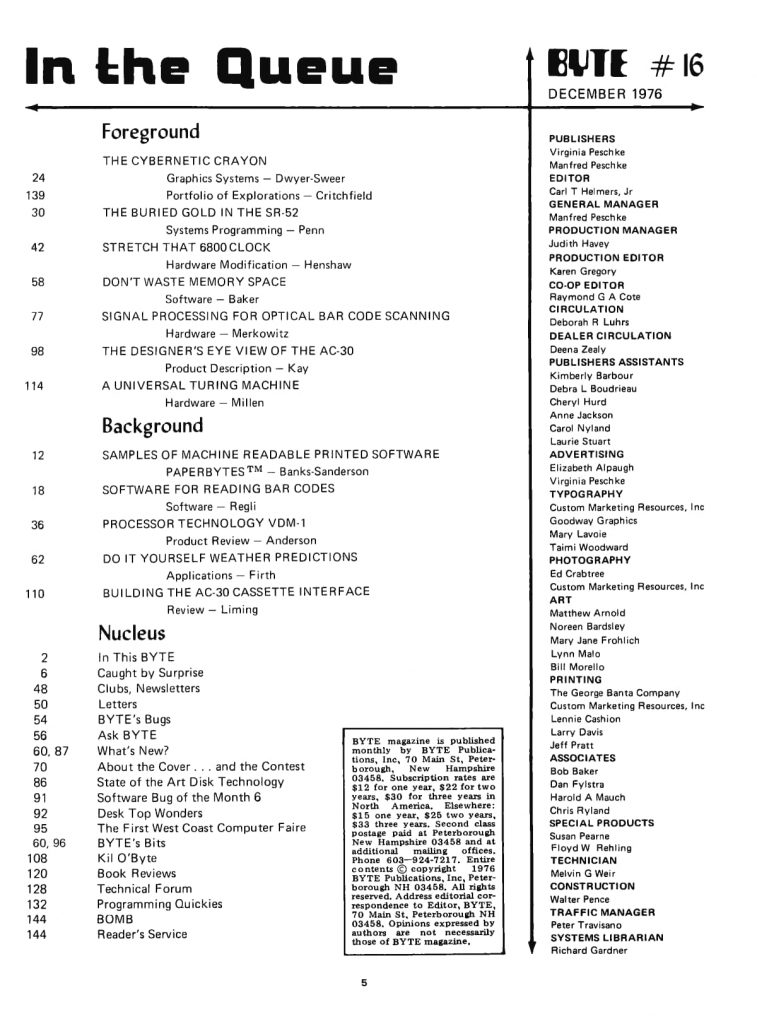
    Byte was a long running computer magazine that covered a wide variety of systems. It was around for a good chunk of early computer history from the 1970s through the early 1990s. In 1976, if you were into computers, you were probably assembling your own from parts and only had 4k or a luxurious 8k of RAM. If you could afford it, you might have had an IMSAI or MITS system with a 12-inch floppy drive running CP/M. The December 1976 issue of Byte includes:

    Foreground

    • The Cybernetic Crayon – The concept of low-cost (as in under $10000) color graphics was still a novelty at the time. The Cromenco TV Dazzler is a device that could display a color image of what was in a computer’s memory. This article provides some programming and hardware ideas to make use of that device.
    • The Buried Gold in the SR-52 – A look at some hidden features of the Texas Instruments SR-52 scientific pocket calculator.
    • Stretch That 6800 Clock – A tutorial for designing an interface for slow memory devices with a Southwest Technical Products M6800 Computer System.
    • Don’t Waste Memory Space – A method for reducing string size by using fewer bits for characters.
    • Signal Processing For Optical Bar Code Scanning – Converting variable width pars into serial signals that a computer can interpret.
    • The Designer’s Eye View of the AC-30 – A technical look at the AC-30 Cassette Interface. This would let you use a standard cassette recorder for computer data storage and retrieval. Not as good a floppy disk but far cheaper at the time.
    • A Universal Turing Machine – How to build a Universal Turing Machine.

    Background

    • Samples of Machine Readable Printed Software – A proposal for software distribution via machine readable printouts.
    • Software for Reading Bar Codes – A detailed description of how software for reading bar codes works.
    • Do It Yourself Weather Predicting – Suggestions for hardware and an outline of what the software would need to do in order to make weather predictions with the help of a computer.
    • Building The AC-30 Cassette Interface – Instructions for building the AC-30 Cassette Interface (introduced above).

    Nucleus

    • Caught By Surprise – How the popularity of personal computing caught most by surprise.
    • Letters – Letters from readers about ham radio operators, the PDP-8, high level languages, back issues, and more.
    • Ask Byte – Questions answered about database file size, using a MITS Altair or other machine for trig functions, and more.
    • What’s New? – A brief look at new products including the Lear Siegler Dumb Terminal Kit, the Holmes Tycom Selectric IO Writer, and more.
    • State of the Art Disk Technology – The introduction of Shugart’s minifloppy. This is the 5.25″ disk size that would become the standard for years to come. Up to this point, if you had a floppy drive then it would have been a 12-inch model.
    • Desk Top Wonders – A type-in game for the SR-52 calculator and PC-100 printer.
    • The First West Coast Computer Faire – Announcing the very first West Coast Computer Faire, featuring The Homebrew Computer Club, The Southern California Computer Society, and much more.
    • Book Reviews – Reviews of Scientific Analysis on the Pocket Calculator and A Guided Tour of Computer Programming in BASIC.
    • Technical Forum – A proposal for a universal bus that would work with different processors.
    • Programming Quickies – A short program for preventing wiping out a program on systems that use an SW1 instruction to return to the monitor.

    …and much more!