• Tag Archives Byte
  • Byte (October 1986)

    Byte was perhaps the best computer magazine throughout most of its life. It tended to be a bit more technical that most and continued to cover non-IBM compatible systems longer that most multi-format magazines survived. The October 1986 issue includes:

    Features

    • Product Preview: The Apple II GS – A detailed first look at Apple’s 16-bit successor to the Apple II line.
    • Ciarcia’s Circuit Cellar: Build an Intelligent Serial EPROM Programmer – A hardware project that allows you to program your own EPROMs.
    • Programming Project: Safe Storage Allocation – Various methods of safely allocating and de-allocating memory.
    • Sound and the Amiga – A detailed look at sound and memory usage on the Amiga.
    • Programming Insight: A Useful Property of 2 – Using powers of 2 to increase available user flags.
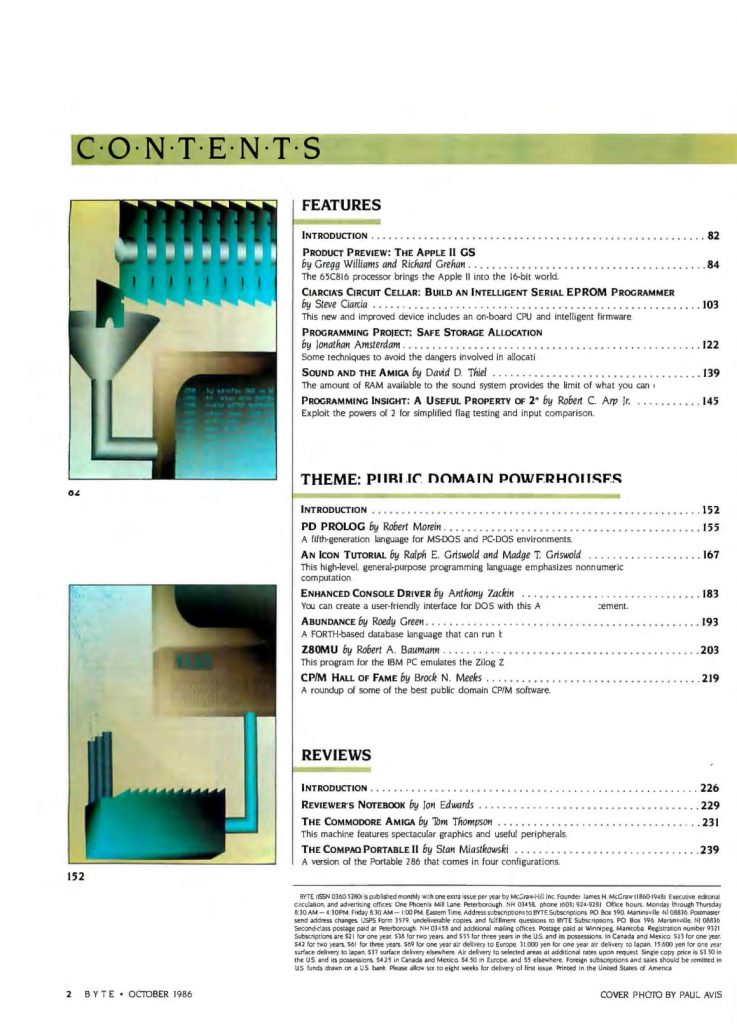
    Theme: Public Domain Powerhouses

    • PD Prolog – A look at a public domain Prolog implementation.
    • An Icon Tutorial – ICON is a high-level general-purpose programming language that emphasizes nonnumeric computation. Apparently it wasn’t very successful…at least I have never heard of it.
    • Enhanced Console Driver – A replacement for ANSI.SYS designed for creating a more user-friendly interface for DOS.
    • Abundance – A public domain database language.
    • Z80MU – An emulator for the Zilog Z80 and CP/M 2.2.
    • CP/M Hall of Fame – An overview of some of the best CP/M software.

    Reviews

    • The Commodore Amiga – A detailed review of the Commodore Amiga which would later be known as the Amiga 1000.
    • The Compaq Portable II – A suitcase style 286 based portable computer with as similar design as the original Compaq Portable.
    • Four 1/4-inch Tape Backup Units – Reviews of various tape backup drives including the QIC-60, Smart QIC-File, FT-60, TG-4060, and Videotrax.
    • muLISP-86 – A customizable LISP implementation with an optional compiler.
    • ITC’s Modula-2 Software Development System – A Modula-2 compiler and editor package for PCs. This would be called an IDE today though it is certainl less integrated than a modern IDE.
    • Microsoft Word Version 3.0 – The latest version (at the time) of Microsoft Word.
    • The Norton Utilities PC Tools And Super Utility – I’m not familiar with versions of Norton Utilities quite this early but by the Windows 3.1 era, this was really indispensable software.
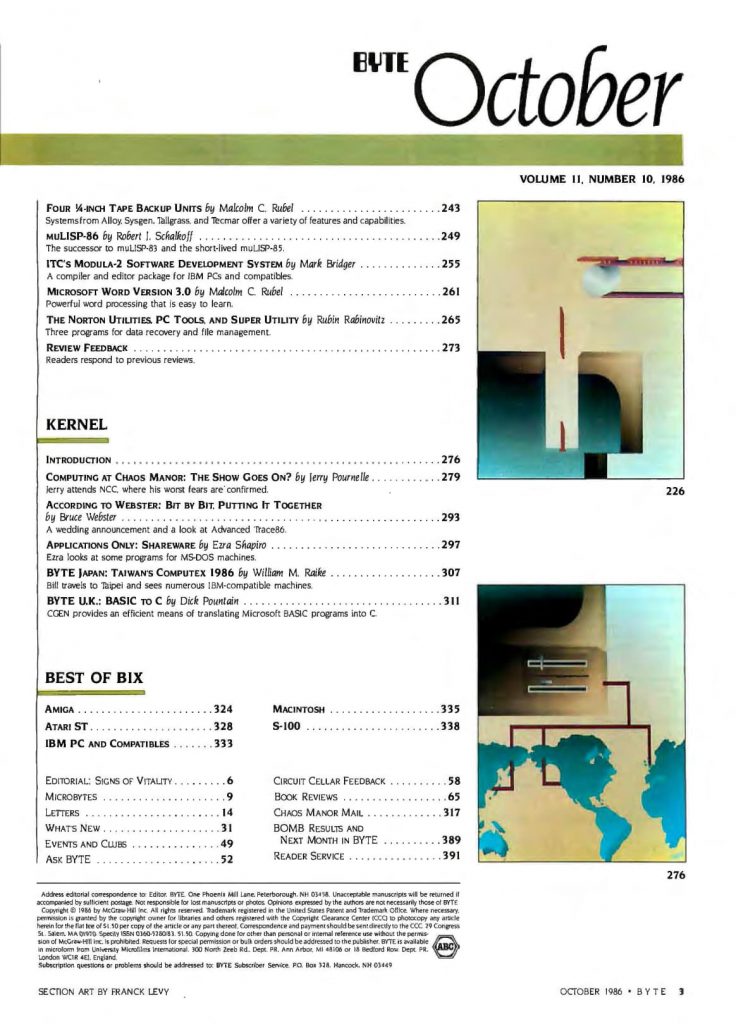
    Kernel

    • Computing At Chaos Manor: The Show Goes On? – A disappointing National Computer Conference and discussions of various products including Aegis Images, FancyWord, Gator S/20, Geometry, MacSpin, Norton Commander, Ready!, ScenicWriter, Turbo Prolog, Wilderness, Word Finder, Z-181 Portable Computer, and more.
    • According to Webster: Bit by Bit: Putting It Together – A look at the product of the month, Advanced Trace86, a tool for 8088 assembly language programming.
    • Applications Only: Shareware – A look at some of the latest and greatest shareware including Recall, TSRCOM, Pibterm, ProComm, Qmodem, and PC-Shell.
    • BYTE Japan: Taiwan’s Computex 1986 – A look at inexpensive Taiwanese PC clones.
    • BYTE U.K.: BASIC to C – A project for translating BASIC programs into C.
    • Editorial: Signs of Vitality – Some signs of renewed vitality in the desktop market include trends toward open hardware including in the new Apple IIGS, the introduction of the 80386, upcoming 68020 based Macs and Amigas, and more.
    • Microbytes – Optical logic device from Bell Labs; Softguard VM OS for the 80386; improved Amiga chips; MIT’s media lab produces computer generated holographic image; and more.
    • Letters – Letters from readers about the mathematics of programming and music, updates for ATOMCC, horizontal sync on the Atari ST, and more.
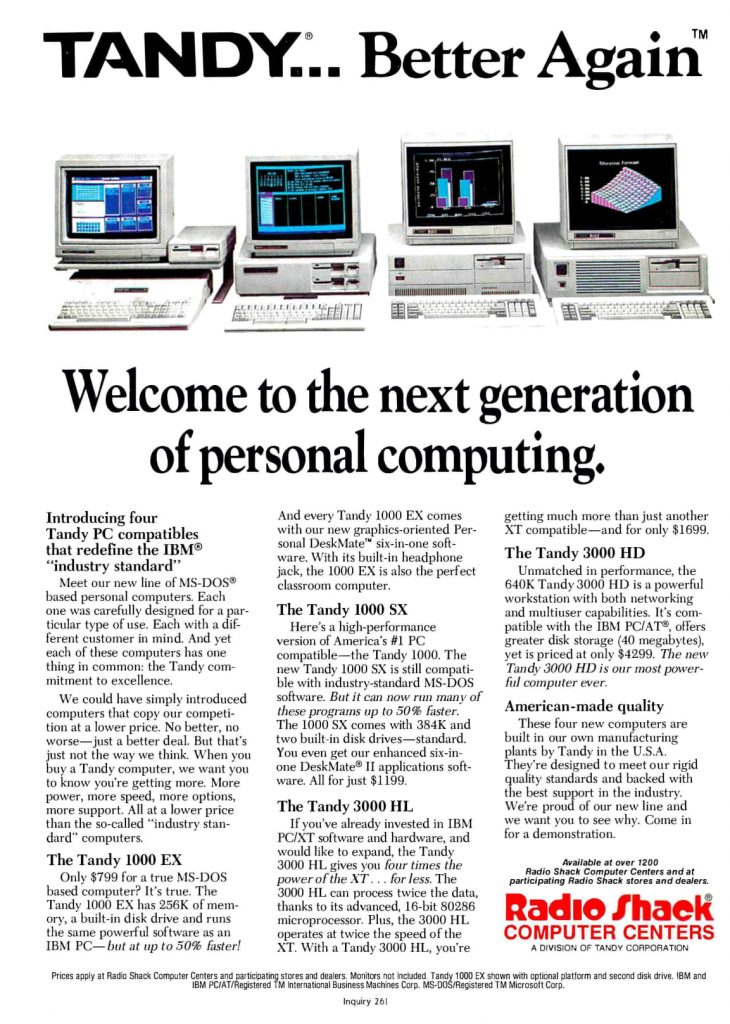
    • What’s New – A brief look at new products including five new Tandy machines (1000 HL, 1000 EX, 1000 SX, 3000 HL, and Color Computer 3), the PAL System Amiga expansion chassis, token ring networks from 3Com, and more.
    • Ask Byte – Questions answered about foreign language daisy wheel printers, C Compilers, the Coleco Adam, computerizing model railroads, and more.
    • Book Reviews – Reviews of CD ROM: The New Papyrus, Programming Pearls, and Advanced Unix Programming.
    …and more!


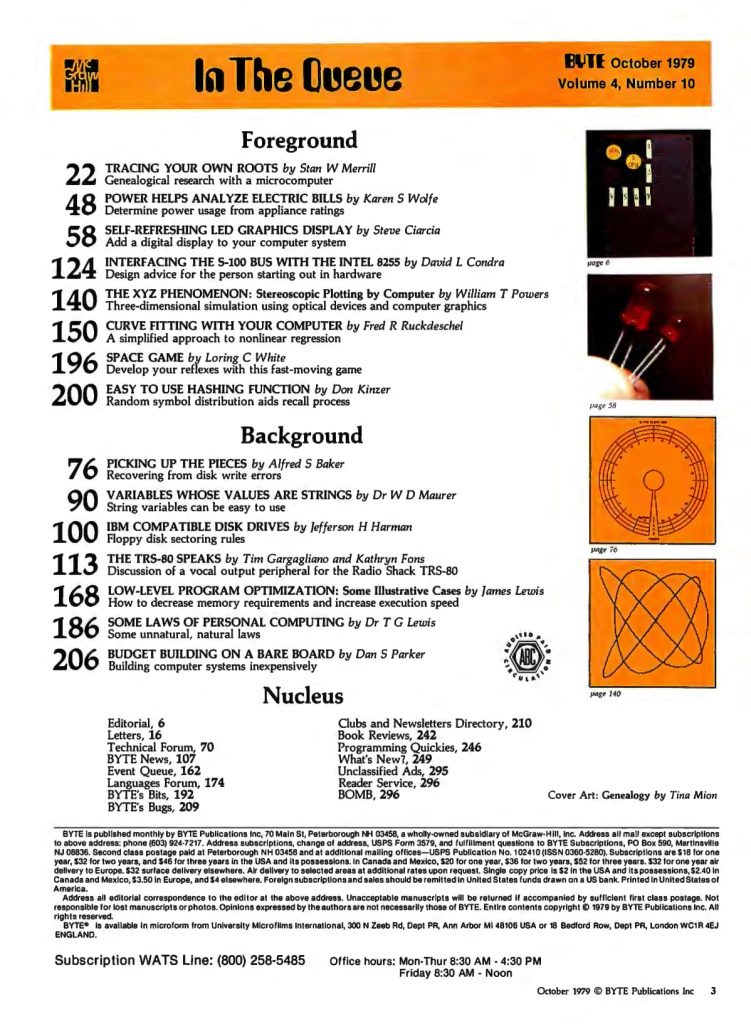
  • Byte (October 1979)

    I’m not sure if Byte was the first computer magazine but I think of it as the original computer magazine. It was around before home computers were even a thing. Nevertheless, Byte was covering “small systems” or microcomputers used by businesses and hobbyists starting in 1975. The October 1979 issue includes:

    Foreground

    • Tracing Your Own Roots – A type-in program to aid you in your genealogical research.
    • Power Helps Analyze Electric Bills – A type-in BASIC program to help you analyze your power bill.
    • Self-Refreshing LED Graphics Displays – A guide to building LED displays of various sizes including a 4×4 LED matrix.
    • Interfacing The S-100 Bus With The Intel 8255 – The Intel 8255 is a programmable peripheral interface chip that could be used, for example, to interface to a printer.
    • The XYZ Phenomenon: Stereoscopic Plotting by Computer – A way to print 3D images.
    • Curve Fitting With Your Computer – Curve fitting multiple variable data tables.
    • Space Game – A BASIC type-in Space War type game that will run on 8080 based machines like the MIPS Altair.
    • Easy To Use Hashing Function – A tutorial on hashing and an assembly hashing function.

    Background

    • Picking Up The Pieces – A guide to recovering from floppy disk errors.
    • Variables Whose Values Are Strings – A couple of methods for storing strings.
    • IBM Compatible Disk Drives – The IBM PC was still in the future. IBM compatible in this case refers to the IBM 33FD 8-inch floppy drive which was originally create for the IBM 3740 Data Entry System.
    • The TRS-80 Speaks – A guide to using BASIC to control the Speech Synthesizer Module for the TRS-80.
    • Low Level Program Optimization – How to reduce the space required and execution time of your programs.
    • Some Laws of Personal Computing – Defining the personal computer experience.
    • Budget Building On A Bare Board – Building a budget machine in 1979 meant starting with a bare circuit board and adding all the parts yourself.

    Nucleus

    • Editorial – Designing a board for a 6809 processor.
    • Letters – Letters from readers about light based communication, mapping phone companies, converting hexadecimal to ASCII, and more.
    • Technical Forum – Implementing a finite state machine.
    • BYTE News – A look at the future of the S-100 bus and competition from Apple, Radio Shack, Commodore, etc.; a new image sensor using a photo diode array; a new online service called The Source, automobile makers researching computer controlled cards; and more.
    • Book Reviews – Reviews of Practical Microcomputer Programming: The Intel 8080, Practical Microcomputer Programming: The M6800, and Practical Microcomputer Programming: The Z80.
    • Programming Quickies – An assembly program for handling ASCII strings.
    • What’s New – An alphanumeric calculator from Sharp, an encryption device for the TRS-80, an 8085 card, CAT acoustically coupled modem, Apple II Disassembler, Super BASIC for 6800 computers, and much more.

    …and more!


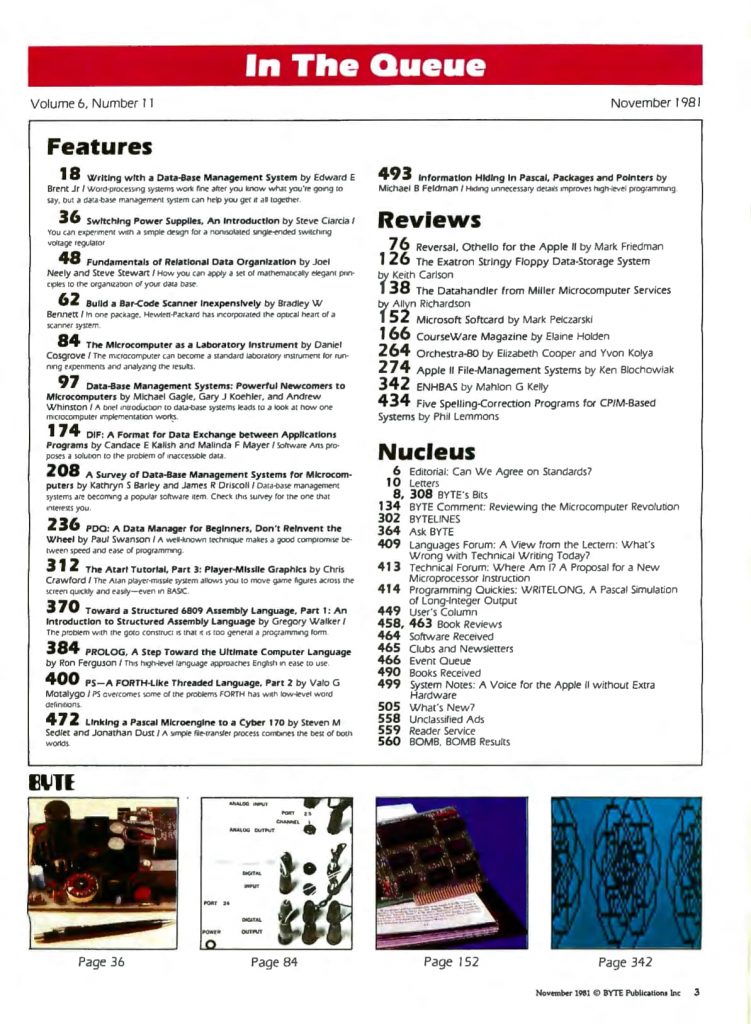
  • Byte (November 1981)

    Byte tended to be the most technical of mainstream computer magazines though it became less so over time. It was not PC specific (after all, it was being published long before IBM’s PC was released). 1981 was the same year the PC first appeared. If you owned a “home computer” it was likely made by Apple, Commodore, Atari, or Tandy. Personal computers on the business side were most often CP/M based. The November 1981 issue of Byte includes:

    Features

    • Writing with a Database-Management System – How a database can help in the early stages of a writing project.
    • Switching Power Supplies, An Introduction – An introduction to building more efficient power supplies that use switching regulators.
    • Fundamentals of Relational Data Organization – A tutorial on relational databases with some examples.
    • Build a Bar-Code Scanner Inexpensively – A guide to building a bar-code scanner. While typing in program listings was common at the time, it was thought that eventually people would be able to scan barcodes vs. hand entering code. While there were some examples of this, the idea never really took off.
    • The Microcomputer as a Laboratory Instrument – Reasons to use a computer as a lab tool and some of its uses including data acquisition, data analysis, and more. The use case presented here is studying the biophysics of plant growth.
    • Data-Base Management Systems: Powerful Newcomers to Microcomputers – Database Management Systems on microcomputers were a relatively new thing at the time. The first big killer apps for microcomputers were the spreadsheet at word processing. This was another.
    • DIF: A Format for Data Exchange between Applications – This was a data exchange standard by Software Arts. I’m not sure if this particular standard ever went anywhere but other companies (like Microsoft) would come up with their own ways of doing this.
    • A Survey of Data-Base Management Systems for Microcomputers – An overview of database management software available for microcomputers. Some of the software looked at here includes The Informer, Data Handler, Cromenco Data Base Management Systems, Micro Manager, MDBS, Selector IV, and more.
    • PDQ: A Data Manager for Beginners, Don’t Reinvent the Wheel – A simple data manager for floppy based systems.
    • The Atari Tutorial, Part 3: Player-Missile Graphics – The third part in a tutorial series on the Atari 400/800. This part covers Player-Missile Graphics which is basically the Atari 8-bit’s version of sprites.
    • Toward a Structured 6809 Assembly Language, Part 1: An Introduction to Structured Assembly Language – Taking a page from structured high level languages like C and Pascal, this article discusses a methodology for doing structured programming in assembly using the 6809. This is the first part in a series.
    • PROLOG, A Step Toward the Ultimate Computer Language – PROLOG is presented here as a language that takes us one step closer to programming in plain English (or whatever spoken language).
    • PS – A FORTH-Like Threaded Language, Part 2 – The second part of the definition of a language called PS which is similar to FORTH.
    • Linking a Pascal Microengine to a Cyber 170 – A guide to sharing resources between a microcomputer (Western Digital Pascal Microengine) and a mainframe (Data Corp Cyber 170).
    • Information Hiding in Pascal, Packages and Pointers – Insulating Pascal programs from low level programming details.

    Reviews

    • Reversal, Othello for the Apple II – Review of this Othello game for the Apple II.
    • The Exatron Stringy Floppy Data-Storage System – So called stringy floppy drives were really high speed tape drives that used specialized digital cassettes. It gets a pretty good review here as tested tith a TRS-80 but they never really caught on.
    • The Datahandler from Miller Microcomputer Services – A database system for the TRS-80.
    • Microsoft Softcard – A hardware/software package for the Apple II that includes CP/M 2.2 and Microsoft’s BASIC-80 version 5.0.
    • CourseWare Magazine – An educational magazine that included a cassette with educational software.
    • Orchestra-80 – A hardware and software add-on for the TRS-80 that allows you to produce music.
    • Apple II File-Management Systems – A look at various database systems for the Apple II.
    • ENHBAS – An enhancement for Microsoft BASIC on the TRS-80.
    • Five Spelling-Correction Programs for CP/M-Based Systems – A look at CP/M based spell-checkers including The Word, Spellguard, Wordsearch, Microspell, and Microproof.

    Nucleus

    • Editorial: Can We Agree on Standards? – The short answer, not really. But this goes over some successful standards including the S-100 bus, BASIC (sort of), and others.
    • Letters – Letters from readers about MusicSystem from Mountain Computer, Ada, and more.
    • BYTE Comment: Reviewing the Microcomputer Revolution – A look back at the last five years of the so-called microcomputer revolution.
    • BYTELINES – IEEE adopts S-100 bus standard; Japanese have little success in U.S. computer market; floppy drive makers to begin making half-height 5.25″ drives; CPU makers to add floating point operations to 16-bit CPUs; and more.
    • Ask BYTE – Questions answered about analog to digital conversion, the TRS-80 Disk-80 project for the TRS-80, interfacing with the TRS-80 Model III, and more.
    • Languages Forum: A View from the Lectern: What’s Wrong with Technical Writing Today? – From the point of view of the college classroom.
    • Programming Quickies: WRITELONG, A Pascal Simulation of Long-Integer Output – A Pascal routine that produces long-integer output.
    • System Notes: A Voice for the Apple II without Extra Hardware – Recording voices digitally on the Apple II.
    • What’s New? – The Bytewriter computer driven typewriter; the Silentype Thermal Printer; an 8088 coprocessor for the Apple II, a light pen for the TRS-80 Model II, the Model 1080 VersaModem (300bps), and much more.

    …and lots more!