• Tag Archives Byte
  • Byte (July 1986)

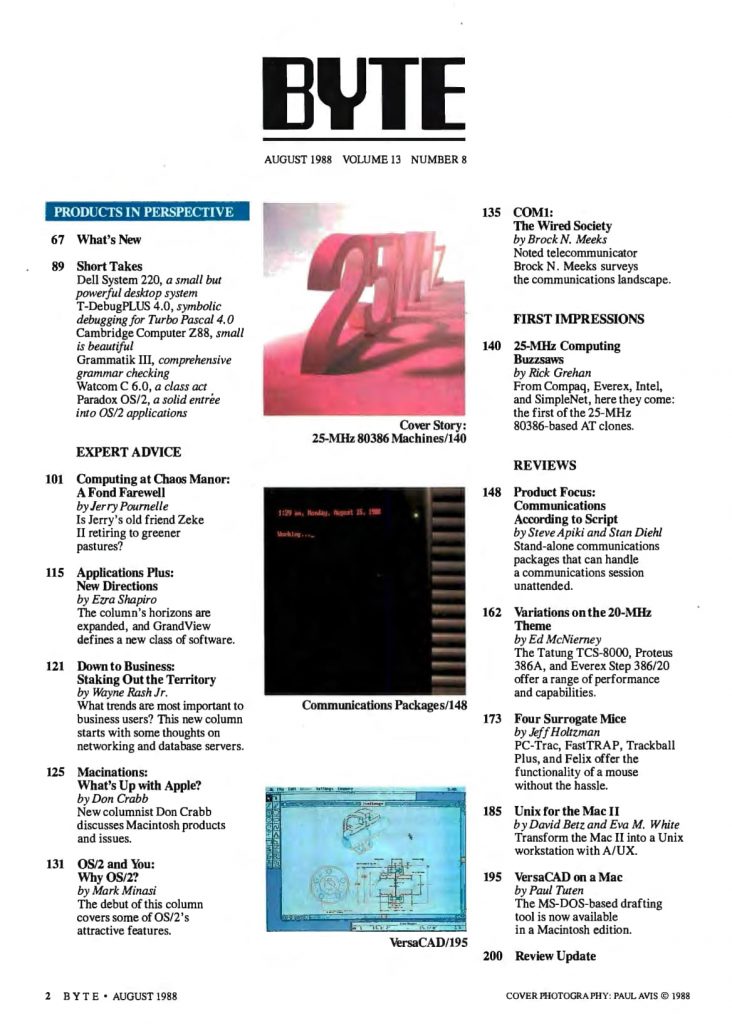
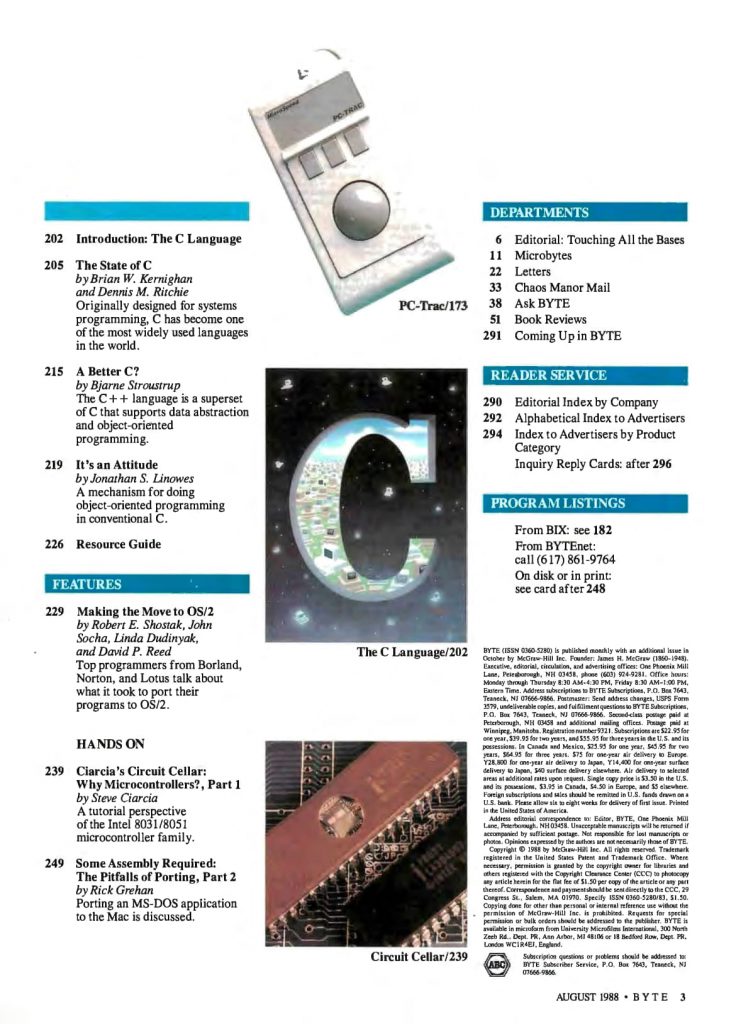
    Byte was really meant more for computer hobbyists than just your average user. As such, it tended to have more technical content though it had plenty of typical reviews and other coverage as well. The July 1986 issue includes:

    Feature

    • Ciarcia’s Circuit: Parallel Interfacing: A Tutorial Discussion, Part 1: Basics – The first in a series of articles on building your own parallel interfaces. This month covers building a parallel keyboard interface and a Centronics printer inteface.
    • Programming Project: A Spreadsheet Program – An implementation of a spreadsheet program in Modula-2 for the Macintosh.
    • Programming Insight: Anagram Solving in Pascal – An algorithm in Pascal for solving anagrams.
    • The Definicon 68020 Coprocessor, Part 1: The Hardware and Operating System – The first part of a very detailed look at this 68020 based coprocessor board for the IBM PC and compatibles.
    • Engineering on a Micro – A bridge-truss analysis program written in BASIC.

    Theme: Engineer’s Toolbox

    • Computer Circuit Simulation – A look at how to analyze linear and non-linear circuits.
    • Analog Circuit Analysis – An analog circuit modeling and simulation program for the Commodore 64.
    • An 8031 In-Circuit Emulator – Creating an emulator to help with debugging.
    • Structural Analysis – Using an IBM PC to implement the finite-element method.
    • Stress Analysis – Using the boundary-element and finite-difference methods to to perform stress analysis on underground mine layouts.
    • A Material Selection Program – A look at MSP, a public domain material selection program that provides a method for finding the appropriate material for construction.
    • Small-Scale Engineering Applications – A program for estimating properties and liquid viscosities of chemicals and building a database for physical property estimation.

    Reviews

    • The Commodore 128 Personal Computer System – A favorable review of what would turn out to be Commodore’s last 8-bit machine. The Commodore 128 was unique in that it was really three machines in one. It had a native Commodore 128 mode, a fully compatible C64 mode, and a CP/M mode.
    • The ITT XTRA XP – An IBM PC AT clone with a 6-MHz 80286 CPU, 512K of RAM, and a 20-megabyte hard drive for $4595.
    • The Conquest Turbo PC – A PC XT clone with an 8088-2 CPU that can run up to 8-MHz, 256K of RAM, and two double density floppy drives for $1239.
    • BYSO LISP and Waltz LISP – A comparison of two LISP implementations for IBM PC compatibles.
    • ExperOPS5 – An implementation of the OPS5 programming language for Macintosh computers.
    • Five Laboratory Interfacing Packages – An overview of five different software packages that can interface with either the Tecmar Lab Master and/or the Data Translation DT2801 interface boards for data acquisition.
    • The IBM Wheelprinter E – A daisy wheel printer from IBM that produces high quality output.

    Kernel

    • Computing at Chaos Manor: Traveling Computers – A look at a variety of products including Fastback from Fifth Generation Systems, Los Angles on a Disk from Klynas Engineering, MCI Mail from MCI International, the NEC PC-8201 from NEC Home Electronics, Traveling SideKick from Borland International, the TRS-80 Model 100 from Tandy, and more.
    • According to Webster: Programming Tools – A look at programming tools including the product of the month which is Personal Pascal for the Atari ST.
    • BYTE U.K.: Personal Supercomputers – A look at Inmos’s Transputer as well as the Computing Surface, a machine that makes use of it.
    • BYTE Japan: A Japanese COMDEX and More – A report on the COMDEX show in Japan and a look at a couple of new machines including the Oki ifCOM7 laptop and NEC PC-9801VM4.
    • Applications Only: Cheap Stuff – A look at some low cost software including It Figures, Dac-Easy Word, AI: Typist, and Datatext.

    …and more!


  • Byte (March 1984)

    Byte, subtitled ‘The Small Systems Journal’, was around for the birth of personal computing. It was still covering a wide variety of systems in 1984. The March 1984 issue includes:

    Columns

    • Build a Third-Generation Phonetic Speech Synthesizer – Making your computer talk seemed to be all the rage in the early to mid 1980s. This is a project for build a speech synthesizer using a new speech synthesis chip, the Silicon Systems SSI263. While it can be made to work with many PCs, this guide focuses on interfacing with an Apple II.
    • User’s Column: New Machines, Networks, and Sundry Software – A look at a variety of products including Concept from Corvus Systems, Concurrent CP/M-86 from Digital Research, DR Manul-Sized Paper, Eagle Spirit from Eagle Computer, Imaginator 2 from Cleveland Codonics, Rogue from Artificial Intelligence Design Systems, System Backup from Norell Data Systems, Uniform from Microsolutions, and the Zenith Z-100 Computer.
    • BYTE West Coast: A First Look at Dayflo – Dayflo is a free-form database or “idea processing” software.

    Themes

    • Computer Simulation: What It IS and How It’s Done – An introduction to computer simulation on microcomputers.
    • Simulating Reality with Computer Graphics – Generating imagery based on simulations.
    • Simulation of Weighted Voting: The Banzhaf Index – How a dark horse candidate can win an election.
    • Queue Simulation – How a computer can help to manage waiting lines.
    • A Risky Business – And Introduction to Monte Carlo Venture Analysis – A method for analyzing business risks.
    • Simulation and Graphics on Microcomputers – Some examples of graphical simulation output using an Atari 800, Epson MX-80 printer and color television.
    • Going Further – An overview of conferences, organizations, book, and software for those interested in simulation.</li

    Reviews

    • Compupro’s System 816/C and System 68K – The Two and Only – Two systems from Compupro that are basically identical except for processor choice. Both use the same memory and S-100 bus but one uses a 8085 and 8088 CPU while the other uses 68000 CPU. They also use the same external disk drive enclosure and they each run a different version of CP/M. Each would set you back $8995 though, which accounting for inflation is the equivalent of $28000 today.
    • Microsoft Flight Simulator – A review of the original Microsoft Flight Simulator for the PC.
    • The Eagle PC – The entry level Eagle PC-E ($1995) doesn’t even include a display interface or operating system and only includes 64K of RAM. The more realistic PC-2 ($3495) includes 128K, two 23K floppy drives, a monochrome monitor, and both MS-DOS and CP/M-86 along with other software.
    • STSC APL Plus and IBM PC APL: Two APLs for the IBM – A comparison of two APL implementations for the PC.
    • Chalk Board’s Powerpad and Leonardo’s Library – A large touch pad for the Atari 400/800, Commodore 64, and Apple II that also includes a wide variety of software.
    • Simulated Computer II – Educational software that shows you the internal operations of a computer as it executes your code.
    • Bank Street Writer – An early popular word processing program for the Apple II, Atari 400/800, Commodore 64, and IBM PC.
    • SPOC: The Chess Master – A chess program for the IBM PC.
    • M.U.L.E. – The iconic strategy game from Electronic Arts for the Atari 400/800 and Commodore 64.
    • The Witness – One of Infocom’s classic interactive fiction games reviewed here for the DEC RT-II, NEC APC, and CP/M though it would ultimately be released for many other systems.

    Features

    • The Tandy TRS-80 Model 2000: A Powerful New MS-DOS Machine – This PC compatible TRS-80 model was one of the more obscure versions of the TRS-80.
    • A Closer Look at the IBM PCjr – While the PCjr gave you some PC compatibility, its limitations and expense made other home computer options like the Commodore 64 a better choice.
    • The Japan Shows: An Update on the Japanese Computing Scene – Some highlights of a recent Japanese computer show include the new NEC PC-100 8086 based computer, the Sord M68 68000 based computer, and more.
    • The User Goes to COMDEX, 1983 – Some highlights at this show include the Helix PC Bubble Disk, new software from Ovation, the Tandy 2000, and more.
    • Pascal’s Design Flaws: Modula-2 Solutions and Pascal Patches – How Modula-2 improves upon Pascal’s design.
    • Trademarking Software Packages – Searching for existing trademarks to ensure you aren’t going to run into any problems.
    • An EPROM Simulator – A project to simulate EPROM to speed up development of software designed to run on EPROM devices.
    • Simulation with Electronic Spreadsheets – Examples of simulating dynamic processes using Visicalc on an Apple II and Supercalc on an Osborne 1.

    Nucleus

    • Editorial: Where BYTE is Going – Clearing up product reviews vs. product descriptions as presented in Byte.
    • MICROBYTES – Sinclair announces 68008 based business computer, Lotus announces new integrated software package, Seiko shows off an wristwatch based computer, Koala to distribute Gibson Light Pen for Apple, IBM and Commodore computers, Radio Shack introduces a disk drive and video interface for its Model 100 computer, Coleco announces modem, disk drive, and other add-ons for the Adam, Commodore introduces a touchscreen and 264 series of computers, Apple ships ProDOSand modems, and more.
    • Letters – Letters from readers about manufacturer involved articles, software design resources, IBM disk drive door fixes, the DEC Rainbow 100, computer crime, and more.
    • Ask BYTE – Questions answered about the S-100 bus, income tax software, portable terminals, the break key on a VIC-20, and more.
    • Book Reviews – A reviews of Discover FORTH by Thom Hogan.
    • What’s New? – A brief look at new products including the MAGIC programming language, Media Magician disk editor, Pro-Accountant General Ledger, Volkswriter Deluxe, Common Lisp, and more.

    …and more!