• Tag Archives Byte
  • Byte (February 1989)

    Source: Byte – February 1989

    Byte was one of the better computer magazines available. It also tended to have a slightly more technical slant than the average PC magazine. It covered a variety of systems but gradually became more PC oriented towards the latter part of its life. The first issue of Byte was published all the way back in 1975 and the final issue was the July 1998 issue. The February 1989 issue weighed in at over 380 pages and includes:

    Products in Perspective

    • What’s New – A look at new products including the Crayon 386 20/20 SP, a ruggedized computer for industrial environments ($7495); Chorus Transputer box for Macintosh networks ($25,000); the VIP SX386 tower PC from ALR that features a 16-MHz 386 which is upgradeable to a 20-MHz 386 ($2395); A small 8-ounce 20 MB hard drive for $1195; a data acquisition board for the Mac SE ($595 + $95 for the driver + $595 for LabView software); Sony 68030 based Unix workstation ($13,900-$54,200 depending on specs); Toshiba T5100 386-based portable Unix workstation ($7199-$8750); The Headstart II Plus (8088-1 based, $2295) and Headstart III (80286 based, $2995) and lots more.
    • Short Takes – Brief hands-on views of new products including the MegaMate (external 3.5″ disk drive for $349), Unix Tools for DOS (including MKS Make, Lex and Yacc), Wordbench (word processor with tools for writers, $189), Data Sentry (hardware based copy protection, $125), and Sourcer (a disassembler, $99.95).
    • Paradox 3: Neither Enigma nor Riddle – A first look at an upgrade to Borland’s DBMS package.
    • Cover Story: The Mac SE Takes Off – A first look at the Mac SE/30 which features a 68030 CPU, 68882 FPU. You could get the 2 MB RAM/40 MB hard drive model fro $5069 or the 4 MB RAM/80 MB hard drive model for $6369.

    • Product Focus: Smoothing Out C – Optimization techniques for C compilers and a comparison of several compilers including Borland Turbo C Professional 2.0, Manx Aztec C86 Commercial 4.1d, MetaWare high C 286 1.4, Microsoft C 5.1, Watcom C 6.5, and Zortech C 1.07.
    • A Pair of Sophisticated Laptops – Reviews of two new laptops including the Zenith SupersPort 286 featuring an 80C286 CPU running at 6 or 12 MHz, 1 MB RAM, one 1.44-MB 3.5″ floppy drive; 20 or 40 MB hard drive, and more for $4999-$5599 and the Mitsubishi MP-286L featuring an 80286 running at 8 or 12 MHz, 640K RAM, one or two 1.44-MB 3.5″ floppy drives, 20 MB hard drive, and more for $3195-$5395.
    • A PS/2 in Channel Only – A review of the Tandy 5000 MC, Tandy’s PS/2 clone…or at least it used the Micro Channel bus. It features a 20-MHz 80386, 2 MB of RAM, 1.44-MB 3.5″ floppy drive, 80 MB hard drive, and more starting at $4999.
    • Three Assemblers for MS-DOS – A review and comparison of three assemblers for DOS including TASM, OPTASM and MASM.
    • Full Impact – A review of an upgrade to this spreadsheet software from Ashton-Tate ($395).
    • dBASE IV Arrives – A review of this DBMS package that really set the standard for years to come ($795 Standard Edition, $1295 Developer’s Edition).

    Expert Advice

    • Computing at Chaos Manor: Ready Line Overload – A look at new products shown at COMDEX, including Intel’s Visual Edge print-enhancement system, Logic Gem (a software package for turning flow charts into code), DESQview 386 (a popular DOS multitasking system), Norton Utilities 4.5, ConvertUnits (unit conversion program), and more.
    • Applications Plus: New Friends and Old – A look at the evolution of integrated software, the Canon Cat printer, Framework III database software, and The Perfect Career…software that is supposed to help you identify the ideal career for you.
    • Down to Business: Getting into Bigger LANs – A look at strategies to create larger local area networks.
    • Macinations: Hey Apple, I Need a Laptop – Apple had yet to release an official Mac based laptop though this author really wanted one. Apparently there were third party companies who hacked such things together and they were planning something called the WalkMac SE that was based on the Mac SE motherboard and featured a backlit LCD screen and rechargeable battery for $5449.
    • OS/2 Notebook: Electing the PM – Requirements for running OS/2 with Presentation Manager. Requirements include a 80286 or 80386 CPU, OS/2 friendly BIOS, IBM PC AT-type hard disk controller, 1.2 or 1.44 MB floppy drive, 60 MB hard drive, EGA or VGA graphics, and at least 2.6 MB RAM. This article examines each of these requirements (and others) in more detail.
    • COM1: The ABCs of X, Y, and XModem – A comparison of various modem file transfer protocols. By the time I started calling BBSes, ZMODEM was the standard though there was at least one more obscure protocol that allowed simultaneous uploads and downloads that I used sometimes…the name escapes me at the moment.

    In Depth

    • Introduction: Personal Workstations – The line between professional workstations and high-end PCs starts to blur.
    • Two Worlds Converge – A low-end workstation or high-end PC could be considered basically the same thing. A personal workstation. This article lists three main architectures: VME, Multi-Bus and the IBM PC AT bus. Perhaps the key to the “workstation” label is a high res display and networking capabilities.
    • The Current Crop – A look at existing professional workstations as well as building your own. Pre-built workstations mentioned include the Apollo DN3000, Sun-3/50, NeXT, Sun386i/150, Sun-3/60, Apollo DN3500, Sun 386i/250, SGI Personal Iris, Sun-4/110, and Apollo DN4500. They range in price from $4990 to $18990. The author’s self built workstation consists of an ALR 386/220 with 20 MHz 80386, and 3 MB of RAM running Unix System V 3.0.
    • Worth the RISC – An overview or RISC technology including the CPUs available now.
    • How Fast Is Fast? – Techniques for measuring performance and how different architectures produce speed in different ways.
    • Art + 2 Years = Science – A look at the state of the art in computer graphics and some of the products available.
    • Networking with Unix – A look at Unix networking including RFS (Remote File System) and NFS (Network File System).

    Features

    • Digital Paper – A look at the technology behind write-once optical media that can store up to a gigabyte of data on floppy disk sized cartridges.
    • Turbo Pascal Windowing System – Pascal’s windowing system, called TWindows, lets you add windows to the application programs you write. This article includes examples and other techinical details.
    • Under the Hood: Hard Disk Interfaces – An overview and techinical comparison of the various hard disk interface standards including ST506, RLL, Advanced and Enhanced RLL, ESDI, SMD, and SCSI.
    • Some Assembly Requires: Trees ‘n Keys, Part 2 – A continuation of a discussion of the B-tree data structure from the previous month.

    Departments

    • Editorial: The End of Application Software – IBM and Microsoft start including more application features in to OS/2 and Windows.
    • Microbytes – Highlights of new developments in the computer industry including new embedded processors from Intel and AMD, analog emulation of the nervous system, flexible superconductors, and much more.
    • Letters – Letters from readers about the high cost of RAM, getting started on BIX, MIX, and Compuserve, the origin of various computer terms, and more.
    • Chaos Manor Mail – Using PC-MOS/386 and Nota Bene (a word processor).
    • Ask BYTE – Questions answered about the Mindset computer, installing a floppy drive, FFT algorithms, upgrading the BIOS of an original IBM PC, interface cables, and more.
    • Book Reviews – Reviews of No Way: The Nature of the Impossible, Programmer’s Guide to OS/2, Better Scientific and Technical Writing, C Traps and Pitfalls, and What Do You Care What Other People Think?

    …and more!


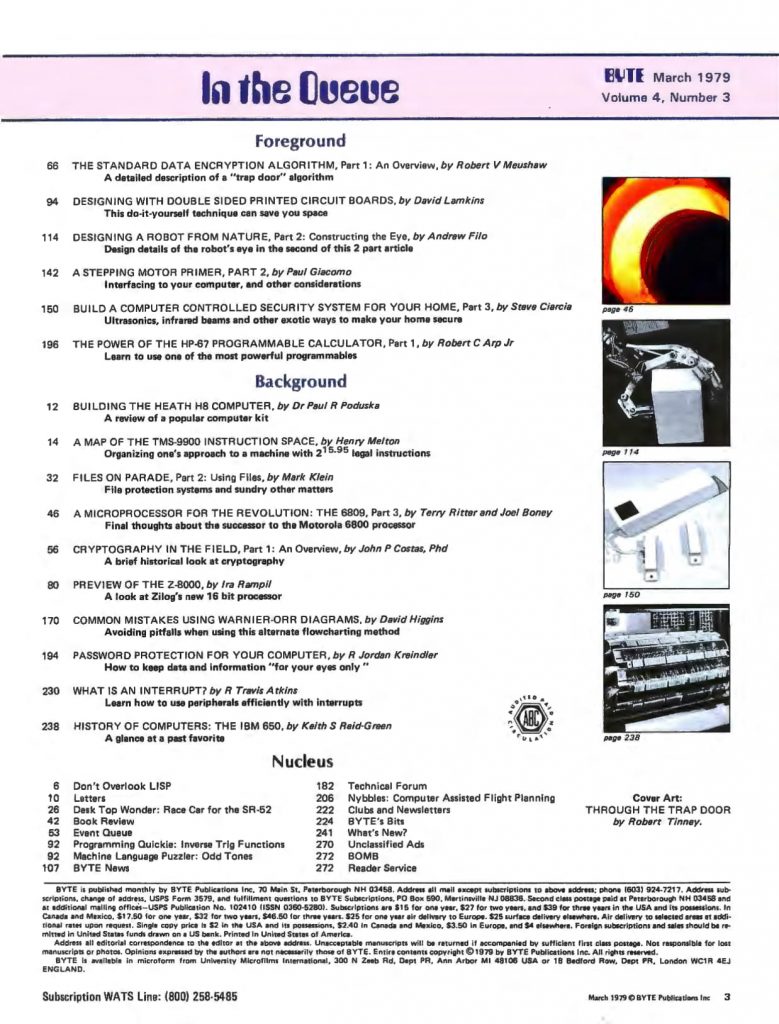
  • Byte (March 1979)

    Source: Byte – March 1979

    Byte was one of the earliest computer magazines and longest running. Publication began in the 1970s and continued through the early 1990s. The content tended to be technical, especially in the older issues. The March 1979 issue includes:

    Foreground

    • The Standard Data Encryption Algorithm, Part 1 – An introduction to the Standard Data Encryption Algorithm and an implementation for the KIM which uses a 6502 processor
    • Designing with Double Sided Printed Circuit Boards – A tutorial for designing your own circuit boards.
    • Designing a Robot From Nature, Part 2 – Part 2 concentrates on the design of the eye of the robot. Really it’s a contrast detector. The robot consists of a manipulator arm, an 8008 computer, and sustained contrast detector.
    • A Stepping Motor Primer, Part 2 – This second part of a multi-part series covers interfacing to a stepper motor.
    • Build a Computer Controlled Security System for Your Home, Part 3 – The third part of detailed guide to building a home security system.
    • The Power of the HP-87 Programmable Calculator, Part 1 – An introduction to the HP-67 Programmable Calculator using a complex programming example.

    Background

    • Building the Heath H8 Computer – The Heath H8 was a computer that came in kit form. It was based on the 8080A CPU. This is a guide to putting it together.
    • A Map of the TMS-9000 – A look at machine language on this 16-bit processor.
    • Files on Parade, Part 2 – The second and final part in a series on using files.
    • A Microprocessor for the Revolution: The 6809, Part 3 – The concluding part of a series on the 6809 processor. This art discusses clock speed, timing signals, condition codes, and software design philosophy. This processor would be used in the TRS-80 Color Computer.
    • Cryptography in the Field, Part 1 – Part one of a series on the practical use of cryptography.
    • Preview of the Z-8000 – A technical look of this new 16-bit processor from Zilog.
    • Common Mistakes Using Warnier-QPR Diagrams – These diagrams are a form of programming documentation and a way to impose structure on non-structured programming languages.
    • Password Protection for Your Computer – A simple procedure for implementing password protection on you system.
    • What is an Interrupt? – A technical explanation of the interrupt.
    • A History of Computers: The IBM 650 – The IBM 650 was the most popular computer of the 1950s, used by small banking, accounting and insurance companies among others.

    Nucleaus

    • Don’t Overlook Lisp – An editorial on the benefits of the LISP programming language.
    • Letters – Letters from readers about computers in the kitchen, computer humor, chess and Pascal, and more.
    • Desk Top Wonder: Race Car for the SR-52 – A racing game for the SR-52 programmable calculator.
    • Book Review – Review of “Your Own Computer” by Mitchell Waite and Michael Pardee.
    • BYTE News – More companies supporting Pascal on their machines; Intel, Texas Instruments and IBM release new memory chips; bubble memory increasing in availability; 5-inch floppy disks to increase in capacity to 1 to 2 MB; flat screen displays being developed; APL microcomputer coming soon; and more.
    • Technical Forum – Information on vector displays.
    • Nybbles: Computer Assisted Flight Planning – Using a computer to perform calculations related to flight planning.
    • What’s New> – A look at new products including a Cromenco Single Card computer featuring a Z-80 CPU and S-100 bus, an Intelligent Programmer for Ultraviolet Memory Chips, the Program Utility Package for the North Star Disk System, a new word processor for the Commodore PET, and more.

    …and more!


  • BYTE (January 1984)

    Source: Computer & Video Game Magazines – BYTE – January 1984

    BYTE was a computer magazine published from 1975 until 1998, appearing not long after the first commercial computer kits started being advertised. It covered a vast array of computers over the years and included technical content as well as hardware and software reviews. The January 1984 issue was a massive 560+ pages and included:

    Columns

    • Build the Circuit Cellar Term-Mite ST Smart Terminal, Part 1: Hardware – Thanks to advancing technology, you can construct an intelligent video terminal with just 21 integrated circuits.
    • BYTE West Coast: Beyond the Word Processor – Tomorrow’s text editors may facilitate text composition from the earliest conceptual stages to the analysis of finished documents.
    • User’s Column: too Many Leads, or What in *;?!#”*? Goes First? – Jerry covers a lot of territory this month, beginning his journey of a thousand words with a trip to the Circuit Cellar.

    Themes

    • 1984 and Beyond – The year calls up inevitable associations with George Orwell’s novel of a futuristic, technologically oppressed society and raises questions concerning the present and future significance of technology to our own culture.
    • Reason and the Software Bus – The Reason research project, exploring artificial intelligence, has developed a software bus that may have a significant effect on future software. As a hardware bus uses ICs, so the software bus manipulates various program components to provide integration, networking, and multitasking.
    • A General-Purpose Robot-Control Language – By bridging the communication gap between people and robots, a plain-language system called Savvy increases the usefulness of these mechanical assistants.
    • 1984, the Year of the 32-bit Microprocessor – As manufacturers rush to introduce their 32-bit designs, it’s time to take a look at what these microprocessors are and what they’re good for.
    • Memory Cards: A New Concept in Personal Computing – Picture a microcomputer without a keyboard, without a power supply, and small enough to fit in your wallet. That’s just one possible application of memory-card technology.
    • Computer-aided Design – CAD capabilities on desktop systems can simplify a variety of tasks, from flowcharting to product design, but the choices in hardware and software can be baffling.
    • Speech Recognition: An Idea Whose Time Is Coming – While the multidisciplinary nature of the technology may slow its advance, speech recognition is well on its way to becoming a major factor in our interactions with machines.
    • Using Natural-Language Systems on Personal Computers – Artificial intelligence offers possible solutions to the problems of communication between people and computers.
    • Portables – 1984 and Beyond: Idea-Processing Software and Portable Computers – When your personal computer leaps off your desktop and into your briefcase, what type of software will accompany it?
    • Beyond the Application Program: A Different Approach to Integrated Software – Element managers that implement objects such as spreadsheet tables and paragraphs may supplant the traditional concept of the application program.

    Reviews

    • Reviewer’s Notebook – This month’s notes touch on Seequa Computer Corporation’s Chameleon Plus and new trends in the printer market.
    • The Zenith Z-100 – Supporting both 8-bit and 16-bit software, the Z-100 also offers impressive color graphics.
    • Pinball Construction Set – Tired o fthe same old pinball games? Try creating your own with this software-design package.
    • The TRS-80 Model 16B with Xenix – Once of the most significant features of Radio Shack’s new computer is its Unix-derived operating system.
    • Naturallink to Down Jones News/Retrieval – A new software package from Texas Instruments simplifies access to a financial database.
    • The Vamp DVM-1 Computer/TV Interface Kit – The picture quality of your display can suffer when you use a radio-frequency modulator to interface your computer’s video output to a standard color television, but a kit from Vamp offers an alternative.
    • The Einstein Compiler – In addition to speeding up Applesoft BASIC programs, the Einstein compiler provides statistical information on the programs compiled and can function as a debugging tool
    • The Basis 108 – Apple compatibility is just one of this German import’s interesting features.

    Features

    • Bubbles on the S-100 Bus, Part 1: The Hardware – Using Intel’s BPK 72 Bubble-Memory Prototype Kit, you can put together a 128K-byte bubble-memory board for an S-100 bus system.
    • Mockingbird: A Composer’s Amanuensis – The chief purpose of this music notation editor from Xerox is to help composers capture their ideas by speeding up the notation process.
    • The VU68K Single-Board Computer – You can construct a 68000-based system for under $200.
    • Translating the SAS Language Into BASIC – A preprocessor program that translates SAS-like statements into equivalent BASIC statements permits SAS-like programs to run on a microcomputer.
    • A Software Review Method That Really Works – The group walk-through, a process of “playing computer,” provides a workable means of correcting programming problems.
    • Real-Time Clocks and PC-DOS – A device-driver program for the clock chip on a typical multifunction board takes advantage of special provisions in the IBM PC operating system.

    Nucleus

    • Editorial: Revisiting the Luddites
    • MICROBYTES
    • Letters
    • BYTE’s User to User
    • Ask BYTE
    • Software Received
    • Event Queue
    • Books Received
    • Clubs and Newsletters
    • What’s New?
    • Unclassified Ads
    • BYTE’s Ongoing Monitor Box, BOMB Results
    • Reader Service

    …and more!