• Tag Archives Byte
  • Byte (March 1981)

    Source: Byte – March 1981

    Computer magazines have been around for a really long time. Or may I should say ‘were’ at this point as you can find no general computer magazines on the shelf these days. Anyway, Byte was first published starting in 1975. This issue is from March 1981 which was still roughly six months before the IBM PC was introduced. There were still plenty of home computers from Commodore, Atari, Apple and others as well as numerous CP/M based machines and other unique computers. This issue weighs in at almost 400 pages and includes:

    Features

    • Structured Programming and Structured Flowcharts – An introduction to structured programming which could be accomplished in virtually any language with a goto statement.
    • Build the Disk-80: Memory Expansion and Floppy-Disk Control – A do-it-yourself hardware project in which you build an expansion interface for the TRS-80 model I that includes both expanded memory (up to 32K) and a floppy disk controller.
    • Three-Dimensional Computer Graphics, Part 1 – The part in a series on generating 3D polygonal graphics. Mostly this goes over the math involved.
    • What is Good Documentation? – A guide to producing good hardware and software documentation with minimal jargon.
    • A Beginner’s Guide to Spectral Analysis, Part 2 – Part 1 introduced ideas behind the Fourier transform. This part extends those ideas into two-dimensional space. Includes examples in 6502 machine-language.
    • A Simple Approach to Data Smoothing – Techniques to smooth out statistical fluctuations in data in order to find underlying trends.
    • The New Literacy: Programming Languages as Languages – A comparison of computer/programming languages vs. human languages.
    • Computer Music: A Design Tutorial – This article starts out by saying “The computational power necessary to synthesize high-quality, polyphonic computer music in real time exceeds the resources of the currently available microprocessors.” How far we have come. This article covers one approach to frequency synthesis.

    Reviews

    • The Micro Matrix Photopoint Light Pen – Light pens were once a popular way to interface with a computer. Ultimately, the mouse took over that roll. This review looks at one such light pen and some software that supports it.
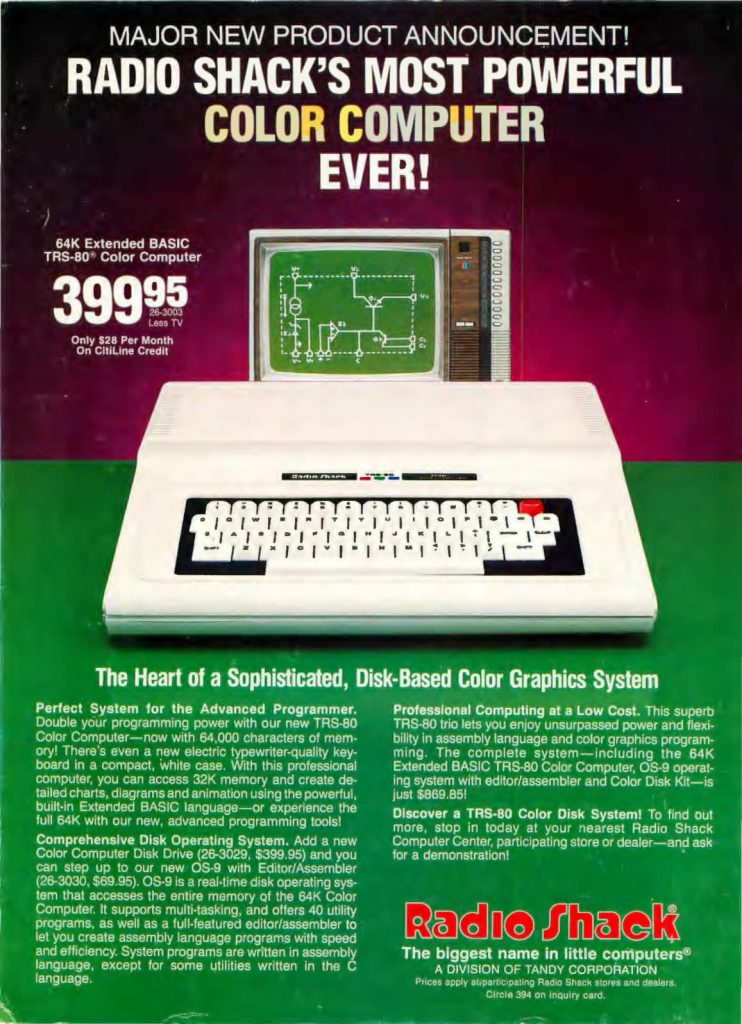
    • What’s Inside Radio Shack’s Color Computer? – A detailed and technical look at the then new Tandy Color Computer. The Color Computer featured the partially 16-bit MC6809E CPU and up to 16K. While Radio Shack supported the Color Computer for more than a decade, it never really gained the popularity of machines like the Apple II, Atari 400/800, Commodore 64, VIC-20, etc. There are no good sales numbers but best guess seems to be that about 500,000 units were sold all the CoCo models combined. I had a neighbor that had a Coco 3 back in the day.

    Nucleus

    • Editorial: Is This Really Necessary? – An editorial on design techniques.
    • Letters – Letters from readers about technical writing, Intel’s educational products, SuperBrain upgrade costs, muSIMP for the TRS-80 Model I, and more.
    • Programming Quickies – Short BASIC programs for computing the determinant of a Matrix and displaying constellations.
    • Languages Forum: A Coding Sheet for FORTH – A form for creating a graphical representation of the stack in FORTH.
    • Byte’s Bits – News bits including an IEEE study on terminals, a computer camp for kids 10-18, an online service for the TI-99/4, research for using computers to aid the handicapped, and more.
    • Technical Forum – A BASIC program that converts object code to data statements; a comparison of addition and subtraction operations between the 1802 and Z-80 processors; and a design for a simple video switch.
    • Desk-Top Wonders: Hunt the Wumpus with Your HP-41C – A type in version of this popular (at the time) game for the HP-41C programmable calculator.
    • System Notes: Software Addressing Modes for the 8080 – Various ways of addressing memory on the 8080 processor.
    • Bytelines – The latest personal computer related news including a new software copyright law, a new 68000 S-100 bus based computer, a 5 Megabyte hard drive for under $2000, sales of Japanese made computers drop sharply in the U.S., wristwatch-sized computer proposed, the Cray-1 and CDC Cyber 205 top the list of the worlds fastest computers, work begins on plasma and LCD based flat panel displays, experimental robot destroys itself at the University of Florida, Xerox introduces first Ethernet system, IBM opens retail stores, ex-employee fined $50,000 for stealing his former employers software and using it in a competing business, Federal auditors discover over 200 government employees using computers at the Sandia Nuclear Weapons Research Center for things like playing games, and much more.
    • Ask Byte – Questions answered about building a modem, home automation with the X-10, upper and lower-case letters on the TRS-80 Model II, and more.
    • What’s New? – A look at new products including an 8088-based board for the S-100 bus; a new microcomputer from DTC featuring 64K RAM, an 8085A-1 CPU, and more; the IMP2-Apple printer designed for the Apple II; the Model 7728 Centronics Printer Interface for the Apple II; a new family of 3.19 to 11.5 megabyte 5-inch hard drives from Tandon; the new VIC-20 computer from Commodore; and more.

    …and more!


  • Byte (September 1985)

    Source: Byte – September 1985

    Subtitled “The Small Systems Journal”, Byte covered a wide variety of home and hobby computers in its earlier days. Towards the end of its life, it became more of a standard PC magazine. In 1985, however, it was large (almost 500 pages for this issue) and covered a lot. The September 1985 issue includes:

    Features

    • Ciarcia’s Circuit Cellar: Build the SB180 Single-Board Computer – The SB180 was a single board computer featuring a 6 MHz HD64180 processor from Hitachi that was Z80 code compatible and could directly address 512KB of RAM (as opposed to the more limited 64K that the Z80 could directly address). This first part of a two part series focuses on the hardware.
    • Programming Project: An Analysis of Sorts – A look at the algorithms and speed of various sorting algorithms including the selection sort, merge sort, and quick sort.
    • The DSI-32 Coprocessor Board, Part 2: The Software – The second of a two part series on the DSI-32 co-processor board for the IBM PC. The co-processor in this case is the National Semiconductor 32032. This part focuses on the software.
    • An Algorithm for Disk Caching with Limited Memory – A set of C-language routines for caching data from floppy disks.
    • Astrophysical Number Crunching – A history of the use of “personal computers” in theoretical astrophysics. Or at least the history from one astrophysicist’s perspective.
    • Two Generalized Floating-Point Representations – A look at both a partitioned representation which allows a trade-off between range and precision and a variable-based representation featuring a larger range but fixed accuracy.
    • Turbo Pascal Drives the Mouse – Two Turbo Pascal procedures that you can use to interface your programs with a mouse.
    • IBM Compatibility for the NEC APC III – It was not uncommon in the early to mid 1980s for computers to have limited or no IBM PC compatibility even thought they had the same basic architecture. A patch is presented here that gives the NEC APC III compatibility with at least some PC apps.
    • Programming Insight: Printing Pascal Graphics – A routine for dumping Pascal graphics on the Apple II to any Epson MX Printer.

    Themes

    • EGO: A Hombuilt CPU, Part I: The Software – The first of a two-part series on the author’s experience crating a homemade CPU. This part focuses on the instruction set.
    • The Quarter-Meg Atari 800XL – Upgrading your Atari 800XL all the way to 256K and turning some of that RAM into a RAMdisk. This article includes a parts list and instructions for constructing your own 256K expansion.
    • A Parallel-To-Serial Printer Port Adapter – Instructions for building a $35 parallel-to-serial printer port adapter that will allow you to connect a serial printer to your parallel port.
    • Add Function Keys to your Microcomputer – Instructions for building a function-key-generator circuit. The idea is to let you add additional keys to your keyboard via an attachment (similar to an external numeric pad) and then be able to program those keys to perform various functions (up to 15 keystrokes).

    Reviews

    • Reviewer’s Notebook – A brief look at upcoming products including the HP 110 Portable Plus and a WORM drive featuring a 400MB capacity for a mere $5000.
    • The Kaypro 16 – A portable PC compatible featuring two floppy drives (or one flopp drive and one hard drive) and 256K of RAM for $2295 to $3295 depending on whether you want that hard drive or not.
    • The Osborne 3 – Another portable PC compatible featuring an 80C86 running at 3.5 MHz, two 5.25″ disk drives, 256K RAM and an LCD (80 characters x 16 lines). It’s only partially PC compatible though and will not work with programs that directly address the hardware.
    • WordStar 2000 – A new easier to use version of this word processor for MS-DOS 2.0. It cost between $500 and $600 depending on whether you got the plus version or not.
    • XyWrite II Plus – A less expensive word processor ($300). It was somewhat unique in that many of its commands were done through a command line interface vs. menus.
    • Filevision – A visual data management system for the Macintosh.
    • DB Master for the Macintosh – A simple to use database managment system for the Macintosh.
    • Paradise Modular Graphics Card – A graphics card from Paradise that could display both color graphics on an RGB monitor and or 16 shades on a monochrome monitor (16 shades). It was common at the time for you to need two different video cards if you wanted to be able to display on both color and monochrome monitors.
    • The RAMDISK-64 – A RAMdisk device for the Commodore 64 that simulates a disk drive. It comes with 64K of RAM for $149 and is expandable up to 256K.
    • Keyport 717 – A programmable membrane keyboard for the Apple II. It has 717 key locations that can be programmed to be whatever you want.

    Kernel

    • Computing At Chaos Manor: PC’s, Peripherals, Programs, and People – Jerry Pournelle reports on a joint press conference by Apple’s Steve Jobs and Microsoft’s William Gates in which they announced Excel for the Macintosh and Switcher, a program that allows you to switch between programs on the Mac. Plus a look at a lot of other products including a new version of BASIC.
    • Byte U.K.: Seventh Anniversary of Microcomputing – A condensed history of personal computing in Britain for the 10th anniversary of Byte. Plus a look at the Husky Hunter.
    • Byte Japan: A History of Japan’s Microcomputers – Some of the computers covered here include the TLCS-12, uCOM-4, uCOM-8, uCOM-16, NEC 700, TK-80, MZ-80, and PC-8001.
    • According to Webster: West Coast Faire, Mac Stuff, and the Amiga – The West Coast Computer Faire isn’t what it used to be; Apple to offer ROM upgrade for the Mac but only for those that haven’t done their own mods; the Amiga shines as the only easily expandable new low cost computer; and more.
    • Mathematical Recreations – Dealing with irrational numbers (like Pi) in BASIC.
    • Circuit Cellar Feedback – TI-99/4A memory expansion, monitoring phone calls from a 6809 single-board computer, books on building computers, and more.
    • Bytelines – Verbatim demonstrates 47 megabyte 3.5″ erasable optical disk; top ten microcomputer makers include IBM, Apple and Commodore at the top; Apple experiences first quarterly loss; and more.

    Departments

    • Editorial – Looking back at the last 10 years of personal computers plus, helping The Computer Museum expand its exhibits.
    • Microbytes – Optical drives, CD-ROMs, image scanners and laser printers show up at the National Computer Conference in Chicago; Motorolla asks FCC to allow radio LANs; Epson, ABC and Indesys signed agreement to deliver electronic info over FM radio station; and more.
    • Letters – Letters from readers about the AT&T PC 6300, DEC’s Rainbow, the IBM PC (a vote against coverage), more powerful BASIC, and more.
    • What’s New – A brief look at new products including the SwyftCard for the Apple IIe, VP-Planner from Paperback Software, Corvus Cheetah 68010 based workstation, the Megadata 8300 Model Seven 68000 based Unix workstation, 10 and 20 megabyte hard drives from HP, and more.
    • Ask Byte – Questions answered about a computer for a starship, S-100 emulator boards, the Radio Shack PC-3 pocket computer, and more.
    • Book Reviews – Reviews of A Computer & Communications Network Analysis Primer, Applied Programming Techniques in C, Diagramming Techniques for Analysts and Programmers, and Introduction to Computer Engineering.

    …and more!


  • Byte (October 1983)

    Source: Byte – October 1983

    Byte was probably the best general computer magazine of its time. It had a long publishing run starting in the 1970s and continuing into the 1990s. This issue is from October 1983 and includes:

    Cover Story

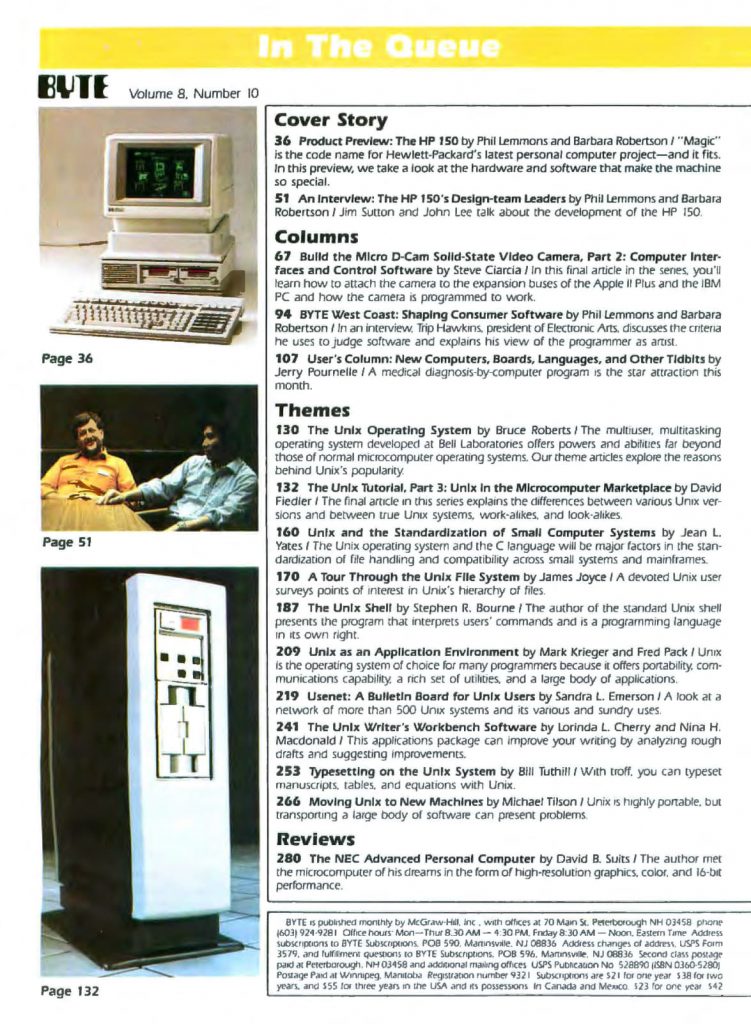
    • Product Preview: The HP 150 – The HP-150 somewhat unique machine. It ran MS-DOS but was not PC compatible. It was also one of the first computers with a touch screen (though it was optional). It was fairly powerful for its time. It used an 8088 CPU but it ran at 8 MHz instead of the 4.77 MHz of the IBM PC.
    • An Interview: The HP 150’s Design-team Leaders – An interview with Jim Sutton and John Lee, the leaders of the design team for the HP 150.

    Columns

    • Build the Micro D-Cam Solid-State Video Camera, Part 2 – The second part of a series on building a digital camera. This part covers serial interfaces for the Apple II and IBM PC and software for the Apple II.
    • BYTE West Coast: Shaping Consumer Software – Trip Hawkins of Electronic Arts talks about how he judges software and the programmer as an artist.
    • User’s Column: New Computers, Boards, Languages and Other Tidbits – Items covered include Modula-2/86, Problem Knowledge Coupler (medical software), Kaypro 4, Osborne Executive, and more.

    Themes

    • The Unix Operating System – An overview of the Unix operating system.
    • The Unix Tutorial, Part 3: Unix in the Microcomputer Marketplace – A look at licensed Unix OS versions as well as look-alikes and work-alikes (Linux would fall under this category though that wouldn’t exist for nearly another decade).
    • Unix and the Standardization of Small Computer Systems – A look at the history of Unix and how it helped to standardize software and hardware of “small systems” (i.e. workstation and mini-computers).
    • A Tour Through the Unix File System – A tutorial on the Unix file system.
    • The Unix Shell – A look at both the command interpreter and programming capabilities of the Unix shell.
    • Unix as an Application Environment – A look at how Unix compares to other operating systems in terms of development tools and end user applications.
    • Usenet: A Bulletin Board for Unix Users – In many ways, Usenet can be thought of as the beginning of the public Internet. This article covers the history and current state of Usenet.
    • The Unix Writer’s Workbench Software – A software package designed to help improve your writing. It includes spelling and grammar assistance among other things.
    • Typesetting on the Unix System – A look at troff (Typesetter RunOFF) and its offshoots.
    • Moving Unix to New Machines – Thoug Unix was extremely portable relative to other operating systems, there were still challenges to porting it to new systems. This looks at some of those challenges.

    Reviews

    • The NEC Advanced Personal Computer – This machine was designed to run CPM/86 so essentially this is a 16-bit CP/M machine with 128K RAM and two 8-inch floppy drives. I don’t know if it was clear at the time but CP/M would shortly disappear from the market in favor if PC compatibles. The 8-inch disk format wouldn’t really be around much longer either.

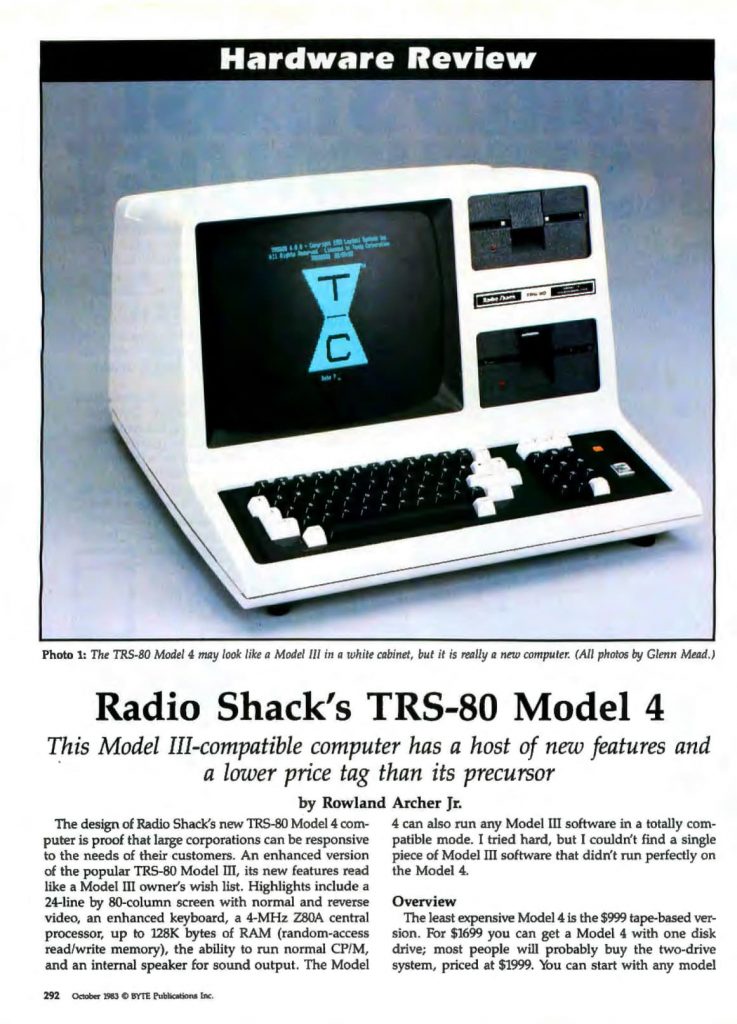
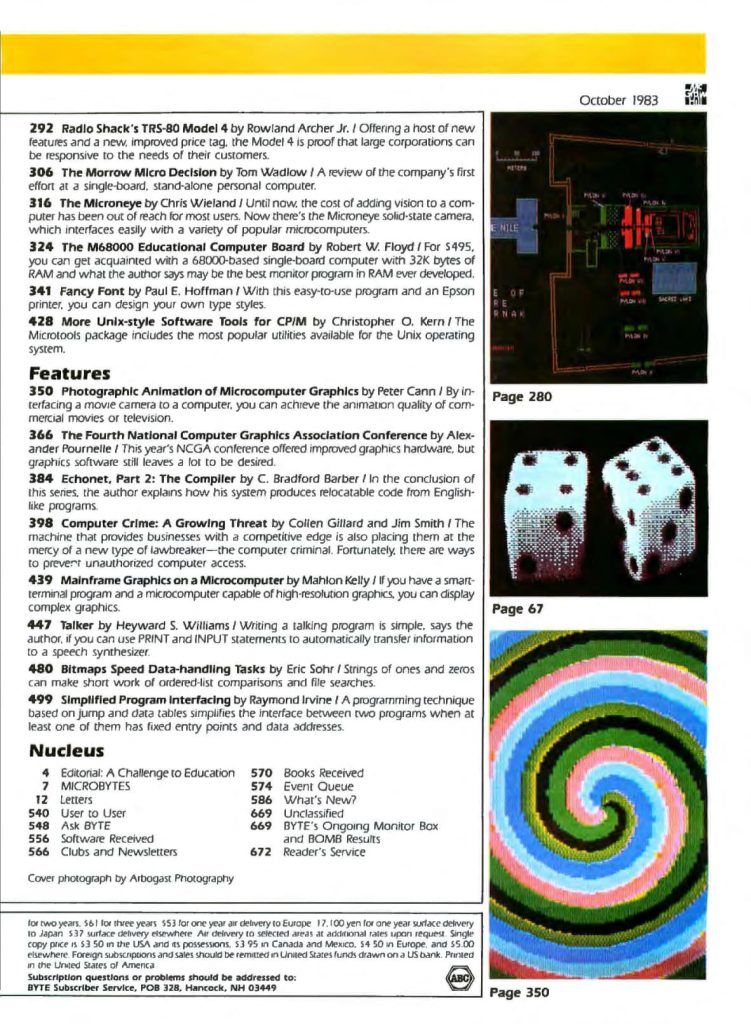
    • Radio Shack’s TRS-80 Model 4 – My high school was still using TRS-80 Model IIIs and 4s to teach BASIC programming at least through the early 1990s. These machines were Z80 based and had their own DOS. The Model 4 could also run CP/M software. With two 5.25″ floppy disk drives and 128K of RAM a Model 4 cost about $3000.
    • The Morrow Micro Decision – The Osbourne 1 and Kaypro II were considered to be the main competition for the Morrow Micro Decision. It is a Z80 based CP/M computer with 64K of RAM and 5.25″ floppy drive that starts at $1200.
    • The Microneye – A digital camera with a 256×128 sensor that could interface with various computers via an RS-232 Interface. It worked at least with the Apple II, IBM PC, Commodore 64, and Color Computer.
    • The M68000 Educational Computer Board – A single board computer with a 4 MHz 68000 CPU, 32K RAM, and various ports and interfaces for $495. This board fits in a Heathkit H-19 terminal.
    • Fancy Font – Software that lets you design your own fonts for Epson printers.
    • More Unix-style Software Tools for CP/M – A look at Microtools, a package of several utilities for CP/M that add Unix-like capabilities. Inclued are tools similar to grep, diff, sort, tree, echo, find, merge, and more.

    Features

    • Photographics Animation of Microcomputer Graphics – A technique for generating stop motion animation using a computer to generate the images and a video camera.
    • The Fourth National Computer Graphics Association Conference – A look at the latest graphics hardware and software.
    • Echonet, Part 2: The Compiler – Part two of a multipart series on Echonet, a programming language/system. This part covers the compiler.
    • Computer Crime: A Growing Threat – This article looks at real-life computer crimes and some of the requirements for a secure system. Most crimes at this point involved unauthorized access. A comparison is drawn between the fictional War Games (great movie) and a real-life incident several months before that movie was released in which several teenagers gaines access to the Los Alamos nuclear weapons laboratory.
    • Mainframe Graphics on a Microcomputer – Techniques for saving mainframe graphical output via a terminal program and converting them for display on your home computer…assuming you have high resolution graphics capabilities.
    • Talker – A program to make writing talking programs for the TRS-80 and Vortrax’s Type-‘N-Talk easier.
    • Bitmaps Speed Data-handling Tasks – Programming techniques for using bitmaps to speed up list comparison and file searches.
    • Simplified Program Interfacing – Using jump and data tables to simplify the interface between two programs.

    Nucleus

    • Editorial: A Challenge to Education – Radio Shack’s “America’s Educational Challenge” initiative.
    • MICROBYTES – The latest news including the first 256K DRAM chips, memory and other componenet shortages, Telelearning electronic university, Texas Instruments and Times reduce prices on their computers, Interland announces a $400 per device Ethernet link, and more.
    • Letters – Letters from readers about Word Tools for the IBM PC, double-spacing with Wordstar, searching in Wordstar, and more.
    • User to User – Questions answered about copy protection and privacy, cache RAM, public key encryption, and more.
    • Ask BYTE – Questions answered about joysticks for the PC, Apple disks, sharing a color monitor with multiple systems, developing games for the Atari 2600, and more.
    • Software Received – Quick looks at Apple: Bookends (a reference management system), The Chambers of Voab (educational game), The Cheap Assembler (menu-driven editor/assembler), Home Investment Package (stock-trading and compound interest), Tactical Armor Command (World War II sim), Ultimaker II (Ultima II character editor, map printer, and hints); Atari: Paris in Danger (1814 military sim), Solar Storm (adventure game); CP/M: Fallout (a fallout prediction and shelter design program), Organizer II (creates menus), Pro Pascal (programming language), Z80ASM (Z80 assembler); Commodore: Casual Writer (word processor), Deadly Skies (arcade game), Dr. Floyd (AI sim game), Gold Fever (arcade game), The Math Teacher (educational math program), Neutral Zone (arcade game), Scorpion (survival game), Type For Your Life (teaches typing), Wordplay (various word games); IBM PC: C Compiler System, Electric Ledger (checking program), Financial Planning for Supercalc (spreadsheet enhancement), and more.
    • Clubs and Newsletters – A listing of some of the latest computer related clubs and newsletters.
    • What’s New? – A brief look at new product including unix benchmark programs, Unity (A relational database for Unix), a new Unix workstation with built-in C compiler (Minibox), CT/680 color graphics terminal from General Digital Industries, two new RGB monitors from Panasonic, Web Network for Kaypro computers, Novell Sharenet X allows up to 255 IBM PC XTs to share up to 320 MB of storage, an interface from Prowell Computer Services that allows Apple IIs and Atari 8-bit computers to share files, a 300 bps modem from Avcom for the IBM PC, CP/M Processor for the TI 99/4A, word processor and database manager from Mirage Concepts, and lots more.

    …and more!