• Tag Archives Byte
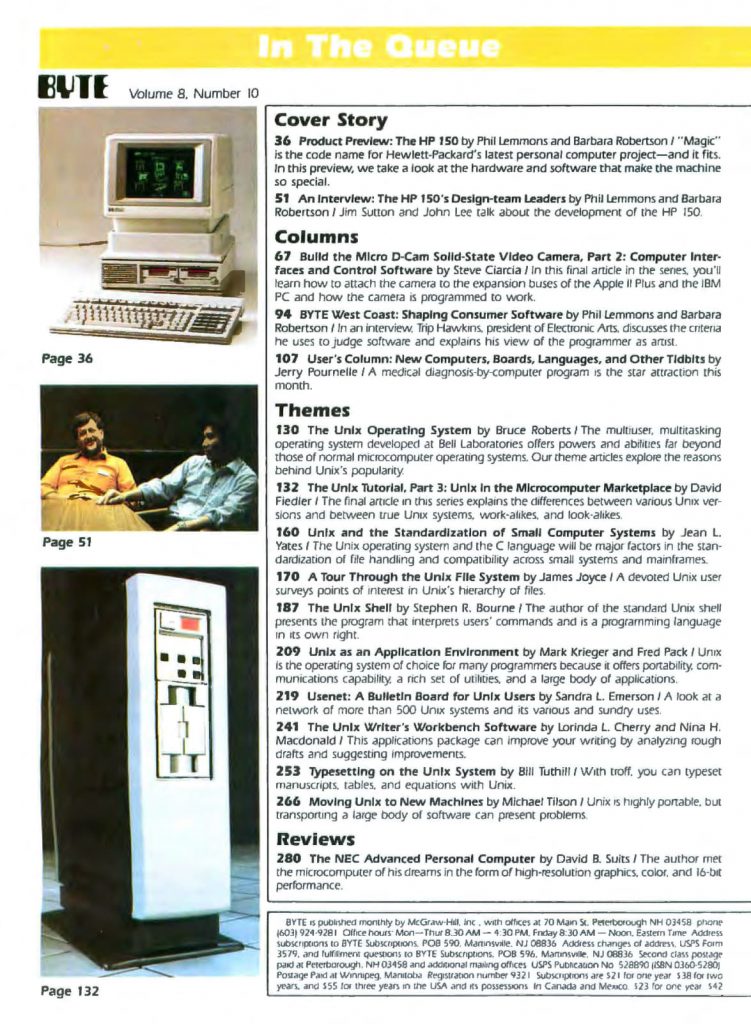
  • Byte (October 1983)

    Source: Byte – October 1983

    Byte was probably the best general computer magazine of its time. It had a long publishing run starting in the 1970s and continuing into the 1990s. This issue is from October 1983 and includes:

    Cover Story

    • Product Preview: The HP 150 – The HP-150 somewhat unique machine. It ran MS-DOS but was not PC compatible. It was also one of the first computers with a touch screen (though it was optional). It was fairly powerful for its time. It used an 8088 CPU but it ran at 8 MHz instead of the 4.77 MHz of the IBM PC.
    • An Interview: The HP 150’s Design-team Leaders – An interview with Jim Sutton and John Lee, the leaders of the design team for the HP 150.

    Columns

    • Build the Micro D-Cam Solid-State Video Camera, Part 2 – The second part of a series on building a digital camera. This part covers serial interfaces for the Apple II and IBM PC and software for the Apple II.
    • BYTE West Coast: Shaping Consumer Software – Trip Hawkins of Electronic Arts talks about how he judges software and the programmer as an artist.
    • User’s Column: New Computers, Boards, Languages and Other Tidbits – Items covered include Modula-2/86, Problem Knowledge Coupler (medical software), Kaypro 4, Osborne Executive, and more.
    Themes

    • The Unix Operating System – An overview of the Unix operating system.
    • The Unix Tutorial, Part 3: Unix in the Microcomputer Marketplace – A look at licensed Unix OS versions as well as look-alikes and work-alikes (Linux would fall under this category though that wouldn’t exist for nearly another decade).
    • Unix and the Standardization of Small Computer Systems – A look at the history of Unix and how it helped to standardize software and hardware of “small systems” (i.e. workstation and mini-computers).
    • A Tour Through the Unix File System – A tutorial on the Unix file system.
    • The Unix Shell – A look at both the command interpreter and programming capabilities of the Unix shell.
    • Unix as an Application Environment – A look at how Unix compares to other operating systems in terms of development tools and end user applications.
    • Usenet: A Bulletin Board for Unix Users – In many ways, Usenet can be thought of as the beginning of the public Internet. This article covers the history and current state of Usenet.
    • The Unix Writer’s Workbench Software – A software package designed to help improve your writing. It includes spelling and grammar assistance among other things.
    • Typesetting on the Unix System – A look at troff (Typesetter RunOFF) and its offshoots.
    • Moving Unix to New Machines – Thoug Unix was extremely portable relative to other operating systems, there were still challenges to porting it to new systems. This looks at some of those challenges.

    Reviews

    • The NEC Advanced Personal Computer – This machine was designed to run CPM/86 so essentially this is a 16-bit CP/M machine with 128K RAM and two 8-inch floppy drives. I don’t know if it was clear at the time but CP/M would shortly disappear from the market in favor if PC compatibles. The 8-inch disk format wouldn’t really be around much longer either.
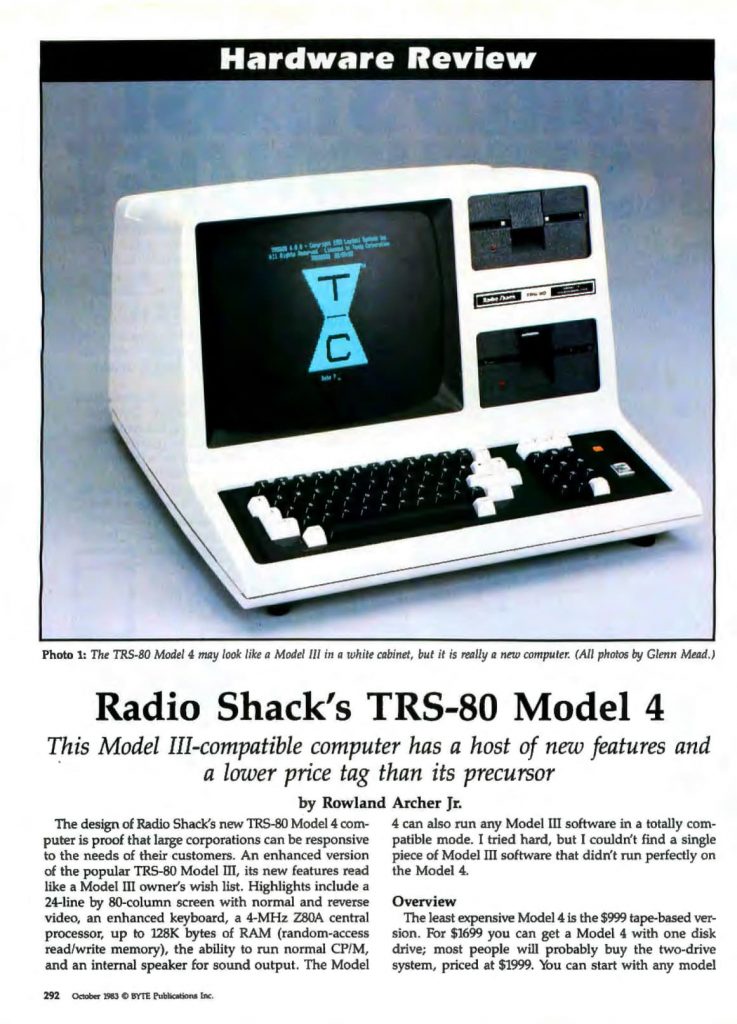
    • Radio Shack’s TRS-80 Model 4 – My high school was still using TRS-80 Model IIIs and 4s to teach BASIC programming at least through the early 1990s. These machines were Z80 based and had their own DOS. The Model 4 could also run CP/M software. With two 5.25″ floppy disk drives and 128K of RAM a Model 4 cost about $3000.
    • The Morrow Micro Decision – The Osbourne 1 and Kaypro II were considered to be the main competition for the Morrow Micro Decision. It is a Z80 based CP/M computer with 64K of RAM and 5.25″ floppy drive that starts at $1200.
    • The Microneye – A digital camera with a 256×128 sensor that could interface with various computers via an RS-232 Interface. It worked at least with the Apple II, IBM PC, Commodore 64, and Color Computer.
    • The M68000 Educational Computer Board – A single board computer with a 4 MHz 68000 CPU, 32K RAM, and various ports and interfaces for $495. This board fits in a Heathkit H-19 terminal.
    • Fancy Font – Software that lets you design your own fonts for Epson printers.
    • More Unix-style Software Tools for CP/M – A look at Microtools, a package of several utilities for CP/M that add Unix-like capabilities. Inclued are tools similar to grep, diff, sort, tree, echo, find, merge, and more.

    Features

    • Photographics Animation of Microcomputer Graphics – A technique for generating stop motion animation using a computer to generate the images and a video camera.
    • The Fourth National Computer Graphics Association Conference – A look at the latest graphics hardware and software.
    • Echonet, Part 2: The Compiler – Part two of a multipart series on Echonet, a programming language/system. This part covers the compiler.
    • Computer Crime: A Growing Threat – This article looks at real-life computer crimes and some of the requirements for a secure system. Most crimes at this point involved unauthorized access. A comparison is drawn between the fictional War Games (great movie) and a real-life incident several months before that movie was released in which several teenagers gaines access to the Los Alamos nuclear weapons laboratory.
    • Mainframe Graphics on a Microcomputer – Techniques for saving mainframe graphical output via a terminal program and converting them for display on your home computer…assuming you have high resolution graphics capabilities.
    • Talker – A program to make writing talking programs for the TRS-80 and Vortrax’s Type-‘N-Talk easier.
    • Bitmaps Speed Data-handling Tasks – Programming techniques for using bitmaps to speed up list comparison and file searches.
    • Simplified Program Interfacing – Using jump and data tables to simplify the interface between two programs.
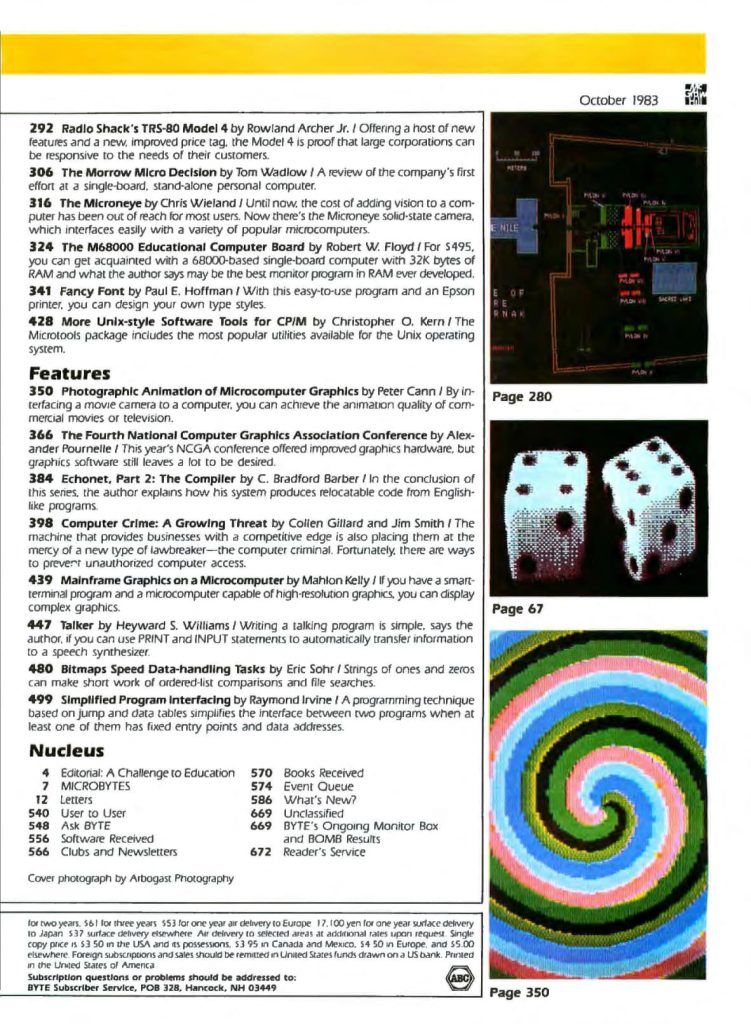
    Nucleus

    • Editorial: A Challenge to Education – Radio Shack’s “America’s Educational Challenge” initiative.
    • MICROBYTES – The latest news including the first 256K DRAM chips, memory and other componenet shortages, Telelearning electronic university, Texas Instruments and Times reduce prices on their computers, Interland announces a $400 per device Ethernet link, and more.
    • Letters – Letters from readers about Word Tools for the IBM PC, double-spacing with Wordstar, searching in Wordstar, and more.
    • User to User – Questions answered about copy protection and privacy, cache RAM, public key encryption, and more.
    • Ask BYTE – Questions answered about joysticks for the PC, Apple disks, sharing a color monitor with multiple systems, developing games for the Atari 2600, and more.
    • Software Received – Quick looks at Apple: Bookends (a reference management system), The Chambers of Voab (educational game), The Cheap Assembler (menu-driven editor/assembler), Home Investment Package (stock-trading and compound interest), Tactical Armor Command (World War II sim), Ultimaker II (Ultima II character editor, map printer, and hints); Atari: Paris in Danger (1814 military sim), Solar Storm (adventure game); CP/M: Fallout (a fallout prediction and shelter design program), Organizer II (creates menus), Pro Pascal (programming language), Z80ASM (Z80 assembler); Commodore: Casual Writer (word processor), Deadly Skies (arcade game), Dr. Floyd (AI sim game), Gold Fever (arcade game), The Math Teacher (educational math program), Neutral Zone (arcade game), Scorpion (survival game), Type For Your Life (teaches typing), Wordplay (various word games); IBM PC: C Compiler System, Electric Ledger (checking program), Financial Planning for Supercalc (spreadsheet enhancement), and more.
    • Clubs and Newsletters – A listing of some of the latest computer related clubs and newsletters.
    • What’s New? – A brief look at new product including unix benchmark programs, Unity (A relational database for Unix), a new Unix workstation with built-in C compiler (Minibox), CT/680 color graphics terminal from General Digital Industries, two new RGB monitors from Panasonic, Web Network for Kaypro computers, Novell Sharenet X allows up to 255 IBM PC XTs to share up to 320 MB of storage, an interface from Prowell Computer Services that allows Apple IIs and Atari 8-bit computers to share files, a 300 bps modem from Avcom for the IBM PC, CP/M Processor for the TI 99/4A, word processor and database manager from Mirage Concepts, and lots more.
    …and more!

  • Byte (February 1989)

    Source: Byte – February 1989

    Byte was one of the better computer magazines available. It also tended to have a slightly more technical slant than the average PC magazine. It covered a variety of systems but gradually became more PC oriented towards the latter part of its life. The first issue of Byte was published all the way back in 1975 and the final issue was the July 1998 issue. The February 1989 issue weighed in at over 380 pages and includes:

    Products in Perspective

    • What’s New – A look at new products including the Crayon 386 20/20 SP, a ruggedized computer for industrial environments ($7495); Chorus Transputer box for Macintosh networks ($25,000); the VIP SX386 tower PC from ALR that features a 16-MHz 386 which is upgradeable to a 20-MHz 386 ($2395); A small 8-ounce 20 MB hard drive for $1195; a data acquisition board for the Mac SE ($595 + $95 for the driver + $595 for LabView software); Sony 68030 based Unix workstation ($13,900-$54,200 depending on specs); Toshiba T5100 386-based portable Unix workstation ($7199-$8750); The Headstart II Plus (8088-1 based, $2295) and Headstart III (80286 based, $2995) and lots more.
    • Short Takes – Brief hands-on views of new products including the MegaMate (external 3.5″ disk drive for $349), Unix Tools for DOS (including MKS Make, Lex and Yacc), Wordbench (word processor with tools for writers, $189), Data Sentry (hardware based copy protection, $125), and Sourcer (a disassembler, $99.95).
    • Paradox 3: Neither Enigma nor Riddle – A first look at an upgrade to Borland’s DBMS package.
    • Cover Story: The Mac SE Takes Off – A first look at the Mac SE/30 which features a 68030 CPU, 68882 FPU. You could get the 2 MB RAM/40 MB hard drive model fro $5069 or the 4 MB RAM/80 MB hard drive model for $6369.

    • Product Focus: Smoothing Out C – Optimization techniques for C compilers and a comparison of several compilers including Borland Turbo C Professional 2.0, Manx Aztec C86 Commercial 4.1d, MetaWare high C 286 1.4, Microsoft C 5.1, Watcom C 6.5, and Zortech C 1.07.
    • A Pair of Sophisticated Laptops – Reviews of two new laptops including the Zenith SupersPort 286 featuring an 80C286 CPU running at 6 or 12 MHz, 1 MB RAM, one 1.44-MB 3.5″ floppy drive; 20 or 40 MB hard drive, and more for $4999-$5599 and the Mitsubishi MP-286L featuring an 80286 running at 8 or 12 MHz, 640K RAM, one or two 1.44-MB 3.5″ floppy drives, 20 MB hard drive, and more for $3195-$5395.
    • A PS/2 in Channel Only – A review of the Tandy 5000 MC, Tandy’s PS/2 clone…or at least it used the Micro Channel bus. It features a 20-MHz 80386, 2 MB of RAM, 1.44-MB 3.5″ floppy drive, 80 MB hard drive, and more starting at $4999.
    • Three Assemblers for MS-DOS – A review and comparison of three assemblers for DOS including TASM, OPTASM and MASM.
    • Full Impact – A review of an upgrade to this spreadsheet software from Ashton-Tate ($395).
    • dBASE IV Arrives – A review of this DBMS package that really set the standard for years to come ($795 Standard Edition, $1295 Developer’s Edition).

    Expert Advice

    • Computing at Chaos Manor: Ready Line Overload – A look at new products shown at COMDEX, including Intel’s Visual Edge print-enhancement system, Logic Gem (a software package for turning flow charts into code), DESQview 386 (a popular DOS multitasking system), Norton Utilities 4.5, ConvertUnits (unit conversion program), and more.
    • Applications Plus: New Friends and Old – A look at the evolution of integrated software, the Canon Cat printer, Framework III database software, and The Perfect Career…software that is supposed to help you identify the ideal career for you.
    • Down to Business: Getting into Bigger LANs – A look at strategies to create larger local area networks.
    • Macinations: Hey Apple, I Need a Laptop – Apple had yet to release an official Mac based laptop though this author really wanted one. Apparently there were third party companies who hacked such things together and they were planning something called the WalkMac SE that was based on the Mac SE motherboard and featured a backlit LCD screen and rechargeable battery for $5449.
    • OS/2 Notebook: Electing the PM – Requirements for running OS/2 with Presentation Manager. Requirements include a 80286 or 80386 CPU, OS/2 friendly BIOS, IBM PC AT-type hard disk controller, 1.2 or 1.44 MB floppy drive, 60 MB hard drive, EGA or VGA graphics, and at least 2.6 MB RAM. This article examines each of these requirements (and others) in more detail.
    • COM1: The ABCs of X, Y, and XModem – A comparison of various modem file transfer protocols. By the time I started calling BBSes, ZMODEM was the standard though there was at least one more obscure protocol that allowed simultaneous uploads and downloads that I used sometimes…the name escapes me at the moment.

    In Depth

    • Introduction: Personal Workstations – The line between professional workstations and high-end PCs starts to blur.
    • Two Worlds Converge – A low-end workstation or high-end PC could be considered basically the same thing. A personal workstation. This article lists three main architectures: VME, Multi-Bus and the IBM PC AT bus. Perhaps the key to the “workstation” label is a high res display and networking capabilities.
    • The Current Crop – A look at existing professional workstations as well as building your own. Pre-built workstations mentioned include the Apollo DN3000, Sun-3/50, NeXT, Sun386i/150, Sun-3/60, Apollo DN3500, Sun 386i/250, SGI Personal Iris, Sun-4/110, and Apollo DN4500. They range in price from $4990 to $18990. The author’s self built workstation consists of an ALR 386/220 with 20 MHz 80386, and 3 MB of RAM running Unix System V 3.0.
    • Worth the RISC – An overview or RISC technology including the CPUs available now.
    • How Fast Is Fast? – Techniques for measuring performance and how different architectures produce speed in different ways.
    • Art + 2 Years = Science – A look at the state of the art in computer graphics and some of the products available.
    • Networking with Unix – A look at Unix networking including RFS (Remote File System) and NFS (Network File System).

    Features

    • Digital Paper – A look at the technology behind write-once optical media that can store up to a gigabyte of data on floppy disk sized cartridges.
    • Turbo Pascal Windowing System – Pascal’s windowing system, called TWindows, lets you add windows to the application programs you write. This article includes examples and other techinical details.
    • Under the Hood: Hard Disk Interfaces – An overview and techinical comparison of the various hard disk interface standards including ST506, RLL, Advanced and Enhanced RLL, ESDI, SMD, and SCSI.
    • Some Assembly Requires: Trees ‘n Keys, Part 2 – A continuation of a discussion of the B-tree data structure from the previous month.

    Departments

    • Editorial: The End of Application Software – IBM and Microsoft start including more application features in to OS/2 and Windows.
    • Microbytes – Highlights of new developments in the computer industry including new embedded processors from Intel and AMD, analog emulation of the nervous system, flexible superconductors, and much more.
    • Letters – Letters from readers about the high cost of RAM, getting started on BIX, MIX, and Compuserve, the origin of various computer terms, and more.
    • Chaos Manor Mail – Using PC-MOS/386 and Nota Bene (a word processor).
    • Ask BYTE – Questions answered about the Mindset computer, installing a floppy drive, FFT algorithms, upgrading the BIOS of an original IBM PC, interface cables, and more.
    • Book Reviews – Reviews of No Way: The Nature of the Impossible, Programmer’s Guide to OS/2, Better Scientific and Technical Writing, C Traps and Pitfalls, and What Do You Care What Other People Think?

    …and more!


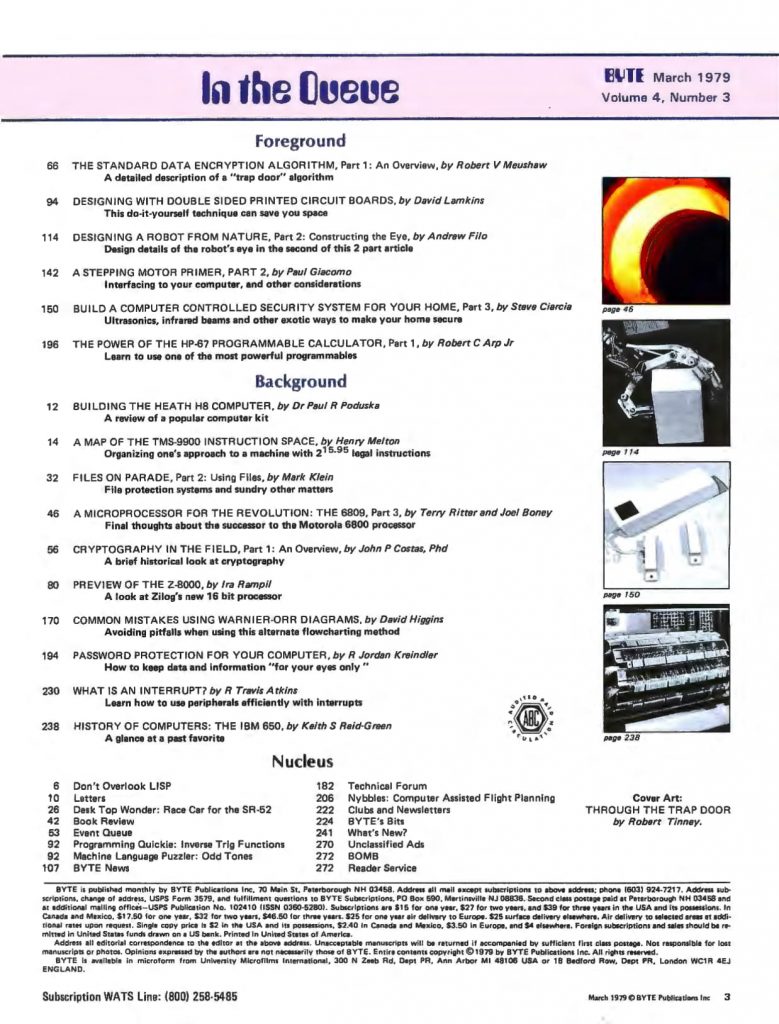
  • Byte (March 1979)

    Source: Byte – March 1979

    Byte was one of the earliest computer magazines and longest running. Publication began in the 1970s and continued through the early 1990s. The content tended to be technical, especially in the older issues. The March 1979 issue includes:

    Foreground

    • The Standard Data Encryption Algorithm, Part 1 – An introduction to the Standard Data Encryption Algorithm and an implementation for the KIM which uses a 6502 processor
    • Designing with Double Sided Printed Circuit Boards – A tutorial for designing your own circuit boards.
    • Designing a Robot From Nature, Part 2 – Part 2 concentrates on the design of the eye of the robot. Really it’s a contrast detector. The robot consists of a manipulator arm, an 8008 computer, and sustained contrast detector.
    • A Stepping Motor Primer, Part 2 – This second part of a multi-part series covers interfacing to a stepper motor.
    • Build a Computer Controlled Security System for Your Home, Part 3 – The third part of detailed guide to building a home security system.
    • The Power of the HP-87 Programmable Calculator, Part 1 – An introduction to the HP-67 Programmable Calculator using a complex programming example.

    Background

    • Building the Heath H8 Computer – The Heath H8 was a computer that came in kit form. It was based on the 8080A CPU. This is a guide to putting it together.
    • A Map of the TMS-9000 – A look at machine language on this 16-bit processor.
    • Files on Parade, Part 2 – The second and final part in a series on using files.
    • A Microprocessor for the Revolution: The 6809, Part 3 – The concluding part of a series on the 6809 processor. This art discusses clock speed, timing signals, condition codes, and software design philosophy. This processor would be used in the TRS-80 Color Computer.
    • Cryptography in the Field, Part 1 – Part one of a series on the practical use of cryptography.
    • Preview of the Z-8000 – A technical look of this new 16-bit processor from Zilog.
    • Common Mistakes Using Warnier-QPR Diagrams – These diagrams are a form of programming documentation and a way to impose structure on non-structured programming languages.
    • Password Protection for Your Computer – A simple procedure for implementing password protection on you system.
    • What is an Interrupt? – A technical explanation of the interrupt.
    • A History of Computers: The IBM 650 – The IBM 650 was the most popular computer of the 1950s, used by small banking, accounting and insurance companies among others.

    Nucleaus

    • Don’t Overlook Lisp – An editorial on the benefits of the LISP programming language.
    • Letters – Letters from readers about computers in the kitchen, computer humor, chess and Pascal, and more.
    • Desk Top Wonder: Race Car for the SR-52 – A racing game for the SR-52 programmable calculator.
    • Book Review – Review of “Your Own Computer” by Mitchell Waite and Michael Pardee.
    • BYTE News – More companies supporting Pascal on their machines; Intel, Texas Instruments and IBM release new memory chips; bubble memory increasing in availability; 5-inch floppy disks to increase in capacity to 1 to 2 MB; flat screen displays being developed; APL microcomputer coming soon; and more.
    • Technical Forum – Information on vector displays.
    • Nybbles: Computer Assisted Flight Planning – Using a computer to perform calculations related to flight planning.
    • What’s New> – A look at new products including a Cromenco Single Card computer featuring a Z-80 CPU and S-100 bus, an Intelligent Programmer for Ultraviolet Memory Chips, the Program Utility Package for the North Star Disk System, a new word processor for the Commodore PET, and more.

    …and more!