

A summary for those that haven’t been keeping up with this series:
I found a number of 5.25″ disks at a thrift store a number of years ago (sometime in the late 1990s to the best of my recollection). I finally got around to acquiring a 5.25″ disk drive and extracting the contents a several years back. Since then, I have been occasionally posting the content here.
Based on the contents, most or all of these disks were apparently once owned by someone named Connie who used to run the “Close Encounters” Special Interest Group (SIG) on Delphi in the mid 1980s.
The following description of this SIG was found in a document on one of the disks: “This SIG, known as ‘Close Encounters’, is a forum for the discussion of relationships that develop via computer services like the Source, CompuServe, and Delphi. Our primary emphasis is on the sexual aspects of those relationships.”
This service was text based and was accessed via a modem and whatever terminal program you had available for your computer to dial in with. Many of these disks have forum messages, e-mails and chat session logs. All of this is pre-internet stuff and I am not aware of any archives in existence today that contain what was on Delphi in the 1980s.
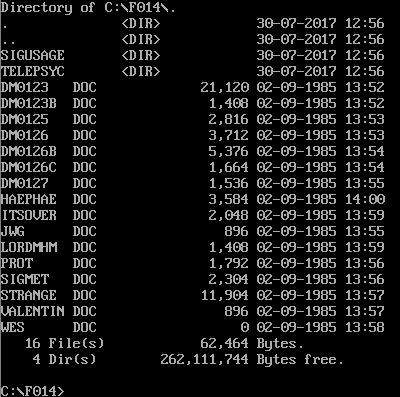
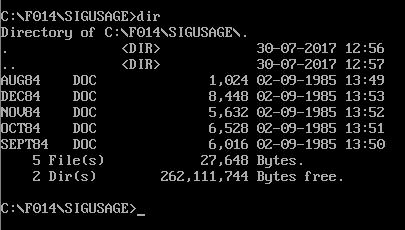
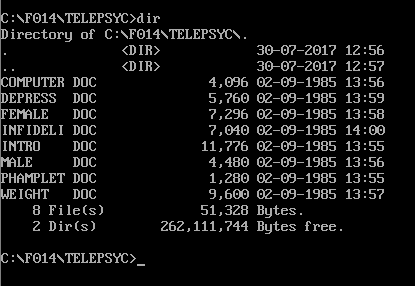
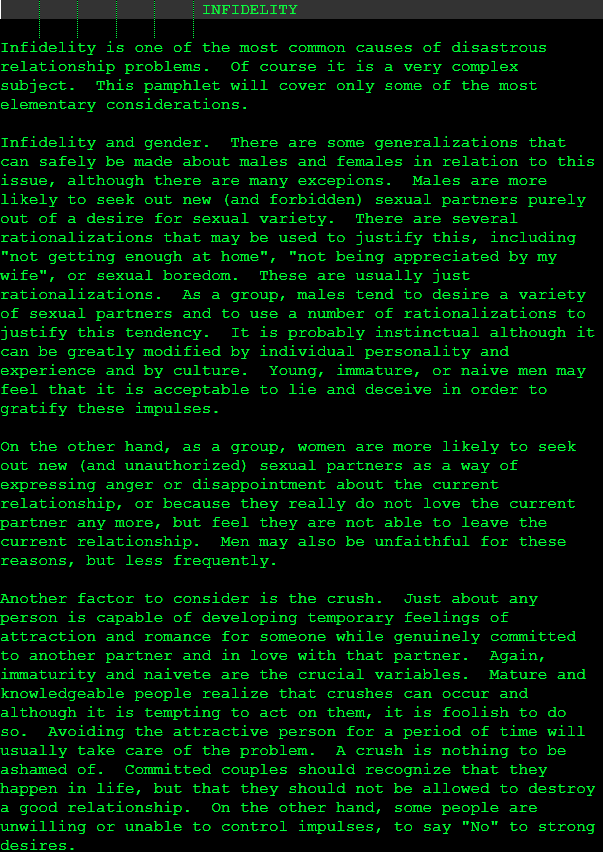
This post includes the contents of INFIDELI.DOC. This file is dated September 2nd, 1985 and is in a subdirectory called TELEPSYC. This is an article on infidelity. No name or other credit is listed in the file. I tried doing a web search on a few strings from this article but couldn’t find anything so I’m not sure who wrote it. Like the last few posts in this series, I believe this article came from a special interest group or some other kind of feature or area on Delphi called “TelePsych”. As far as I can tell, these articles were exclusive to Delphi. I skipped ahead and the next file is an intro to TELEPSYC and mentions that Timothy Miller,Ph.D. is who runs it. This is most likely the author of these articles though these files are not specifically credited.
=-=
INFIDELI.DOC
=-=
—
                 FEMALE SEXUAL PROBLEMS

Nonmedical female sexual problems usually involve actual or
imagined lack of normal sexual response.  Keep in mind the
word "imagined".  A male partner's opinion may not be the best
judge of "normal" sexual response;  many so called female
sexual problems are really only a mismatch in sexual drive
between partners.  The complaint may be that there is lack of
arousal or orgasm, or it may be painful intercourse or lack of
lubrication secondary to insufficient arousal.

First, let's distinguish between sexual drive and sexual
response.  We will define Sexual drive as any feeling of
sexual desire or excitement, regardless of the context in
which it is experienced.  We'll define sexual response as
the ability to experience sexual desire at a time when there
is the intention to have intercourse.  This distinction is
quite important.  Past or present frequency and intensity of
sexual drive are an indicator of a woman's capacity for sexual
response.  If sexual response seems small in comparison to
sexual drive, there may be factors interfering with response.
On the other hand, if the pattern of drive seems consistent
with the pattern of response, it may be that the woman is
responding normally for her.  This is not necessarily a
problem unless she or her partner thinks it is.

            INHIBITIONS OF SEXUAL RESPONSE

Another distinction is in order here.  We need to distinguish
between two types of response: sexual excitement and orgasm.
Usually sexual excitement precedes orgasm.  However, orgasm
may not take place even though a high level of excitement
develops.  The female orgasmic response is more vulnerable to
disruption by psychological factors than is drive or response
per se.  The same factors that block excitement will also
block orgasm, although there are specific self help approaches
you may try.

If both partners feel that response is not adequate and the
woman's patterns of drive suggest that better response is
possible, they may well be right.  The problem is usually
nothing more than tension, anxiety, or anger regarding sexual
expression.  Those feelings may be specific to the current
partner or the current situation, or they may relate more to
sexual expression in general.

                         WHAT TO DO

1.  If inhibition of response seems to be a problem specific
to the present relationship, have an honest talk with your
partner regarding the current psychological state of the
relationship, with particular emphasis on sources of anxiety
or anger that are not being honestly confronted.  Set goals
for solving these problems and the sexual problem may solve
itself.

2.  Many female response problems are nothing more than a
matter of clumsiness and insensitivity on the part of the male
partner.  Male partners:  Ask yourself, "If I were clumsy and
insensitive at times in bed, would my partner feel she could
tell me?"  Become the kind of partner who can talk comfortably
about such things.  It is not easy at first, but it gets
easier with practice. Females: learn to talk with your partner
about the sexual activities that do and don't turn you on, and
learn to give and get feedback about when it feels good and
when it doesn't.

3.  Many men and some women feel that a woman should need only
vaginal intercourse for maximum response.  Only a minority of
women are maximally responsive to this kind of stimulation.
Usually, other forms of sexual stimulation, applied by the
woman herself, her partner, or both, are needed to achieve
maximum response.

4. The next most common cause of incomplete female sexual
response is too little time, or in other words, too little
foreplay.  Most men can attain maxiumum response in a matter
of minutes.  The average woman requires fifteen to twenty
minutes of gentle sexual stimulation to reach maximum
response.  Sexually inexperienced or anxious male partners
may be in just too much of a hurry.

5.  Most women do not respond ideally to unromantic sexual
stimulation.  An awkward partner or a relationship that has
lost its romance and affection is inhibiting to many women.

6.  Some women have fears of intimacy or sexual expression
that have roots that extend beyond the current reltionship.
Self help may or may not be effective.  The most important
thing to do is to talk the feelings out with the partner.
Another possibility is to try to desensitize the woman to the
inhibiting presence of the male.  Try substituting playful
sexual affection in bed for intercourse or "serious" foreplay.
The woman could try masturbating, just to feel good, not
trying to reach an orgasm, while in bed with her partner.

7.  Many women who do not normally masturbate can achieve
orgasms through masturbation.  Other women reach orgasm with
masturbation but not with intercourse.  In either case,
masturbation can be very helpful if the male partner can get
over feeling jealous or hurt.  A vibrator is often helpful.
The first step is to learn to have an orgasm in private,
which is easier for most women.  Then gradually introduce the
presence of the partner, first in a purely affectionate role.
When orgasms can reached in this way, try gradually adding
more direct sexual contact with the partner.  Experiment with
"non-demand" intercourse in combination with masturbation.
"Non-demand" intercourse is intercourse that is done in such
a way that it is comfortable and pleasant for both partners,
but not intended to result in orgasm for either partner.

              WOMEN WITH LITTLE SEXUAL AROUSAL

This is not necessarily a problem.  Are you unhappy with your
level of drive, or is it only your partner who is
dissatisfied?  It could be that what is required is
reassurance of your partner.  Couples who cannot negotiate a
satisfactory understanding regarding dissimilar sexual drives
should seek professional consultation.  Such a problem can
be solved; it is not justified to throw away an otherwise good
relationship over it. A woman may have good reason to feel
that she is capapble of greater sexual drive.  In such a case
I doubt that self help would do much good.  Seek a competent
therapist.

                    PAINFUL INTERCOURSE

Some women experience painful intercourse as a result of
involuntary clenching of the muscles at the entrance to the
vagina.  The same general principles for self help apply to
this problem.  If self help is not effective, a sex therapist
or a good Ob/Gyn can be helpful.  Always seek a medical
examination if you experience unusual painful intercourse, as
it could signify a serious medical condition.

                       DEPRESSION

Severe loss of sexual desire can signify a serious depression.
Refer to pamphlet on depression.

                    IN GENERAL......

Sexual problems are usually treatable.  Don't be afraid to try
self help.  There are a great many self help books, and most
of them are pretty good.  Buy a few and read them. "For
Yourself"  and "For Each Other" by Lonnie Barbach are highly
recommended.  If it doesn't seem to help, professional help is
a good investment in your future happiness.  Make sure the
professional who treats you knows what he or she is doing.
Make sure it is someone who you trust and with whom you feel
comfortable. Good luck.