• Tag Archives PC
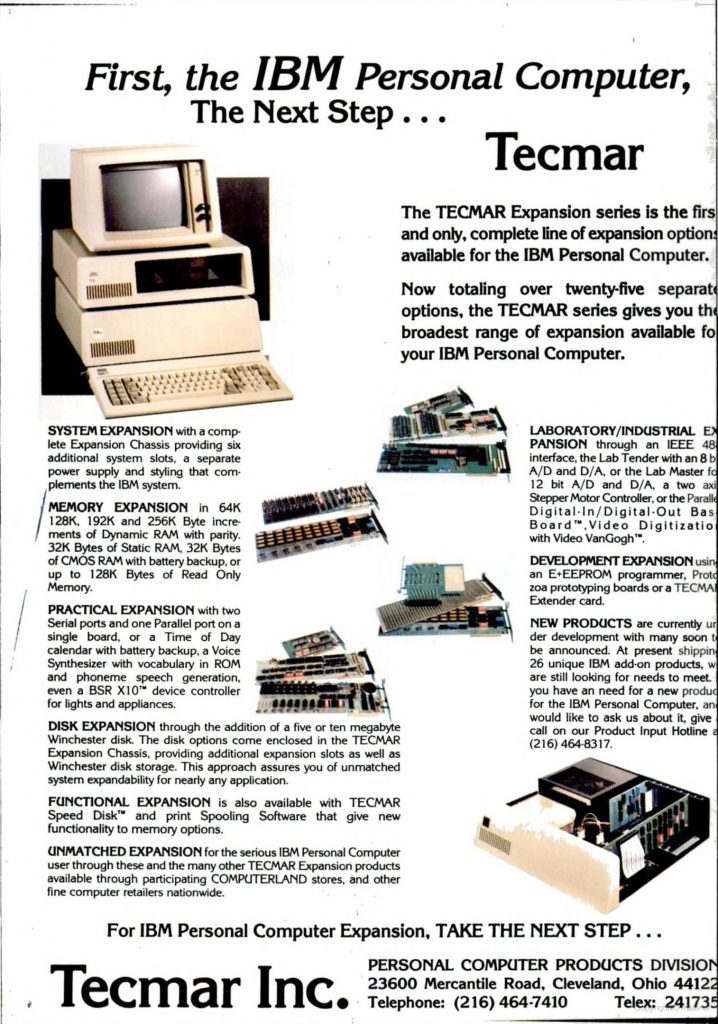
  • PC Magazine (August 1982)

    The IBM PC was a year old when this issue of Pc Magazine was on the stands. Going by page count, which was over 225 pages for this issue, there was already a ton of advertising behind PC products. The August 1982 issue of PC Magazine includes:

    PC Interview

    • An Interview with VisiCalc Entrepreneur Daniel Fylstra – A look at the history of VisiCalc and VisiCorp.

    Business

    • The More PCs the Merrier – IBM offers discounts on very large purchases (in the hundres or thousands of units).

    Events

    • NCC Roundup – A look at what was to be seen at the National Computer Conference in Houston, Texas.
    • Of Camesl and Tents – A look back at the past five years of the NCC and personal computing.

    Finance

    • How Much Are You Really Worth? – Calculating your net worth with a PC and spreadsheet.

    Software

    • Calc Wars – Testing SuperCalc and comparing it to VisiCalc.
    • The Challenger: Multiplan – A review of Multiplan, Microsoft’s new spreadsheet program.

    Marketplace

    • Mega Forces Unite – Sears introduces 45 new business centers with the IBM PC as the lead item.
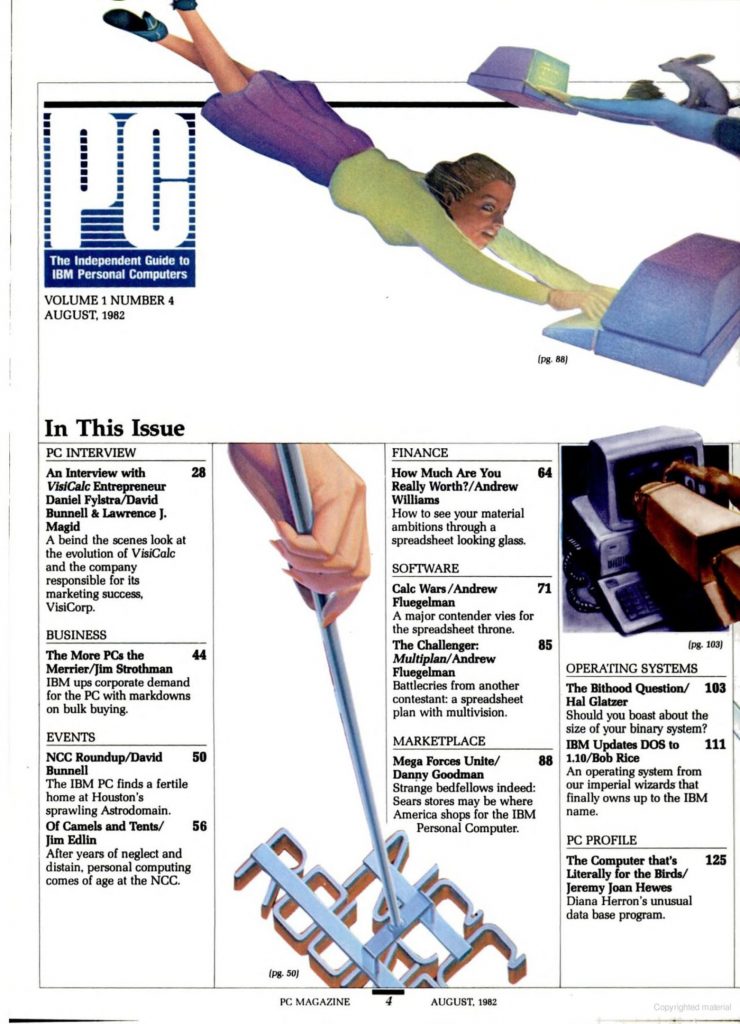
    Operating Systems

    • The Bithood Question – 8- vs. 16- vs. 32-bit CPUs.
    • IBM Updates DOS to 1.10 – DOS 1.10 added features such as the ability to handle dual-sided 320K disk drives, improved disk I/O speed, improved copy and dir commands, and more.

    PC profile

    • The Computer that’s Literally for the Birds – How one ornithologist uses a custom database program and VisiCalc to keep track of bird data.

    Communications

    • PC-Talk – A free communications program for the PC.

    Books

    • A Tool for the Layperson – A review of the book IBM Personal Computer: An Introduction to Programming and Applications.

    Product Reports

    • PC Reviews the Smith-Corona TP-1 Printer – A letter quality daisy wheel printer for about $700.

    PC Lab

    • PC Takes a Look at IBM’s Pascal Compiler – A review of this early Pascal compiler for the PC.

    Follow-Up

    • EasyWriter Resurrected – A look at this improved version of the EasyWriter word processor.
    • New Software Submission Guidelines from IBM – Highlights of IBM’s new software submission guidelines for those that want to try to have their software sold by IBM.

    At Home

    • The Computer Workstead – Working at home with your PC.
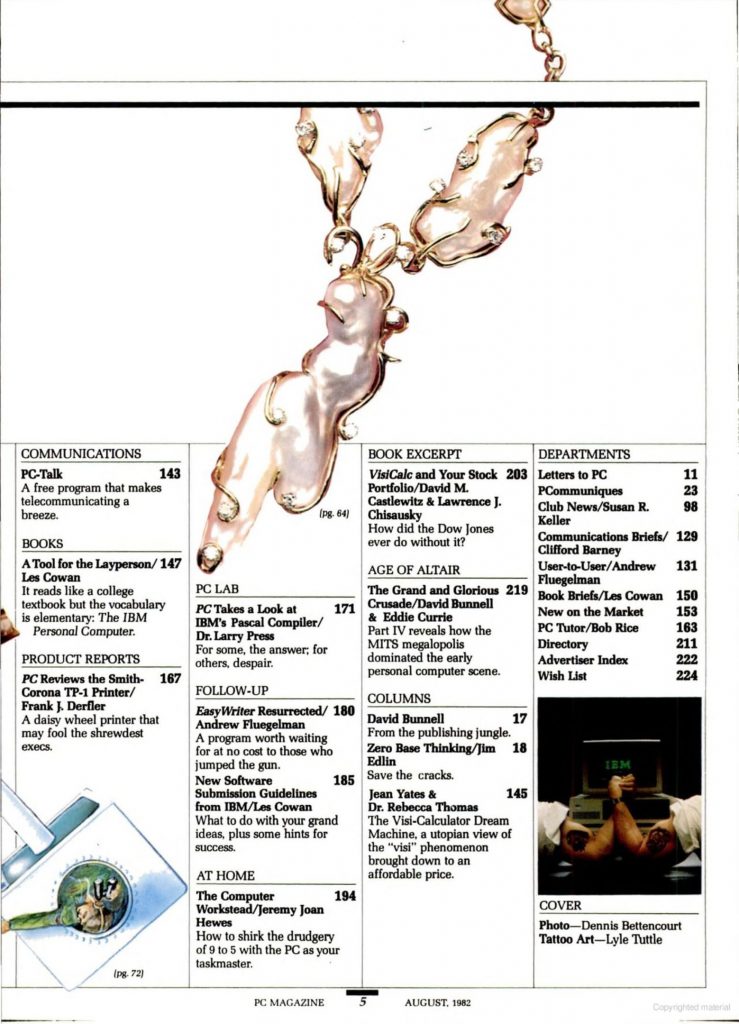
    Book Exerpt

    • VisiCalc and Your Stock Portfolio – An excerpt from VisiCalc Home and Office Companion.

    Age of Altair

    • The Grand and Glorious Crusade – One in a series of articles about the history of the Altair computer.

    Columns

    • David Bunnell – The software publishing jungle.
    • Zero Base Thinking – How e-mail systems help to keep things from falling through the cracks.
    • Jean Yates & Dr. Rebecca Thomas – An idea for a low-cost dedicated VisiCalc machine.

    Departments

    • Letters to PC – Letters from readers about adding a customer service card, copy protected software, IBM employee sales, adding a an MP1 B51 drive to the PC, speeding up disk drive access, and more.
    • PCommuniques – Keeping your PC cool; reduced price 64K expansion board; Zork released for the PC; electronic greeting cards; King James Bible released on disk; successor to the PC may have 8087 math coprocessor; four new computers announced that are software compatible with the PC; and more.
    • User-to-User – A look at the bugs fixed in the V1.05 update to BASICA, BASIC programming tips, PASCAL tips, printing with the NEC Spinwriter 3530, and more.
    • Book Briefs – A look at new books including A User Guide to the UNIX System and Introduction to WordStar.
    • New on the Market – A brief look at new PC related products including 64K-256K memory boards from Micro Match, the Intel 8087 Chip, the DataSouth DS180 dot matrix printer, a joystick from TG Products, the Move-It communications program, and more.
    • PC Tutor – Using an autoexec.bat file, solving double character problems with The Source and the IBM Asynchronous Communications Support program, and more.
    …and more!

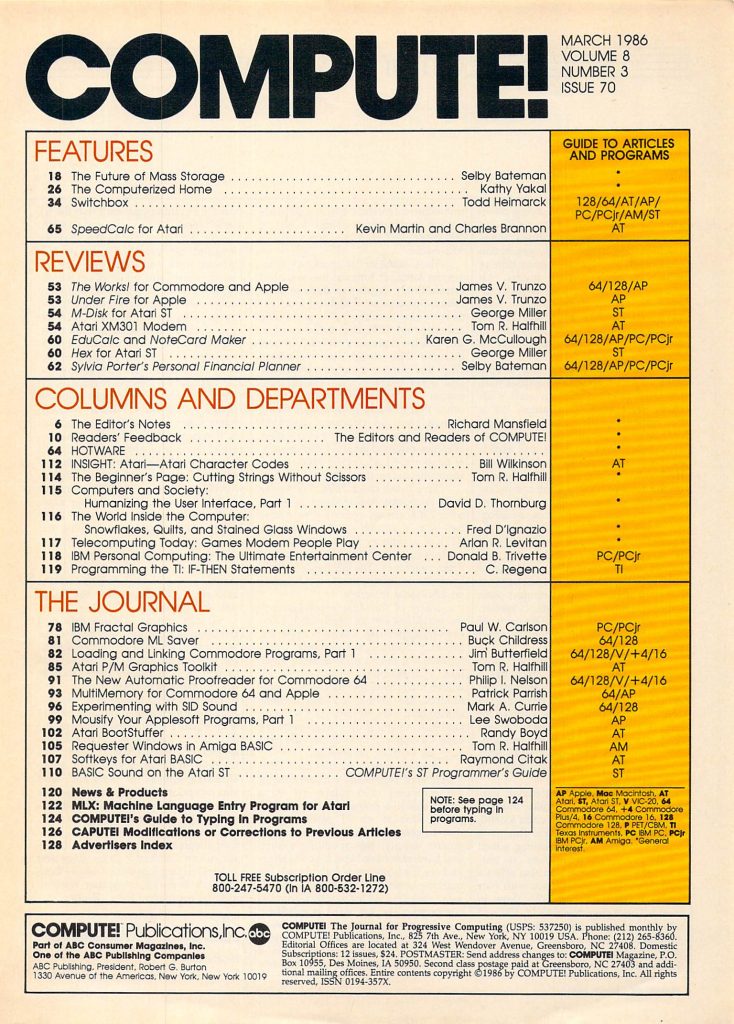
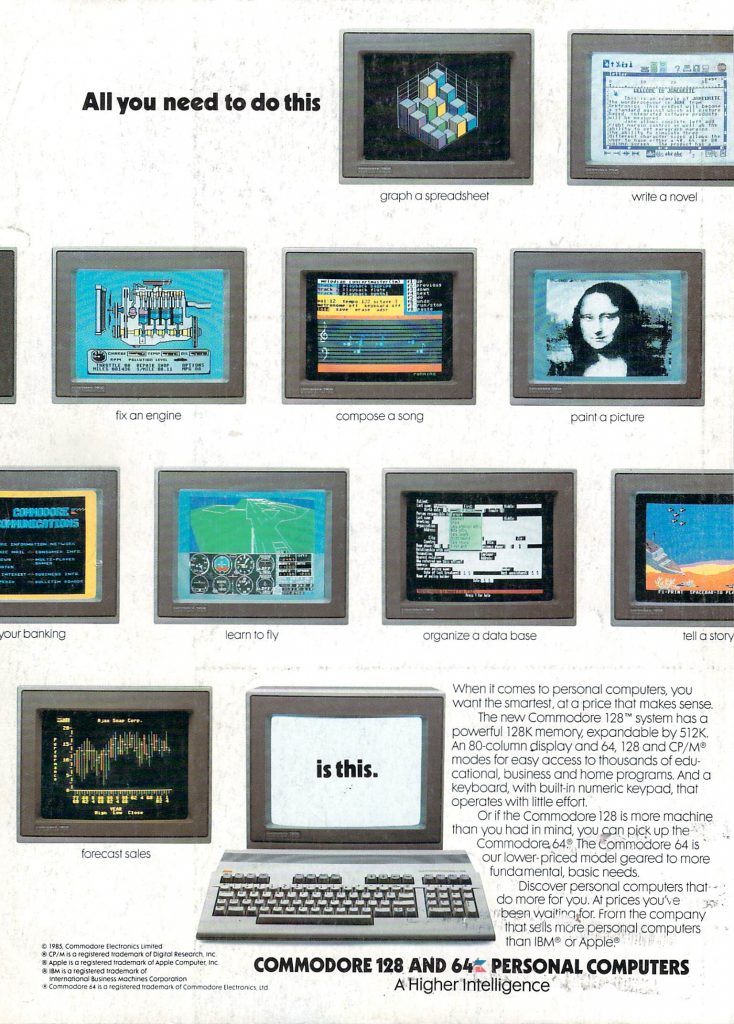
  • Compute! (March 1986)

    Source: Compute! – Issue Number 70 – March 1986

    Compute! was an excellent magazine that covered most popular computers of the time. I was partial to the spin-off Gazette because I had a Commodore 64 but this one was excellent as well. It was a little less technical that Byte but all magazines at the time were technical compared to today. The March 1986 issue includes:

    Features

    • The Future of Mass Storage – The future was bright for mass storage. 3.5″ floppies were replacing 5.25″ floppies, Hard drives were becoming affordable, and optical storage for the average user was on the horizon.
    • The Computerized Home – Computerized home automation was a thing long before Alexa. The X-10 interface was the de-facto standard and X-10 modules were available for pretty much any platform.
    • Switchbox – A type-in puzzle game with versions specifically for the Commodore 128, Commodore 64, Atari 8-bit, Atari ST, PC, and Amiga.
    • SpeedCalc for Atari – A type-in professional quality spreadsheet program for the Atari 8-bit.

    Reviews

    • The Works! – A software package for the Commodore 64 and Apple II that includes 13 programs in the categories of tools, organizers, arts, and learning.
    • Under Fire – A World War II strategy game for the Apple II.
    • M-Disk – Software for creating a RAM Disk on the Atari ST.
    • Atari XM301 Modem – A 300bps direct connect modem for Atari 8-bit computers.
    • EduCalc and NoteCard Maker – A combination of a simplified spreadsheet program and simplified database manager with versions for the Commodore 64, Apple II, and PC (Apple II version reviewed here).
    • Hex – A puzzle/strategy game for the Atari ST.
    • Sylvia Porter’s Personal Financial Planner – This software package includes six programs including Transaction Manager, Budget Manager, Asset/Liability Manager, Balance Sheet, and Financial Planner. The Commodore 64 version is reviewed here with versions also available for the PC and Apple II.

    Columns and Departments

    • The Editor’s Notes – A comparison of the new Amiga and Atari ST.
    • Readers’ Feedback – Letters from readers about code comments, computers for charity, recording music on the Amiga, and more.
    • HOTWARE – The top five selling software titles in three different categories. In the top places were F-15 Strike Eagle (Entertainment), Typing Tutor III (Education), and Print Shop (Home Management).
    • INSIGHT: Atari – A look at Atari character codes. Atari 8-bit computers used a variant of ASCII called ATASCII.
    • The Beginner’s Page: Cutting Strings Without Scissors – How to split strings in BASIC.
    • Computers and Society: Humanizing the User Interface, Part 1 – Exploring ways to make the user interface easier to use and more intuitive.
    • The World Inside the Computer: Snowflakes, Quilts, and Stained Glass Windows – Art on the Amiga.
    • Telecomputing Today Games Modern People Play – A look at online multiplayer gaming. At the time, that typically meant turn based gaming on BBS systems or services like CompuServe.
    • IBM Personal Computing: The Ultimate Entertainment Center – A guide for using your PC or PCjr with a TV.
    • Programming the TI: IF-THEN Statements – Using IF-THEN statements including examples for simulating AN/OR, doing Algebra, and more.
    • News & Products – Valhalla announced for the Commodore 64; MIDI Ensemble for the PC; AtariWriter and AtariWriter Plus word processors for the Atari ST; What’s Our Worth? home inventory package for the Commodore 64; and more.

    The Journal

    • IBM Fractal Graphics – Three type-in programs for creating fractals on the IBM PC and PCjr.
    • Commodore ML Saver – A type-in program for saving machine language programs directly from memory to disk on the Commodore 64.
    • Loading and Linking Commodore Programs, Part 1 – The first in a series of article on loading, chaining, and overlaying programs on Commodore computers.
    • Atari P/M Graphics Toolkit – Atari Player/Missile graphics is the Atari 8-bit version of sprites. This type-in toolkit makes it easier to develop and use P/M graphics on the Atari.
    • MultiMemory for Commodore 64 and Apple – Short type-in programs for the Commodore 64 and Apple II that allow you to segment memory for loading multiple BASIC programs.
    • Experimenting with SID Sound – Some examples for controlling the Commodore 64’s SID sound chip.
    • Mousify Your Applesoft Programs, Part 1 – The first of a two-part guide to using a mouse (or joystick or paddles) with your own programs.
    • Atari BootStuffer – This short type-in program for the Atari 8-bit allows you to create a menu system to load up to 8 different programs with one key press.
    • Requester Windows in Amiga BASIC – A guide to adding requester windows (dialog boxes) to Amiga BASIC programs.
    • Softkeys for Atari BASIC – This type-in program gives you automatic line numbering and various hotkeys when writing your own BASIC programs.
    • BASIC Sound on the Atari ST – A guide to getting started with creating basic sound effects on your Atari ST.

    …and more!


  • PC Magazine (May 28, 1985)

    Source: PC Magazine – May 28, 1985

    Not only were 1980s issues of PC Magazine quite large (this one is around 375 pages), for a while it was also published every other week. The May 28, 1985 issue includes:

    Cover Stories

    • Plug-ins: The Inside Story – Some of the best add-in devices including hard drives and half-height floppy drives, and backup devices such as tape drives (these weren’t officially supported by IBM until the XT and PCjr came along).
    • Installing Megabytes in Minutes – A comparison of some of the hard drives available for the PC, including the Mountain Computer XT Internal, Micro Design IS 10, Falcon Technology PC Extender, Everex Everdisk, Quadram QuadDisk (12 MB), Sigma Designs HHK-02000, Kamerman Labs Megaflight, Micro Design IS 30, and Quadram QuadDisk (72 MB).
    • Portability Meets Privacy – A comparison of available removeable-cartridge hard disk systems including the Genie XL 10P, Quadram QuadDisk, IDEAssociates IDEAdisk, and Tecmar PC-Mate. These all coast in the neighborhood of $2000 for a storage capacity of 5 to 10MB per cartridge.
    • Double Your Driving Pleasure – A comparison of half-height floppy drives for the PC including the Panasonic JU-455, Control Data 9428, TEAC FD-55B-01-U, and QUME QumeTrak 142.
    • An Up-Front Approach to Backup – A comparison of internal tape drives for the PC including the Everex EXCELL 4500, Micro Design MT 10, Mountain Computer FSI60-AT, Sigma Designs STK-45, and Tecmar QIC-60-AT.
    • New Frontiers for Add-in Technology – A look at some technologies so new that IBM does not officially support them (but that didn’t mean you couldn’t use them…if you had the money). These include quad-density floppy drives such as the Tandon TM64-4, embedded servo drives such as the TeamMate 1103, and CD-ROM technology.

    Features

    • OmniTel’s Encore Performance – A look at the Encore 1200B Hayes compatible internal modem (1200bps for only $449).
    • Get Smart with MaxThink – MaxThink is a “thought processor”, a category of software designed to sort out the pros and cons and other factors for making choices.
    • 2001: Futuristic Accounting? – 2001 from FIS is an accouting package designe for small businesses.
    • Macro Dynamos for the PC – A comparison of two pieces of software for creating macros: ProKey 3.0 and SmartKey 4.1.
    • Fine-Tuning Your Sales Technique – A review of The Sales Manager, software for tracking clients, expenses, commissions, and more.
    • Perfect Components: All in the Family – The Perfect series is an integrated software package with the advantage that you can buy only the components you need.

    Pro Columns

    • Finding Anything Anywhere – A type-in BASIC program for searching text in files on your disk.
    • Keeping the Wolves at Bay – A look at a bankruptcy-reorganization program from Arthur Anderson & Co. called The Reorganization Model.
    • Banking on Your Computer – Online banking has been around longer than you might think. In 1985, you could access your accounts via dial-up to systems such as PRONTO.
    • Restoring Matrix Commands to BASIC – The original Dartmouth BASIC including matrix functionality but this was cut when BASIC was created for PCs. Matrix 100 is a BASIC software package that adds back these BASIC matrix commands.
    • Enter at Your Own Risk – A review of The Computer-Assisted Investment Handbook which includes 50 type-in investment programs.
    • The Organized Writer – ThinkTank is software designed to help in planning the structure of writing projects.

    Departments

    • PC News – IBM enters the “phone-computer” market; IBM cuts prices and releases new XT models; AT&T’s STARLAN; Ericcsson releases 15-pound portable computer for $2995; Kodak makes offer for Verbatim; electronic mail privacy issues; Japan’s new PC JX (sort of a Japanese version of the PCjr), and much more.
    • The Mouse That Roared – Editors at PC Magazine experiment with using a mouse.
    • Letters to PC – Letters from readers about Professional BASIC, user software rights, sending files by modem vs. LAN, BBS lists, and more.
    • Complementary Comments – A look at new printers from IBM (Wheelprinter and Quietwriter Printer), the advantages of using non-IBM hard drives with the IBM AT, and a look at IBM’s new Enhanced Graphics Adapter.
    • User-To-User – Using the IBM’s low resolution graphics mode (160 x 100).
    • New On The Market – A look at new PC related items on the market including the EIT-PS Personal Scanner, Modemphone, new half-height removable cartridge drives, PcOS 100 dot matrix printer, Star Cal II (database of celestial events through 1990), and more.
    • Taming a Wild Language – A review of the book Assembly Language Safari on the IBM PC: First Explorations by John Socha.

    …and more!