• Tag Archives Byte
  • Byte (February 1988)

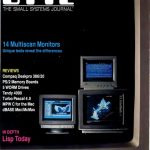
    Among the mainstream computer magazines at the time, Byte tended to be the most technical. Unlike PC specific magazines such as PC Magazine and PC World, Byte also covered non-PC systems, at least for as long as they were viable. The February 1988 issue includes:

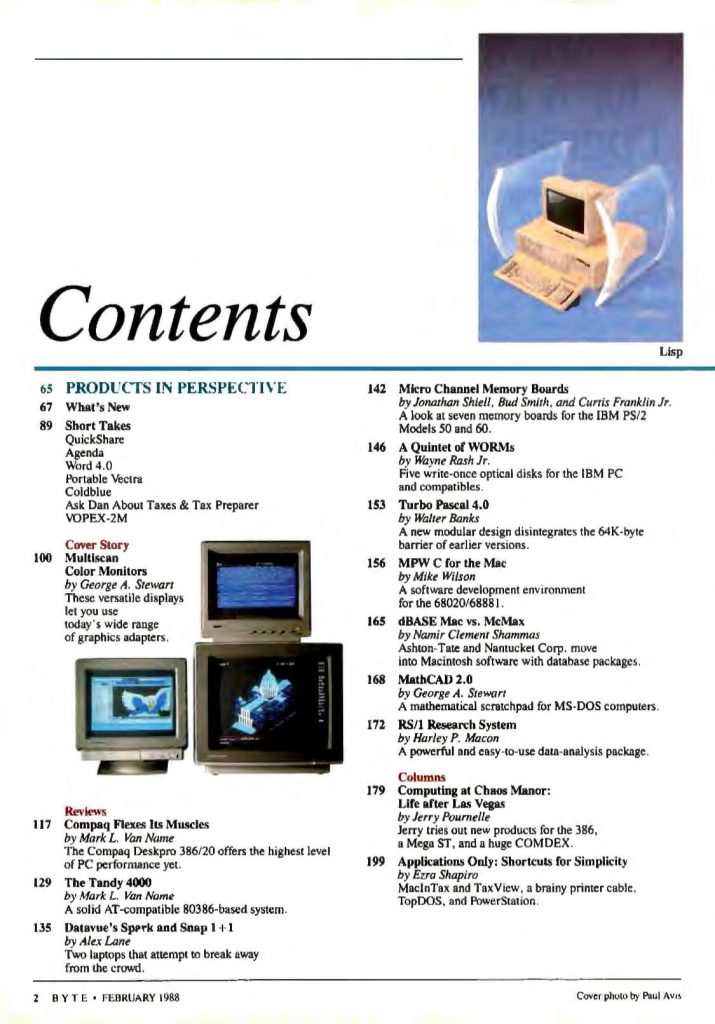
    Products in Perspective

    • What’s New – The MPP 286 line of computers, The Toshiba T3200 portable, the CompuPro Mp 200 series of parallel processing multiuser systems, 2400bps laptop modems, the CDR-3500 Hitachi CD-ROM drive, Commodious 20 MB hard drive for PS/2 Model 25, WM-S500 WORM drive (can store 2 GB on each side of a 12-inch disc), GigaStore storage device that uses VHS to store up to 2.5 GB, and lots more.
    • Short Takes – Short reviews of the QuickShare (PC card designed to share a Mac hard drive), Lotus Agenda, Word 4.0, Tax Preparer, Ask Dan About Taxes, and more.

    Cover Story

    • Multiscan Color Monitors – An overview of fourteen monitors including the Conrac 7250, Electrohome ECM 1310, 1312, and 1910, Logitech Autosync, Magnavox MultiMode, Mitsubishi Diamond Scan, Nanao Flexscan, NEC MultiSync Plus, NEC MultiSync XL, Princeton Graphic Ultrasync, Sony Multiscan, Taxan Multivision, and Thompson Ultrascan.
    Reviews

    • Compaq Flexes Its Muscles – A look at Compaq’s 386/20. It included a 20 MHz 386 CPU, 1 MB of RAM, 1.2 MB 5.25″ floppy drive, and a 60 MB hard drive (or larger). It was the fastest PC you could get at the time but expensive starting at $7499.
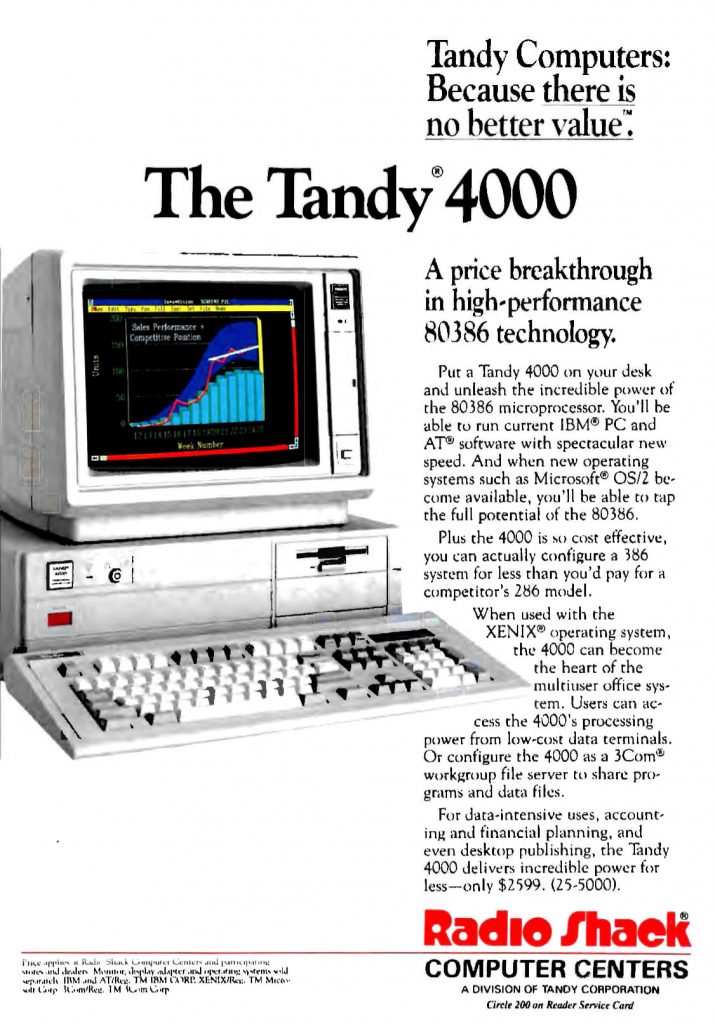
    • The Tandy 4000 – This was Tandy’s 386 based system. While not quite as advanced as Compaq’s overall, it was a solid machine for less money. It included a 3.5″ 1.44 MB disk drive and 1 MB of RAM for $2599. For $5977 you could get an EGA monitor, 40 MB hard drive and some other additions.
    • Datavue’s Spark and Snap 1 + 1 – A look at two laptops. The Snap 1 + 1 features an NEC V20 CPU, 640K RAM, and two 720K disk drives. The Spark features an NEC V20 CPU, 384K RAM, and one 720K drive. There are also various screen, hard drive, and other expansion options.
    • Micro Channel Memory Boards – A look at three memory expansion boards for the PS/2 Models 50 and 60 that add up to 8 MB of RAM. Prices range from $840 to $4170 depending on the board and RAM amount.
    • A Quintet of WORMs – A look at some early optical drives with prices ranging from $2500 to over $4000.
    • Turbo Pascal 4.0 – The latest version of Borland’s Pascal compiler.
    • MPW C for the Mac – A C compiler for The Macintosh Programmers’ Workshop.
    • dBASE Mac vs. McMax – A comparison of these two database managers for the Macintosh.
    • MathCAD 2.0 – MathCAD combines number-crunching and documentation into one tool.
    • RS/1 Research System – A statistical package with versions for the PC, XT, and AT.

    Columns

    • Computing at Chaos Manor: Life after Las Vegas – A discussion of various products including Time Bandits, Cyber Studio, Donald Duck’s Playground (I remember playing this game on the Commodore 64), Earl Weaver Baseball, HiSoft BASIC, Atari ST Mega 2 and Mega 4, Sota MotherCard 5.0, 386-to-the-Max, VM/386, Wizard’s Crown, and more.
    • Applications Only: Shortucts for Simplicity – The potential for OS/2 to fragment the PC standard, plus discussion of MacinTax, TaxView, TopDOS, PowerStation and more.
    In Depth: Lisp

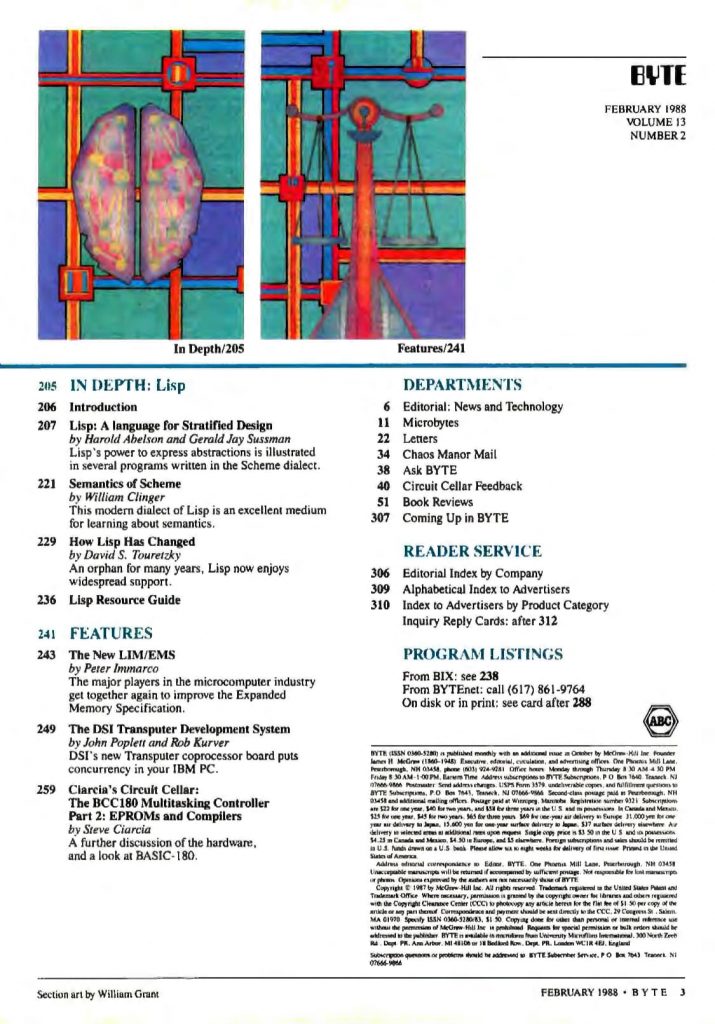
    • Lisp: A language for Stratified Design – Creating abstraction with Lisp.
    • Semantics of Scheme – Lisp was one of the first languages used for artificial intelligence. Scheme is a particular implementation of Lisp and one that I used in my very first computer science class in college.
    • How Lisp Has Changed – Lisp was already 30 years old at this point. It had been almost abandoned but was experiencing somewhat of a resurgence. This looks at how it has changed over the years.

    Features

    • LIM/EMS – The Lotus/Intel/Microsoft Expanded Memory Specification adds a variety of improvements in version 4.0.
    • The DSI Transputer Development System – A card for parallel computing on the PC.
    • Ciarcia’s Circuit Cellar: The BCC180 Multitasking Controller Part 2: EPROMs an Compilers – A project for building a single-board computer/controller with multitasking capabilities based on the Hitachi HD64180 CPU.

    Departments

    • Editorial: News and Technology – Some notes on changes to the magazine starting with this issue.
    • Microbytes – HP’s NewWave application environment, the Matrix I supercomputer based on older hardware, and lots more.
    • Letters – Letters from readers about creating CRCs, High C 386 compiler, Fibonacci numbers with APL on a 286, and more.
    • Ask BYTE – Questions answered about Turbo Pascal 3, PC security, building an analog-to-digital converter, and more.
    • Book Reviews – Reviews of A Programmer’s Guide to Common Lisp, The Scheme Programming Language, The Little Lisper, and The Third Apple: Personal Computers and the Cultural Revolution.
    …and lots more!

  • Byte (July 1984)

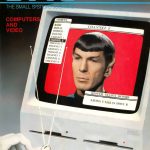
    Throughout much of the 1980s, Byte was really the magazine to have if you were into computers. It covered pretty much everything and was an excellent resource, especially before the PC dominated everything. The July 1984 issue includes:

    Features

    • Symphony: A Full-Orchestra Version of Lotus 1-2-3 – A preview of the new integrated software package from Lotus centered around the Lotus 1-2-3 spreadsheet application.
    • Ciarcia’s Circuit Cellar: A Musical Telephone Bell – A guide to customizing the ring of your telephone…it wasn’t as easy as just changing your ringtone.
    • The West Coast Faire – A report from the West Coast Computer Faire including a Modula-2 panel, Turbo Pascal, and more.
    • The Ada Language Primer, Part 2: Tool Building in Ada – The second in a two-part series on Ada. I used Ada a little in my very first job.
    • Kermit: A File Transfer Protocol for Universities, Part 2: States and Transitions, Heuristic Rules and Examples – The second part of a technical look at the Kermit protocol. I remember that this file transfer protocol was also frequently available on BBSes but XMODEM and ZMODEM were more commonly used.

    Theme: Video

    • Electronic Encyclopedias – Today when you hear “electronic encyclopedia” you probably think of Wikipedia. However, in the early 1980s, the idea was to combine computers with “interactive video” – think laserdiscs.
    • Televisions as Monitors – It was already common to use a TV as a monitor for some computers such as the Atari and Commodore 64. This article talks about current technologies as well as future technologies such as LCD.
    • Computer Control of a Video Recorder – A project for controlling VCRs with varactor tuners with a TRS-80 (or any sound-generating computer).
    • Controlling Videodiscs with Micros – A look at current videodisc formats, ways to interface with computers, and potential use cases.

    Reviews

    • The Sage II and Sage IV Computers – A series of computers that included up to 1 MB of RAM, 40 megabyte hard drive and floppy drive, based on the Motorola MC68000 chip.
    • The Compaq Plus – A follow-up to the original Compaq portable that was basically identical except for the inclusion of a 10 MB hard drive.
    • Xenix for the IBM PC XT – An add-on card for the IBM PC XT that includes an 68000 processor and an additional 256K of RAM for running Microsoft’s Xenix OS.
    • Turbo Pascal – A review of Borland’s original Pascal compiler. I used a later version in high school.
    • LISP for the IBM Personal Computer – A look at two implementations of the Lisp programming language for the PC including IQLISP and muLISP. LISP was one of the original AI languages.
    • The Smith-Corona L-1000 Printer – A 12cps daisy wheel printer for $549 (tractor feed optional).

    Kernal

    • Computing at Chaos Manor: The AT&T Computers – A discussion of various products including the AT&T 382/300 Computer, CompuPro 8/16 System, Disk Maker I, Enchanter and Sorcerer from Infocom, the Macintosh, RAM Disks for the Z400 and Z-100, the Sage II and Sage IV computers, and more.
    • BYTE West Coast Trends in Telecommunications – A look at online search software (software designed to search online databases) such as In-Search and Dialog and new, faster modems up to 9600bps such as the Gamma Technology FAXT-96 for $1995.
    • BYTE Japan Start-Up – A look at Seiko’s wrist computer, Tokyo’s Akihabara district, and more.
    • Mathematical Recreations: Invariance – Card tricks with numbers.
    • Editorial: Patronizing the Naive User – How computer companies mistrust their users.
    • Microbytes – New battery powered portable from Morrow called Pivot, new laser and color printers, new 3.5″ disk drives, new 20 megabyte hard drives and 10 megabyte half-height drives, new Apricot computers from ACT, Digital Research introduces Concurrent PC-DOS, new speech recognition hardware for the PC, and more.
    • What’s New – A brief look at new products including the NEC Advanced Personal Computer III, Omni-Reader, Otrona 200I portable computer, Gibson Light Pen, StarLink multi-user system for the IBM PC, 512K memory expansion for the PCjr, and more.
    • Ask BYTE – Questions answered about power-line pollution, bank switching, infrared links, MS-DOS vs. PC-DOS, and more.
    • Book Reviews – Reviews of Algorithms by Robert Sedgewick, Forth Fundamentals Volume I by C. Kevin McCabe, The Unix Operating System by Kaare Christian, and Artificial Intelligence Applications for Business by Walter Reitman.

    …and more!


  • Byte (April 1985)

    You really got your money’s worth when you bought an issue of Byte in the 1980s. For only $3.50 per issue (less if you were a subscriber), you got a whopping 500+ pages. And the cover story in April 1985? Artificial Intelligence. Contents of this issue includes:

    Features

    • Ciarcia’s Circuit Cellar: Build The Home Run Control System – The first part of a series on building a home control system using X-10 modules, sensors and a single board computer.
    • Coprocessing in Modula-2 – Writing concurrent programs in Modula-2.
    • A Million-Point Graphics Tablet – A guide to building a low cost graphics tablet for the Zenith Z-100.

    Themes

    • Communication With Alien Intelligence – How we might communicate with aliens from an artificial intelligence perspective.
    • The Quest to Understand Thinking – Attempting to understand how the brain works starting with the simplest steps.
    • The LISP Tutor – Developing a computer based tutor effective at teaching the LISP programming language.
    • PROUST – A knowledge based systems for automatically debugging Pascal programs.
    • Architectures for AI – Improving computational throughput for artificial intelligence.
    • The LISP Revolution – LISP was the first language primarily used for AI applications. It is still used today though Python and C++ seem to be the main players now.
    • The Challenge of Open Systems – In this context, “open systems” refer to systems of interconnected and interdependent computers.
    • Vision – Computer Vision was one of the earliest applications of artificial intelligence. This article discusses methods of making computers see.
    • Learning in Parallel Networks – Building learning systems with parallel networks.
    • Connections – Comparing parallelism in nature with artificial intelligence.
    • Reverse Engineering The Brain – Creating artificial intelligence by simulating the brain.
    • The Technology of Expert Systems – Expert Systems were another early implementation of artificial intelligence concepts.
    • Inside an Expert System – Developing an Expert System using Pascal.

    Reviews

    • The ITT XTRA – An IBM compatible computer with 256K of RAM, two double-density 5.25″ floppy drives, and monochrome display for $2395.
    • Insight – A Knowledge System – Review of this rule-based knowledge system for the IBM PC.

    Kernel

    • Computing At Chaos Manor: Over The Moat – A look at various products including CP/M Utilities, WRITE, dBASE III, Framework, S1 Operating System, Symphony, System Backup, The World Plus, and more.
    • BYTE West Coast: Lasers, Office Publishing, and More – A look at products from Canon, Imagen, Interleaf, Kurzwil, Ricoh, Sun Microsystems, Tardis Software, and Xerox.
    • BYTE U.K.: New Database Ideas – A look at Frame Theory for use in database management systems.
    • BYTE Japan: The Fifth Generation in Japan – A look at the Hitachi S-810 family of vector super computers. The S-810 was the second super computer from Japan and the first from Hitachi. The fastest of them could reach about 630 MFLOPS.
    • Editorial: Golfers and Hackers – A comparison of golfing and hacking.
    • Microbytes – An IBM PC emulator for Macintosh users; a memory upgrade for the Mac; Microsoft releases C compiler; Zenith releases new portables with backlit LCD displays; Proteon offers 80 megabits per second networking ($8000 per node); and more.
    • Letters – Readers write in about the Fujitsu Micro 16, the Apple II, Wordstar .BAK files, manual from Apple, and more.
    • What’s New – A brief look at new products including the General Electric 3-8100 thermal printer, SuperKey, GE TVs that can be used as 80-column monitors, 300bps direct acoustic modem from GE, the Kaypro 286i IBM PC AT compatible computer, the Alphacom Aero printer (Epson RX-80 compatible), 30-megabyte hard drive from Control Data Corporation, S-100 graphics cards, and more.
    • Ask BYTE – Questions answered about switching power supplies for the S-100 bus, high resolution graphics, and more.
    • Book Reviews – Reviews of Build Your Own Expert System by Chris Naylor, Artificial Intelligence In BASIC by Mike James, The Cognitive Computer: On Language Learning And Artificial Intelligence by Roger C. Schank.

    …and lots more!