• Tag Archives Byte
  • Byte (March 1987)

    Source: Byte – March 1987

    While Byte would basically become just another PC magazine towards the end of its life, in the mid to late 1980s it was still covering a variety of systems. The March 1987 issue includes:

    Features

    • Product Preview: The Commodore A2000 – A detailed preview of Commodore’s Amiga 2000. This machine offered much greater expandability over the original Amiga 1000 and also optional PC compatibility.
    • Product Preview: Turbo BASIC – A preview of this compiled version of BASIC.
    • Ciarcia’s Circuit Cellar: Build a Trainable Infrared Master Controller – Instructions for building a programmable universal remote.
    • Programming Insight: Building a Random-Number Generator – A Pascal version of a random number generator.
    • Programming Project: Installing Memory-Resident Programs with C – A tutorial for writing DOS memory resident programs in C. The example used is a calculator.

    THEME: Image Processing

    • Probing Space by Camera – A history of image processing at NASA’s Jet Propulsion Laboratory.
    • Digital Image Processing in Art Conservation – Various photographic and image processing techniques can help preserve art and even discover previous versions of paintings.
    • Introduction to Image Processing Algorithms – This image processing tutorial includes code examples.
    • Low-Cost Image Processing – Building an inexpensive image processing workstation using an Amiga.
    • PreScript – A proposed standard for capturing and digitally manipulating images.

    Review

    • A Trio of 8-MHz PC AT Compatibles – A review of three PC AT clones including the NCR PC8 (starting at $3895), The Victor V286 (starting at $2195), and the QIC AT-Plus 1800 (starting at $1295).
    • AT&T’s TrueVision Image Processing Systems – TruVision is a software package for digitizing and manipulating video images.
    • Four Laser Printers – A review of four laser printers (really five) including the Canon LBP-8 A1 and A2 ($3000 and $4300), BDS Model 630/8-E ($3495), QMS Kiss ($1995), and Quadram QuadLaser ($4495).
    • PC Scheme: A Lexical LISP – Scheme was what they used to teach my intro to Computer Science class long ago, though I’m sure it wasn’t PC Scheme version 2.0 reviewed here. It wasn’t THAT long ago.
    • Concurrent PC DOS – Version 5.0 of a multitasking DOS system that lets you run more than one DOS program at a time.
    • Wendin’s Operating System Toolbox – A variety of mostly C and some assembly source files that you can compile (and modify if you wish) to create your own operating system.
    • PFS: First Choice – An integrated software package for the PC that includes word processing, spreadsheet, and file management capabilities among others.
    • WriteNow – A word processing package for the Macintosh and Macintosh Plus.

    Kernel

    • Applications Only: Status Report – The author reviews Ragtime for the Mac (a combination of spreadsheet, word processor and page layout application), and Write Now (a word processor for DOS). He also discusses which apps he uses most.
    • BYTE U.K.: Taking Control – Devices which allow computers to be used as controllers are discussed including the Scorpion single board computer, RTX Robot Arm, and Martello which is a FORTH development system.
    • According to Webster: Amiga Developer’s Conference – A look at some of the upcoming and new released products seen at the Amiga Developers Conference including the StarBoard II (memory expansion), Marauder II (disk backup program), ProWrite (word processor), and more.

    Best of BIX

    • Amiga – Printer driver problems (and some solutions) plus slow circle/ellipse routines in Aztec C.
    • Atari ST – A discussion of the Atari ST disk format and determining the status of shift/control/alt keys.
    • IBM PC and Compatibles – Techniques to prevent accidentally formatting your hard drive and more.
    • Apple II/Macintosh – Speeding up compile times on the Mac, BLOADing a text file in DOS 3.3, accessing a clock through ProDOS on the Apple IIgs, and booting from a RAM disk on the IIgs.
    • BASIC – Windows and mouse devices in QuickBASIC 2.0 and Turbo BASIC, and more.
    • Pascal – Data file integrity and security in Turbo Pascal and more.

    Departments

    • Editorial: The Enigma of the Amiga 2000 – An intro to the Amiga 2000; the BYTE Information Exchange exceeds 12,000 users prompting an upgrade to the existing 1986 era Arete supermicrocomputer that runs it; and more.
    • Microbytes – University of California uses Ped-Pak genetic management software to help endangered animals; Synaptics Inc. plans neural net chips; Atari plans 32-bit Atari ST workstations; Common LISP evolving to support object-oriented features; and much more.
    • Letters – Letters from readers about text editing standards, CRT safety, type of sorts, text compression, ZBasic, and more.
    • What’s New – Adobe Illustrator, the Atari PC, Metro memory resident tools, 80386 CPUs, HP symbolic math calculator, WordStar 4.0, Jet 386 upgrade for 286 machines, TecTran’s 98064 RS232 interface for the Commodore 64, and much more.
    • Ask BYTE – Questions answered about defining screens of 132 columns in Turbo Pascal, using the Amiga for bio feedback, using multiple hard drives on the IBM PC AT, SB180 user groups, CP/M on the Commodore 128, and more.

    …and more!


  • Byte (October 1982)

    Source: Byte – October 1982

    Byte covered a wide variety of systems over the course of its live form the 1970s until the 1990s. In 1982, the IBM PC was still new and it wasn’t yet clear that IBM PC compatibility would come to dominate both home and business. Issues were generally pretty massive at this time with the October 1982 issue containing well over 500 pages. It includes:

    Features

    • Beyond the Peaks of Visicalc – A look at more complex financial planning applications than a spreadsheet (of which Visicalc was the main representative at this point). Packages looked at here include Desktop Plan II, Microfinesse, and Plan80.
    • Build the Microvox Text-to-Speech Synthesizer, Part 2: Software – The second in a series on building your own speech synthesizer. This part concentrates on creating the software to make it work.
    • What Makes Business Programming Hard? – A case study in writing software for a bank.
    • Adapting Microcomputers to Wall Street – Microcomputers as a tool for financial investors. At this point, it’s hard to imagine NOT having computers as tools.
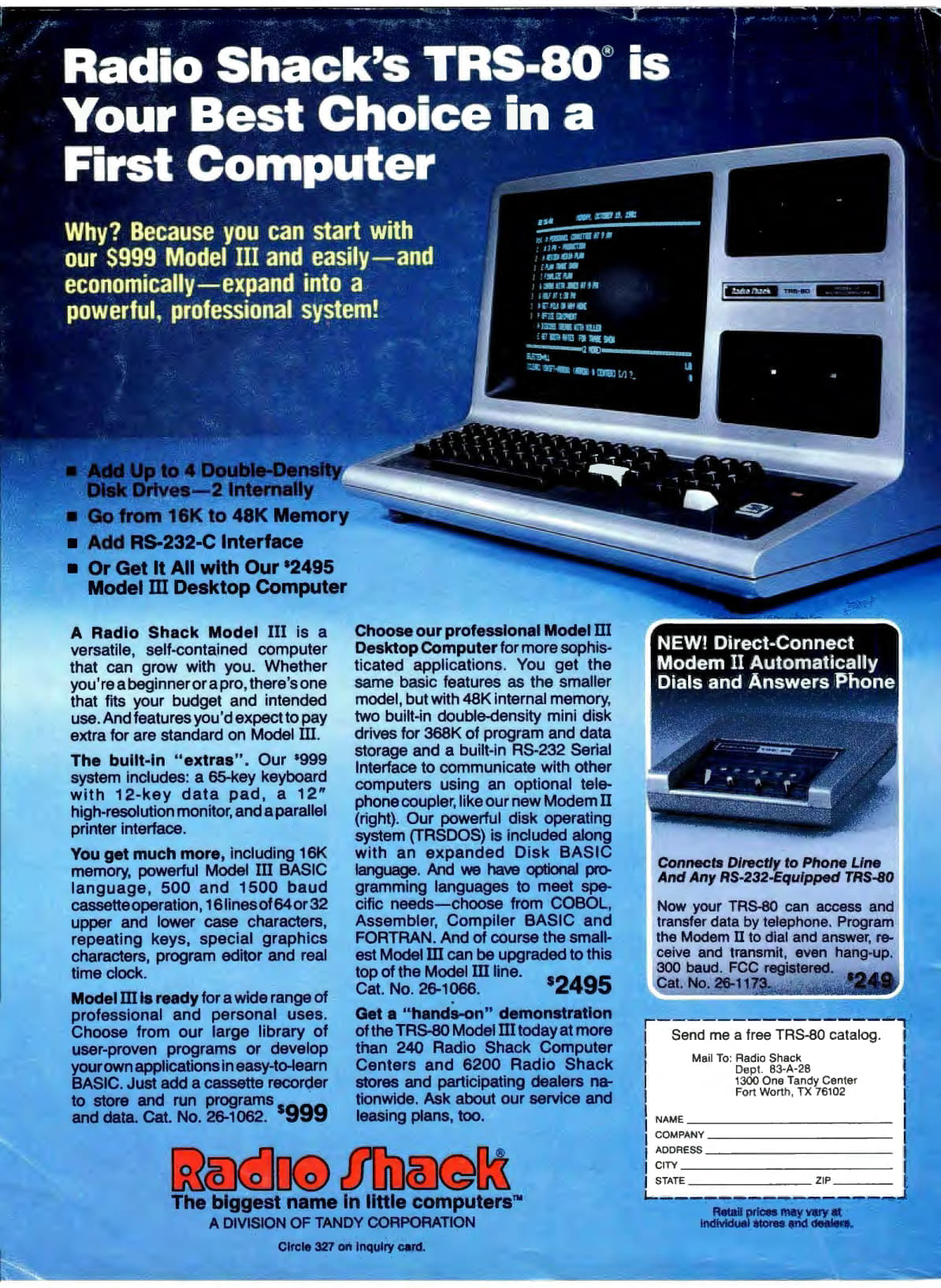
    • Putting Real-World Interfaces to Work, Part 1 – Part one of a two-part series on monitoring the physical environment (things like temperature, water level, light level, pressure, etc.) with a TRS-80 Model I, TRS-80 Model III, and TRS-80 Color Computer.
    • The State of Industrial Robotics – A look at how robots were currently being used in industry, still a relatively new thing at this time.
    • Marketplace – A type-in BASIC telecomputing game for two TRS-80 Model IIIs in which you compete in marketing a product with another person.
    • Ringquest – A type-in adventure game for the Apple II that originated on the Commodore PET.
    • The Case of the Purloined Object Code, Part 2 – The second in a two part series on software protection from both a technical and legal standpoint.
    • User’s Column – A comparison of BASIC and Pascal speed, the best language for different purposes, and more.
    • An Introduction to the Human Applications Standard Computer Interface, Part 1 – A standard for personal computer interfaces.
    • The Personal Computer as an Interface to a Corporate Management Information System – Building an intelligent terminal interface for the Apple II in Pascal specifically designed to work with GEISCO Mark III time sharing service.
    • Software Arts’ TK Solver – A look at a new toolkit based equation solver from Software Arts called TK Solver. Essentially, it is like an electronic calculator for solving algebraic equations.
    • Naming Your Software – Considering trademarks when naming your software.
    • Program Your Own Text Editor, Part 2 – Part two of a series on creating a text editor. Source code in assembly for the Z80/8080 is provided.

    Reviews

    • Radio Shack Compiler BASIC – A BASIC compiler for the TRS-80 Model I and Model III.
    • Wyse Technology’s WY-100 Terminal – At the time, standalone terminals were still a thing but they would soon be replaced by IBM PCs and other personal/small business computers with terminal emulation software.
    • EduWare’s Statistics 3.0 – The latest update to a statistical package for the Apple II.
    • Systems Plus: FMS-80 – While referred to as a file management system by the maker, FMS-80 is really a type of DBMS. It runs on systems with an 8080 or Z80 processor running CP/M.

    Nucleus

    • Editorial – Answers to frequently asked questions such as what’s the best computer to buy, buy now or wait, which OS will be the standard, which processor will be the leader in five years, etc.
    • Letters – Letters from readers about a standard BASIC, RSCOBOL, IBM, alternate repair services, double density disks on the Osborne 1, and more.
    • Programming Quickies – A BASIC program for generating Mohr’s Circle (a way to find the principal stresses due to combined loads).
    • Book Reviews – A of VisiCalc: Home and Office Companion by David M. Castiewitz, Lawrence J. Chisausky, Patricia Kronberg, and L. D. Chukman.
    • Ask BYTE – Questions answered about letter quality printers for the Apple II Plus, addressing more that 64KB with a 6502, 8-inch disk drives vs. 5.25-inch disk drives, cassette recorders for the VIC-20, music on the ZX-81, and more.
    • BYTELINES – Rumors of Osbourne working on an 80-column display for its portable computer; Morrow Designs to introduce CP/M-based system for $1195; DEC to introduce PDP-11/23 with 256K RAM and 10.8 MB hard drive with support for up to 8 users for $9200; AT&T to enter computer business; IBM to provide improved version of EasyWriter; Apple to drop price of Apple II from $2604 to under $2000; Radio Shack drops price of TRS-80 Model III with 1 floppy drive from $1995 to $1849 and with 2 floppy drives from $2495 to $2295; S-100 bus to be an official standard by the following year (near the end of its life); Grid Compass shows machines with flat panels; techniques being researched for erasable optical disks; and much more.
    • What’s New? – Atari markets Telelink II communications kit; new Multifunction Utility Board for the Heath H-89; Mean Green 12-inch green monitor; Hayes Smartmodem 1200 ($699); Pi-3 amber monitor from USI International; 3-inch disk driver from Amdek; portable HP-75C computer from Hewlett-Packard; Zenith Data Systems Z100 series S-100 based computers; DEC introduces the Professional 350 and 325, DECmate II and Rainbow 100; new database for the PET and VIC-20; The Big Four accounting package for the Olivetti M-20; Deadline from Infocom; and lots more.

    …and more!


  • Byte (July 1982)

    Source: Byte – July 1982

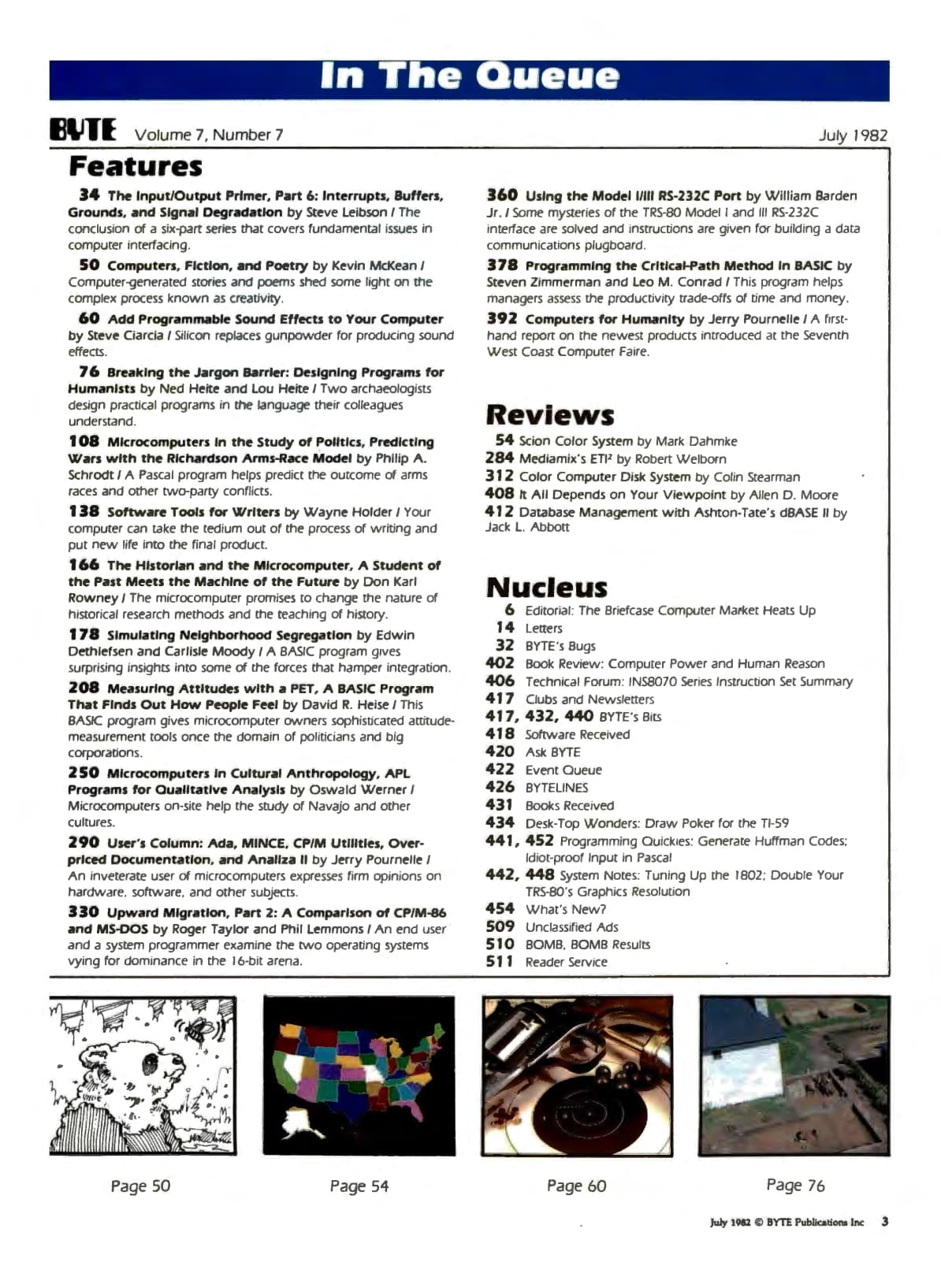
    Byte covered a wide variety of systems over the course of its live form the 1970s until the 1990s. In 1982, the IBM PC was still new and it wasn’t yet clear that IBM PC compatibility would come to dominate both home and business. The July 1982 issue of Byte is an impressive 500 pages plus and includes:

    Features

    • The Input/Output Primer, Part 6: Interrupts, Buffers, Grounds, and Signal Degradation – The concluding part of a series on computer interfacing with an emphasis on building your own.
    • Computer, Fiction, and Poetry – An article on “computer assisted literature”. This concept has come a long way in the days of AI.
    • Add Programmable Sound Effects to Your Computer – Building a device to create sound effects with your computer. In this project, the SN76489A sound-generator circuit from Texas Instruments is used as the primary component.
    • Breaking the Jargon Barrier: Designing Programs for Humanists – Computer jargon is blamed for the lack of computers in the field of archaeology.
    • Microcomputers in the Study of Politics, Predicting Wars with the Richardson Arms-Race Model – How political scientists are using computer. Here, a Pascal program provides insight into two-party conflicts including arms races.
    • Software Tools for Writers – Software tools for improving you writing. One advantage using a word processor adds is the ability to easily experiment.
    • The Historian and the Microcomputer, A Student of the Past Meets the Machine of the Future – How computers have changed historical research methods.
    • Simulating Neighborhood Segregation – Using computers in social sciences by creating models.
    • Measuring Attitudes with a PET – A BASIC program for the Commodore PET that measures attitude by giving instructions, asking questions, and measuring your responses.
    • Microcomputers in Cultural Anthropology – Using APL to manage data related to the study of Navajo and other cultures.
    • User’s Column – Commentary on the M-Drive (basically a RAM disk), dBASE II version 2.3, a recommendation to learn ADA for high paying DoD jobs, and more.
    • Upward Migration, Part 2: A Comparison of CP/M-86 and MS-DOS – A detailed comparison of CP/M-86 (basically, CP/M for the IBM PC) and MS-DOS.
    • Using the Model I/III RS-232C Port – Detailed instructions for building a data communications interface for the RS-232C port of the TRS-80 Model I and III.
    • Programming the Critical-Path Method in BASIC – Determining the optimal trad-off of project cost and time to completion.
    • Computers for Humanity – A look at the West Coast Computer Faire. This year there were lots of games for Atari 8-bit computers, TRS-80s, and Apple IIs. Also, new workstations featuring the Motorola 68000 CPU, specifically the Sage II. S-100 and CP/M based systems were also still plentiful.

    Reviews

    • Scion Color System – A graphics system for the S-100 bus that uses multiple boards to achieve color. I guess in a way this could be though of as a very early version of SLI.
    • Mediamix’s ETI^2 – Review of a device that allows you to use an IBM Electronic Typewriter as a printer. The cost is $495 for a parallel version and $595 for a serial version.
    • Color Computer Disk System – A 5.25″ disk drive system for the TRS-80 Color Computer. It cost $599 for the first drive and $399 for each additional drive for up to four total drives.
    • It All Depends on Your Viewpoint – A review of a $650 video terminal from ADDS (Applied Digital Data Systems).
    • Database Management with Ashton-Tate’s dBASE II – A review of dBASE II Version 2.02A. dBASE II was one of the most popular and influential database management systems around.

    Nucleus

    • Editorial: The Briefcase Computer Market Heats Up – Not yet small enough to really be called “laptops” or “notebooks”, here we have a look at new “briefcase” computers. Some recent models include the Epson HX-20, Toshiba T100, Panasonic Link, the Grid Compass, and there are lots more.
    • Letters – Letters from readers about a new file structure (‘skip sequential’), the Base 2 Printer, computer documentation, VEDIT, the Epson MX-70 printer, RSCOBOL (COBOL for the TRS-80 Model III), and more.
    • Book Review: Computer Power and Human Reason – A book that looks at the impact of computers on society.
    • Technical Forum: INS8070 Series Instruction Set Summary – A table featuring the instruction set of National Semiconductor’s SC/MP processor.
    • Ask Byte – Questions answered about computer controlled irrigation, using the ZX81 for home control, an overheating TRS-80 Color Computer, redefining characters on the Atari 800, and more.
    • BYTELINES – Recent computer related news: IBM expected to be shipping 1000 personal computers per day by the third quarter of 1982, TRS-80 Model 16 hits the streets, Apple donates computers to schools, Concurrent CP/M-86 released, Smalltalk for more computers coming soon, TI cuts prices, and more.
    • Desk-Top Wonders: Draw Poker for the TI-59 – A type in program that implements poker on the TI-59 programmable calculator.
    • Programming Quickies – A BASIC program to generate Huffman Codes for a set of characters and phrases and a technique for idiot proof input in Pascal.
    • System Notes – A music program that will let you hear a tone and simultaneously displaying it on a musical staff. Written for the RCA VIP. Plus, a hardware modification to allow you to double the vertical resolution on the TRS-80.
    • What’s New – The Kaycomp II CP/M portable computer, MC-1000 series 6502 based single board computers featuring 64KB RAM, new 68000 based computers, Xenix compatible single board computer, version 2 of the JRT System Pascal Compiler for CP/M, and lots more.

    …and more!