• Tag Archives Byte
  • Byte (January 1979)

    Source: Byte – January 1979

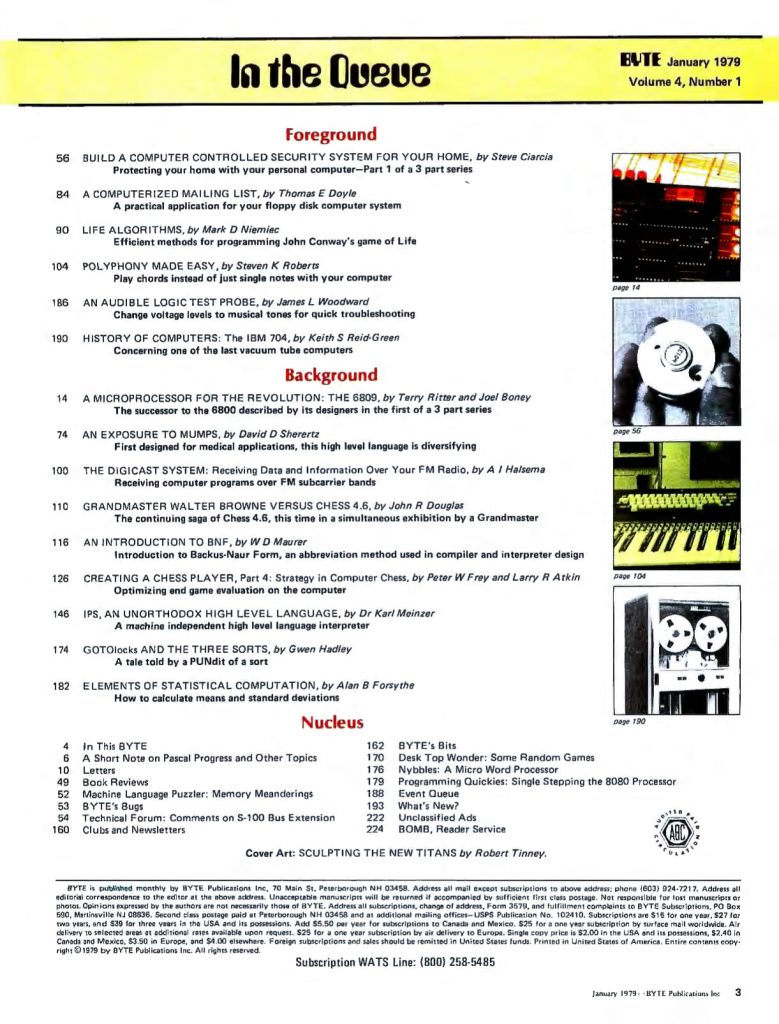
    In 1979, you had to be into computers in a serious way to own one for your home. They were expensive, laughably underpowered by today’s standards, and in most cases you had to build them yourself, including soldering the chips on the motherboard. Some businesses had computers but even that was relatively rare. The evolving standard at the time was 8080 or Z80 CPU based machine with an S100 bus for expansion and 64K of RAM or less running the CP/M operating system. There was still a lot of variety outside of that though. The January 1979 issue of Byte includes:

    Foreground

    • Build a Computer Controlled Security System For Your Home – Part one of a series on building a home security system based around the Intel SDK-85 single board computer.
    • A computerized Mailing List – A series of type-in BASIC programs for managing a mailing list.
    • Life Algorithms – Some algorithms are provided here in a pseudo-language resembling ALGOL based on Conway’s game of Life.
    • Polyphony Made Easy – A guide for interfacing a (music) keyboard to a computer that allows multiple notes to be played at once.
    • An Audible Logic Test Probe – A guide to building a logic probe that outputs one tone for a high logic level and another for a low logic level and also includes two LEDs for monitoring single pulses and pulse trains.
    • History of Computers: The IBM 704 – A detailed look at the IBM 704. This “data processing system” was announced in 1956 and was one of the last vacuum tube computers.
    Background

    • A Microprocessor for the Revolution: The 6809 – Part one of a series on the Motorola 6809 microprocessor. This part covers the design philosophy. The 6809 was one of the most advanced 8-bit processors but also one oft he most expensive. It found its way into some home computers like the TRS-80 Color Computer and arcade games like Star Wars, Defender, Joust and Robotron. However, its high expense led to the design of the inexpensive 6502.
    • An Exposure to MUMPS – A detailed look at the Massachusetts General Hospital Utility MultiProgramming System.
    • The Digicast System: Receiving Data and Information Over Your FM Radio – A proposed way that computer data could be sent via FM radio. As far as I know, this was never implemented.
    • Grandmaster Walter Browne Versus Chess 4.6 – An early human vs. computer chess match.
    • An Introduction to BNF – BNF is a standardized way to abbreviate computer language statements that would be used, for example, in manuals.
    • Creating a Chess Player, Part 4: Strategy – The fourth part in a series on creating a computerized chess game. This part focuses on how the computer can form strategies by giving it knowledge of certain patterns.
    • IPS, An Unorthodox High Level Language – A detailed look at this high level language designed for amateur radio satellites and associated ground control stations.
    • Elements of Statistical Computation – Methods for calculating the mean of a set of data.

    Nucleus

    • A Short Note on Pascal Progress and Other Topics – A plan for making Pascal available on the Apple II.
    • Letters – Letters from readers about computer insurance, Tokyo computer shows, using a DECWriter with an H8 system, and much more.
    • Book Reviews – A reviews of Financial Analysis and Business Decisions on the Pocket Calculator by Jon M Smith.
    • Machine Language Puzzler: Memory Meanderings – A puzzle in which the reader must figure out the operation of a given 8080 machine language program.
    • Technical Forum: Comments on S-100 Bus Extension – A proposed 16-bit extension to the S-100 bus.
    • BYTE’s Bits – Tips for TRS-80 owners who are upgrading memory, info on the Personal Computing Festival of the 1979 National Computer Conference, solving the eight queens problem, and more.
    • Desk Top Wonder: Some Random Games – A couple of type-in games for the Texas Instruments model 58 and 59 programmable calculators.
    • Nybbles: A Micro Word Processor – A type-in machine language word processor for the Z80/8080 CPU.
    • Programming Quickies: Single Stepping the 8080 Processor – A type-in machine language program that will allow you to single step your way through a program. Useful for debugging.
    • What’s New? – SAM76 high level language, clock board from Mountain Hardware Inc., MSBC family of video interface boards designed to work with the Intel single board computer bus, the Micro Bee 2 8085A processor controlled buffered video display terminal, 88-SAI synchronous interface board for the S-100 bus, 16-port serial board from Ohio Scientific, and much more.
    …and more!


  • Byte (December 1983)

    Source: Byte – December 1983

    I used to think that no magazine, certainly no computer magazine, could compare to the size that Computer Shopper reached. However, there are some early magazines that give it a run for its money. For instance, the December 1983 issue of Byte comes in somewhere around a mind boggling 660 pages. Most novels aren’t nearly that large. While there were of course a lot of ads, there was also a lot of contents, some of which includes:

    Columns

    • Keep Power-Line Pollution Out of Your Computer – A guide to building a powerline transient and noise suppressor.
    • BYTE West Coast: Microsoft Windows – While Windows didn’t really take off until version 3.0, the earliest versions still offered among the cheapest ways to use a GUI and mouse. Originally, Windows only required two 320K floppy disk drives and 192KB of RAM on an IBM PC.

    Themes

    • An Introduction to Integrated Software – The concept of integrated software existed long before the modern office suite. This article discusses three levels of integration: concurrency, shared technology and functional integration.
    • Presentation and Form in User-Interface Architecture – The dichotomy of needing simpler user interfaces even as software gets more complex.
    • Why is Software So Hard to Use? – In summary, creating easy to use software requires significant extra effort.
    • Walt Disney and User-Oriented Software – How effective communication is the key to making great software.
    • Making Life Easier for Professional and Novice Programmers – The evolution of programming tools and how visual tools will make programming easier.
    • Simplify, Simplify, Simplify – How software design should emphasize logical design over technology.
    • Integrating Voice in the Office World – How voice recognition and “voice as data” was expected to simplify the user interface in the business world.
    • The Starburst User Interface – A look at Micropro’s Starburst, a software package for implementing efficient menu designs.
    • The Complete Information-Management System – A look at the history of software integration and the ultimate goal.
    • The Allegory of Software – Various software metaphors are discussed though the “desktop” is the only one that seemed to have ever really mattered.
    • The New Interface Technology – How new hardware and software are combining to make interfaces that are more efficient. Primarily, this refers to GUIs like Microsoft Windows and the Apple Lisa OS though it also includes things like touchscreens.
    • Trackball Interfacing Techniques for Microprocessors – Trackballs were finally reaching the point of affordability. This article discusses a way to build an inexpensive interface for one.
    • The User Interface: Two Approaches – Two user interface philosophies are discusses.
    • The Future of Metaphor in Man-Computer Systems – Looking at the future of user interfaces by considering what makes a watch a watch (i.e. how digital and analog watches are both immediately recognizable as watches while operating in completely different ways).

    Review

    • The Texas Instruments Professional Computer – While sharing similar hardware to an IBM PC, the TI Professional Computer was not compatible. A strategy described as “brave” here but not one that would ultimately lead to success.
    • The ATR8000 – The ATR8000 was a peripheral for Atari 8-bit computers that could add CP/M and DOS compatibility.
    • The Hercules Graphics Card – A graphics card for the IBM PC that added monochrome graphical capabilities. This would become a standard.
    • The Wang Professional Computer – Another computer that was PC like and ran MS-DOS 2.0 but was not PC compatible. It came with word processing software which was something Wang was known for.
    • In Search of the Most Amazing Thing – Review of this adventure game that was available for the IBM PC, Apple, Atari, and Commodore 64.

    Features

    • Color Graphics from Any Computer – An article about recording color computer images on film including code examples.
    • Mainframe to Micro: Adapting a Financial-Modeling Language – While the emphasis is on a financial modeling language, this article covers various issues with moving from mainframes to micro-computers.
    • POKEing Around in the IBM PC, Part 2: Subroutines for the BIOS Interface and Screen-Display Disk Storage – The second of a two-part series on accessing IBM PC BIOS routines from BASIC programs.
    • The CMOS 6502 – A new version of the 6502 processor that is more power efficient and includes new instructions.
    • A Tiger Meets a Dragon – A look at the mathematical properties of Dragon Curves and a program to print them from a TRS-80 Model I to a IDS Paper Tiger printer.
    • A Computer-Algebra-Based Calculating System – A calculator that includes automatic unit conversion.
    • The User Looks at Books – Reviews of several books on CP/M, Pascal, C, and Ada.

    Nucleus

    • Editorial: Christmas in Chapter XI – It was a volatile time in the computer industry and this editorial points out that one of the things you should consider when buying computer hardware is whether or not the company you were buying from would likely still be in business in a year.
    • MICROBYTES – IBM announces two versions of PCjr to be delivered in 1984; IBM announces color printer; National Semiconductor ships samples of new 32032 microprocessor; Wester Design Center begins test production of 65816 CPU; Wang introduces digitizing image scanner; Shugart introduce $6000 optical drive with 1 gigabyte of storage (non-erasable)…disks cost $150 each; and more.
    • Letters – Letters from readers about the HP-75 portable computer, the Epson HX-20 (an early laptop), Unix, the TRS-80 Model 12 and Model 16, and more.
    • BYTE’s Bits – IBM PC announces the PCjr, what would ultimately be a failed attempt at creating a low cost “home computer”, plus the new IBM XT/370 and IBM 3270.
    • User to User – Converting Pascal programs to Modula-2, the Sage and Modula-2, Vector Graphics equipment and software, the Ex-Mon monitor adapter for the Osborne 1, the TI-99/4A, S-100 bus replacement, CP/M vs. TRSDOS, and more.
    • Ask BYTE – Building an interface between the Apple II Plus and Teletype Model 33ASR terminal, the 6301 microprocessor, IMSAI manuals, setting for the ECM-103 modem, and more.

    …and much more!


  • Byte (March 1977)

    Source: Byte – March 1977

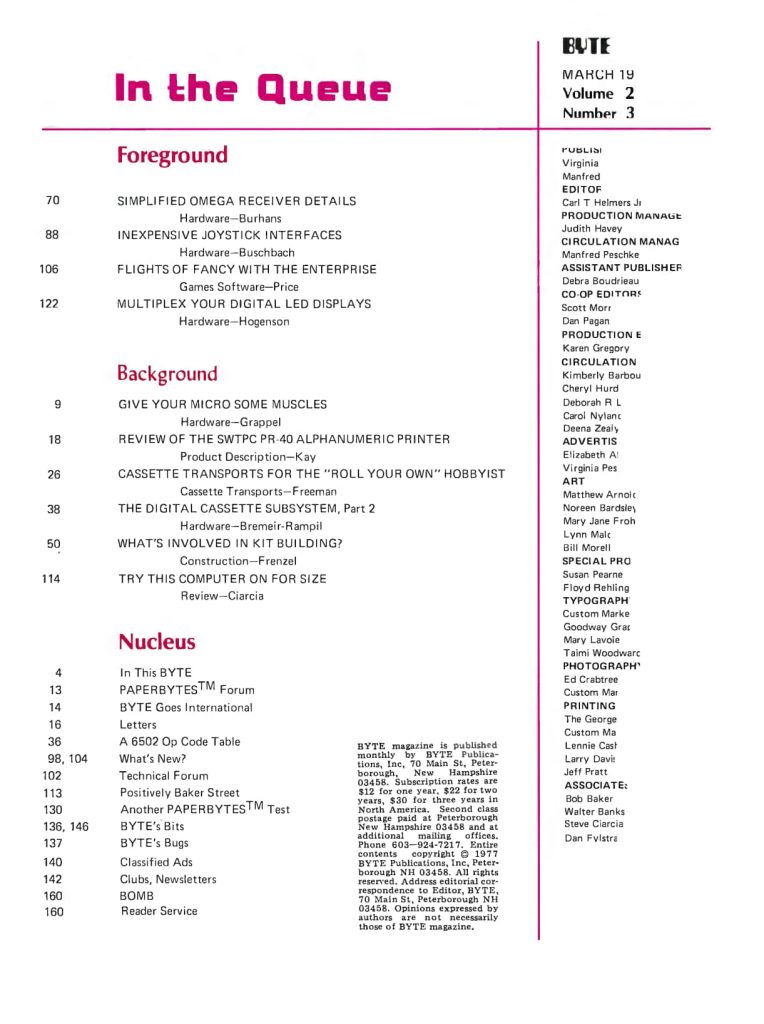
    Byte magazine (subtitled The Small Systems Journal) was a VERY early computer magazine with publication starting in 1975. This issue is from 1977. This is well before the IBM PC was introduced and there wasn’t much in the way of what would come to be known as home or personal computers around. However, the Commodore PET, TRS-80 (Model I), and Apple II were all released year igniting what might be considered the first home computer war. Most other machines were either kit based (you build it yourself, often including soldering) or more business oriented (CP/M based machines). The main CPUs in use were the Intel 8080, Zilog Z80, and MOS 6502. This would remain true for several more years. The March 1977 issue of Byte includes:

    Foreground

    • Simplified Omega Receiver Details – Byte tended to be pretty technical. The earlier the issue, the more technical it tended to be. This article just goes into building something called an Omega receiver. I guess if you didn’t know what that was, you didn’t need to build one. According to Wikipedia, “An Omega receiver is a device that picks up very low frequency radio signals transmitted by Omega stations to determine a position. It was used in conjunction with the Omega navigation system, which was operational from around 1971 until it was shut down in 1997. Omega receivers helped ships and aircraft establish their locations by receiving signals in the 10 to 14 kHz range from a network of eight fixed terrestrial radio beacons.” Sort of an early GPS system…
    • Inexpensive Joystick Interfaces – Earlier computers wouldn’t have joystick interfaces and there wasn’t really a standard interface. Here’s a guide for building your own.
    • Flights of Fancy with The Enterprise – A type-in BASIC action game based on Star Trek in which you must hunt down and destroy the Klingon battle cruisers. It requires approximately 22K of RAM which was a pretty hefty chunk in those days.
    • Multiplex Your Digital LED Displays – By this time, Digital LED displays had gone from an expensive luxury to something the hobbyist could perhaps afford. This guide to multiplexing them is useful, for example, for those wishing to replace the binary lights on some computer control panels or as another form of output.

    Background

    • Give Your Micro Some Muscles – Using a computer to control external devices.
    • Review of the SWTPC PR-40 Alphanumeric Printer – An early dot matrix printer that looks more like a telegraph machine. It is a 5 by 7 dot matrix printer capable of printing the 64 upper case ASCII character set with 40 characters per line at a speed of 75 lines per minute. It comes in kit form, meaning you have to assemble it yourself, for $250.
    • Cassette Transports for the “Roll Your Own” Hobbyist – At this time, data storage for computer hobbyists was almost entirely done via cassette. Basically using the same cassettes and tape recorder devices you would use for audio. This article describes building your own cassette device starting with choosing a better transport mechanism than what you would typically find in cheap consumer devices.
    • The Digital Cassette Subsystem, Part 2 – The second part in a series on the technical details of using cassettes for computer storage.
    • What’s Involved in Kit Building? – What it takes to build your own computer from a kit. It was a little more difficult that bulding (really putting together) a computer today. You may have to do your own soldering, wire wrapping, etc.
    • Try This Computer On For Size – A review of the Digital Group 8080A microcomputer. This is a computer that came in kit form that required extensive soldering and assembly including even CRT assembly.

    Nucleus

    • PAPERBYTES Forum – Excerpts of various letters discussing machine readable printed software. Conceptually, this idea is similar to reading a barcode which was starting to become commonplace, for example, in supermarkets at this time. However, the idea here was to input entire programs via some kind of printed code.
    • BYTE Goes International – Byte announces new Australian edition of the magazine.
    • Letters – Letters from readers regarding arithmetic on the 8080, the ELIZA program, word processing on the Altair, cooling the CPU in an Altair 8800, bank switching with the RCA COSMAC 1802, and more.
    • A 6502 Op Code Table – A reference chart that includes all the op codes for the MOS 6502 CPU. Useful for debugging hex dumps.
    • What’s New? – Phi Deck Tape Mass Storage for the Altair Bus (a tape drive for the Altair with up to 1 MB of storage), Computer Power & Light offers 8080A based computer system for $1863 completely assembled, new version of SC/MP processor from National Semiconductor, and more.
    • Techincal Forum – Comments on a proposed Universal Bus that was described in a previous issue of Byte.
    • Another PAPERBYTES Test – A contest in which you must scan the given page (similar to a really long barcode) and interpret the data which is a series of words. Decode the data and describe how you did it to win.
    • BYTE’s Bits – Steven Jobs reports what he claims is the first shipment of a personal computer system using new 16 K dynamic memory chips. The first systems (the Apple I) was delivered to retailers (in kit form) starting on December 17th, 1976.

    …and more!