• Tag Archives atari
  • Compute! (August 1987)

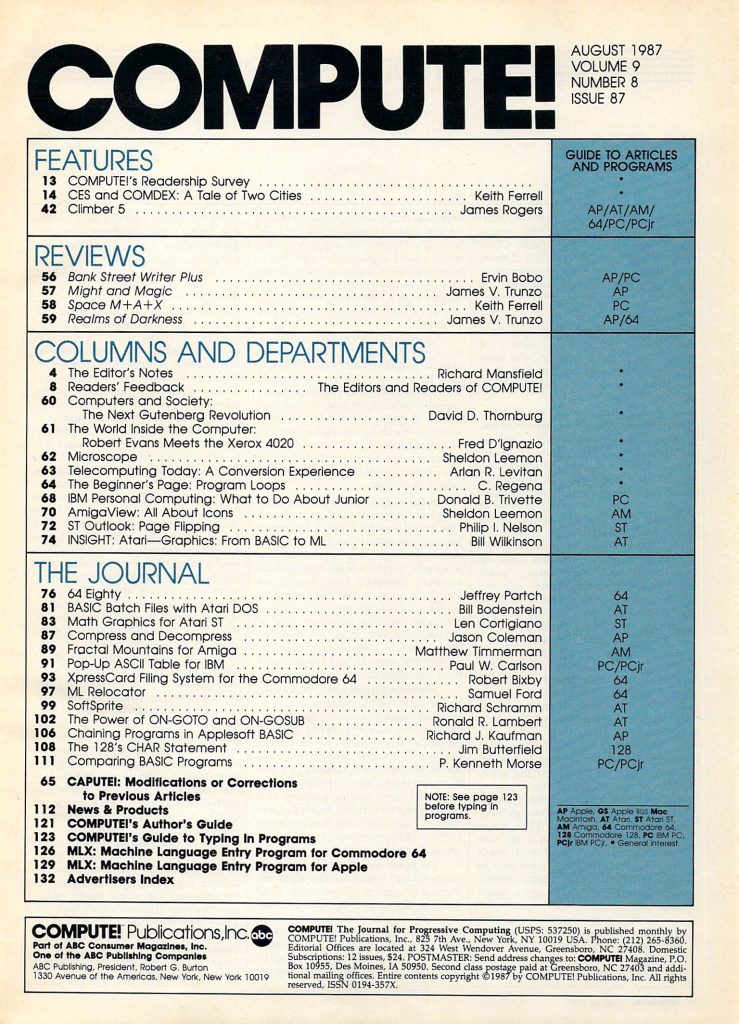
    Compute! was a multiformat magazine that covered a variety of popular machines. It was one of the better magazines in this category, especially if you wanted something more home computer oriented and a little less technical than Byte. The August 1987 issue includes:

    Features

    • Compute!’s Readership Survey – A survey for readers that asks questions like what kind of computer you use, what kind of applications, etc. This was used in part to determine coverage in future issues.
    • CES and COMDEX: A Tale of Two Cities – Comparing the Consumer Electronics Show in Chicago with COMDEX in Atlanta. Both were big shows for electronics and computer software and hardware.
    • >Climber 5 – A type in game for the Commodore 64, Atari, Amiga, Apple II, and PC in which you must climb to the top of a building to retrieve a baseball while avoiding various obstacles.

    Reviews

    • Bank Street Writer Plus – A word processor for the Apple II line and the IBM PC.
    • Might and Magic – The classic fantasy RPG reviewed here for the Apple II.
    • Space M+A+X – A simulation in which you must make money operating a space station for the IBM PC.
    • Realms of Darkness – Another role-playing game, this one from Strategic Simulations (SSI) for the Apple II and Commodore 64.
    Columns and Departments

    • The Editor’s Note – Recent advancements in superconductivity and its implications for computing.
    • Readers’ Feedback – Readers write in about the future of 5.25″ disks, checking the CAPS key on the Atari 130XE, the importance of saving a typed-in program before running it, upgrading an Amiga CPU, and more.
    • Computers and Society: The Next Gutenberg Revolution – Desktop publishing becomes more affordable with the introduction of Atari’s laser printer for the ST.
    • The World Inside the Computer: Robert Evans Meets the Xerox 4020 – A look at a new printer from Xerox featuring ink jet technology.
    • Microscope – A look at IBM’s new PS/2 line (an their marketing), and some comparisons with the Atari ST and Amiga.
    • Telecomputing Today: A Conversion Experience – Issues converting an old MacWrite disk to a new system with a utility download coming to the rescue.
    • The Beginner’s Page: Program Loops – A look at GOTO, FOR-NEXT, and WHILE-END loops in BASIC.
    • IBM Personal Computing: What to Do About Junior – The merits of upgrading a PCjr (or lack thereof) vs. getting a whole new PC.
    • AmigaView: All About Icons – Creating your own icons.
    • ST Outlook: Page Flipping – A tutorial for flipping between multiple display screens.
    • INSIGHT: Atari – Graphics: From BASIC to ML – A look at how Atari BASIC converts graphics commands to machine language.

    The Journal

    • 64 Eighty – A type-in program that will give you an 80-column display on the Commodore 64. A similar software trick was used in a terminal program I used back in the day. It’s not as high quality as a genuine 80-column displays (the C64s native display is 40 columns) but it was pretty good.
    • BASIC Batch Files with Atari DOS – How to execute BASIC commands (or other things) upon startup.
    • Math Graphics for Atari ST – A couple of type-in graphics demos for the ST.
    • Compress and Decompress – A couple of type-in utilities for compressing and decompressing high-res graphics files on the Apple II.
    • Fractal Mountains for Amiga – A type-in program that will generate fractal graphics on the Amiga.
    • Pop-Up ASCII Table for IBM – A type-in utility that runs in the background and will give you a pop-up ASCII table on a keypress.
    • XpressCard Filing System for the Commodore 64 – A type-in database program for the C64.
    • ML Relocator – A type-in machine language utility that will let you move ML programs around in memory that normally need to use the same memory space.
    • SoftSprite – A type-in machine language routine that adds commands to BASIC that allow you to quickly move shapes around the screen.
    • The Power of ON-GOTO and ON-GOSUB – A tutorial for using the conditional ON-GOTO and ON-GOSUB commands in BASIC on the Atari (and most other machines with BASIC).
    • Chaining Programs in Applesoft BASIC – A tutorial for calling one program from another.
    • The 128’s CHAR Statement – A detailed look into the BASIC CHAR statement on the Commodore 128 by Jim Butterfield.
    • Comparing BASIC Programs – A type-in BASIC program for the PC that will compare two BASIC programs and report any differences. So basically a diff program for BASIC.
    • News and Products – Life Simulation 100 is a sim of possible consequences based on various choices; Diskette Manager Plus 1.1 and Diskette Manager II disk manager for the PC; Time Scrolls for the Mac reports on what happened the day you were born; Up Periscope and Sentry games for the Commodore 64; and much more.
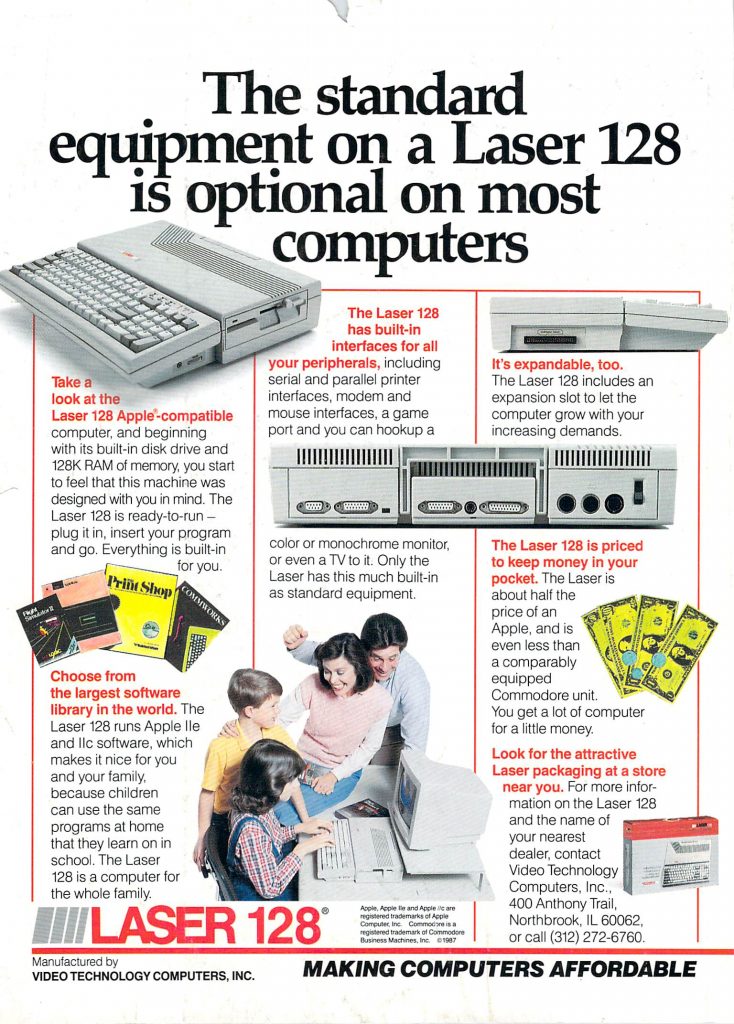
    …and more!


  • Antic (August 1984)

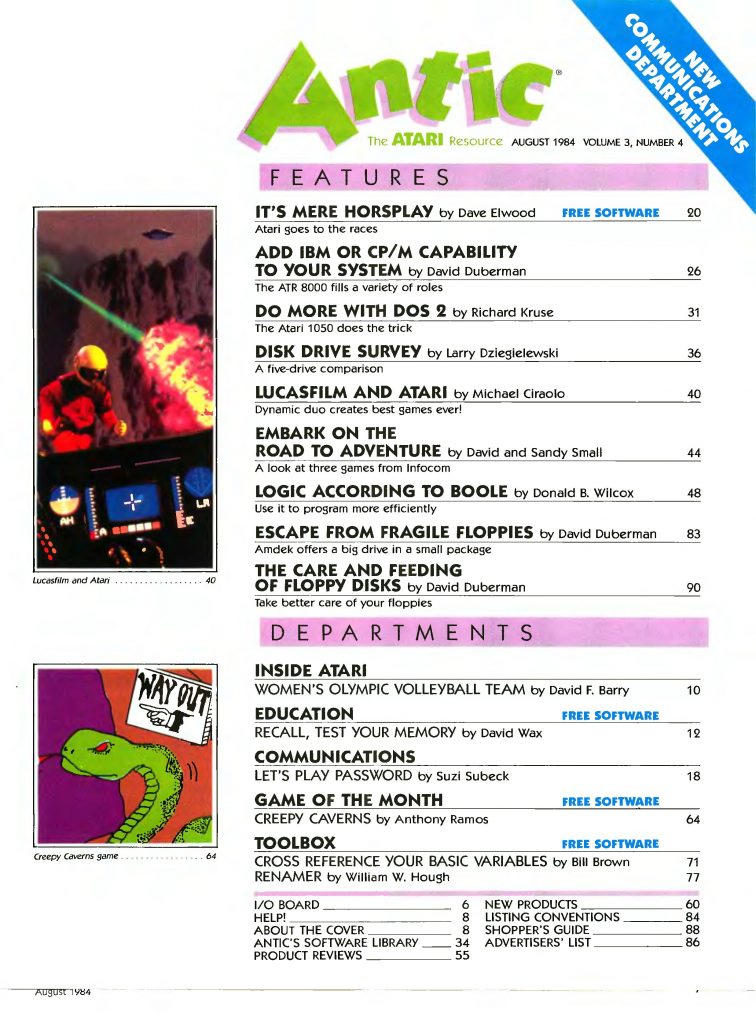
    Antic was one of the two major Atari 8-bit magazines in the U.S. (the other being ANALOG). Antic also had some coverage of the Atari ST though 1984 was before that. The August 1984 issue includes:

    Features

    • It’s Mere Horseplay – A type-in program for handicapping horse races.
    • Add IBM Or CP/M Capability To Your System – A look at the ATR8000, a versatile expansion for Atari 8-bit computers that adds the ability to connect standard disk drives and printers and depending on the variant, can also add CP/M or IBM PC compatability.
    • Do More With DOS 2 – Using DOS 2.0 to increase disk storage with the Atari 1050 disk drive.
    • Disk Drive Survey – A look at some of the disk drives available for the Atari 8-bit, including the TRAK AT-D2, RANA 1000, INDUS GT, Atari 1050, ASTRA 1620, and Atari 810.
    • Lucasfilm And Atari – Early Lucasfilm games came out first on the Atari 8-bit. These include Ballblazer and Rescue on Fractalus which are discussed here.
    • Embark On The Road To Adventure – A look at adventure games including Infocom’s Enchanter, Infidel, and Planetfall.
    • Logic According To Boole – Using Boolean logic in your programs.
    • Escape From Fragile Floppies – A look at the AMDC I and AMDC II, single and dual 3-inch floppy drive systems for the Atari 8-bit.
    • The Care And Feeding Of Floppy Disks – A guide to taking care of your floppy disks.

    Departments

    • Inside Atari – Atari’s sponsorship of the women’s Olympic volleyball team.
    • Education – A type-in memory game that gives you what is basically a computer version of Simon.
    • Communications – A look at password protected BBS’s. In the early days, you didn’t necessarily need a login and password to access a PC. Though obviously, having a unique account has its advantages and would become the norm.
    • Game of the Month – A type-in action/adventure game called Creepy Caverns. It looks a little like Gateway to Apshai.
    • Toolbox – A type-in tool for creating a variable cross-reference list for your programs. It gives you a list of variables and line numbers on which they appear.
    • Product Reviews – Reviews of the Aprom and Six Pack, Panzer-Jagd (Avalon Hill), Exodus: Ultima III (Origin), Safetyline (Maximus), Spare Change (Broderbund), BASIC Building Blocks, 810 Turbo, Dragonriders of Pern (Epyx), and Success With Math (CBS Software).
    • New Products – A brief look at new and upcoming products including Bruce Lee (Datasoft), C-221M and C-2215 disk drives, Pack It/Chain It, Relax (Synapse), Diskette Head Cleaning Kit, and more.

    …and more!


  • Compute! (March 1986)

    Source: Compute! – Issue Number 70 – March 1986

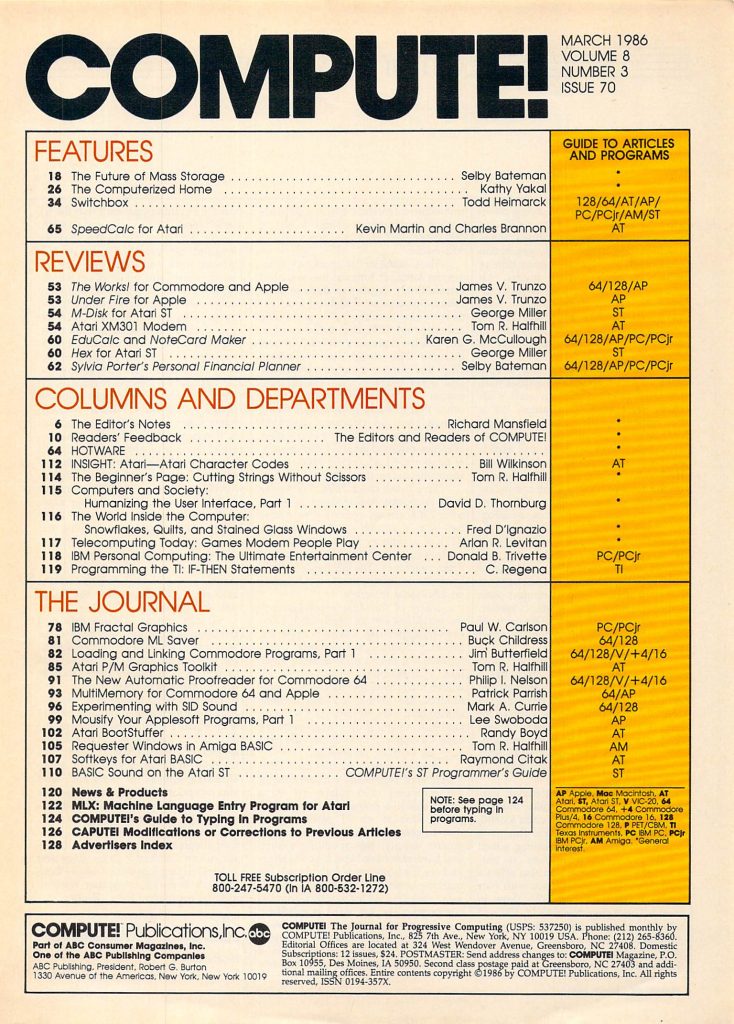
    Compute! was an excellent magazine that covered most popular computers of the time. I was partial to the spin-off Gazette because I had a Commodore 64 but this one was excellent as well. It was a little less technical that Byte but all magazines at the time were technical compared to today. The March 1986 issue includes:

    Features

    • The Future of Mass Storage – The future was bright for mass storage. 3.5″ floppies were replacing 5.25″ floppies, Hard drives were becoming affordable, and optical storage for the average user was on the horizon.
    • The Computerized Home – Computerized home automation was a thing long before Alexa. The X-10 interface was the de-facto standard and X-10 modules were available for pretty much any platform.
    • Switchbox – A type-in puzzle game with versions specifically for the Commodore 128, Commodore 64, Atari 8-bit, Atari ST, PC, and Amiga.
    • SpeedCalc for Atari – A type-in professional quality spreadsheet program for the Atari 8-bit.

    Reviews

    • The Works! – A software package for the Commodore 64 and Apple II that includes 13 programs in the categories of tools, organizers, arts, and learning.
    • Under Fire – A World War II strategy game for the Apple II.
    • M-Disk – Software for creating a RAM Disk on the Atari ST.
    • Atari XM301 Modem – A 300bps direct connect modem for Atari 8-bit computers.
    • EduCalc and NoteCard Maker – A combination of a simplified spreadsheet program and simplified database manager with versions for the Commodore 64, Apple II, and PC (Apple II version reviewed here).
    • Hex – A puzzle/strategy game for the Atari ST.
    • Sylvia Porter’s Personal Financial Planner – This software package includes six programs including Transaction Manager, Budget Manager, Asset/Liability Manager, Balance Sheet, and Financial Planner. The Commodore 64 version is reviewed here with versions also available for the PC and Apple II.

    Columns and Departments

    • The Editor’s Notes – A comparison of the new Amiga and Atari ST.
    • Readers’ Feedback – Letters from readers about code comments, computers for charity, recording music on the Amiga, and more.
    • HOTWARE – The top five selling software titles in three different categories. In the top places were F-15 Strike Eagle (Entertainment), Typing Tutor III (Education), and Print Shop (Home Management).
    • INSIGHT: Atari – A look at Atari character codes. Atari 8-bit computers used a variant of ASCII called ATASCII.
    • The Beginner’s Page: Cutting Strings Without Scissors – How to split strings in BASIC.
    • Computers and Society: Humanizing the User Interface, Part 1 – Exploring ways to make the user interface easier to use and more intuitive.
    • The World Inside the Computer: Snowflakes, Quilts, and Stained Glass Windows – Art on the Amiga.
    • Telecomputing Today Games Modern People Play – A look at online multiplayer gaming. At the time, that typically meant turn based gaming on BBS systems or services like CompuServe.
    • IBM Personal Computing: The Ultimate Entertainment Center – A guide for using your PC or PCjr with a TV.
    • Programming the TI: IF-THEN Statements – Using IF-THEN statements including examples for simulating AN/OR, doing Algebra, and more.
    • News & Products – Valhalla announced for the Commodore 64; MIDI Ensemble for the PC; AtariWriter and AtariWriter Plus word processors for the Atari ST; What’s Our Worth? home inventory package for the Commodore 64; and more.

    The Journal

    • IBM Fractal Graphics – Three type-in programs for creating fractals on the IBM PC and PCjr.
    • Commodore ML Saver – A type-in program for saving machine language programs directly from memory to disk on the Commodore 64.
    • Loading and Linking Commodore Programs, Part 1 – The first in a series of article on loading, chaining, and overlaying programs on Commodore computers.
    • Atari P/M Graphics Toolkit – Atari Player/Missile graphics is the Atari 8-bit version of sprites. This type-in toolkit makes it easier to develop and use P/M graphics on the Atari.
    • MultiMemory for Commodore 64 and Apple – Short type-in programs for the Commodore 64 and Apple II that allow you to segment memory for loading multiple BASIC programs.
    • Experimenting with SID Sound – Some examples for controlling the Commodore 64’s SID sound chip.
    • Mousify Your Applesoft Programs, Part 1 – The first of a two-part guide to using a mouse (or joystick or paddles) with your own programs.
    • Atari BootStuffer – This short type-in program for the Atari 8-bit allows you to create a menu system to load up to 8 different programs with one key press.
    • Requester Windows in Amiga BASIC – A guide to adding requester windows (dialog boxes) to Amiga BASIC programs.
    • Softkeys for Atari BASIC – This type-in program gives you automatic line numbering and various hotkeys when writing your own BASIC programs.
    • BASIC Sound on the Atari ST – A guide to getting started with creating basic sound effects on your Atari ST.

    …and more!