• Tag Archives arcade
  • Edge (April 1999)

    Edge was a multi-format videogame magazine published in the U.K. However, Next Generation was basically a U.S. version of Edge and they shared much of the same content. The April 1999 issue of Edge includes:

    • The Next Generation PlayStation – A report on the PlayStation 2 which had just been shown publicly for the first time in Japan.
    • The Truth Is Out There – On game rarity and emulations gift of letting you play the rarest of games.
    • Crazy Taxi – A detailed look at this now classic arcade game from Sega. It must have been around this time that the last decent arcade games came out. It used to be that many games would have arcade versions before being ported to home systems but Crazy Taxi was near the end of that trend. I don’t think this ever happens anymore (though technically Sega still produces arcade machines).

    • Switched On – How the video game audience has change over the years going from being villainized by traditional media to starring in their own TV show.
    • Testscreen – Reviews of Power Stone, Silent Hill, Castlevania, Silver, Wild Metal Country, Lander, Warzone 2100, Civ: Call to Power, and Bloody Roar 2.
    • Prescreens – Previews of games still in progress including V-Rally 2, Grand Theft Auto: Mission Pack #1, London 1969, Undercover 2025AD, Conquest: Frontier Wars, Starlancer, Loose Cannon, Crazy Taxi, Rally Masters, Project Velocity, and Daikatana. Plus some very early previews of Gran Turismo 2, Blue Stinger, War: Final Assault, Hidden and Dangerous, Omega Boost, Dino Crisis, and Carrier.
    • An Audience With John Carmack – John Carmack of id Software talks about what’s next for 3D shooters. In this case, Quake III Arena and the technologies that games of the future might use.

    • News – Coverage of the PlayStation 2, Sega’s Naomi hardware, a PlayStation emulator for the Dreamcast, and more.
    • Develop – An interview CRI representatives about new game tech including MPEG Sofdec and ADX.
    • Arcadeview – Coverage of Tokyo’s AOU show featuring Sega’s Naomi arcade hardware and new games like Bust A Move, Jumping Groove, Pop’n Music 2, Dance Dance Revolution 2, Beat-Mania II DX, Silent Scope, Airline Pilots, Spikout, Blood Bullet, Dead or Alive 2, Gun Beat, Power Stone, Giga Wing, Street Fighter III 3rd Strike, and more.
    • Retroview – A look back at Castlevania IV on the Super NES and the April 1994 issue of EDGE, plus Alex Garden of Relic Software talks about his memories of Wolfenstein 3D.
    • Out There – A look at some of the latest in consumer electronics including the Sony PBD-V30 DVD Discman, the Panasonic NV-EX1B MiniDV Camcorder, the 400MHz Macintosh G3, and more.
    • Letters – Letters from readers about software piracy, Sega Rally 2, and more.
    • Next Month – A special report from 1999’s Tokyo Game Show.

    …and more!


  • Bad Dudes vs. DragonNinja (Arcade, 1988)

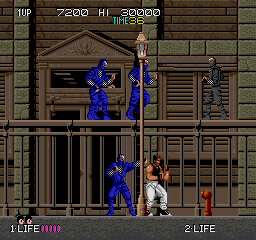
    Bad Dudes vs. DragonNinja is a beat-em-up style arcade game that can be played single player or cooperatively with another player. It was released by Data East in 1988. The plot is that President Ronnie (a very thinly veiled reference to Ronald Reagan) has been kidnapped by the evil (of course) Dragon Ninja. The secret service engages the help of the “Bad Dudes”, a heroic duo named Blade and Striker.

    The game play is fairly typical of any side-scrolling beat-em-up though this game helped to define the genre. There are several chapters or levels that include locations such as New York City streets, a moving truck, a sewer, a forest, a freight train, a cave, and an underground factory. You have basic attacks like punches and kicks as well as a charged attack and you can pick up various weapons along the way, including knives and nunchuks as well as other power ups. And of course, at the end of each level there is a boss character.

    The arcade game was extremely successful and there were a multitude of home ports introduced the same year including for the NES, Amiga, Apple II, Atari ST, Commodore 64, DOS, and more. The NES version is probably the most well known. The “vs. DraonNinja” part was dropped or de-emphasized so the game came to be better known as just “Bad Dudes”. Reviews of both the arcade and home versions were mostly positive. The biggest difference between the arcade version and the original home versions was that the home versions did not allow two player simultaneous play. Instead, you took turns.

    It was a long time before there were any re-releases. Data East financial troubles probably contributed to this though you would have thought they could have made some money on re-releases. Instead, they went bankrupt in 2003 and a company called G-Mode bought the rights to the game. The arcade version of the game was re-released in 2010 as part of Data East Arcade Classics for the Wii, in 2017 as part of a dedicated console called Super Retro-Cade, in 2018 as part of Flying Tiger’s Johnny Turbo series for the Switch, and in an arcade cabinet from Arcade1Up in 2020. The NES port has also been re-released several times. There was also an arcade sequel called Two Crude Dudes (at least in North America) that was released in 1990 and ported to the Genesis.

    If you like this style of game, then Bad Dudes, as well as its sequel, are definitely ones you want to try. The arcade version is obviously the best and you may be able to get your hands on one of the re-release options mentioned above or you can play it via an emulator. If you are a particular fan of one of the home platforms that it was ported to then it might be worth trying out as well. However, while they generally aren’t bad ports, contemporary arcade conversions were not always a strong suit of 8-bit computers…especially later ports where the arcade hardware had gotten better. There were always sacrifices.

    Screen shots above are from the arcade version of the game.


  • Daytona USA (Arcade)

    Daytona USA was Released in 1994 by Sega AM2. When it was released, it was basically THE arcade racing game to play. Play mechanics were really pretty simple but well refined and the graphics pushed it to the next level.

    Daytona USA, in terms of hardware, was based on Sega’s Model 2 arcade board. This board featured an Intel i960-KB CPU @ 25 MHz, a Fujitsu TGP BM86234 FPU as a graphics co-processor, a Motorola 68000 for sound control, 2 Zilog Z80s for communications and feedback, and more. Daytona USA was the first arcade machine to use this hardware. They weren’t cheap though at over $15K per machine when introduced.

    One of the weaknesses of this game were the limited number of tracks. There were only three: Three-Seven Speedway, Dinosaur Canyon, and Seaside Street Galaxy. However, they were well designed and each provided a different level of difficulty. Likewise, the car choices were limited as well.

    While the limited number of tracks and cars may have been disappointing to some, Daytona USA had a number of stand-out features that made it a blast to play. The deluxe style sit down cabinet with steering wheel, pedals and gear shift along with excellent responsiveness added a sense of realism beyond what had been seen before. Multiplayer with linked arcade cabinets was an awesome feature as well. What would initially draw people’s attention though were the outstanding graphics. Sega partnered with GE Aerospace when developing the Model 2 board which used tech from military flight sims. This board was capable of 3D graphics with texture filtering and texture mapping. Stuff that would be common in PC video hardware (and game systems) a few years later but was brand new at the time.

    The sound and music were also highly praised. There’s not much to say about the sound except that it added to the realism of the game. The soundtrack was interesting in that included vocals and other music that were sampled onto a Yamaha sound chip. Once again, there wasn’t a lot of variety though with only a few songs. However, these few songs are well remembered by fans of the game.

    The gameplay features many common racing mechanics that have been used both before and since. The most notable is probably the time extension mechanic though this certainly wasn’t new either. It did help to provide a sense of urgency though as you had to pass each checkpoint before time ran out in order to extend your race.

    If you are a racing game fan then you should definitely play this game in an arcade if you can find one. While there have certainly been more advanced racing games since, this one set many new standards at the time it was released. Ironically, you could also argue that this game was in part responsible for the continued decline of arcades. Not because it was a bad game or anything but because when the next generation of home systems came along, like the Saturn and PlayStation, they were capable of near arcade perfect ports of games of this caliber.

    Because of its popularity, there were many ports and sequels. The port that was released for the Saturn was a big deal at the time. There was also a Daytona USA: Championship Circuit Edition released for the Saturn in 1996, an arcade sequel called Daytona USA 2: Battle on the Edge released in 1998 using Model 3 hardware, Daytona USA 2001 which was a remake of the original game and Championship Circuit Edition for the Dreamcast, an arcade remake called Sega Rally Classic in 2010, and a Daytona Championship USA/Daytona USA 3 released in arcades in 2016.