• Tag Archives Activision
  • Mindshadow (Activision)

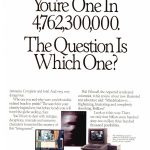
    Mindshadow was first released in 1984 and is essentially and illustrated text adventure game. The text adventure genre is perhaps best illustrated by Infocom and the Zork series. Adding illustrations was basically the next step in the evolutionary development of these games. This game was developed by Interplay and published by Activision.
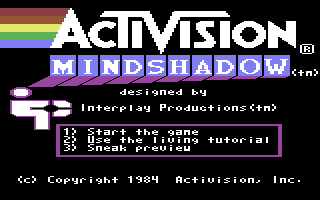
    A text adventure game (or interactive fiction as they were sometimes called) basically described the scene in front of you and then you would have to enter commands (e.g. “go north”, “take sword”, “hit troll with sword”, etc.) then the results would be described to you. Games like Mindshadow worked the same way, they just provided some pictures to go along with the text. This type of game can be extremely fun though they are not particularly replayable. They were also unique in that they were exclusively available on home computer systems vs. video game consoles (for obvious reasons). However, the point and click adventure is not too far removed from this type of game.
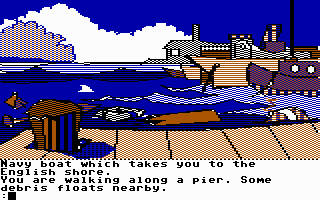
    Mindshadow, though not necessarily the best, was an above average example of the graphics adventure genre. Reviews were mixed but generally positive for the most part. Honestly, while I enjoyed the occasional text adventure game (especially Zork), it was never really my favorite genre. They never felt long enough (except when you were just stuck and frustrated) and to me, they had zero replayability. I can read novels multiple times (at least some of them) but playing these types a games a second time was just boring. Unless maybe you waited long enough to completely forget it.
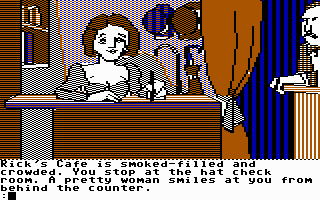
    Mindshadow has an interesting lineage. One of the game’s programmers (Allen Adham) would later go on to found Blizzard. Another interesting fact about Mindshadow is that it is loosely based on Robert Ludlum’s novel, The Bourne Identity. You can sort of think of this game as an interactive version of that novel.

    Mindshadow here is advertised for the Commodore 64, Apple II, Atari 8-bit, PC, and PCjr. It would also be available for the Amiga, Amstrad CPC, Atari ST, Macitosh, and ZX Spectrum. There aren’t really any modern re-releases though it was released in CD format as part of Interplay’s 10 Year Anthology, a collection of ten classic DOS games from Interplay that also includes such classics as The Bard’s Tale, Wasteland (the real first game in the Fallout series), Battle Chess, Out of this World, and other classics. However, this collection was released in 1993 and these games are in their original DOS format so in any case you will need a computer capable of running DOS or use some kind of emulation to be able to play this game. If you are looking to give the graphics adventure genre a try, you could do worse.
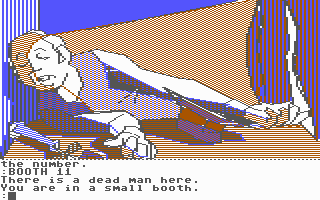
    Screen shots above are from the Commodore 64 version of the game.


  • BioMetal (Super Nintendo)


    BioMetal
    Activision
    Super NES
    1993

    https://darth-azrael.tumblr.com/post/188050099320/videogameads-biometal-activision-super-nes-1993


    BioMetal was developed by Athena and published by Activision in the North American market in 1993. What seems like a game that should have been something great really ends up being a pretty mediocre horizontal shooter. Not terrible but not in any top ten lists of its genre.

    BioMetal looks a lot like R-Type and and is clearly influenced by that game down to a couple of bosses that look suspiciously like the ones in R-Type. However, R-Type was a pretty great game and this one just doesn’t quite reach that caliber. The level design isn’t anything special and the other design elements are pretty derivative. There’s just not all that much unique about it.

    However, shooter fans will probably still get some enjoyment out of this game. It does have one somewhat unique feature it its shield system. You have a shield of rotating balls that loses energy as you use it and recharges when you turn it off. Using this shield at the appropriate time adds a strategic element to the game that adds some originality.

    Again, it isn’t really a bad game and personally I love shooters from the 16-bit era so if you are a fan of the genre you will definitely get some enjoyment out of it. Just don’t let its looks fool you into expecting R-Type caliber game play.

    If you do want to play this one, you’ll have to track down an original or use an emulator. It has not been re-released on modern systems that I am aware of. There was a sequel called BioMetal Gust that was included as part of the Japanese only release, Dezaemon 2 on the Sega Saturn. Dezaemon 2 was basically a shooter construction kit that allowed you to create your own games.


  • Quake II (PlayStation)


    Source: Official U.S. PlayStation Magazine – Volume 3, Issue 1 – October 1999

    The Quake series was id’s follow up to the Doom series. At this point in time, first person shooters were still progressing rapidly in terms of the technology and game play features. For instance, in the Doom games you were primarily limited to 2 dimensional movement and shooting at only what was directly in front of you. Quake added the novel feature of being able to look up and down. Quake II was the second game in a series that continues to this day.

    Quake II, like its predecessor and the Doom games before it were all developed first as PC games. Quake II was the first of id’s games to support hardware 3D acceleration out of the box (though it was added in later patches for the original Quake as well). The ad above is for the PlayStation version of Quake II. the PlayStation version (and also the Nintendo 64 version) was released two years after the original PC game. Because of the limitations of the PlayStation, Quake II ran at a lower resolution and featured fewer levels. There were assorted other various changes as well, including some different enemies and music. Despite the PlayStation’s relative limitations, the graphics were still well done. However, there is one huge negative with the PlayStation version. There was no network multiplayer. To me this was the feature that made the Doom and Quake games truly great. The PlayStation version did feature split-screen multiplayer but it’s just not the same.

    There were several official add-ons to Quake II, including The Reckoning, Ground Zero, and Extremeties. However, there were no add-ons released for the PlayStation as such. Also, the source code has been released so there are a number of games, both free and commercial, that were based on that code. Hexen II was my personal favorite.

    If you are a PlayStation collector, then Quake II is still a game worth having. Some may even prefer the split-screen approach for multiplayer. However, for the best Quake II experience, it needs to be played on a PC. Fortunately, there are easy and cheap ways to do this today, including buying the game for $4.99 from Steam. Or you can always go old school and install the original game on a Pentium II.

    The ad above, a rather unique supermarket parody ad, is from the October 1999 issue of The Official U.S. PlayStation Magazine. Screen shots above are from the PlayStation version of the game.