• Tag Archives Genesis
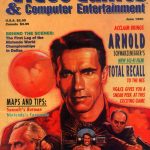
  • VideoGames & Computer Entertainment (June 1990)

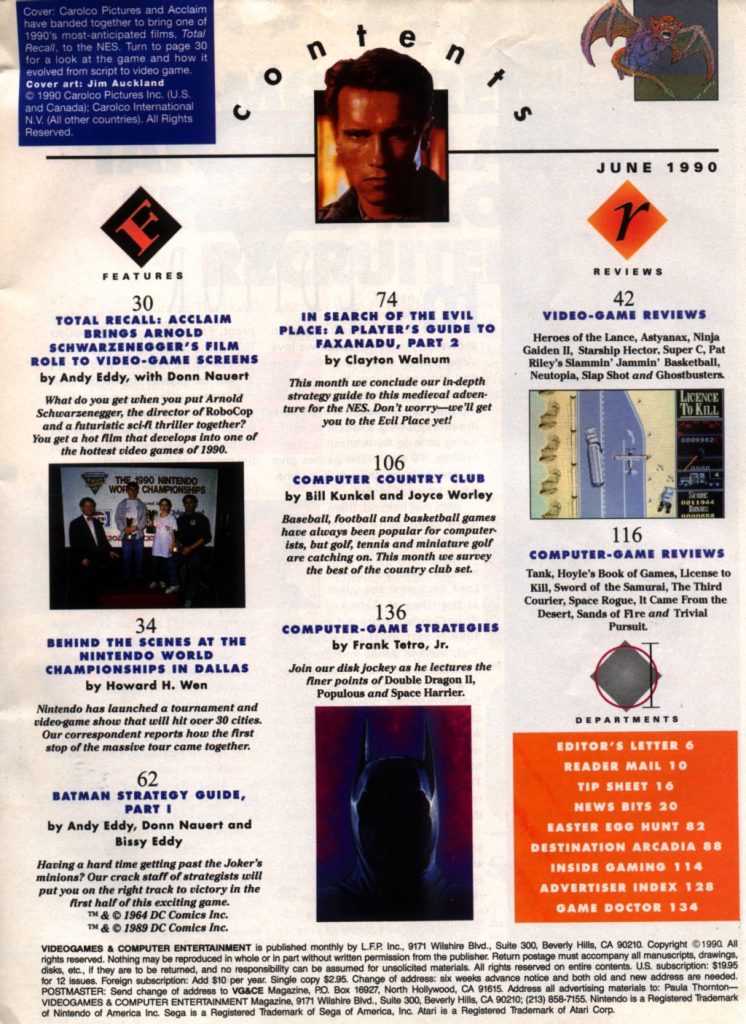
    VideoGames & Computer Entertainment was my favorite video game magazine of the late 1980s and early 1990s. Some of the key people responsible for the original Electronic Games magazine were involved with VG&CE. It eventually evolved into Tips & Tricks which wasn’t really my cup of tea. The June 1990 issue of VG&CE includes:

    Features

    • Total Recall: Acclaim Brings Arnold Schwarzenegger’s Film Role to Video-Game Screens – A detailed look at this NES game based on the movie of the same name. Like most licensed games, this one wasn’t great though I suppose it was better than some. It definitely has the nostalgia factor going for it.
    • Behind the Scenes at the Nintendo World Championships in Dallas – The Nintendo World Championship had to be just about the height of the NES era. It was sort of a case of life imitating art as The Wizard had just been released in theaters the year before.
    • Batman Strategy Guide, Part I – The first part of a detailed strategy guide for Batman: The Video Game for the NES. While licensed games are pretty poor the vast majority of the time, this one bucks the trend and was actually a solid game. The game and the movie are probably still my Batman favorites.
    • In Search of the Evil Place: A Player’s Guide to Faxanadu, Part 2 – The second part of a detailed strategy guide for this classic NES adventure game.
    • Computer Country Club – An overview of available golf and tennis games. Some of the golf games looked at here include Accolade’s Mean 18, Hole-In-One (miniature golf), Mini-Putt, World Tour Golf, World Class Leaderboard, Jack Nicklaus’ Greatest 18 Holes of Major Championship Golf, Table Tennis Simulation, Serve & Volley, and others.
    • Computer-Game Strategies – Brief strategy guides for Double Dragon II (Amiga, Atari ST, Commodore 64, IBM PC), Populous (Amiga, IBM PC), and Space Harrier (Amiga, Atari ST, Commodore 64, IBM PC).
    Reviews

    • Video-Game Reviews – Reviews of Heroes of the Lance (NES) – (while I loved the Gold Box series of D&D games, I thought this action oriented game was pretty terrible), Astyanax (NES) – (I actually didn’t care for this one much though it got good reviews), Ninja Gaiden II (NES), Starship Hector (NES), Super C (NES), Pat Riley’s Slammin’ Jammin’ Basketball (Sega Genesis), Neutopia (TurboGrafx-16), Slap Shot (Sega Master System), and Ghostbusters (Sega Genesis).
    • Computer-Game Reviews – Reviews of Tank (Spectrum Holobyte for the IBM PC), Hoyle’s Book of Games (Sierra On-Line for the IBM PC), License to Kill (Domark/Broderbund for the Amiga, Atari ST, IBM PC, and Commodore 64), Sword of the Samurai (Microprose for the IBM PC), The Third Courier (Accolade for the IBM PC), Space Rogue (by Origin for the Apple II, Commodore 64, and IBM PC – I always wanted this one), It Came From the Desert (by Cinemaware for the Amiga, Atari ST, IBM PC), Sands of Fire (by Three-sixty Software for the IBM PC and Macintosh), and Trivial Pursuit (by Parker Brothers for the IBM PC).

    Departments

    • Editor’s Letter – Andy Eddy discusses games based on movies and celebrities in video games.
    • Reader Mail – The letters from readers this month are mostly about Nintendo’s business practices and then current anti-trust issues.
    • Tip Sheet – The inaugural edition of this column includes tips and basic strategies for Kung-Fu Heroes by Culture Brain for the NES.
    • News Bits – Joe Montana signs deal with Sega, new add-on for A-10 Tank Killer, Defender of the Crown creator developing Centurion: Defender of Rome, Atari opens up direct phone line for orders of Atari Lynx and Portfolio products, new newsletter for Amiga gamers, Commodore to market games machine based on Amiga 500, and much more.
    • Easter Egg Hunt – Hidden features and secrets in Double Dragon II (NES), Golden Axe (Genesis), Revenge of Shinobi (Genesis), and Fighting Street (TurboGrafx-16).
    • Destination Arcadia – A look at new games shown at the 1990 Acme Show in Chicago including DJ Boy from American Sammy, WWF Superstars from Technos, Klax from Atari, AmeriDarts from Ameri Corporation, Four Trax from Atari, Badlands from Atari, Metal Hawk from R. H. Belam, Capcom Bowling from Capcom, Buster Bros. from Capcom, Mercs from Capcom, Final Fight from Capcom, Vapor Trail from Data East, Too Crude – Double Dragon from Data East, Rai Den from Irem, Dragon Breed from Irem, R-Type II from Irem, Toki from Irem, Aliens from Konami, Teenage Mutant Ninja Turtles from Konami, Off Road from Leland, Trog from Bally/Midway, PlayChoice from Nintendo, Fire Shark from Romstar, Beast Busters from SNK, Neo-Geo System from SNK, Line of Fire from Sega, M.V.P. from Sega, Cadash from Taito, and lots more.
    • Inside Gaming – A look at who might win the upcoming video game battle between Nintendo, Sega, and NEC.
    • Game Doctor – Questions answered about music on the SMS, the NES expansion port, the TurboGrafx-16 CD-ROM add-on, transferring files between an Apple II and IBM PC, and more.
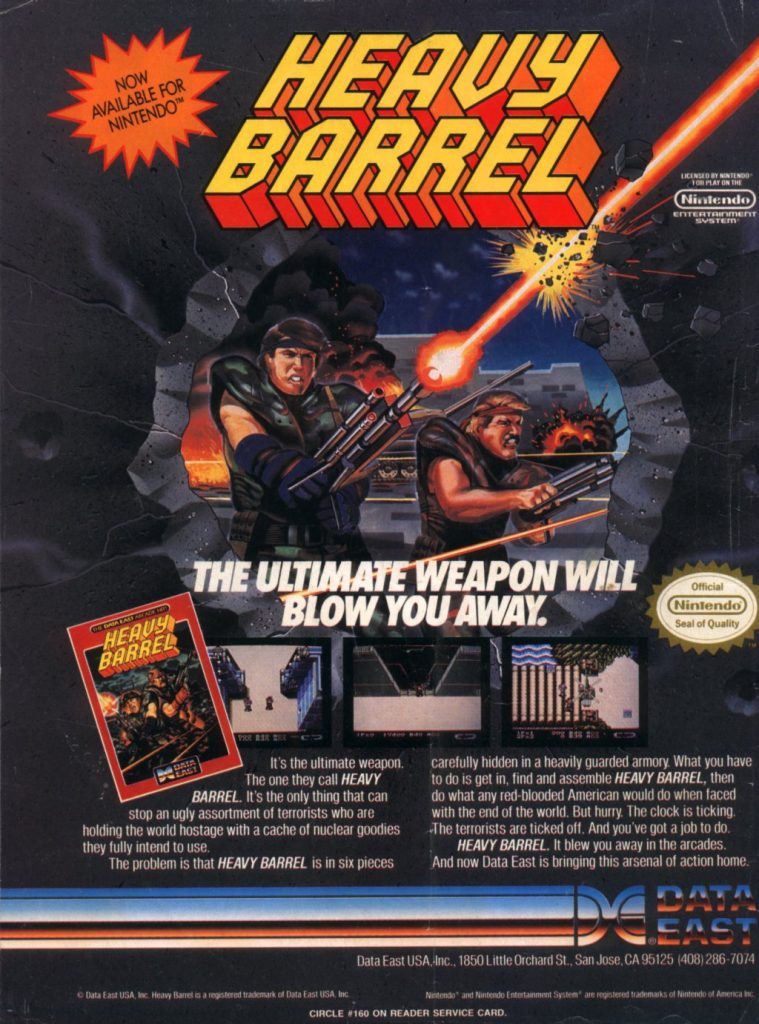
    …and more!


  • General Chaos (Sega Genesis)

    General Chaos was released by Electronic Arts for the Sega Genesis in 1993. While it never seemed to gain much traction, it was really a game ahead of its time. It is basically a squad based real-time strategy game. Warcraft, the game that really popularized the real-time strategy genre in general, wasn’t released until the following year.

    Of course, other than a real-time strategy component, there isn’t much that is similar to Warcraft here. General Chaos is squad based. Players can choose from one of four five man squads with various types of units or a more powerful two man commando team. Unit types include Machine Gunner, Launcher, Flamethrower, Chucker, and Blaster. The different squad choices have different combinations of these units.

    General Chaos is played from an isometric perspective. One other aspect of this game that will be familiar to real-time strategy players is the control mechanism. Basically, you select a unit and assign an order and the AI will execute it. Individual battles are generally pretty short but the game can be played in campaign mode which is basically a series of battles (between General Chaos and General Havok) with the ultimate objective of capturing the enemy’s capital city. In addition to the real-time strategy aspect, there are a few other things that make this game stand out as unique.

    One of the most prominent aspects of this game is its humor. Sure, you can order your units around but they aren’t always competent. Adding to the humor is the cartoonish nature of the graphics. In some ways, the humor of the game reminds me of another humorous strategy game that is one of my all time favorites…Worms.

    Another fairly unique feature, especially for the Genesis at the time, was that you could play (with an appropriate adapter) with up to four players. Everybody can team up against the computer or you can play as more of a free for all. As you could imagine, having four players adds significantly to the chaos…and the fun.

    General Chaos generally got excellent reviews. However, I don’t recall it being all that popular. It doesn’t appear to be particularly rare though as an original copy can be found for reasonable prices on eBay. This game is, however, exclusive to the Sega Genesis. The only way to play is to track down an original or use emulation. There has never been a sequel. There was a Kickstarter campaign in 2014 to create a sequel but it was unsuccessful, falling way short of its goal.

    I definitely recommend this game if you are a real-time strategy fan or of humorous games in general. Just don’t expect anything serious here. Yes, it is a strategy game but the goal here is to entertain, not to simulate serious warfare. In that, it does an excellent job.

    The three page magazine ad above is from the October 1993 issue of Electronic Gaming Monthly.


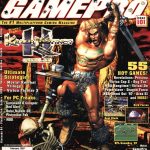
  • GamePro (February 1997)

    Source: GamePro – February 1997

    Along with Electronic Gaming Monthly, GamePro was one of the most popular gaming magazines for a long time. In 1997 is was primarily covering the Nintendo 64, PlayStation, and Sega Saturn and was also still covering the Super NES, Sega Genesis and Neo Geo. It also had a little PC and arcade coverage. The February 1997 issue includes:

    Cover Story

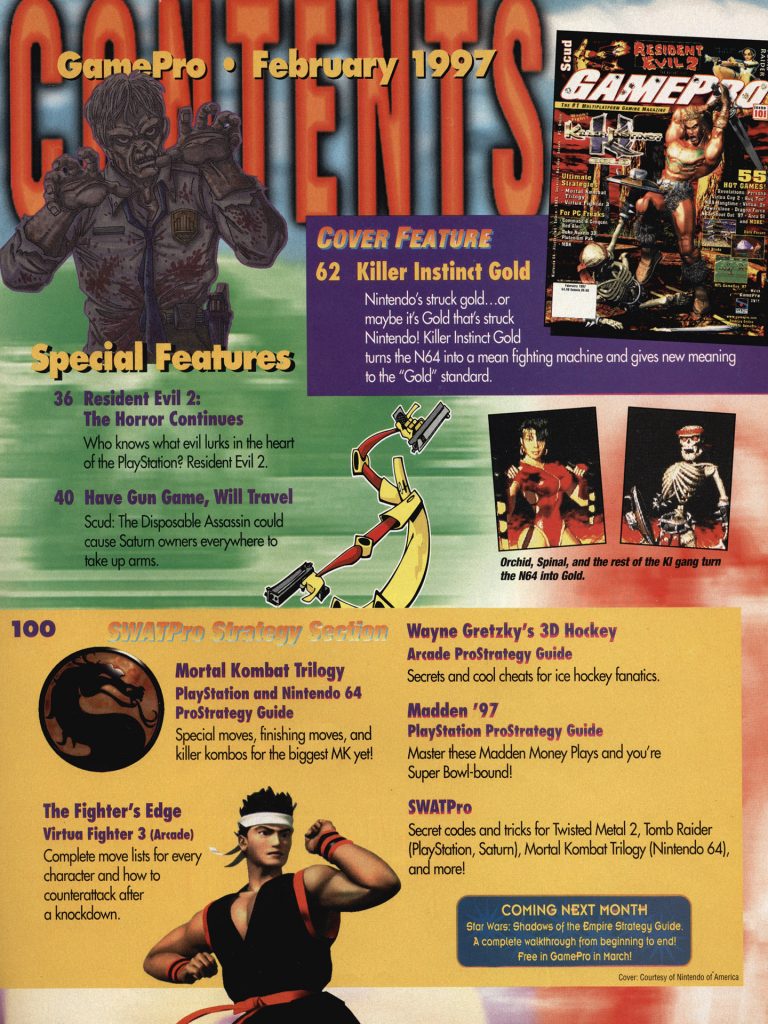
    • Killer Instinct Gold – A preview of ths $80 cart for the Nintendo 64 and is basically a combination of Killer Instinct and Killer Instinct 2.

    Special Features

    • Resident Evil 2: The Horror Continues – The first sequel to the immensely popular survival horror game on the PlayStation.
    • Have Gun Game, Will Travel – A somewhat humorous light gun game that combines both first person and side-scrolling sections. It can be played with one or two players.

    SWATPro Strategy Section

    • Mortal Kombat Trilogy – A strategy guide for Mortal Kombat Trilogy on the PlayStation and Nintendo 64. As the name suggests, this game is really a combination of the first three Mortal Kombat games.
    • The Fighter’s Edge: Virtua Fighter 3 – A complete move list for all characters and how to counterattack in Virtual Fighter 3 in the arcade.
    • Wayne Gretzky’s 3D Hockey – A strategy guide for this arcade hockey game featuring various secrets and cheats.
    • Madden ’97 – A strategy guide for this early Madden game on the PlayStation.
    • SWATPro – Codes and various tips for Twisted Metal 2 (PlayStation), Tomb Raider (PlayStation, Saturn), Mortal Kombat Trilogy (Nintendo 64), and lots of other games.

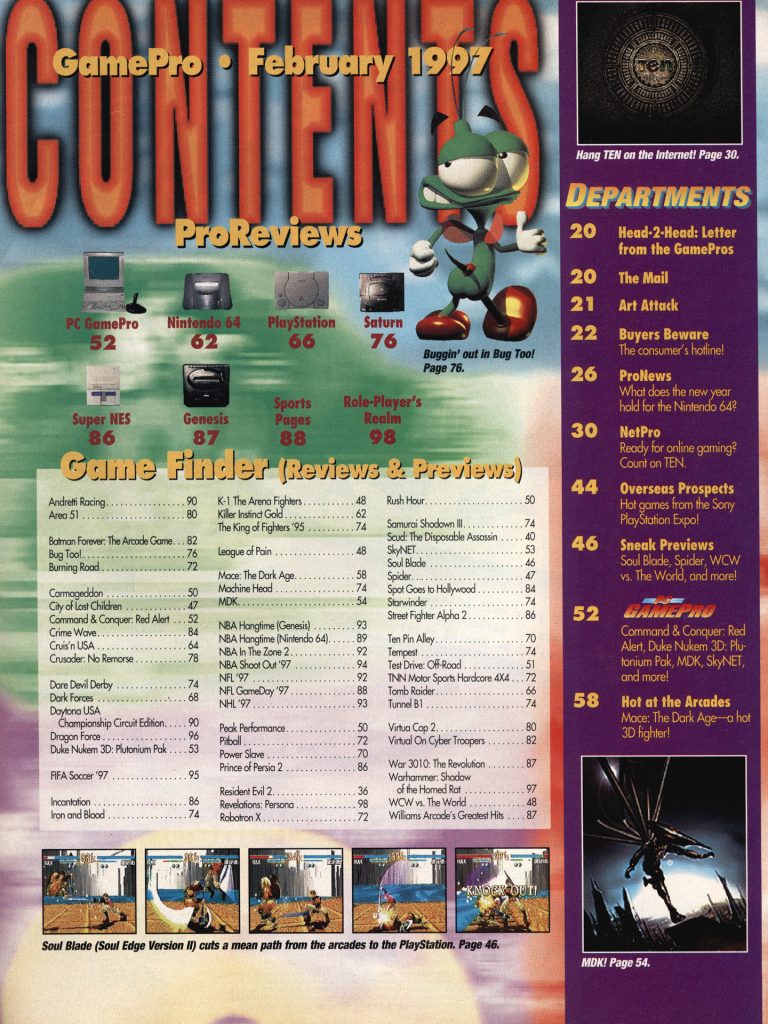
    ProReviews

    • PC GamePro – Reviews of Command & Conquer: Red Alert, Duke Nukem 3D Plutonium PAK, SkyNET, and MDK.
    • Nintendo 64 – Reviews of Killer Instinct Gold, and Cruis’n USA.
    • PlayStation – Reviews of Tomb Raider, Dark Forces, Ten Pin Alley, Power Slave, PitBall, Burning Road, Robotron X, Hardcore 4×4, The King of Fighters ’95, Dare Devil Derby, Starwinder, Iron and Blood, Samurai Showdown III, Tempest, Machine Head, and Tunnel B1.
    • Saturn – Reviews of Bug Too!, Crusader, Virtua Cop 2, Area 51, Virtual On Cyber Troopers, Batman Forever: The Arcade Game, Spot Goes to Hollywood, and Crime Wave.
    • Super NES – Reviews of Street Fighter Alpha 2, Prince of Persia 2, Incantation, and War 3010: The Revolution.
    • Genesis – A reviews of Williams Arcade’s Greatest Hits.
    • Sports Pages – Reviews of NFL GameDay ’97 (PlayStation), NBA Hang Time (Nintendo 64), Andretti Racing (Saturn), Daytona USA Championship Circuit Edition (Saturn), NBA In The Zone 2 (PlayStation), NFL ’97 (Saturn), NHL ’97 (Saturn), NBA Hangtime (Genesis), NBA Shoot Out ’97 (PlayStation), FIFA Soccer ’97 (Nintendo 64),
    • Role-Player’s Realm – Reviews of Dragon Force (PlayStation), Warhammer: Shadow of the Horned Rat (PlayStation), and Persona (PlayStation).

    Departments

    • Head-2-Head: Letter from the GamePros – Discussion about 3DO’s upcoming new M2 system.
    • The Mail – Letters from readers about 3DO, secret codes for Twisted Metal 2, Tecmo’s Deception, and more.
    • Art Attack – Reader submitted artwork.
    • Buyers Beware – Modifying your PlayStation to play Japanese games, Nintendo 64 controller problems, Xband support, and more.
    • ProNews – N64 and PSX game releases delayed, including Shadows of the Empire, Curis’n USA, Tetrisphere, Turok, Mission Impossible, and others; Virtual Boy discontinued; and more.
    • NetPro – How to play online games via TEN.
    • Overseas Prospects – A look at Sony PlayStation Expo ’96 in Chiba, Japan. Some new games shown include Final Fantasy VII, Puzzle Fighter, Rockman (Mega Man) 8, Ace Combat 2, Soul Edge, and more.
    • Sneak Previews – Previews of upcoming games including Spider (PlayStation), City of Lost Children (PlayStation), WCW vs. The World (PlayStation), League of Pain (PlayStation), Carmageddon (PlayStation, DOS), Rush Hour (PlayStation), Peak Performance (PlayStation), and Test Drive: Off-Road (PlayStation DOS, Windows 95).
    • Hot at the Arcades – A look at Mace: The Dark Age, a 3D fighting game from Atari Games.

    …and more!