• Tag Archives COVID-19
  • The New York Times Finally Discovers Unintended Consequences

    The New York Times published an article on Friday under a simple headline: “Covid Absolutism.”

    The article opens by noting that during public health emergencies, absolutism—the idea that people should cease any and all behavior that creates additional risk—is a tempting response. Times writer David Leonhardt gives various examples of this “absolutism” on display in America today.

    “People continue to scream at joggers, walkers and cyclists who are not wearing masks. The University of California, Berkeley, this week banned outdoor exercise, masked or not, saying, ‘The risk is real,’” he writes. “The University of Massachusetts Amherst has banned outdoor walks. It encouraged students to get exercise by ‘accessing food and participating in twice-weekly Covid testing.'”

    Examples like these are virtually endless. They invite two key questions, Leonhardt notes: How effective are these behaviors in reducing the spread of the virus? And is there a downside?

    As Leonhardt notes, many of these actions are essentially a kind of “hygiene theater,” the subject of a recent article in the Atlantic written by Derek Thompson.

    The phrase basically speaks for itself. According to Leonhardt, these actions are not rooted in science, and are primarily a form of theatrical presentation that will have little or no actual impact.

    “Prohibiting outdoor activity is unlikely to reduce the spread of the virus, nor is urging people always to wear a mask outdoors,” he writes. “Worldwide, scientists have not documented any instances of outdoor transmission unless people were in close conversation, Dr. Muge Cevik, an infectious-disease specialist at the University of St. Andrews in Scotland, told me.”

    So the answer to Leonhardt’s first question—How effective are they at reducing the spread of the virus?— is not difficult to answer: they’re not effective.

    The second question, and its answer, is more interesting.

    One might be tempted to argue that these theatrics still produce positive outcomes, since they are likely to make people more conscious of the pandemic and slow the spread of the virus.

    Taking extreme precautions is simply “playing it safe.” What’s the harm in that?

    The answer is, “plenty.” First, Leonhardt argues it’s not part of human nature to live in a perpetual state of extreme caution.

    “Taking every possible precaution is unrealistic,” he writes. “Human beings are social creatures who crave connection and pleasure and who cannot minimize danger at all times.”

    Perhaps more importantly, he argues that extreme caution can backfire and produce outcomes that have the opposite of their desired effect. He uses the AIDS crisis as an example, pointing out that demonizing sexual intercourse and trying to frighten people away from it had the unintended consequence of increasing unsafe sex.

    A similar phenomenon appears to be at work today.

    “Telling Americans to wear masks when they’re unnecessary undermines efforts to persuade more people to wear masks where they are vital,” Leonhardt writes.

    For many, this statement probably doesn’t sound particularly noteworthy. It basically has the ring of common sense, a variation of The Boy Who Cried Wolf, one of Aesop’s famous parables, which taught that false alarms can harm humans by inhibiting their ability to detect actual danger.

    The COVID-19 pandemic has been a case study in “unintended consequences,” a term popularized by American sociologist Robert K. Merton in the twentieth century. Basically, it’s the idea that virtually every action comes with outcomes that are not foreseen or intended.

    The French economist Frédéric Bastiat alluded to this concept in his famous essay, “That Which is Seen, and That Which is Not Seen.”

    “In the department of economy, an act, a habit, an institution, a law, gives birth not only to an effect, but to a series of effects,” Bastiat wrote.

    The problem, he noted, is that humans rarely pay attention to the unseen or unintended effects of a given action or policy. Ignoring these outcomes is one of the great mistakes in public policy, the Nobel Laureate Milton Friedman once observed.

    Unfortunately, ignoring unintended consequences and focusing on intentions is precisely what we saw in 2020, and nobody has been more guilty of this than the Times.

    If you search for articles discussing the unintended consequences of COVID-19 policies, which are boundless, you’ll find virtually nothing on their site. I was able to find two articles using the phrase “unintended consequences” of COVID lockdowns.

    One article, published in September, is a profile of Dr. Bonnie Henry, a Canadian physician and British Columbia’s top doctor who spoke of minimizing the unintended consequences of government interventions. The other is an article in May that discussed how lockdowns could result in a surge of mental illness.

    This dearth of coverage is unfortunate. The Times is one of the most influential papers in the world. It has immense reach and a news staff of 1,300 people. And yet—our tiny writing team at FEE has produced more articles on the unintended consequences of lockdowns than the Grey Lady.

    No one is served by ignoring unintended consequences. (Well, maybe politicians.) If we’re to understand the damage wrought in 2020 and prevent it in the future, lockdowns must be judged by their actual consequences, not what they were designed to achieve.

    And the adverse unintended consequences of lockdowns are legion.

    The fact that even the New York Times is finally beginning to discuss the unintended consequences of COVID-19-inspired actions is a sign that we may be, however belatedly, moving in the right direction.

    WATCH: What Cobras Can Teach Us About Incentives


    Jon Miltimore

    Jonathan Miltimore is the Managing Editor of FEE.org. His writing/reporting has been the subject of articles in TIME magazine, The Wall Street Journal, CNN, Forbes, Fox News, and the Star Tribune.

    Bylines: Newsweek, The Washington Times, MSN.com, The Washington Examiner, The Daily Caller, The Federalist, the Epoch Times.

    This article was originally published on FEE.org. Read the original article.


  • ‘It’s Easy Money’: Nigerian Scammer Laughs about Huge Sums Stolen from COVID Welfare Programs in Bombshell Interview

    State unemployment agencies aren’t especially responsible stewards of taxpayer dollars even in the best of times. Yet when the COVID-19 crisis and government lockdowns put tens of millions of Americans out of work, Congress responded by pouring more taxpayer money into state-level unemployment systems.

    The federal legislation enormously increased weekly payouts and expanded unemployment benefits to many new classes of workers, with little in the way of verification or qualification requirements. This welfare expansion was just reauthorized in the second major COVID-19 spending package, which Congress passed in mid-December. Sadly, lawmakers didn’t bother to address the runaway fraud that had plagued the first round of COVID relief efforts.

    An astonishing $36 billion has been lost to fraud in pandemic unemployment benefits, the Department of Labor reports. To put this figure in context, the entire unemployment system only paid out about $26 billion in 2019.

    That’s right: Bureaucrats lost to fraud more than is usually paid out in an entire year. The $36 billion lost—and that’s just the fraud we know about—amounts to an average of roughly $1,894 lost per current unemployment beneficiary. (What would we think of a private system that lost nearly $2,000 for each customer served?)

    These figures alone are horrifying, but a new bombshell interview with one of the countless international scammers getting rich off our relief efforts makes it painfully clear just how carelessly Congress is throwing around our money.

    A Nigerian student named Mayowa spoke to USA Today and, on the condition of partial anonymity, openly admitted to scamming $50,000 from the US pandemic welfare system so far.

    All he had to do was make a list of real people and then search through available databases of hacked information for their Social Security numbers and birthdates.

    “In most states that information is all it takes to file for unemployment,” USA Today’s Nick Penzenstadler says. ”Even when state applications require additional verification, a little more money spent on sites such as FamilyTreeNow and TruthFinder provides answers – your mother’s maiden name, where you were born, your high school mascot.”

    It doesn’t always work, of course. But Mayowa told the newspaper his success rate is pretty high—about one success in every six claim attempts.

    “Once we have that information, it’s over,” Mayowa told reporters. “It’s easy money.”

    Government bureaucrats were caught flat-footed, and the flood of money being rushed out the door in the name of emergency meant more vulnerabilities than ever. It took many states more than six months to add verification requirements and partially stem the flow. Just to use one state as an example, Washington state usually identifies a few dozen fraudsters in a year—now, it has identified more than 122,000 since March.

    “When you consider the policy factors accelerating benefits and getting them to the neediest people and the expanded $600 available … we had the perfect storm,” Washington Employment Security Department Commissioner Suzi Levine said. “[Scammers] have been lying in wait for this moment.”

    It’s certainly true that the COVID-19 pandemic and the sweeping big government response are unprecedented in our lifetimes. So, the runaway unemployment fraud and rampant fraud in other COVID relief programs are indeed an extreme example. But do not make the mistake of thinking that they are uncharacteristic of big-government programs by any stretch.

    As Austrian economist Ludwig von Mises explained, bureaucracy, incompetence, and waste are inherent to government administration by its very nature.

    In contrast, private businesses are driven to efficiency by the profit motive. A company-wide system that is broken and bleeding money is, in short order, fixed—or if it cannot be, that company will soon be driven out of business by more efficient competitors. This influences the behavior, not only of the business’s owners, but of its hired managers, and thus all its employees.

    “Within a business concern [the management of expenses] can be left without hesitation to the discretion of the responsible local manager,” Mises explained in his book Bureaucracy. “He will not spend more than necessary because it is, as it were, his money; if he wastes the concern’s money, he jeopardizes the branch’s profit and thereby indirectly hurts his own interests.”

    Fundamentally, in private enterprise, everyone involved has skin in the game. So, while mistakes still certainly happen, there’s a strong incentive to correct them and push for as much efficiency as is possible.

    In government the opposite is true.

    “It is another matter with the local chief of a government agency,” Mises explained. “In public administration there is no connection between revenue and expenditure. In public administration there is no market price for achievements.”

    It’s not that government bureaucrats want to waste taxpayer money. But the lack of proper incentives breeds incompetence, and all government agencies have a monopoly on what they do.

    If a state’s unemployment agency does a poor job, it doesn’t go out of business. Neither the profits of the “owners” nor the salaries of the workers are on the line. So, it’s much less likely that anyone will even face firing or disciplinary action for mistakes in government. (Especially thanks to the strength of public sector unions).

    Need proof? Only a few state administrators have been fired throughout this entire national COVID-19 welfare fraud scandal. It’s simply unthinkable that this level of scandal and waste could happen in private enterprise without wide-scale firings and other forms of accountability.

    This inherent inefficiency is a feature of government bureaucracy, not a bug.

    Yes, this particular problem may fade, if expanded pandemic unemployment relief programs are eventually allowed to expire. But waste, fraud, and inefficiency will plague big government efforts long after the COVID-19 pandemic subsides.

    RELATED: Why You Should Expect More Stimulus Fraud Coming Soon.


    Brad Polumbo

    Brad Polumbo (@Brad_Polumbo) is a libertarian-conservative journalist and Opinion Editor at the Foundation for Economic Education.

    This article was originally published on FEE.org. Read the original article.

  • How Finland and Norway Proved Sweden’s Approach to COVID-19 Works

    The coronavirus is back in force. Many nations around the world are seeing alarming rises in cases and deaths, totals that in many instances exceed the highs reached in March, April, and May.

    From the beginning of the pandemic, governments around the world have tried to tame the virus. All have failed, to varying degrees.

    Whether governments implement draconian lockdowns, modest lockdowns, or no lockdowns at all, the virus has spread. Some countries with harsh lockdowns have fared better; many have fared worse. As some have pointed out, the virus doesn’t seem to care what policies you put in place.

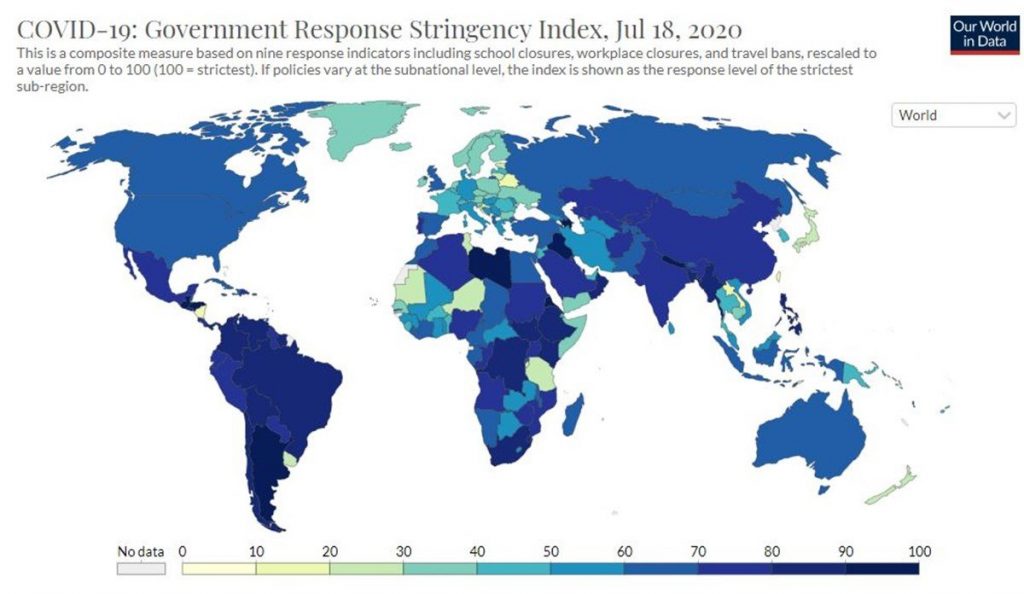
    Belgium, for example, has the second highest COVID-19 death rate in the world even though it implemented one of the strictest lockdowns in the world (81.5 stringency). Italy and Spain had even harsher lockdowns, and both countries are also among the most devastated by the virus. (Italy’s current death rate is lower than that of Belgium and Spain, but the country is facing a resurgence of the virus that looks positively frightening.)

    We can measure lockdown stringency because of a feature created by Our World in Data, a research team based at the University of Oxford that produces information in all sorts of wonderful charts and graphs.

    While most of the world went into lockdown in March, Swedish officials chose to forgo a full lockdown, opting instead for a “lighter touch” approach that relied on cooperation with citizens, who were given public health information and encouraged to behave responsibly.

    Our World in Data shows Sweden’s government response stringency never reached 50, peaking at about 46 from late April to early June.  (As a point of reference, the US averaged a stringency of about 70 from March to September.) This is well below the top stringency of Spain (85) and Italy (94). 

    Yet, Sweden’s per capita death rate is lower than Spain, Belgium, Italy and other nations despite the fact that it did not initiate a lockdown. As a result, Sweden’s economy was spared much of the damage these nations suffered (though not all).

    Despite the apparent success of Sweden’s strategy, the Swedes have found themselves attacked. The New York Times has described Sweden’s policy as a “cautionary tale,” while other media outlets have used it as an illustration of how not to handle the coronavirus.

    Critics of Sweden’s policy point out that although Sweden has experienced fewer deaths than many European nations, it has suffered more than its Nordic neighbors, Finland and Norway.

    This is true, but it needs to be contextualized.

    Norway and Finland have some of the lowest COVID-19 death rates in the world, with 54 deaths per one million citizens and 66 per million respectively. This is well below the median in Europe (240 per million) and Sweden’s rate (605 per million).

    What these critics fail to realize is that both Finland and Norway have had less restrictive policies than Sweden for the bulk of the pandemic—not more lockdowns.

    Norway’s lockdown stringency has been less than 40 since early June, and fell all the way to 28.7 in September and October. Finland’s lockdown stringency followed a similar pattern, floating around the mid to low 30s for most of the second half of the year, before creeping back up to 41 around Halloween.

    When people compare Sweden unfavorably to Finland and Norway to dismiss its laissez-faire policy, they are drawing the opposite conclusion from what the data point really reveals. Yes, Finland and Norway have lower deaths than Sweden—but they have actually been more laissez-faire than their neighbor for the majority of the pandemic.

    Since June, Finland and Norway have had less restrictive government policies than Sweden, and both nations have endured the coronavirus remarkably well. They have been among the freest nations in the world since early June, and COVID-19 deaths have been miniscule.

    Neither country even has a mask mandate, though both implemented mask recommendations in August. In Norway, private gatherings in public places are still permitted, though the capacity was recently reduced to 50 people (down from 200).

    In Finland, people say daily life hasn’t changed very much.

    “My daily life actually hasn’t been affected too much,” healthcare assistant Gegi Aydin told one local news station.

    The lighter touch approach can be seen in their economies, as well. In the second quarter of 2020, Norway and Finland saw their economies contract by 6.3 percent and 6.4 percent respectively. That’s about half the 11.8 percent drop of the European Union, and well below that experienced by Spain (-18.5%) and the United Kingdom (-19.1%). It’s even lower than that of Sweden, which saw a decline of 8.6 percent.

    Despite their low lockdown stringency, Norway and Finland are among the only places in Europe you’ll find considered safe for travel.

    As I’ve pointed out before, people aren’t attacking the results of Sweden’s policies. They are attacking the nature of its policies. Of course, there are many nations that have been hit much harder than Sweden. But these nations are ignored because they don’t threaten the narrative that government lockdowns work, and that millions more would have died without them.

    Norway and Finland show that the coronavirus doesn’t care about government policy. Their numbers have remained low with moderately strict lockdowns and with laissez-faire policies. 

    With the coronavirus resurging around the world, there is talk of implementing another round of crippling lockdowns. World leaders are facing immense pressure to “do something.”

    This would be a mistake. Lockdowns come with severe and deadly unintended consequences. Moreover, they have proven utterly ineffective at taming the virus—which is why the World Health Organization is now advising against their use.

    The reality is, humans are unwilling to accept how powerless they are to stop this virus. They are unwilling to admit they cannot control it.

    Decades ago, in his Nobel Prize acceptance speech, the economist F.A. Hayek warned of the dangers of such hubris. If man continued to live in ignorance of the limits of his knowledge, it would breed a “fatal striving to control society – a striving which makes him not only a tyrant over his fellows, but which may well make him the destroyer of a civilization…”

    It’s a lesson that has never been more important. We’ll soon know if it’s one we’re finally prepared to learn.

    Jon Miltimore


    Jon Miltimore

    Jonathan Miltimore is the Managing Editor of FEE.org. His writing/reporting has been the subject of articles in TIME magazine, The Wall Street Journal, CNN, Forbes, Fox News, and the Star Tribune.

    Bylines: Newsweek, The Washington Times, MSN.com, The Washington Examiner, The Daily Caller, The Federalist, the Epoch Times. 

    This article was originally published on FEE.org. Read the original article.